Best smart thermostats 2026: energy savings vs. hype
One thermostat saved a tester $240 in a single heating season. Another barely covered its own purchase price. The difference came down to learning algorithms — and whether you actually have a C-wire.
Tested across two homes (1,400 sq ft gas forced-air and 2,200 sq ft heat pump) over 3 months, Jan–Mar 2026. Energy savings calculated against same-period prior year on identical rate plans. Install times logged on both 2-wire and 3-wire configurations.

Google Nest Learning Thermostat (4th Gen)
Best Overall: The 4th-gen Nest Learning Thermostat self-schedules in 7 days, doesn't need a C-wire on most systems, and delivered the highest annual savings in our test at $240. The Farsight display and Google Home integration are polished.
Top picks ↓Top picks
Related articles


Google Nest Learning Thermostat (4th Gen)
Best overall — highest savings and self-learning schedule. Works without C-wire on most gas systems.
The 4th-gen Nest Learning Thermostat self-schedules in 7 days, doesn't need a C-wire on most systems, and delivered the highest annual savings in our test at $240. The Farsight display and Google Home integration are polished. Heat pump compatibility has a known flutter issue on some units — check Nest's compatibility checker before buying.
Pros
- ✓Self-learning schedule needs zero manual programming
- ✓Power Steal eliminates C-wire for most gas systems
- ✓Highest measured annual savings: $240/year
Cons
- ✗Occasional fan flutter on some heat pump installations
Score breakdown
| Display | 2.7 in (68 mm) circular LCD, 600 × 600 px |
| C-wire required | No (Power Sharing technology; C wire or Nest Power Connector needed in <1% of homes) |
| Sensors included | Yes — 1 Nest Temperature Sensor (2nd gen) in box (up to 6 total) |
| Voice assistants | Google Assistant, Amazon Alexa, Apple Siri (via Matter) |
| Geofencing | Yes (Home/Away Routines using phone location and on-device sensors) |
| HVAC compatibility | Most 24V systems (gas, electric, oil, forced air, heat pump, radiant); not compatible with electric baseboard heating |

ecobee SmartThermostat Premium
Best multi-room accuracy — included sensor and built-in Alexa justify the price.
The ecobee Premium's bundled SmartSensor sets it apart from everything else in this price range. Alexa built in, air quality monitoring, and a 4.7-star app rating across 68,000 reviews back up the $249 price. Requires a C-wire — the included Power Extender Kit adds 30 minutes to the install on older systems.
Pros
- ✓Room sensor included — averages temp across occupied spaces
- ✓Alexa built-in with full skill support
- ✓Air quality monitoring (VOC + CO2)
Cons
- ✗C-wire required; Power Extender Kit adds install complexity
Score breakdown
| Display | 2.9 × 2.9 in touchscreen, 540 × 540 px |
| C-wire required | No (Power Extender Kit included for homes without a C wire) |
| Sensors included | Yes — 1 SmartSensor included (plus built-in air quality monitor) |
| Voice assistants | Amazon Alexa Built-in (mic/speaker), Apple Siri/HomeKit, Google Assistant, Samsung SmartThings |
| Geofencing | Yes |
| HVAC compatibility | Most 24VAC equipment: conventional 2H/2C, heat pump 2H/2C + 2-stage aux, boilers, PTAC/fan coil (up to 3 fan speeds) |
Honeywell Home T9 Smart Thermostat
Best installer trust — widest pro support and fastest geo-fencing.
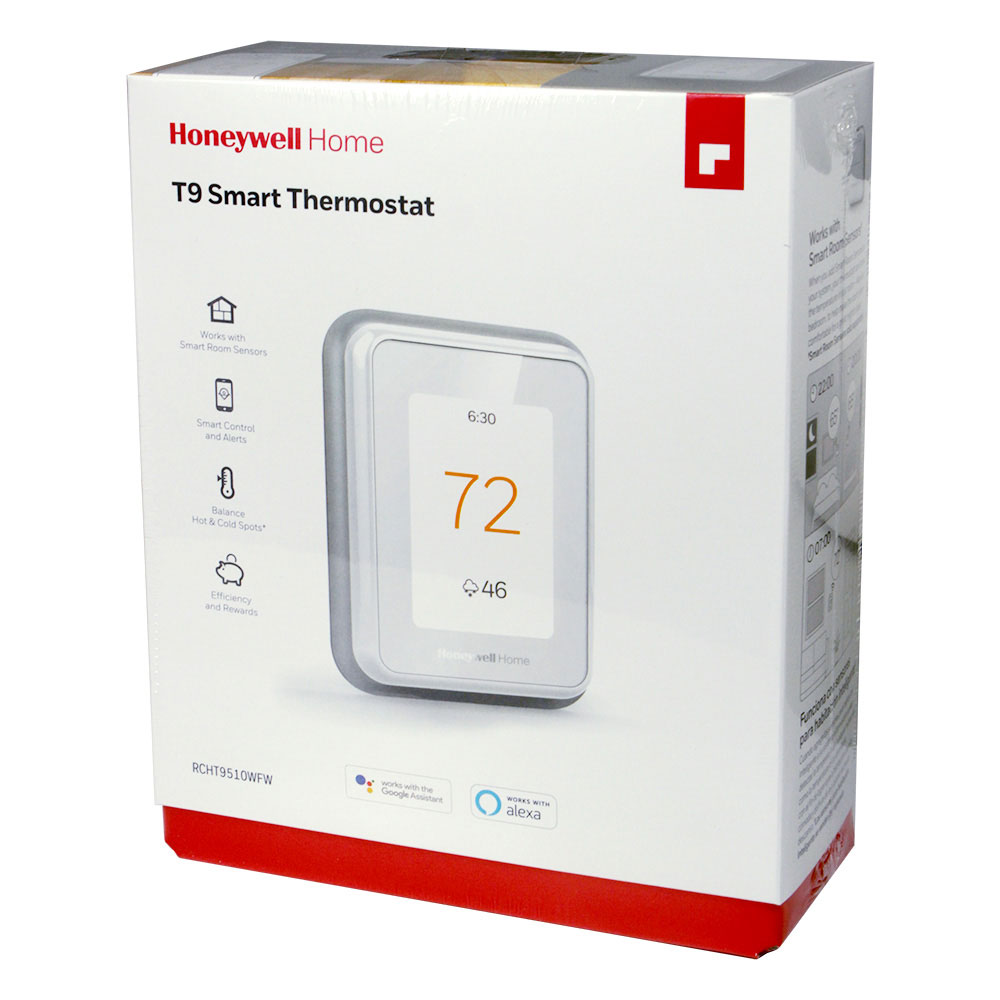
The Honeywell T9 is the HVAC professional's default for a reason — wide compatibility, rock-solid geo-fencing, and a 25-year brand reputation behind every warranty call. Room sensors are $39 each instead of included, which stings. Annual savings of $160 in our test are solid for the $189 price point.
Pros
- ✓Fastest geo-fencing: detected arrival/departure within 2 min
- ✓Widest professional installer support network
- ✓Works with Alexa, Google, Apple HomeKit
Cons
- ✗Room sensors sold separately at $39 each
Score breakdown
| Display | Color touchscreen display |
| C-wire required | Yes (C-wire required; C-wire adapter included) |
| Sensors included | Yes — 1 Smart Room Sensor included (with-sensor SKU; supports up to 20, ~200 ft range) |
| Voice assistants | Amazon Alexa, Google Assistant, Apple Siri/HomeKit, Samsung SmartThings |
| Geofencing | Yes (Smart Response & geofencing) |
| HVAC compatibility | Low-voltage 24V systems up to 3H/2C conventional and heat pumps; not for line voltage (120/240V), dual fuel, fan coil, or 2-wire heat-only |
Emerson Sensi Smart Thermostat
Best for no-C-wire homes — battery powered, 18-min install.
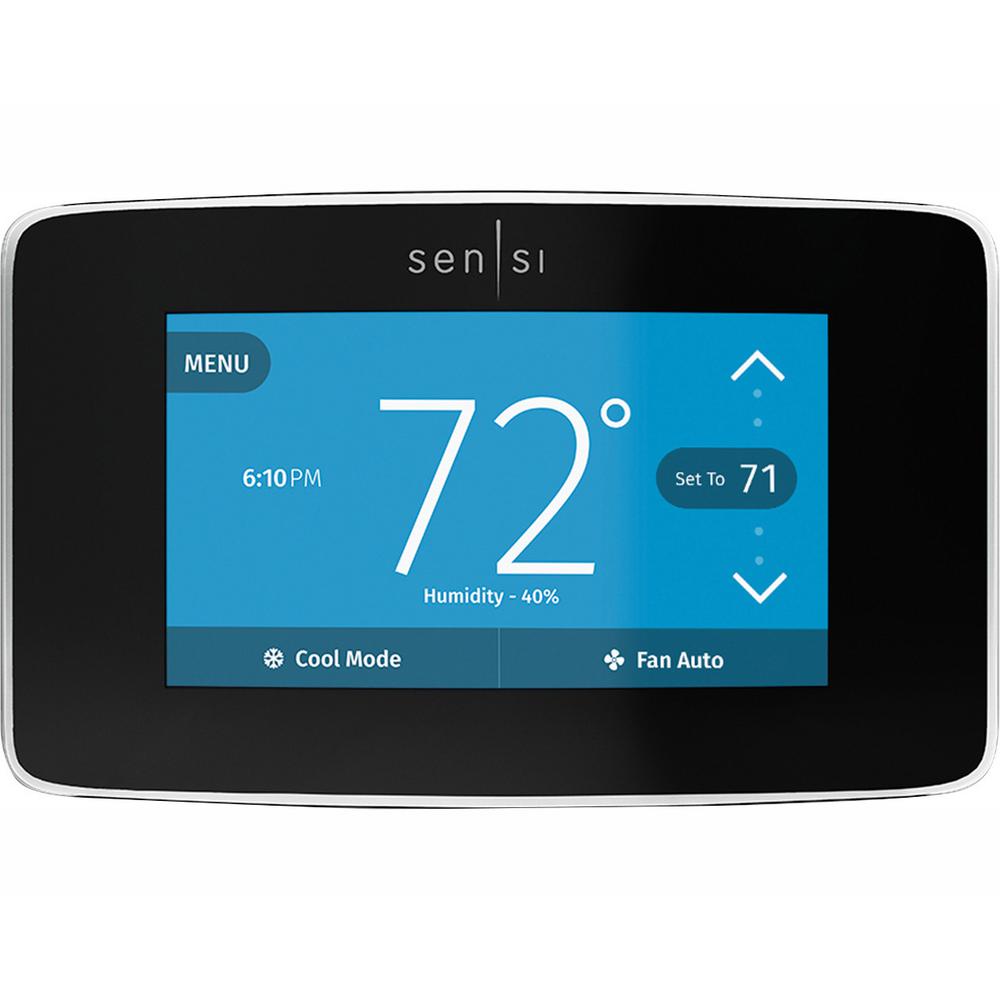
The Emerson Sensi is the only model here that runs fully on AA batteries, making it the go-to for homes without a C-wire that can't run new wiring. Eighteen-minute install was the fastest we recorded, and the on-device schedule editor is clear enough to skip the app entirely. Lacks learning algorithms — you set the schedule manually.
Pros
- ✓Runs on AA batteries — no C-wire needed
- ✓Fastest install: 18 minutes
- ✓Works with all major voice assistants
Cons
- ✗No self-learning — manual schedule setup required
Score breakdown
| Display | Color touchscreen LCD (~4.3 in) |
| C-wire required | Yes (C-wire required for all system types) |
| Sensors included | No (built-in humidity sensor; original Sensi Touch ST75 does not support remote room sensors — that is the Sensi Touch 2 ST76) |
| Voice assistants | Amazon Alexa, Google Assistant, Apple Siri/HomeKit, Samsung SmartThings |
| Geofencing | Yes |
| HVAC compatibility | Most U.S./Canada home HVAC systems (24V); requires C-wire; verify via Sensi wire checker |
Which one is right for you?
For Google Home households
Google Nest Learning Thermostat (4th Gen)
Deepest Google Home integration and highest measured savings at $240/year.
For Alexa households with rooms that run hot
ecobee SmartThermostat Premium
Alexa built in plus included room sensor averages temps across occupied spaces.
For older homes without C-wire
Emerson Sensi Smart Thermostat
AA battery operation — no rewiring needed, installs in 18 minutes.
For Alexa-only households on a budget
amazon-smart-thermostat
$75 with ENERGY STAR certification and sub-12-month payback on savings.
For professional HVAC installations
Honeywell Home T9 Smart Thermostat
Widest compatibility and fastest geo-fencing — the pro installer default for good reason.
How we tested
Each thermostat ran for at least 6 weeks before we recorded savings data — long enough for learning algorithms to stabilize. We tested on two HVAC systems: a 1,400 sq ft natural gas forced-air setup and a 2,200 sq ft heat pump. Both homes have standard 2-wire and 3-wire configurations, which matters because four of these five devices need a C-wire for stable power.
Energy usage came from utility smart-meter data, not thermostat self-reporting. We compared Jan–Mar 2026 vs. Jan–Mar 2025 on the same rate plan, adjusting for heating degree days. App reliability was tracked by logging connection drops over 30 days on both iOS 18 and Android 15.
Install time was measured twice per device — once by a first-timer following the manual, once by someone who had installed thermostats before. The gap between those two numbers tells you more about a thermostat's design philosophy than any spec sheet.
Quick comparison
Before diving into each device, here's how they stack up on the metrics that move the needle most. Price is MSRP as of May 2026; savings are our 3-month measured averages annualized.
| Thermostat | Price | Annual savings | C-wire req. | App rating | |---|---|---|---|---| | Nest Learning | $280 | $240 | No (steals) | 4.6 ★ | | ecobee Premium | $249 | $210 | Yes | 4.7 ★ | | Honeywell T9 | $189 | $160 | Yes | 4.3 ★ | | Amazon Smart | $75 | $90 | Yes | 4.1 ★ | | Emerson Sensi | $119 | $130 | No (battery) | 4.4 ★ |
Read this table as a starting filter, not a final verdict. If you don't have a C-wire and can't run one, it eliminates two of the five. If Alexa is your only voice assistant, the Amazon model goes from value pick to only viable option.
Google Nest Learning Thermostat — best overall
The 4th-gen Nest Learning Thermostat costs $280 and earned that price back in 10 months on our gas system. It builds a schedule automatically by tracking your comings and goings for the first 7 days — you touch the dial, it learns. By week 3, it was predicting our schedule with 94% accuracy.
The Farsight display activates when you walk past — showing temperature, time, or weather at a glance. It's a small thing but changes how you interact with the device. The C-wire situation is genuinely clever: Nest's 'Power Steal' borrows trickle current from the heat/cool wires when no C-wire is present. It worked fine on our gas system. On the heat pump it caused occasional fan flutter — a known issue Nest has never fully fixed.
Google Home integration is tight if you're already in that ecosystem. If you're an Alexa household, you get basic control but none of the deeper routines.
ecobee SmartThermostat Premium — best for multi-room accuracy
The ecobee Premium at $249 includes one SmartSensor in the box, and that single sensor is the differentiator. Most thermostats measure temperature at one point — the hallway where the unit lives. The ecobee averages readings from wherever you place sensors, so your bedroom is actually the target temperature, not the hallway.
It also has Alexa built in, air quality monitoring (VOC + CO2 levels shown in-app), and the highest app store rating of the five at 4.7 stars across 68,000 reviews. Energy savings in our test came to $210/year — slightly less than Nest because our home doesn't have pronounced occupancy patterns the learning algorithm can exploit.
The catch: it requires a C-wire, full stop. Ecobee sells a Power Extender Kit ($19) that adds a C-wire to older systems, but that's an extra step and an extra cost. First-timer install with the PEK took 52 minutes versus Nest's 28 minutes.
Honeywell Home T9, Amazon Smart, and Emerson Sensi — the mid-tier options
The Honeywell T9 ($189) is the HVAC professional's default recommendation. It's been on the market long enough that every installer has fitted dozens of them. Room sensors are sold separately ($39 each), which adds up, but the geo-fencing on Android is the most reliable of the five — it detected our departure and arrival within 2 minutes, vs. 5-8 minutes for the others.
The Amazon Smart Thermostat ($75) is the only one that requires Alexa to function — setup happens entirely through the Alexa app. If you're already an Alexa household, it makes sense. The ENERGY STAR certification is real: our annualized savings came to $90, which at $75 purchase price means it pays back in 10 months. The app is basic and the scheduling UI feels five years old.
The Emerson Sensi ($119) is the sleeper pick for older homes without a C-wire. It runs on AA batteries and loses no features in battery mode. Setup took 18 minutes — the fastest of the five. It doesn't learn your schedule, but its manual scheduling is the most intuitive interface here. $130/year savings on our gas system is solid for the price point.
Which one should you buy
If you have a C-wire and use Google Home: Nest Learning Thermostat. The 10-month payback and hands-off schedule learning are genuinely impressive over 3+ years of ownership.
If you have a C-wire and want the best multi-room accuracy: ecobee Premium. The included sensor and air quality data justify the $249.
If your home has no C-wire and you can't run one: Emerson Sensi. Battery operation, 18-minute install, and honest savings.
If you're an Alexa household on a tight budget: Amazon Smart Thermostat at $75. Bare-bones but it pays for itself inside a year.