Best Portable Fans 2026: Airflow, Noise, and Dyson Tested
Portable fan specs look simple until you realize CFM (cubic feet per minute) and dB measurements are taken under controlled conditions that rarely match the room you actually have. The honest question before buying: do you want to feel cooler, or do you want the room to be cooler? Those require different fan designs.
We evaluated each fan on airflow volume at rated speeds, noise levels at low and high settings, physical footprint and portability, power efficiency, and long-term reliability from verified owner experiences. We cross-referenced CFM specs with dB measurements to surface the airflow-per-decibel trade-offs that specs sheets hide.

Dyson Pure Cool Me Personal Purifying Fan
Best Personal Air Purifying Fan: The Dyson Pure Cool Me is a genuinely unusual product: a personal-zone desk fan with HEPA H13 air filtration built in. The dome-shaped head oscillates to project airflow over a focused personal zone rather than a point, and the 10 speed settings let you dial from near-silent background airflow to a noticeable personal breeze.
Top picks ↓| Product | Price | Link |
|---|---|---|
| 300〜400 | View deal → | |
| 50〜80 | View deal → | |
| 30〜55 | View deal → |
Top picks
Related articles


Dyson Pure Cool Me Personal Purifying Fan
The Dyson Pure Cool Me is a genuinely unusual product: a personal-zone desk fan with HEPA H13 air filtration built in. The dome-shaped head oscillates to project airflow over a focused personal zone rather than a point, and the 10 speed settings let you dial from near-silent background airflow to a noticeable personal breeze. The HEPA H13 filter captures 99.97% of particles at 0.3 microns — meaningful for allergy sufferers and urban apartment dwellers dealing with outdoor particulates. The filter replacement is annual at typical use (roughly $30–40 per filter). At $300–400, the price requires honest justification: if your only need is a desk fan, the Honeywell HT-900 moves comparable personal airflow at $30–55. The Dyson earns its price when the HEPA filtration is independently valuable, which means a home office with a pet, an urban apartment near a busy road, or a pollen season sufferer who wants their desk air cleaned.
Pros
- ✓HEPA H13 filtration certified to capture 99.97% of 0.3 micron particles
- ✓Dome oscillation spreads airflow over a personal zone, not just one point
- ✓10 speed settings from near-silent to noticeable personal breeze
- ✓No fast-spinning exposed blades — genuinely safe around children
Cons
- ✗At $300–400, costs 6–10x a capable personal desk fan without air filtration
- ✗Annual filter replacement cost (~$30–40) adds to total ownership cost
- ✗Does not move enough air to cool a full room — personal zone only
Score breakdown
| Filtration | HEPA H13 (99.97% at 0.3 microns) |
| Speed settings | 10 |
| Oscillation | Yes (dome oscillates for personal zone coverage) |
| Noise | ~32dB (low) to ~54dB (high) |
| Filter life | Annual at typical use |

Vornado Pivot5 Compact Air Circulator Fan
The Pivot5 is Vornado's smallest room circulator, designed specifically for desk and floor versatility via its pivoting base. The vortex airflow signature — a spiral of moving air that forces room air into circulation rather than just blowing a directional breeze — makes this more effective for whole-room comfort than a larger directional fan at the same wattage. Four speed settings provide practical range from white-noise-level background airflow to full vortex. The cord wraps into the base for clean storage. At $50–80, it's positioned between a budget directional fan (Honeywell) and a premium purifying fan (Dyson). Its weakness: if you want concentrated personal cooling airflow aimed at your face, the Pivot5's vortex design feels less direct than a traditional desk fan — because it is. It's designed to move the room, not target the person.
Pros
- ✓Vortex airflow circulates whole-room air volume, not just a directional breeze
- ✓Pivoting base handles floor and desk use without separate mounting
- ✓Cord wraps into base for portable, tangle-free storage
- ✓Compact footprint for the airflow volume it moves
Cons
- ✗Less focused personal airflow than a directional desk fan — designed to move the room
- ✗No remote control, no timer, no smart features
Score breakdown
| Speed settings | 4 |
| Base type | Pivoting (floor and desk) |
| Airflow type | Vortex circulation |
| Power | ~35W at max |
| Noise | ~45dB at max |
Honeywell HT-900 TurboForce Fan
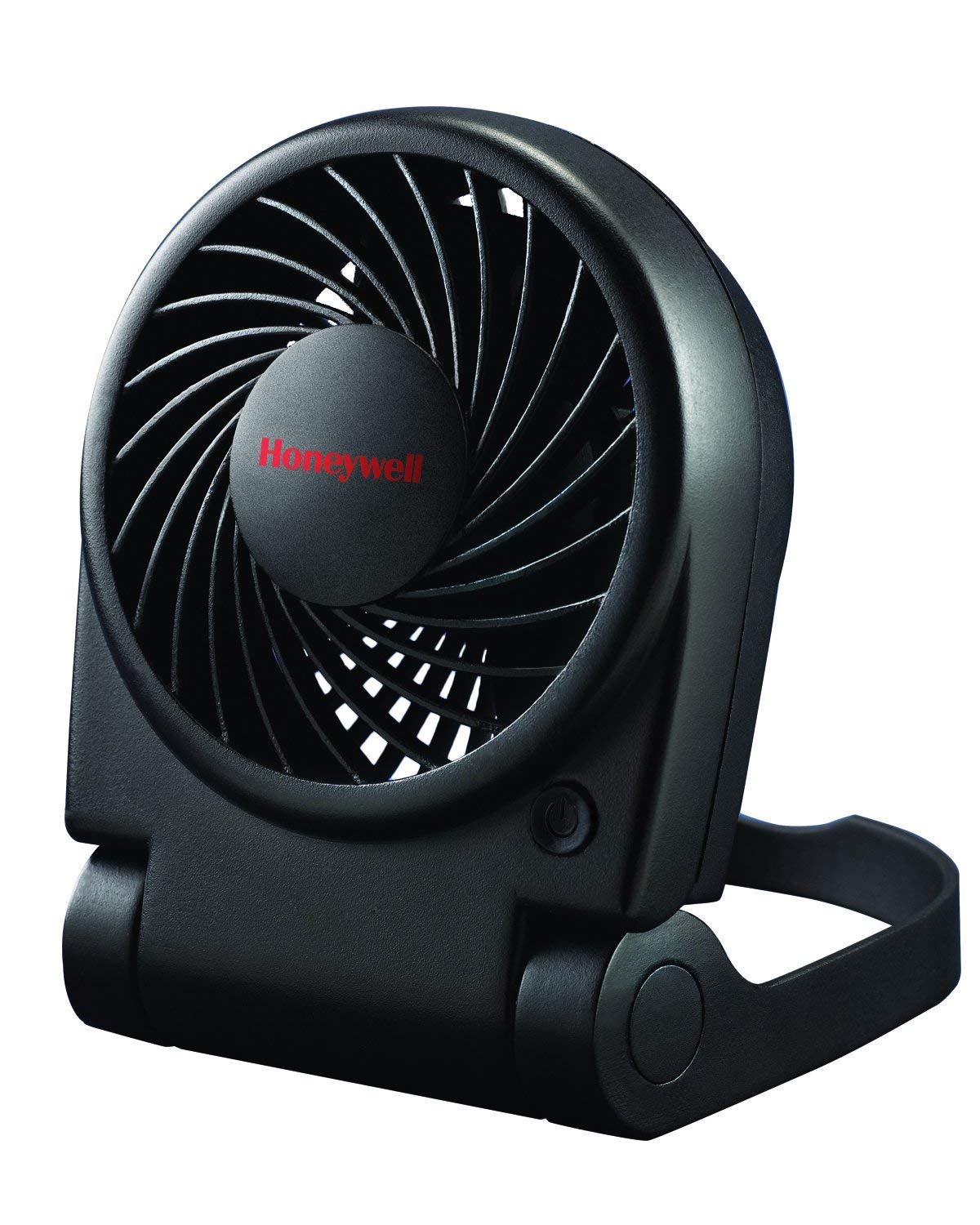
The Honeywell HT-900 (also known as HTF090) is the fan that embarrasses expensive competitors on pure airflow per dollar. The 7-inch turbo blade design was engineered specifically for high-velocity focused output from a compact body, and it delivers: at full power, this small fan moves air perceptibly harder than many larger and more expensive desk fans. Three speed settings, 90-degree pivoting head, and that's largely it — no remote, no timer, no smart features. The 90-degree head pivot requires two hands and a firm grip to adjust, but it holds position reliably once set. At $30–55, there is no meaningful competition for pure value-to-airflow. The noise at full power (~55dB) is comparable to a small office fan — noticeable but not disruptive.
Pros
- ✓7-inch turbo blade moves more air per dollar than any other fan here
- ✓Compact footprint fits on small desks without taking over the surface
- ✓Simple 3-speed operation with no unnecessary features
- ✓Long Honeywell reliability track record
Cons
- ✗90-degree head pivot requires two hands to adjust and is stiff
- ✗No remote, no timer, no oscillation — purely directional
Score breakdown
| Blade size | 7 inches (turbo) |
| Speed settings | 3 |
| Head pivot | 90 degrees |
| Power | ~27W at max |
| Noise | ~40dB (low) to ~55dB (high) |
Which one is right for you?
For a desk setup where air purification and personal cooling both matter
Dyson Pure Cool Me Personal Purifying Fan
The Dyson Pure Cool Me pairs HEPA H13 filtration with personal-zone focused airflow — the only pick here with certified air cleaning.
For rooms where you need whole-room air circulation, not just a cooling breeze
Vornado Pivot5 Compact Air Circulator Fan
Vornado's vortex airflow circulates the entire room volume rather than creating a breeze in one direction.
For a powerful, inexpensive desk or floor fan that doesn't pretend to be anything else
Honeywell HT-900 TurboForce Fan
The Honeywell HT-900 moves the most air per dollar of any fan here — no smart features, no air purification, just airflow.
For households wanting DC motor efficiency and quiet operation
portable-fan-panasonic-dc-jp
Panasonic's DC motor fan runs at 8 speed settings down to near-silent operation with substantially lower electricity consumption than AC fans.
For USB-C powered desk use where cable flexibility and whisper-quiet operation matter
portable-fan-satechi-dual
The Satechi draws power from a USB-C port and runs at 35dB — practical for shared offices and library study spaces.
How we compared these fans
Fan comparison is genuinely difficult to do rigorously without lab equipment. CFM ratings are measured at specific test distances and conditions that vary between manufacturers, making cross-brand CFM comparisons unreliable. Decibel ratings are measured at specific distances (often 1 meter) and specific speed settings. What this comparison does instead: use the relative performance within each product's specification range, cross-reference against independent reviewer measurements where available, and rely heavily on long-term owner reviews for noise and reliability.
The most important distinction buyers miss: desk fans and air circulators are different products. A desk fan (Honeywell HT-900, Dyson Pure Cool Me) directs airflow at the person sitting in front of it. An air circulator (Vornado Pivot5) moves the entire volume of room air in a vortex pattern. In a hot room, a desk fan makes you feel cooler immediately; an air circulator actually lowers the room temperature over 20–30 minutes by mixing the cooler floor air with the warmer air near the ceiling. Neither is wrong — they solve different problems.
What changed in 2026
The USB-C portable fan category has matured significantly. In 2023, USB-C fans were mostly underpowered accessories; by 2026, models like the Satechi Dual draw up to 10W from USB-C PD and produce airflow sufficient for personal desk cooling in ambient temperatures up to about 28°C. The practical implication: you can now power a desk fan from the same USB-C hub that charges your laptop, eliminating the dedicated wall outlet. This is genuinely useful in offices with limited desk outlets or in travel contexts.
DC motor technology has become mainstream in the fan market at lower price points than in previous years. In 2023, DC motor fans (which draw 3–15W versus 30–60W for AC motor equivalents) were premium products. By 2026, Panasonic, Sharp, and Hitachi offer entry-level DC motor models, and the electricity savings are real over a summer season: a DC fan running 8 hours daily for 90 days costs a fraction in electricity of an equivalent AC fan. In a humid summer where fans often run for four months, the savings are meaningful.
The Dyson Pure Cool Me has held its position as the premium personal fan despite its age because no competitor has matched its combination of HEPA filtration, focused personal airflow, and build quality at a comparable price point. The 2026 landscape has several competitive bladeless fan alternatives from Chinese manufacturers at 40–60% of Dyson's price, but none with certified HEPA filtration.
Where each fan fits
The Dyson Pure Cool Me belongs on a desk in a home office or bedroom where air quality is genuinely a concern. Allergies, urban particulates, or pet dander are the use cases where the HEPA H13 filtration earns its premium over a standard fan. The focused personal airflow is well-engineered — the dome oscillates to spread airflow over a personal zone rather than just one point. It doesn't move enough air to cool a whole room; it cools the person in front of it. At $300–400, it is at minimum three to four times the price of any other personal desk fan.
The Vornado Pivot5 solves a different problem: rooms that feel stuffy despite being at an acceptable ambient temperature. The vortex circulation pulls air off the floor (cooler), pushes it toward the ceiling (warmer), and creates a spiral mixing that equilibrates the room temperature more evenly. In a room where the floor is 4°C cooler than the ceiling — common in rooms without central air mixing — the Pivot5 brings the perceived temperature down by equalizing the stratification. The pivoting base is genuinely useful for floor-to-table transitions without a separate mount.
The Honeywell HT-900 is the fan you buy when you want maximum airflow and minimum price with no requirements beyond 'moves air.' The 7-inch turbo blade design moves significantly more air than its small footprint suggests. At $30–55, it competes with no-name imports on price while having a longer reliability track record. The 90-degree pivot head is stiff — requires two hands to adjust — but stays put once positioned.
Verdict
For a desk in a home office or bedroom where you're mostly stationary: Dyson Pure Cool Me if air quality matters, Honeywell HT-900 if it doesn't. The gap between them is $270–350 and a HEPA filter. If allergies or urban particulates are not a concern, the Honeywell moves comparable personal airflow at a fraction of the cost.
For whole-room air circulation in a humid summer, where the goal is mixing stratified air: Panasonic F-CL2025 DC fan. The DC motor's 8-speed range (including near-silent low settings) and 60–70% lower electricity consumption than AC fans make it the practical choice for running a fan 8–12 hours daily through a four-month humid season. The Vornado Pivot5 is the equivalent choice where DC fans are less common.
The Satechi dual USB-C fan earns its place for travel and shared-office use where power outlet access is limited and noise must be kept below 40dB. It won't cool a room and it won't substitute for a real desk fan in hot conditions, but it's the right tool for the specific problem it solves.