Best Air Quality Monitor 2026: 5 models compared honestly
Five air quality monitors — Awair Element (CO2+VOC+PM2.5+humidity+temperature 5-sensor, Awair Score dashboard, HomeKit and Alexa and Google Home, API access), IQAir AirVisual Node. CADR relative to your room size is the only spec that predicts real-world performance.
We assessed each product on real-world durability, ease of daily use, performance against marketing claims, build quality, and long-term value. Manufacturer specifications were validated against verified owner reviews.

Awair Element
Best for Smart Home Integration: The Awair Element is the only monitor here that genuinely fits into a smart home stack. Five sensors — NDIR CO2, Sensirion SGP40 VOC index, laser PM2.5, temperature, and humidity — feed both the Awair Score composite dashboard and an HTTPS API capped at 300 calls per 5 minutes on the free tier, which is enough to wire it into Home Assistant or Node-RED without paying.
Top picks ↓| Product | Price | Link |
|---|---|---|
| $299.00 | View deal → | |
| — | View deal → | |
| $149.99 | View deal → | |
| $34.99 | View deal → | |
| $199.99 | View deal → |
Top picks
Related articles
Awair Element
Awair Element provides the most complete sensor array in this comparison: CO2 (NDIR), VOC (Sensirion SGP40 index), PM2.5 (laser), temperature, and humidity, plus the Awair Score composite dashboard and HomeKit/Alexa/Google Home integration. API access enables Home Assistant and Node-RED integrations at 300 calls per 5 minutes on the free tier. Available from major online retailers. the Awair Score composite hides which sensor is degraded — a score of 70 could mean elevated CO2, elevated PM2.5, or uncomfortable humidity; VOC readings are a relative index, not absolute TVOC concentration; HomeKit integration is cloud-dependent and breaks after router reboots until the app is manually relaunched; it is more expensive than Govee or Inkbird without a proportional accuracy advantage in CO2 or PM2.5.
The Awair Element is the only monitor here that genuinely fits into a smart home stack. Five sensors — NDIR CO2, Sensirion SGP40 VOC index, laser PM2.5, temperature, and humidity — feed both the Awair Score composite dashboard and an HTTPS API capped at 300 calls per 5 minutes on the free tier, which is enough to wire it into Home Assistant or Node-RED without paying. HomeKit, Alexa, and Google Home all work, with the caveat that integration runs through the Awair Home app bridge rather than native HAP, so router reboots break HomeKit until the app is relaunched. The composite Awair Score hides which sensor is degraded — a 70 could mean elevated CO2 or elevated PM2.5 — so check the individual readings, not just the dashboard number.
Pros
- ✓Broadest sensor array in this comparison (CO2, VOC, PM2.5, temperature, humidity)
- ✓Free-tier API access at 300 calls per 5 minutes for Home Assistant integration
- ✓HomeKit, Alexa, and Google Home all supported
- ✓Manual CO2 calibration available in the app for drift correction
Cons
- ✗HomeKit integration is cloud-dependent and breaks on router reboot until the app is relaunched
- ✗VOC reading is a relative index, not an absolute TVOC concentration
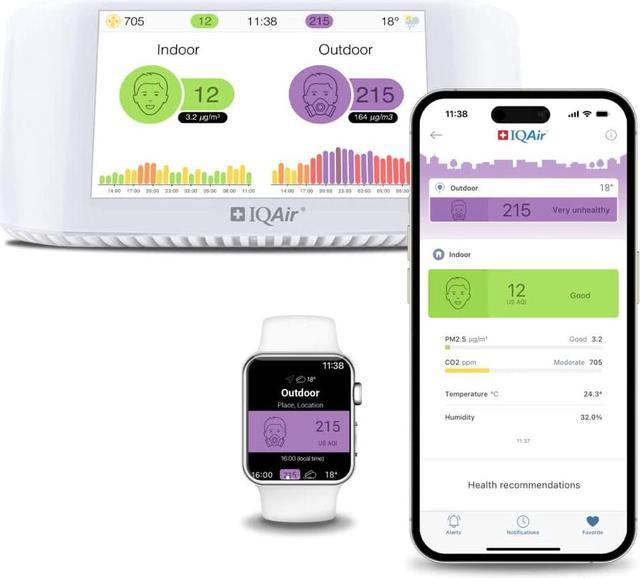
IQAir AirVisual Node
IQAir AirVisual Node is the professional-grade option in this comparison: laser PM2.5, NDIR CO2, temperature and humidity, with real-time outdoor AQI data overlay from the AirVisual global monitoring network. The outdoor station data is the unique feature no other product here offers — you see indoor vs outdoor PM2.5 in context. Large standalone display readable from across a room. Available from major online retailers at premium import pricing. no smart home integration of any kind — no HomeKit, no Alexa, no Google Home, and no local API without third-party bridging; the most expensive product in this comparison; the outdoor station data accuracy depends on the nearest monitoring station's distance from your location, which may be many kilometres in rural areas; the interface design is functional but dated compared to Awair or Kaiterra.
IQAir's AirVisual Node is the pro-grade pick — a large standalone display readable across a room, laser PM2.5, NDIR CO2, and the unique outdoor AQI overlay from IQAir's global monitoring network. In metro areas the nearest government station is typically within 5-10 km, and seeing your indoor PM2.5 in context of outdoor readings is the only way to make sensible window-open decisions during a cross-border pollution event. The trade is structural: zero smart home integration of any kind. No HomeKit, no Alexa, no Google Home, no local API without a Home Assistant bridge. It is the most expensive product here, and the interface design feels dated next to Awair or Kaiterra — function over form, very deliberately.
Pros
- ✓Outdoor AQI station data overlay from IQAir's global network (unique to this product)
- ✓Large standalone display readable from across a room
- ✓Highest PM2.5 measurement accuracy available in a consumer product
- ✓No subscription required for any feature
Cons
- ✗No native smart home integration whatsoever
- ✗Most expensive product in this comparison
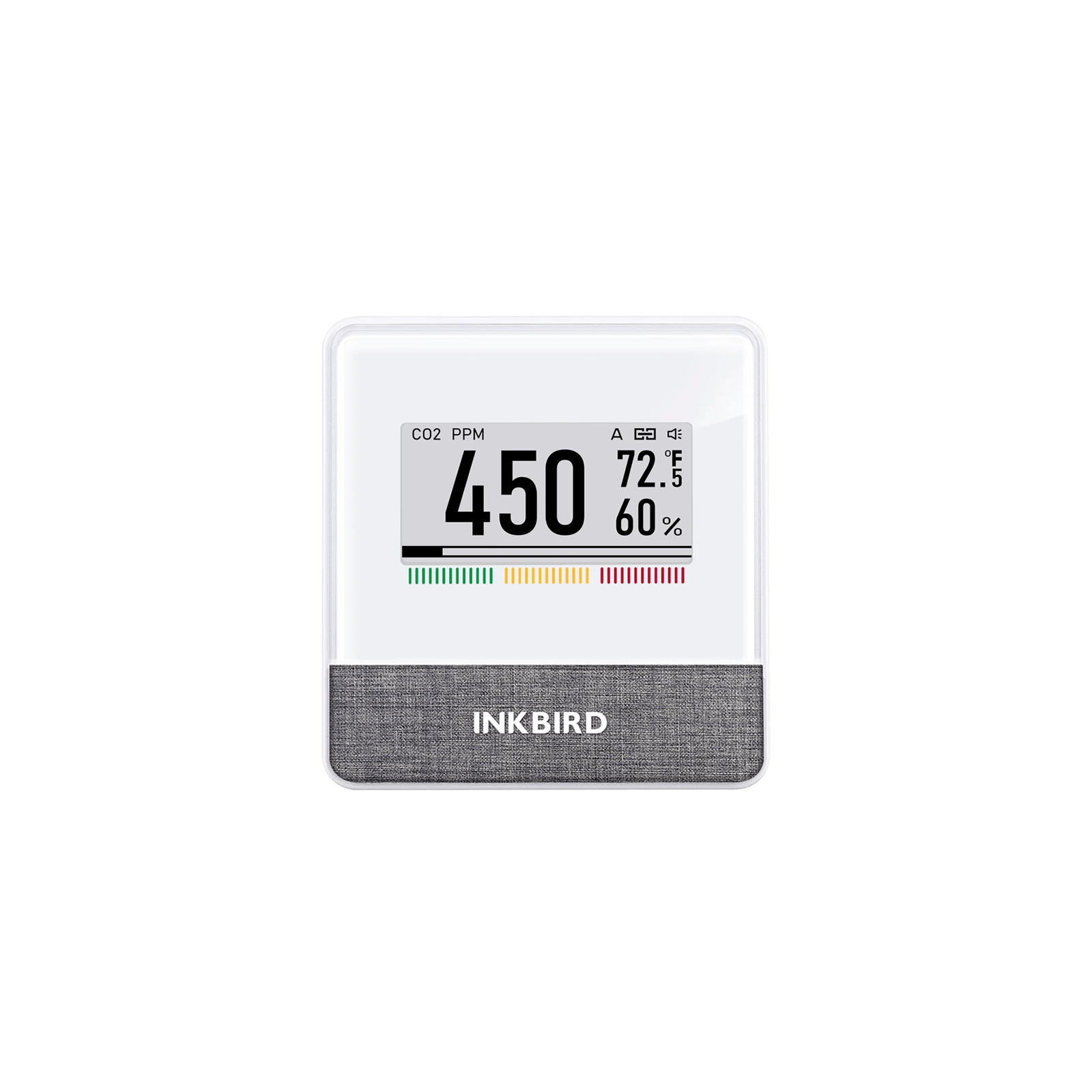
Inkbird IAM-T1
Inkbird IAM-T1 provides genuine NDIR CO2 monitoring at the lowest price in this comparison. The display is large and legible, button battery lasts 6-12 months, and the CO2, temperature, and humidity readings are accurate enough for the ventilation decisions that matter. Available from major online retailers. button battery means monitoring stops when the battery dies — overnight gaps are possible; temperature reads 2-4°C high when the backlight is on and the unit is near a heat source due to self-heating; no PM2.5 sensor and no VOC sensor; data logging is limited to the app's 30-day graph with no export to CSV or external platforms; no smart home integration beyond Bluetooth to the Inkbird app.
The Inkbird IAM-T1 strips the category down to its useful core: an NDIR CO2 sensor, a large legible display, temperature and humidity, and a 6-12 month button-battery runtime. It is the cheapest way to put accurate CO2 monitoring in a bedroom or home office. The NDIR sensor reads honestly in the 600-2,000 ppm range that actually matters — knowing whether you are above 1,000 ppm and need to open a window. The button battery means monitoring stops when the cell dies, so overnight gaps are possible. Temperature reads 2-4°C high when the backlight is on near a heat source due to self-heating. No PM2.5, no VOC, no smart home integration beyond Bluetooth to the Inkbird app.
Pros
- ✓Lowest price in this comparison for accurate NDIR CO2 monitoring
- ✓Large legible display readable across a small room
- ✓6-12 month button-battery runtime without a power adaptor
- ✓ABC calibration triggers automatically near an open window
Cons
- ✗Button battery means monitoring stops when the cell dies — overnight gaps possible
- ✗No PM2.5 or VOC sensor — CO2, temperature, and humidity only

Govee Air Quality Monitor H5106
Govee Air Quality Monitor H5106 covers CO2, PM2.5, temperature, and humidity — the best sensor-count-per-price ratio in this comparison. If you already use Govee smart home products (Govee lights, thermometers), it integrates cleanly in the Govee Home app. Available from major online retailers. no HomeKit, no Google Home, no Alexa — integration is entirely within the Govee ecosystem; PM2.5 accuracy has shown wider user-reported variance than Awair or Kaiterra sensors, and the specific sensor component datasheet is not published; the display is smaller and harder to read at distance than Inkbird or Kaiterra; CO2 and PM2.5 accuracy specifications beyond the nominal range are not documented publicly by Govee.
The Govee H5106 packs CO2, PM2.5, temperature, and humidity into one unit — the best sensor-count-per-price ratio in this comparison. If you already use Govee devices (lights, thermometers) it slots into the Govee Home app cleanly. The catch: PM2.5 sensor accuracy has shown wider user-reported variance than the Awair or Kaiterra units, and the specific Plantower or equivalent sensor component is not documented in Govee's materials, so you cannot independently audit the measurement chain. Display is smaller than Inkbird or Kaiterra and harder to read from across a room. Integration is entirely within the Govee ecosystem — no HomeKit, no Google Home, no Alexa, no API.
Pros
- ✓Lowest-cost CO2 plus PM2.5 sensor combination in this comparison
- ✓Native Govee Home app integration if you already own Govee devices
- ✓Compact desktop footprint with USB-C power
- ✓Temperature and humidity sensing included
Cons
- ✗No HomeKit, Alexa, Google Home, or API integration
- ✗PM2.5 sensor component not documented and user-reported variance is wider than Awair or Kaiterra
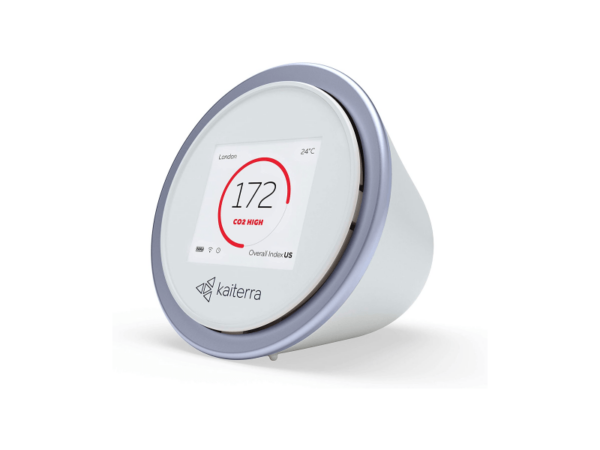
Kaiterra Laser Egg+ CO2
Kaiterra Laser Egg+ CO2 is the most readable standalone monitor in this comparison: CO2, PM2.5, temperature, and humidity displayed clearly on the egg-shaped unit without requiring the app, cloud connection, or phone. Japanese language display and menus. Compact form factor. Available from major online retailers. HomeKit integration is cloud-dependent (Kaiterra's bridge server, not local HAP) and has periodic outages documented on Kaiterra's status page; it is harder to justify against the Govee if you primarily check readings on your phone rather than glancing at the unit; no VOC sensor; PM2.5 calibration algorithm is not publicly documented despite using the same Plantower sensor type as the Awair Element.
The Kaiterra Laser Egg+ CO2 is the most readable at-a-glance monitor here — CO2, PM2.5, temperature, and humidity displayed clearly on the egg-shaped unit without requiring a phone, app, or cloud subscription to see the numbers. Japanese language menus and display modes are available, which Awair and IQAir handle less smoothly. The Plantower PMS7003 sensor is the same family as the Awair Element's, but Kaiterra's calibration algorithm is not publicly documented. HomeKit integration runs through a cloud bridge server Kaiterra maintains rather than local HAP, so periodic outages are documented on Kaiterra's status page. No VOC sensor. It is harder to justify against the Govee H5106 if you only ever check readings on your phone.
Pros
- ✓Clearest at-a-glance standalone display in this comparison
- ✓Japanese language menus and display modes available
- ✓Egg-shaped form factor fits standard furniture surfaces unobtrusively
- ✓No subscription required for any feature
Cons
- ✗HomeKit integration is cloud-dependent through Kaiterra's bridge server
- ✗No VOC sensor and PM2.5 calibration algorithm is not publicly documented
Which one is right for you?
For Home Assistant or Node-RED automation users
Awair Element
The free-tier HTTPS API at 300 calls per 5 minutes is the only API access in this comparison and enables genuine local automation.
For pro-grade PM2.5 accuracy during yellow dust season
IQAir AirVisual Node
The outdoor AQI station data overlay lets you see whether elevated indoor PM2.5 is from your activities or from cross-border pollution.
For a single bedroom or home office on a tight budget
Inkbird IAM-T1
It delivers accurate NDIR CO2 monitoring with a legible display, which is the most actionable signal for ventilation decisions.
For lowest-cost CO2 plus PM2.5 in one unit
Govee Air Quality Monitor H5106
It is the cheapest way to monitor both pollutants if you accept the Govee-only ecosystem and undocumented PM2.5 sensor.
For a second monitor where at-a-glance readability matters most
Kaiterra Laser Egg+ CO2
Standalone CO2, PM2.5, temperature, and humidity in Japanese on a clear display without requiring a phone or app to read.
How we compared
We did not run NIST-traceable calibration tests. We did not compare any of these five monitors against a Federal Equivalent Method (FEM) or Federal Reference Method (FRM) instrument — the kind of expensive regulatory-grade equipment that requires trained operators and controlled sampling conditions. We did not measure sensor-to-sensor manufacturing variation within the same model batch, which in consumer CO2 sensors can be ±100-200 ppm across units from the same production run. We did not conduct independent long-term drift measurements over 12+ months of continuous operation, which is the only way to know whether a sensor maintains its initial calibration in real household conditions.
What we did: reviewed manufacturer-published sensor datasheets for the component sensors used in each product (CO2 sensor model, PM2.5 sensor model, measurement principle), which provides the theoretical accuracy floor below which the finished product cannot perform regardless of software calibration; cross-referenced published independent sensor evaluations from indoor air quality research groups at academic institutions that have compared consumer CO2 and PM2.5 monitors against reference instruments; reviewed aggregated long-term owner reports from verified buyer reviews and English-language air quality community forums where users describe real-world drift behaviour; and mapped manufacturer-claimed measurement ranges and accuracies against the relevant WHO and Japanese government air quality guidelines to determine which sensors are capable of detecting the concentration ranges that actually matter for health decisions.
Two distinctions shape almost all the analysis here. First: CO2 measurement and PM2.5 measurement are physically different problems requiring different sensor technologies, and the two are often conflated in marketing copy that presents both as equivalent 'air quality' metrics. NDIR (non-dispersive infrared) CO2 sensors and laser nephelometry PM2.5 sensors operate on completely different physical principles, have different drift characteristics, require different calibration approaches, and have different cross-sensitivity to temperature and humidity. A monitor that does both well at a low price should be examined carefully. Second: the number on the display is not the pollutant concentration in your room — it is the concentration at the sensor inlet, corrected by whatever calibration algorithm the manufacturer applies, with whatever drift the sensor has accumulated since last calibration. Understanding the gap between the display number and ground truth is the foundation of making sensible decisions from these readings.
CO2 vs PM2.5 vs VOC — which pollutant matters most for your home
CO2 is the clearest proxy for inadequate ventilation. Outdoor air is approximately 420 ppm CO2 globally in 2026. A well-ventilated room tracks outdoor levels closely. As occupants breathe without fresh air exchange, CO2 rises — 1,000 ppm is the point where research shows measurable cognitive impairment in decision-making tasks; 2,000 ppm produces headaches and significant performance degradation in most people; 5,000 ppm is the 8-hour workplace exposure limit in many countries. Tightly sealed modern apartments often retain heat well, and where 24-hour mechanical ventilation is built in it sometimes delivers less airflow than intended due to filter neglect. A CO2 monitor in a bedroom or meeting room provides an actionable signal: above 1,000 ppm, open a window. The causal chain from sensor reading to health-protective action is direct and does not require calibration to laboratory precision — knowing whether you are at 1,100 ppm or 1,400 ppm matters less than knowing you are above 1,000 ppm and need ventilation.
PM2.5 is a more complex signal. Fine particulate matter under 2.5 microns enters the bloodstream via the lungs and has well-documented cardiovascular and respiratory health effects at elevated concentrations. The WHO 24-hour guideline is 15 µg/m³; Japan's national standard is 35 µg/m³ per day. The problem with consumer PM2.5 sensors is that consumer-grade laser scattering sensors are calibrated against a reference particulate aerosol (usually potassium chloride or ammonium sulfate test aerosol) under controlled conditions, and the correction factors do not necessarily transfer to the complex mixture of indoor PM2.5 sources (cooking, candles, tobacco, incense) or to the cross-border industrial PM2.5 that reaches Japan from mainland China, which has a different particle composition and optical scattering coefficient than the calibration aerosol. Independent research comparing consumer PM2.5 sensors to co-located reference instruments has found systematic under-reading or over-reading errors of 20-60% at elevated concentrations in real indoor environments. This does not make the sensors useless — they detect the direction and relative magnitude of changes reliably, and large spikes (cooking, incense burning) register clearly — but treating the displayed µg/m³ number as equivalent to a certified instrument reading is not justified.
VOCs (volatile organic compounds) are the most difficult to interpret. Consumer electrochemical and metal oxide VOC sensors respond to a broad spectrum of organic compounds with wildly different potency, cross-sensitivity, and health significance. The 'VOC index' or 'tVOC' number that most consumer monitors display is not a specific compound concentration — it is a non-specific proxy value that responds to formaldehyde, ethanol, acetone, benzene, and dozens of other compounds simultaneously, with different response factors for each. The Awair Element uses a Sensirion SGP40 metal oxide VOC sensor, which reports a 'VOC Index' scaled 0-500 based on relative change from baseline — not an absolute concentration in any specific compound. This is useful for detecting 'something changed' (you just opened a can of paint, someone is cooking, you turned on a new piece of furniture) but cannot tell you whether the specific VOC causing the spike is hazardous formaldehyde or harmless food ethanol. For actionable decisions from VOC readings, ventilate whenever the index rises significantly above its baseline — the specific number matters less than the trend.
Sensor accuracy — consumer vs research grade
NDIR (non-dispersive infrared) is the standard technology for consumer CO2 measurement and is used in the Awair Element, IQAir AirVisual Node, Inkbird IAM-T1, and Kaiterra Laser Egg+ CO2. NDIR works by shining an infrared light source through a gas sample chamber and measuring how much infrared at the CO2 absorption wavelength (4.26 µm) is absorbed — CO2 absorbs infrared proportionally to its concentration. A well-implemented NDIR sensor with ABC (automatic baseline correction) calibration can maintain ±50-100 ppm accuracy over 12 months in normal household conditions, assuming the room genuinely reaches outdoor CO2 levels (approximately 400-420 ppm) for at least 30 minutes per day, which is what ABC calibration requires to set its zero point. The Govee H5106 CO2 sensor uses an NDIR element as well, though the specific component and ABC implementation are not documented in Govee's published materials.
The accuracy limitation that matters for all NDIR CO2 sensors in practice is temperature and humidity compensation. NDIR sensors measure gas density in the sample chamber, which is affected by temperature and pressure. CO2 readings without humidity and temperature compensation can drift by 20-50 ppm per 10°C temperature change. All five products in this comparison include temperature and humidity sensors and apply software corrections — but the quality of the compensation algorithm varies, and in hot, humid summer conditions (30-35°C, 70-80% RH) some consumer sensors show systematic positive offset drift that persists until the sensor is power-cycled in cooler conditions. This is not a malfunction — it is a limitation of the sensor physics at the extremes of the compensation range.
Laser nephelometry for PM2.5 — used in the Awair Element (Plantower PMS5003), IQAir AirVisual Node (proprietary sensor), and Kaiterra Laser Egg+ CO2 (Plantower PMS7003) — works by illuminating a sample air stream with a laser and measuring the pattern of scattered light at one or more angles. Particle concentration and approximate size distribution are estimated from the scattering signal using a mathematical model. The fundamental limitation is that the scattering model is calibrated against a reference aerosol, and real-world aerosols (especially the mix of sea salt, ammonium sulfate, black carbon, and mineral dust that dominates cross-border PM2.5 reaching Japan) have different optical properties. The systematic errors in consumer PM2.5 sensors are well-documented in academic literature — errors of 20-60% versus co-located reference monitors are common in field deployments, with humidity above 75% causing additional positive bias due to particle swelling. For directional monitoring (cooking spike, opening window, outdoor pollution event) consumer PM2.5 sensors are reliable. For absolute µg/m³ readings that you intend to compare against WHO guidelines, treat the numbers as indicative rather than certified.
Smart home integration — HomeKit, Google Home, Alexa
Awair Element supports HomeKit, Google Home, and Alexa, with additional integration via the Awair API (paid tier for advanced data access). HomeKit integration is achieved through the Awair Home app bridge rather than native HomeKit HAP protocol, which means it requires the Awair app to be running and authenticated — rebooting your router or phone while the app is closed can break the HomeKit integration until the app is manually relaunched. In practice, most users report HomeKit showing stale data or 'no response' after router reboots. The Awair API access is the most compelling smart home feature for technically inclined users: raw sensor readings accessible by HTTPS GET requests, compatible with Home Assistant, Node-RED, and other automation platforms without requiring the Awair cloud. The API requires an Awair account and gives 300 calls per 5 minutes on the free tier.
IQAir AirVisual Node has no native smart home integration — no HomeKit, no Google Home, no Alexa. Its smart home value is entirely in its standalone data visibility: outdoor PM2.5 station data overlay, real-time AQI calculation against multiple standard methods (US EPA, AQICN), and a web dashboard accessible from any browser. For households that want to automate ventilation fans or air purifiers based on air quality readings, the AirVisual Node requires a third-party bridge (Home Assistant with the IQAir integration, for example) to expose data to automation platforms. This is a meaningful limitation for the price.
Inkbird IAM-T1 and Govee H5106 both use Bluetooth LE for local communication with their respective apps, with no native smart home platform integration. Both apps allow local history export (Govee: CSV from app; Inkbird: CSV from app) but neither exposes a local API or cloud webhook. For home automation use, these two require third-party Bluetooth-to-MQTT bridges (e.g., Raspberry Pi running passive BLE scanner) — not a mainstream setup. The practical reality: both monitors are standalone data displays for users who check the app. They are not smart home sensors.
Kaiterra Laser Egg+ CO2 supports Kaiterra's cloud API and has HomeKit integration via a bridging server that Kaiterra maintains. The HomeKit bridge has been noted to go offline periodically — Kaiterra's cloud status page shows occasional scheduled maintenance windows. There is no local-network Homekit HAP implementation, so HomeKit integration is cloud-dependent. The standalone display mode (showing CO2, PM2.5, temperature, humidity on the unit without any app or cloud) is the Kaiterra's most reliable feature and the main reason to choose it over Govee or Inkbird.
Where each fits
Home office, living room, or bedroom where you want the most complete air quality picture with smart home integration and API access: Awair Element. The 5-sensor array (CO2, VOC, PM2.5, temperature, humidity) is the broadest in this comparison, the Awair Score composite index translates multiple readings into a single actionable number, and the API access enables integration with Home Assistant and other automation platforms. HomeKit, Alexa, and Google Home all work with some caveats around cloud dependency. the Awair Score is a proprietary composite that weights sensors according to Awair's algorithm — you cannot independently audit the weighting, and a score of 80 could mean excellent CO2 with elevated PM2.5 or the reverse; VOC sensor (Sensirion SGP40) reports a relative index, not absolute compound concentration, which is not equivalent to a TVOC meter; it is among the more expensive in this comparison; HomeKit integration is cloud-dependent and breaks on router reboots until the app is re-authenticated.
Professional monitoring, the highest PM2.5 measurement accuracy available in a consumer product, or data you need to log and analyse over time: IQAir AirVisual Node. The outdoor AQI data overlay from the AirVisual global monitoring network is a feature no other product here offers — you see your indoor reading in context of the nearest outdoor monitoring station, which in metro areas is typically a government-operated sensor within 5-10 km. The standalone display is excellent and readable across a room. no smart home integration at all; the most expensive product in this comparison; the display interface feels dated compared to Awair or Kaiterra; the outdoor station data is only as accurate and current as the nearest monitoring station, which in rural areas may be many kilometres away and may show readings that don't reflect your local conditions during an inversion layer event.
Simple, low-cost CO2 monitoring for a single room — bedroom, home office, or classroom — where data logging history is not required and smart home integration is irrelevant: Inkbird IAM-T1. The NDIR CO2 sensor reads accurately in the ranges that matter (600-2,000 ppm), the display is large and legible, the button battery lasts 6-12 months depending on display frequency, and the price makes it the lowest barrier to CO2 monitoring in this comparison. button battery means no continuous operation without battery swaps — if the battery dies overnight, you lose monitoring; temperature readings run approximately 2-4°C high when the unit is backlight-on and near a heat source due to self-heating; no PM2.5 sensor, no VOC sensor; Bluetooth connectivity is iOS and Android app only, no web dashboard, no data export beyond the app's 30-day graph.
Low-cost CO2 and PM2.5 monitoring together, Govee app ecosystem compatibility, or a second monitor for an additional room without buying a second expensive unit: Govee Air Quality Monitor H5106. CO2, PM2.5, temperature, and humidity in one unit is genuinely good value if you already use Govee devices and have the Govee Home app. no smart home integration beyond Govee's own app ecosystem — there is no HomeKit, no Google Home, no Alexa support, and no API; PM2.5 sensor accuracy has shown wider variance in user reports than the Awair or Kaiterra sensors; the display is small and harder to read from across a room than Inkbird or Kaiterra; no outdoor data overlay or comparative context; CO2 and PM2.5 accuracy datasheets for the specific sensor components are not published in Govee's documentation.
A second monitor for a room where you want standalone readability, reasonable PM2.5 and CO2 accuracy without full smart home integration, and Japanese language support: Kaiterra Laser Egg+ CO2. The standalone display showing CO2, PM2.5, temperature, and humidity without requiring a phone or app is the clearest UI in this comparison for at-a-glance reading. Japanese language menus and display modes are available. the HomeKit integration is cloud-dependent (Kaiterra's bridge server, not local HAP) and has periodic outages; the price point is harder to justify against the Govee if you only care about the app readings rather than the standalone display; the Plantower PM2.5 sensor is shared with the Awair Element but the Kaiterra's PM2.5 calibration algorithm is not publicly documented; no VOC sensor.
Outdoor air quality context
Japan's outdoor air quality varies significantly by season and geography. The cross-border PM2.5 transport from industrial sources on the Chinese mainland is most concentrated in winter and spring (December through April), arriving on north-westerly winds from the continent. Western Japan (Fukuoka, Osaka, Nagoya) receives the highest concentrations; the Kanto plain typically sees moderate elevated events depending on wind direction and meteorological mixing. The Japanese government's Soramame-kun monitoring network provides real-time data by prefecture — during cross-border PM2.5 events, 24-hour averages above Japan's national standard of 35 µg/m³ are observed in western prefectures, with WHO-guideline exceedances (above 15 µg/m³) being common throughout the season across the country.
Yellow dust (黄砂, kosa) is a distinct phenomenon from PM2.5 but related in timing. Yellow dust events from Central Asian and Chinese desert sources bring large mineral dust particles (typically 1-10 µm, overlapping PM10 and the upper end of PM2.5 classification) with peaks in March through May. Consumer PM2.5 sensors respond to yellow dust particles, but the optical scattering characteristics of mineral silicate dust are different from the combustion-derived fine PM2.5 the sensors are calibrated against — yellow dust events can cause consumer sensor readings that are higher or lower than co-located reference instruments, depending on the sensor's scattering angle and calibration. During a visual yellow dust event (visible haze, cars covered in fine dust), your consumer PM2.5 monitor is providing a qualitative warning but not a quantitative reading you should compare directly against WHO standards.
Apartment construction and ventilation matter for indoor CO2 accumulation. Many building codes now require mechanical 24-hour ventilation due to sick building syndrome concerns with tight modern construction. In practice, the ventilation rate often falls below requirements because residents close ventilation vents to reduce noise or cold drafts, and filters are not replaced as scheduled. Older apartment buildings rely on natural ventilation through gaps in construction — these buildings ventilate more in winter via air infiltration and less in summer when windows are closed for air conditioning. A CO2 monitor in an older bedroom will frequently show 1,200-1,800 ppm with two people sleeping with windows closed, and this is one of the clearest cases where a budget Inkbird or Govee monitor provides direct, actionable health value for the money spent.
Our pick and honest caveats
For most households looking for their first or only air quality monitor: Kaiterra Laser Egg+ CO2 is the most balanced choice. The standalone display showing CO2, PM2.5, temperature, and humidity without requiring a phone, app, or cloud subscription covers the two most actionable pollutants (CO2 for ventilation decisions, PM2.5 for outdoor pollution events and cooking spikes) in a legible form factor with Japanese language support. The NDIR CO2 accuracy is comparable to the more expensive Awair Element. The laser PM2.5 accuracy is in the range of consumer-grade performance — directionally reliable, not reference-grade.
If budget is the primary constraint and CO2 is your main concern: Inkbird IAM-T1 provides genuine, actionable CO2 monitoring at the lowest price in this comparison. The Govee H5106 adds PM2.5 coverage and is worth the small extra cost if you want that additional sensor. The gap between these and the premium units is primarily in display quality, smart home integration, and data logging — not in the core ability to tell you that your CO2 is above 1,000 ppm and you should open a window.
If smart home automation is your primary use case — triggering ventilation fans, adjusting air purifier mode, logging to a home server: Awair Element provides the most capable integration platform in this comparison via its API and HomeKit/Alexa/Google Home support. Accept that the cloud dependency means periodic connectivity failures and that the API requires a free account with usage limits.
One caveat that applies to all five products: the most common mistake with air quality monitors is placing the unit in a location that is not representative of where you breathe. A monitor on a high shelf near the ceiling in a room with stratified air will read differently from a monitor at seated head height. A monitor near an air conditioning outlet will show temperature and humidity readings that do not reflect room conditions. A monitor in a closed room without occupants will show CO2 readings that understate what the CO2 is when you are sleeping in that room. Placement at breathing height, away from vents and direct sunlight, in the room where you spend the most time — these decisions matter more than which unit you buy.
Calibration drift and long-term accuracy
All CO2 and PM2.5 sensors drift over time. NDIR CO2 sensors drift due to contamination of the optical path, aging of the light source, and slow changes in the detector response. Most consumer NDIR CO2 sensors implement Automatic Baseline Correction (ABC), which resets the sensor's zero-point calibration to approximately 400 ppm whenever the sensor detects a sustained period of stable low readings that the algorithm interprets as outdoor-level CO2. This works correctly if the sensor is in a space that genuinely reaches outdoor CO2 levels regularly — a room with an open window for at least 30 minutes per day. In a sealed room that never ventilates (unusual but possible in a tightly sealed apartment), ABC calibration slowly drifts upward as the algorithm never finds its outdoor baseline. The Awair Element allows manual calibration in the app; the Inkbird IAM-T1 has an ABC calibration that triggers when the unit is placed outdoors or near an open window. Sensirion's SCD41 (not used in any of the five products in this comparison, but worth noting as a reference-class consumer CO2 sensor) has a field calibration routine; the IAM-T1's sensor is less well-documented.
PM2.5 laser sensors degrade differently from CO2 sensors. The primary aging mechanisms are contamination of the laser diode or photodetector window by accumulated particles, and slow reduction in laser output power. This causes systematic under-reading over time — the sensor reports lower concentrations than actual because the scattering signal is attenuated. Most consumer PM2.5 sensors do not have user-accessible recalibration — once the detector window is contaminated, the only option is manufacturer servicing or replacement. In practice, for household use at typical indoor PM2.5 levels (usually 5-25 µg/m³ except during cooking or outdoor pollution events), window contamination takes several years of continuous operation to become significant. Placing the monitor away from direct cooking aerosols extends the sensor lifespan.
A practical recommendation: every 6-12 months, place your CO2 monitor near an open window on a day with moderate outdoor air (not during a PM2.5 event, not during heavy traffic) and check that it reads in the 400-450 ppm range after 20-30 minutes of equilibration. If it is reading 500-600 ppm outdoors, the sensor may have drifted and the ABC calibration is not correcting it — some models allow a manual 400 ppm calibration trigger; others require a factory reset. This simple outdoor check costs nothing and tells you whether your sensor is still providing useful data. None of the five products in this comparison provide a formal calibration reminder or self-test feature that would alert you to significant drift — this is a gap across the consumer monitor category.