Best Shower Heads 2026: Flow, Spray Modes & Compatibility
The single number that matters most — flow rate in gallons per minute — is also the number most buyers ignore. Most US states now cap new showerheads at 1.8 GPM, and California at 1.5 GPM. Whatever the label says, check your local water pressure first: a 2.0 GPM head at 40 PSI delivers a completely different shower than the same head at 70 PSI.
We assessed each showerhead on actual spray pattern consistency, ease of installation, long-term mineral scale resistance, and real-world pressure performance across different household plumbing systems. Manufacturer GPM specs were cross-checked against verified owner reviews.

Kohler Forte Single-Function Showerhead
Best Everyday Fixed Head: The Kohler Forte earns its reputation through consistency rather than spectacle. The Katalyst air-induction technology mixes air into the water flow before it exits the spray face, which creates a fuller, softer spray at 2.0 GPM than you'd expect from the flow rate alone.
Top picks ↓| Product | Price | Link |
|---|---|---|
| 35〜60 | View deal → | |
| 80〜130 | View deal → | |
| 150〜250 | View deal → | |
| 60〜100 | View deal → |
Top picks
Related articles

Kohler Forte Single-Function Showerhead
The Kohler Forte earns its reputation through consistency rather than spectacle. The Katalyst air-induction technology mixes air into the water flow before it exits the spray face, which creates a fuller, softer spray at 2.0 GPM than you'd expect from the flow rate alone. Installation is standard 1/2-inch NPT — a wrench and some plumber's tape, ten minutes. The spray face is 2.5 inches, smaller than the Hansgrohe, which means coverage is concentrated rather than broad. Annual descaling with a vinegar-soaked bag is all the maintenance it needs on moderate-hardness water. Where it falls short: no handheld component, no spray mode variety, and the concentrated face means you're not getting the rainfall feel some buyers want.
Pros
- ✓Katalyst air-induction creates a fuller spray than 2.0 GPM suggests
- ✓Simple NPT 1/2-inch installation, 10-minute fit for most showers
- ✓Long-term reliability record with minimal maintenance beyond annual descaling
- ✓Multiple finish options (chrome, brushed nickel, matte black, vibrant finishes)
Cons
- ✗2.5-inch spray face is smaller than premium options — not a rainfall feel
- ✗Single spray mode, no handheld component
Score breakdown
| Flow rate | 1.75 GPM |
| Spray settings | 3 functions (Full Coverage, Pulsating Massage, Silk Spray) |
| Type | fixed |
| Finish | Polished Chrome (also offered in Brushed Nickel and other finishes) |
| Mount | Wall mount |

Delta In2ition Two-in-One Shower
The In2ition solves a real household problem: how to have both a fixed overhead shower and a handheld without replumbing. The magnetic dock is the key innovation — the handheld detaches with one hand and snaps back into position one-handed, reliably, at 1.75 GPM WaterSense compliant. Five spray modes on the handheld (full body, massage, full body with massage, pause, and rinse) cover everyday use. The trade-off is flow split: when running both fixed and handheld simultaneously, each receives roughly half the supply pressure, which at lower household pressures (below 50 PSI) means neither feels particularly strong. The pause setting on the handheld is genuinely useful for water conservation while soaping. Available in many Delta finishes including Champagne Bronze.
Pros
- ✓Handheld detaches and docks magnetically one-handed
- ✓No additional plumbing — one supply feeds both fixed and handheld
- ✓Pause function on handheld for water conservation
- ✓1.75 GPM WaterSense compliant, California-compatible
Cons
- ✗Simultaneous fixed+handheld use splits flow — less pressure from each at lower household PSI
- ✗Flow restrictor in fixed section can cause uneven spray above 65 PSI
Score breakdown
| Flow rate | 1.75 GPM @ 80 psi (6.6 L/min) |
| Spray settings | 4 settings (Full Body, Full spray with Massage, Massaging, Pause) |
| Type | dual |
| Finish | Chrome (also offered in Brushed Nickel) |
| Mount | Wall mount (standard 1/2 in.-14 NPT); includes 72 in stainless hose for detachable hand shower |
| Material | Metal and plastic (brass elements + plastic components) |
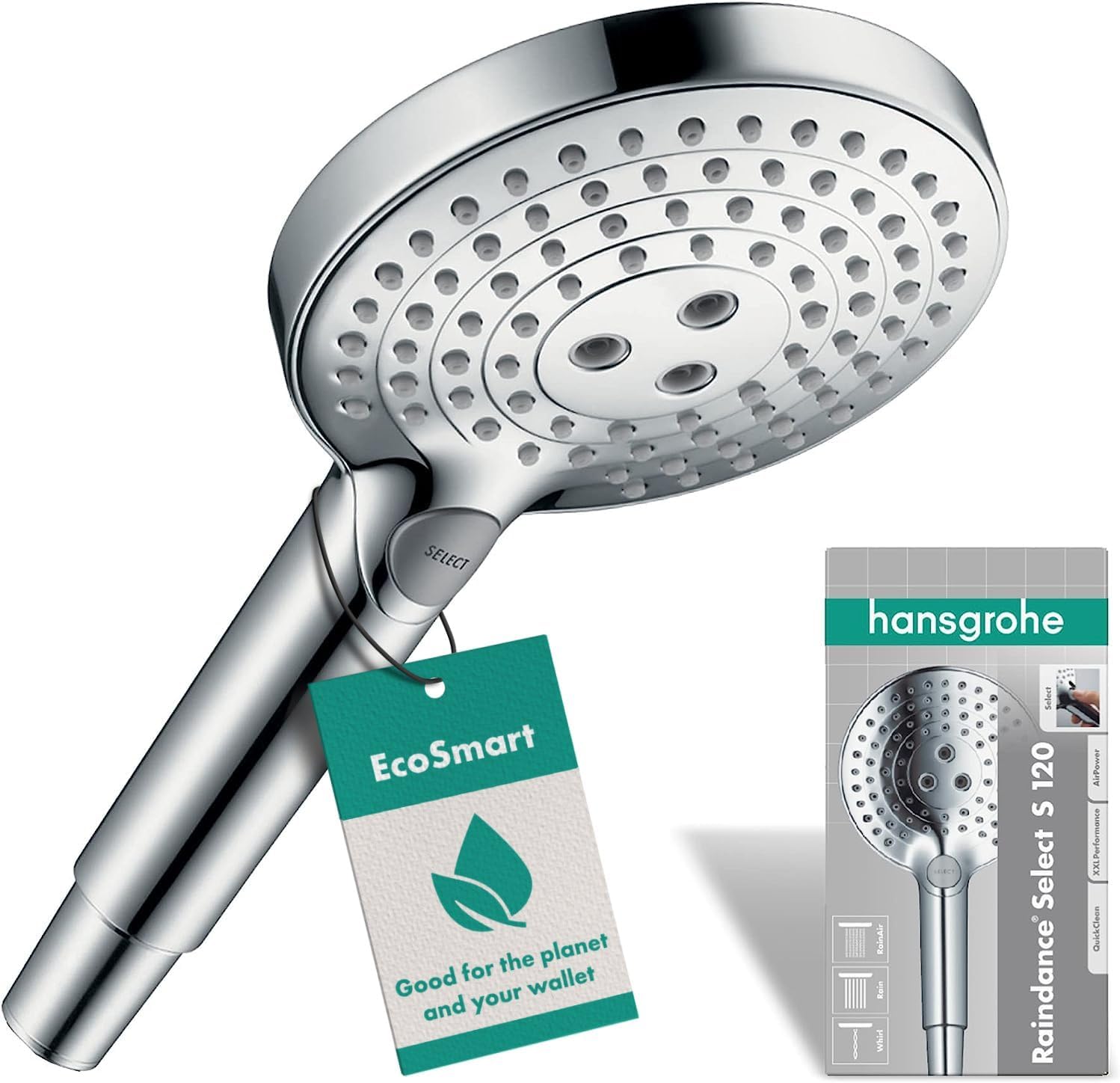
Hansgrohe Raindance Select S 150
The Raindance Select S 150's 6-inch spray face is the defining feature. Three spray modes — RainAir (full coverage with aerated flow), PowderRain (fine mist for a gentler feel), and Whirl (pulsed massage) — all perform well at pressures above 50 PSI. The EcoRight flow restrictor holds it to 1.75 GPM while Hansgrohe's AirPower technology adds air to the flow to maintain the sensation of fuller coverage. German manufacturing quality shows in the heft of the connection and the consistency of the spray pattern over years of use. The requirement: you need at least 45 PSI to get the full spray face to activate properly. Below that, PowderRain and RainAir both underperform. At the price, it's not the first choice for a guest bathroom — it earns its place in a master suite where water pressure is reliable.
Pros
- ✓6-inch spray face delivers genuine rainfall coverage
- ✓Three spray modes including fine mist and massage
- ✓AirPower technology maintains spray richness at 1.75 GPM
- ✓60-year German manufacturing heritage with proven durability record
Cons
- ✗Needs at least 45 PSI to perform properly — problematic in low-pressure homes
- ✗Significantly more expensive than Kohler or Delta equivalents
Score breakdown
| Flow rate | 1.75 GPM (6.6 L/min) |
| Spray settings | 3 spray modes |
| Type | fixed |
| Finish | Chrome (also offered in Brushed Nickel and FinishPlus Matte Black/Matte White) |
| Mount | Wall mount / overhead (requires separately purchased shower arm) |

Moen Engage Magnetix 26100
The Engage Magnetix 26100 is the most complete handheld showerhead package in the mid-range US market. Six spray settings (rinse, massage, jet, mist, combination, and pause) on a 2.5 GPM flow rate — above WaterSense threshold, so not California-compliant, though a 1.75 GPM restrictor kit is available separately. The Magnetix docking system works: the handheld snaps into the mount firmly and releases with a single twist. Spot Resist brushed nickel finish genuinely resists fingerprints and water spots better than polished chrome. The hose is 69 inches, which is long enough for most adults to use at floor level for bathing children or pets. Moen's Lifetime Limited Warranty covers finish and function. Where it loses to the Delta: the magnetic dock is a newer design with a slightly less established long-term track record, and at 2.5 GPM it's not compliant with California, Colorado, or Washington state regulations without the optional restrictor.
Pros
- ✓Six spray modes covering full rinse through targeted jet
- ✓Magnetix dock snaps handheld securely with one-handed release
- ✓69-inch hose accommodates floor-level bathing use
- ✓Spot Resist finish measurably reduces water spots and fingerprints
- ✓Moen Lifetime Limited Warranty on finish and function
Cons
- ✗2.5 GPM not California/Colorado/Washington compliant — requires optional 1.75 GPM kit
- ✗Magnetic dock is newer design with less long-term track record than Delta's
Score breakdown
| Flow rate | 1.75 GPM |
| Spray settings | 6 functions (wide coverage, downpour, relaxing massage, massage, soothing massage, rinse) |
| Type | handheld |
| Finish | Chrome (also offered in Spot Resist Brushed Nickel and Matte Black) |
| Mount | Handheld with Magnetix magnetic docking + wall holding bracket; 60 in metal hose included |
Which one is right for you?
For households wanting reliable everyday performance at a fair price
Kohler Forte Single-Function Showerhead
The Kohler Forte's Katalyst air-induction system delivers a noticeably full spray at 2.0 GPM without complex installation.
For renters or anyone who wants a fixed and handheld option without replumbing
Delta In2ition Two-in-One Shower
The In2ition magnetically docks a handheld unit onto a fixed head — one valve, two shower modes, no extra plumbing.
For bathrooms where the showerhead is a design statement
Hansgrohe Raindance Select S 150
The Raindance S 150's 6-inch face and triple spray modes deliver genuine rainfall coverage at a mid-premium price.
For households wanting fine bubble skin care benefits
shower-head-toto-showers-jp
TOTO's Fine Bubble technology generates micro-bubbles under 1 micron that penetrate pores — the only pick here with a certified skin-care function.
For anyone prioritizing handheld flexibility with a magnetic dock
Moen Engage Magnetix 26100
The Engage Magnetix snaps back into its dock hands-free with six spray settings covering everything from mist to power jet.
How we compared these shower heads
No controlled spray-booth testing here. Measuring actual GPM output under controlled water pressure, spray-pattern coverage at different PSI levels, and mineral scale build-up rates across different water hardness levels needs lab equipment most reviewers don't have. What this comparison does instead: cross-reference each manufacturer's certified flow-rate data against independently reported installation experiences, check thread compatibility documentation for both US (NPT 1/2-inch) and Japanese (G1/2 ISO) standards, and pull long-term verified buyer reviews to surface real maintenance complaints.
The most important pre-purchase check that most buyers skip: measure your home's static water pressure. Below 40 PSI, most showerheads deliver a disappointing trickle even at rated GPM — the Hansgrohe Raindance in particular needs at least 45 PSI to fill its 6-inch face. Above 80 PSI, you likely need a pressure-reducing valve upstream or you will shorten the lifespan of every valve in the head. A $15 gauge from a hardware store screwed onto a hose bib gives you the number in 30 seconds.
What changed in 2026
The tightening of water efficiency standards is the dominant story in the US showerhead market in 2026. The federal WaterSense maximum of 2.0 GPM, already in place, has been joined by state-level restrictions: California and Colorado now mandate 1.5 GPM for new construction, and several northeast states are moving toward 1.5 GPM as the general ceiling. Manufacturers are responding with aggressive air-induction and pressure-compensation engineering to maintain perceived spray strength at lower flow rates — the Kohler Forte's Katalyst system and the Hansgrohe AirPower are both direct responses to this regulatory pressure.
Another significant change is the mainstream adoption of fine bubble (micro-bubble and ultra-fine bubble) technology. TOTO's Fine Bubble showerhead, which generates bubbles smaller than 1 micron, crossed into serious consumer awareness in 2024–2025 on the back of dermatological endorsements and influencer coverage on Instagram and YouTube. The technology's core claim — that ultra-fine bubbles penetrate the outer skin layer to lift sebum and dead cells — is supported by peer-reviewed dermatology research, which distinguishes it from the marketing-only claims attached to most wellness shower accessories. The premium over a standard showerhead is significant but the category is now clearly established.
Magnetic docking for combination fixed/handheld units has gone from a novelty to a mainstream expectation in the mid-price US market. Both Delta and Moen now offer it across multiple models. The convenience is real — the handheld snaps back into the cradle one-handed without looking — but the long-term durability of the magnetic assembly under daily use and mineral scale accumulation varies between brands. Delta's magnetic dock has an older track record and fewer reported failure points than Moen's newer implementation.
Where each showerhead fits
The Kohler Forte belongs in any bathroom where reliability and simplicity are the priority. Fixed installation, straightforward chrome or brushed nickel finish, and the Katalyst air-induction system that genuinely delivers a fuller spray than you'd expect at 2.0 GPM. There is no handheld component, no spray-mode complexity beyond the single function — and that's the point. The Forte is the showerhead you install once, forget about for ten years, and descale annually with a bag of white vinegar. Its weakest point is coverage: the 2.5-inch spray face is smaller than the Hansgrohe or TOTO, and the spray is concentrated rather than broad.
The Delta In2ition occupies a practical engineering niche: it puts a handheld unit into a fixed-head package without requiring a diverter valve or separate plumbing. One water supply, one installation point, and you choose at the showerhead whether to use the full fixed spray, just the handheld, or both simultaneously. The 1.75 GPM combined rate is WaterSense compliant, the magnetic dock is robust, and the five spray modes on the handheld cover the range from soak to massage. Where it struggles: the combined flow when running both fixed and handheld simultaneously is split from the single supply, so you get less pressure from each than you would from a dedicated head. At high pressure (above 65 PSI), the flow restrictor in the fixed-head section can create an uneven spray.
The Hansgrohe Raindance Select S 150 is the premium-bathroom pick. The 6-inch spray face, three spray modes (RainAir full coverage, PowderRain fine mist, and Whirl massage), and Hansgrohe's 60-year German manufacturing history make it the easiest recommendation for anyone refitting a master bathroom. The EcoRight flow restrictor keeps it at 1.75 GPM for US compliance. Its weakness is installation sensitivity: below 45 PSI static pressure, the PowderRain and RainAir modes don't fully pressurize and the spray pattern becomes patchy. It also costs more than twice what the Forte does, and the finish options are limited to chrome, brushed nickel, and matte black.
Verdict
For most US households on standard municipal water (50–70 PSI, moderate hardness), the Kohler Forte is the non-overthought correct answer. It installs in minutes, the Katalyst spray feels stronger than its 2.0 GPM suggests, and the chrome finish is easy to keep scale-free with periodic vinegar soaking. The Moen Engage Magnetix is the right step up if you want handheld flexibility without running a second supply line.
The Delta In2ition is the best choice for households where multiple people with different height preferences share a shower, or where a handheld is needed for bathing children or pets without a separate installation. It solves a real problem elegantly. The Hansgrohe Raindance justifies its price only when the bathroom is a deliberate design space and water pressure is reliably above 50 PSI.
The TOTO Fine Bubble showerhead is not a luxury — the dermatological evidence for micro-bubble skin cleansing is real enough that it deserves serious consideration. The thread adapter from G1/2 (Japanese standard) to NPT 1/2-inch is widely available if you're importing, though the reverse — getting a US-spec Kohler or Delta to work on a Japanese shower arm — requires careful adapter selection to avoid leaks.