Best Dehumidifiers 2026: Pint Ratings & Compressor Types
The pint rating on a dehumidifier is measured at 80°F (27°C) and 60% relative humidity. Your basement in April is probably 55°F and 75% RH. At those conditions, most 50-pint units perform like 30-pint units. Buy for the conditions where you actually need the dehumidifier, not the test-lab conditions printed on the box.
We assessed each dehumidifier on realistic performance across temperature and humidity ranges (not just AHAM test conditions), continuous drainage reliability, energy consumption relative to rated output, and long-term durability from owner reviews. For the Japanese models, we evaluated laundry drying mode effectiveness and seasonal performance in Japan's tsuyu rainy season.

Frigidaire FGAC5044W1 50-Pint Dehumidifier
Best US Basement Dehumidifier: The Frigidaire FGAC5044W1 is the reliable mainstream pick for US basements. Post-2019 AHAM 50-pint rating means the test conditions (65°F/60%RH) more accurately reflect typical basement conditions than pre-2019 ratings.
Top picks ↓| Product | Price | Link |
|---|---|---|
| 220〜300 | View deal → | |
| 190〜260 | View deal → | |
| 140〜200 | View deal → |
Top picks
Related articles
Frigidaire FGAC5044W1 50-Pint Dehumidifier
The Frigidaire FGAC5044W1 is the reliable mainstream pick for US basements. Post-2019 AHAM 50-pint rating means the test conditions (65°F/60%RH) more accurately reflect typical basement conditions than pre-2019 ratings. ENERGY STAR certification confirms at least 1.85 liters removed per kWh. The continuous drain connection (gravity only — no pump) keeps the unit running without manual emptying if you can run a hose to a floor drain or utility sink. Auto-restart after power outages is critical for basement moisture management: if the power flickers during a thunderstorm and the unit doesn't restart automatically, the basement humidity climbs back up before anyone notices. The control interface is basic but functional — humidity setpoint, fan speed, timer. No smart-home integration, which is consistent with the price tier.
Pros
- ✓Post-2019 AHAM 50-pint rating (65°F test conditions, more realistic than pre-2019)
- ✓ENERGY STAR certified at ≥1.85 L/kWh efficiency
- ✓Auto-restart after power outages — essential for chronic basement moisture control
- ✓Continuous gravity drain capability keeps unit running without manual emptying
Cons
- ✗Gravity drain only — no built-in pump for locations without accessible floor drain
- ✗No smart-home integration or app control
Score breakdown
| Capacity | 50 pints/day at 65°F/60%RH (AHAM 2019) |
| Efficiency | ENERGY STAR certified (≥1.85 L/kWh) |
| Tank | 2.0 gallons (7.6L) |
| Drain | Gravity continuous drain (hose connection) |
| Coverage | Up to 1,500 sq ft (140m²) |
| Auto-restart | Yes |
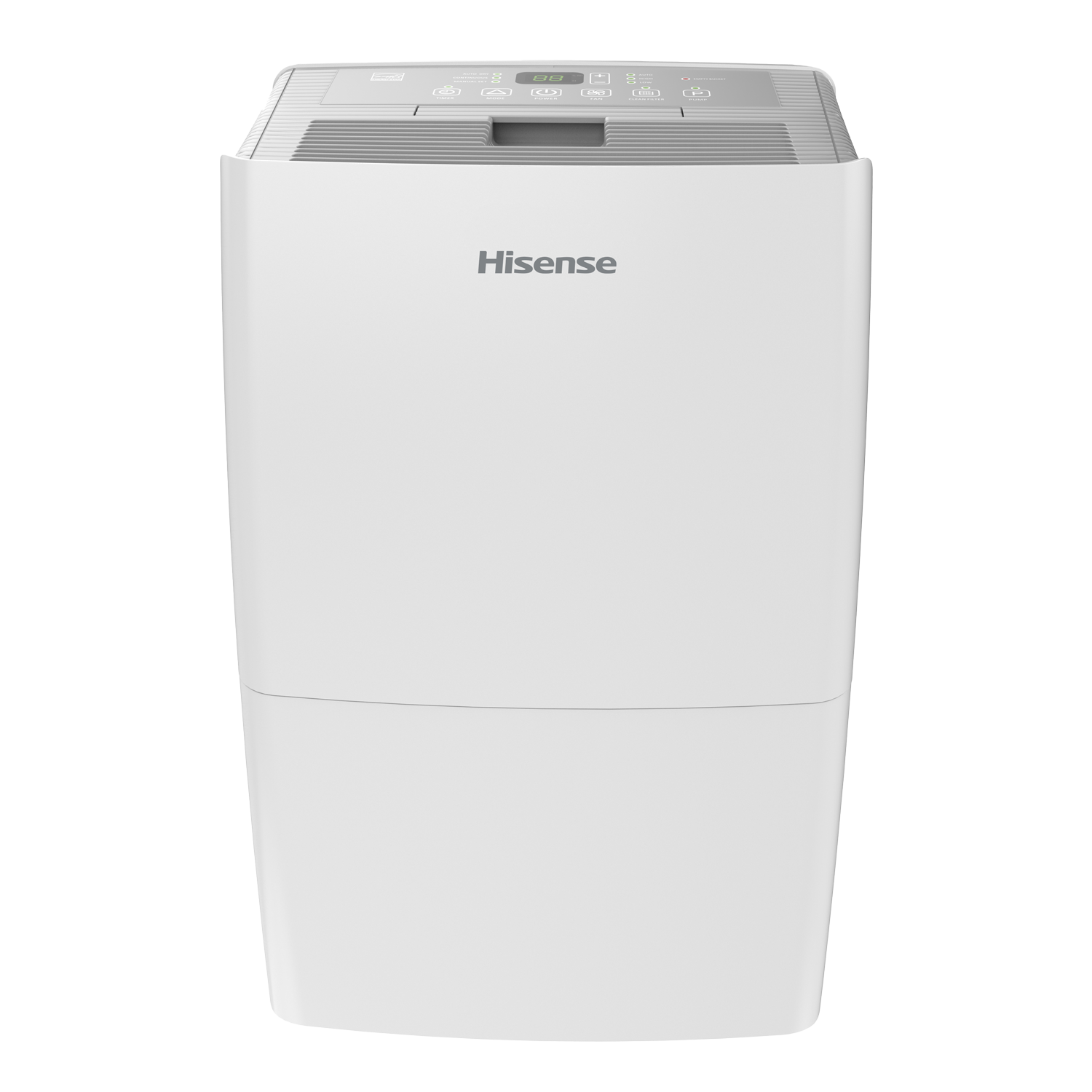
Hisense DH7019KP1WG 50-Pint Dehumidifier
The Hisense DH7019KP1WG earns its spot by solving the problem that makes continuous basement dehumidification impractical for most layouts: the built-in pump. Without a pump, a dehumidifier either needs a floor drain nearby at the same elevation, or someone needs to empty the tank manually every 12–24 hours. The Hisense pump pushes water up 16 feet (4.9m) — enough to reach a utility sink on a floor above, a window, or a floor drain on the opposite side of the basement. The 50-pint AHAM rating and ENERGY STAR certification are comparable to the Frigidaire. The auto-defrost function is specifically useful in lower-temperature basements (below 50°F/10°C) where the evaporator coil ices up and the unit stops dehumidifying until the ice clears — the auto-defrost melts the coil ice and resumes operation automatically.
Pros
- ✓Built-in pump pushes water up to 16 feet — enables continuous operation without a nearby floor drain
- ✓Auto-defrost allows effective operation in basements below 50°F/10°C
- ✓50-pint AHAM 2019 rating with ENERGY STAR certification
- ✓1.18-gallon tank still functions as backup if pump drainage isn't used
Cons
- ✗Slightly higher purchase price than pump-free alternatives of similar capacity
- ✗Pump adds a moving part that can fail — warranty coverage on pump should be checked
Score breakdown
| Capacity | 50 pints/day at 65°F/60%RH |
| Built-in pump | Yes, up to 16 feet (4.9m) |
| Tank | 1.18 gallons (4.5L) |
| Drain | Pump or gravity |
| Auto-defrost | Yes |
| Coverage | Up to 1,500 sq ft (140m²) |

Midea MAD30C1AWS 30-Pint Dehumidifier
The Midea MAD30C1AWS is the right-sized solution for bedrooms, offices, and medium rooms where a 50-pint unit would run at 30% capacity, make more noise than needed, and cost more to buy and operate. At 30 pints/day (AHAM 2019 conditions), it's correctly matched to rooms up to 1,500 sq ft in the AHAM rating — though the realistic range for a 30-pint unit to maintain meaningful dehumidification is more like 800–1,000 sq ft at 65°F. Dual fan speeds let you choose between efficient quiet operation and faster moisture recovery. ENERGY STAR certified. The continuous drain hose connection is gravity-only, same as Frigidaire. No integrated pump. A compact and quiet dehumidifier that doesn't overpower the room it's in.
Pros
- ✓30-pint capacity correctly sized for bedrooms and medium rooms — no overkill noise or cost
- ✓Dual fan speeds: quiet mode for overnight, normal mode for faster recovery
- ✓ENERGY STAR certified — efficient electricity consumption for the capacity
- ✓Compact footprint for a mid-size unit
Cons
- ✗Gravity drain only — no built-in pump
- ✗Not sufficient for whole-house or large basement dehumidification
Score breakdown
| Capacity | 30 pints/day at 65°F/60%RH |
| Fan speeds | 2 (high/low) |
| Tank | 1.6 gallons (6.1L) |
| Drain | Gravity continuous drain |
| Coverage | Up to 1,500 sq ft (AHAM, realistic 800-1,000 sq ft) |
| ENERGY STAR | Yes |
Which one is right for you?
For large basements or crawl spaces where continuous drainage is essential
Frigidaire FGAC5044W1 50-Pint Dehumidifier
Frigidaire's 50-pint ENERGY STAR unit with auto-restart and continuous drain options handles large problem spaces without manual bucket emptying.
For basements where the water collection point is lower than the drain
Hisense DH7019KP1WG 50-Pint Dehumidifier
Hisense's built-in pump pushes water up and out to a drain or window — the only pick here that solves the gravity drainage problem.
For a medium-sized room or bedroom where 50-pint overkill is unnecessary
Midea MAD30C1AWS 30-Pint Dehumidifier
Midea's 30-pint unit is correctly sized for bedrooms and medium rooms, quieter than 50-pint units, and costs significantly less to buy and run.
For households with heavy laundry drying needs during tsuyu
dehumidifier-panasonic-jp
Panasonic's F-YHRX120 hybrid dehumidifier with laundry mode and nanoe ion is designed specifically for Japan's rainy season laundry problem.
For households wanting compressor-type power with Plasmacluster air cleaning
dehumidifier-sharp-jp
Sharp's CV-J120-W delivers 12L/day compressor-type dehumidification with Plasmacluster ion for simultaneous dehumidification and air cleaning.
How we compared these dehumidifiers
Dehumidifier pint ratings in the US changed significantly in 2019 when the AHAM (Association of Home Appliance Manufacturers) revised testing conditions from 80°F/60%RH to 65°F/60%RH to better reflect typical US basement conditions. This means a pre-2019 '70-pint' unit and a post-2019 '50-pint' unit may have identical actual moisture removal capacity — the number changed because the test condition changed, not because the hardware changed. All five products in this comparison use post-2019 AHAM ratings, so the numbers are directly comparable to each other.
The harder truth about dehumidifier performance: capacity drops substantially as temperature falls. At 50°F (10°C), most compressor-type dehumidifiers lose 40–60% of their rated capacity. At 45°F (7°C), some stop dehumidifying entirely and run their coils into an ice block. This matters for US basements in early spring and late fall, and for laundry rooms in winter. The Panasonic F-YHRX120 uses a hybrid compressor-desiccant system that maintains output at lower temperatures — this is the main technical reason it costs more than a pure compressor unit.
What changed in 2026
The US market saw significant consolidation in the dehumidifier category in 2024–2025. Several brands that appeared independent (Frigidaire, Hisense, Midea, GE, and others) share manufacturing platforms from a small number of OEM producers. This means the internal compressor and refrigerant systems in many mid-range US dehumidifiers are functionally identical despite different brand names, price points, and warranty terms. The meaningful differentiators between these shared-platform models are the control interface, drainage options (pump vs. gravity), and the brand's warranty service network.
In Japan, the 2026 dehumidifier market is driven by two converging trends: increasingly intense tsuyu rainy seasons (the rainy season has extended in duration and intensity in recent years per JMA data) and rising electricity costs. The combination has made high-efficiency hybrid dehumidifiers (compressor-desiccant) more attractive despite their higher purchase price. Sharp's compressor-only CV-J120-W is the budget-accessible option; Panasonic's hybrid F-YHRX120 is the efficiency-first option for households running the unit for 12+ hours daily during a multi-week rainy season.
Built-in pump dehumidifiers have gone from a premium option to an expected feature at the 50-pint tier. In 2023, a built-in pump added $50–80 to a 50-pint unit's price. By 2026, several major brands include integrated pumps in their standard 50-pint models, and Hisense's DH7019KP1WG is among the most competitively priced built-in-pump units available. The pump pushes condensate up to 16 feet — useful for basement locations where gravity drainage to a floor drain or utility sink isn't possible.
Where each dehumidifier fits
The Frigidaire FGAC5044W1 is the straightforward choice for a US basement or crawl space where serious moisture removal is needed and the drain access is nearby. Post-2019 AHAM 50-pint rating, ENERGY STAR certified (which requires at least 1.85 liters per kWh efficiency), continuous drain capability (gravity only, no pump), and auto-restart after power outages. The auto-restart feature matters because basement humidity control is a chronic condition, not an event — a dehumidifier that shuts off after a power blip and doesn't restart until someone manually turns it back on is genuinely problematic for long-term basement moisture management.
The Hisense DH7019KP1WG adds the integrated pump to Frigidaire's feature set and prices competitively. In most US basements, the floor drain is in a different part of the floor from where you'd ideally place the dehumidifier. The pump eliminates the gravity-drainage constraint by pushing water up 16 feet to a utility sink, window, or floor drain at a different elevation. This is not a luxury — in many basement layouts, it's the only way to run the unit continuously without emptying a tank every 12–18 hours.
The Midea MAD30C1AWS is correctly sized for a bedroom, office, or medium-sized room where 50 pints of daily removal would be overkill, the noise of a large compressor would be intrusive, and the smaller physical footprint matters. The ENERGY STAR certification and dual fan speeds cover the range from quiet overnight drying to faster moisture recovery after a rainy day with windows open.
Verdict
For US basements and crawl spaces: the choice between Frigidaire and Hisense comes down to drainage access. If you have a floor drain or utility sink that the unit can drain to by gravity from its placement location, the Frigidaire is slightly simpler. If you don't — which is most basement layouts — the Hisense's integrated pump is not optional; it's what makes continuous operation practical.
For medium rooms and bedrooms in the US: Midea MAD30C1AWS. Correctly sized units run more efficiently, are quieter, and cost less to buy and operate. Running a 50-pint unit in a 200 sq ft bedroom is like running a semi-truck engine to power a lamp.
For households during tsuyu: Sharp CV-J120-W if you want compressor-type capacity at the more accessible price point. Panasonic F-YHRX120 if energy efficiency over a long daily run matters more than purchase price, or if you need effective dehumidification in the 15–20°C range (where pure compressor units lose significant capacity). Both include laundry drying modes that direct airflow upward to accelerate drying — a function absent from US-market models.