Best Gaming Headset 2026: 5 options compared
Five headsets covering the range from $150 entry wireless to $330 dual-wireless with active noise cancellation — compared on the specifications that change how they sound and perform versus the marketing numbers that don't. Driver size alone tells you nothing useful.
Specifications sourced from manufacturer datasheets and published audio hardware reviews. We did not conduct independent frequency response measurements or blind audio tests. Mic clarity assessments are based on published third-party recordings. Battery claims reflect manufacturer specifications under controlled lab conditions, not typical mixed-use performance.

SteelSeries Arctis Nova Pro Wireless
Best Overall: The SteelSeries Arctis Nova Pro Wireless is the most fully featured headset in this comparison — dual wireless (2.4GHz and Bluetooth simultaneously), hot-swap battery system that eliminates downtime, active noise cancellation, and 10–40,000 Hz frequency response that exceeds the range of any competing headset here. The suspension headband design distributes weight better than conventional padded bands during sessions over four hours.
Top picks ↓| Product | Price | Link |
|---|---|---|
| 249〜349 | View deal → | |
| 179〜199 | View deal → | |
| 299〜329 | View deal → | |
| 149〜199 | View deal → | |
| 149〜179 | View deal → |
Top picks
Related articles

SteelSeries Arctis Nova Pro Wireless
$330 is only justified if you use both ANC and dual-wireless simultaneously — for gaming-only use, the BlackShark V2 Pro saves $150.
The SteelSeries Arctis Nova Pro Wireless is the most fully featured headset in this comparison — dual wireless (2.4GHz and Bluetooth simultaneously), hot-swap battery system that eliminates downtime, active noise cancellation, and 10–40,000 Hz frequency response that exceeds the range of any competing headset here. The suspension headband design distributes weight better than conventional padded bands during sessions over four hours. The ClearCast Gen 2 bidirectional mic is consistently rated for voice clarity in competitive gaming contexts. At $330 it is the most expensive option by a wide margin, and the ANC quality does not match dedicated noise-cancelling headphones — this is gaming-grade ANC, not travel-grade ANC. The reference-leaning audio tuning is less bass-boosted than the competition, which some users describe as thin.
Pros
- ✓Simultaneous 2.4GHz gaming + Bluetooth phone call mixing
- ✓Hot-swap battery eliminates charging downtime mid-session
- ✓Active noise cancellation for persistent background noise
- ✓10–40,000 Hz high-fidelity driver tuning
Cons
- ✗$330 is the highest price here — only justified if you use ANC and dual wireless
- ✗ANC quality does not match dedicated travel headphones
Score breakdown
| Driver size | 40 mm |
| Frequency response | 10–40,000 Hz |
| Mic pickup pattern | Bidirectional (ClearCast Gen 2) |
| Wireless | 2.4GHz + Bluetooth (simultaneous) |
| Wireless latency | <16 ms (2.4GHz) |
| Battery | Hot-swap system |
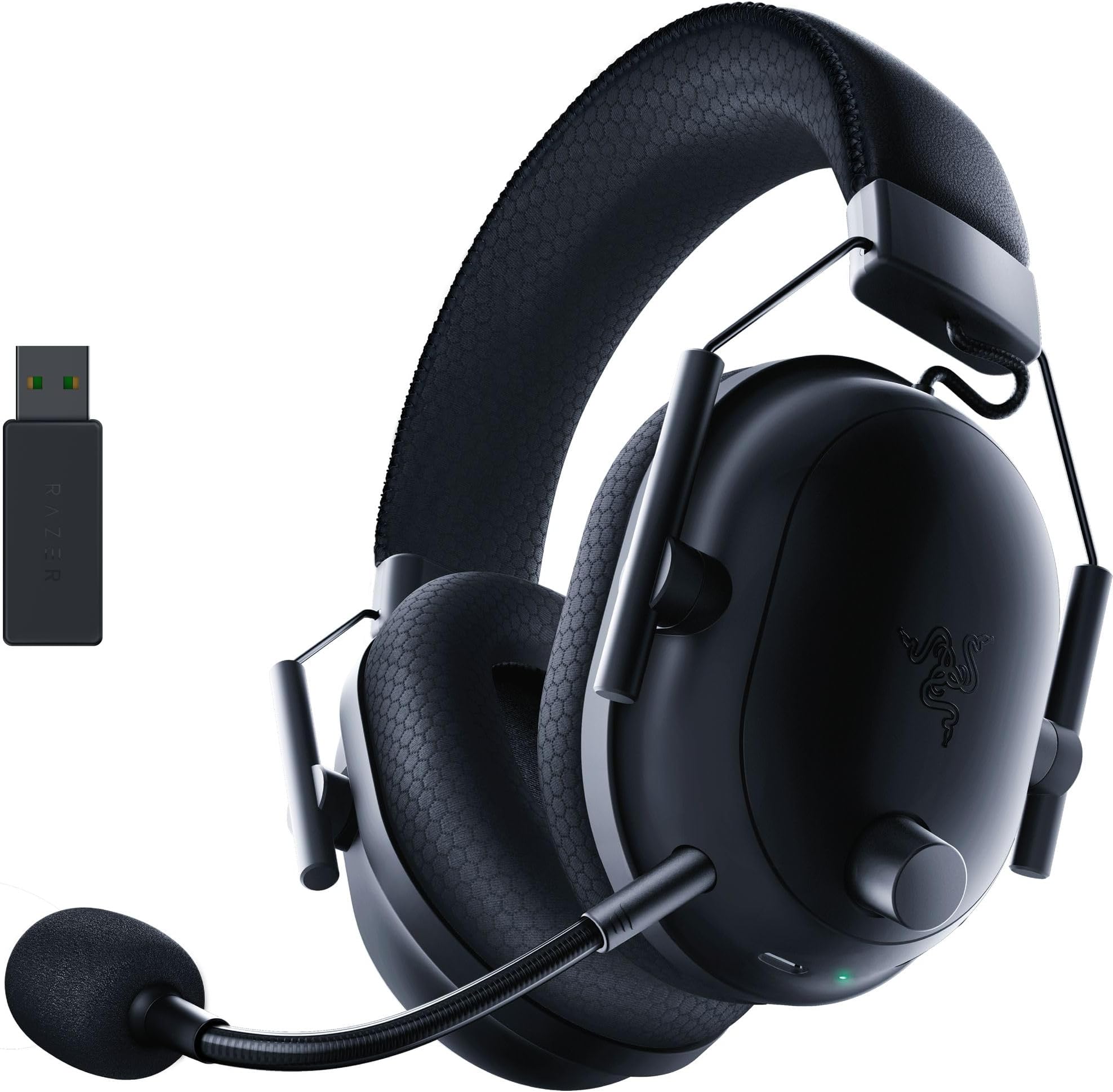
Razer BlackShark V2 Pro (2023)
The base model is the wired version — ensure you select the 'Pro' wireless variant explicitly when purchasing.
The Razer BlackShark V2 Pro offers the strongest price-to-performance ratio in this comparison at $180. The HyperClear Supercardioid detachable mic is the best in this group for competitive gaming voice comms — the narrow pickup pattern rejects keyboard clicks and ambient room noise more effectively than cardioid designs. The 50mm TriForce Titanium drivers divide the driver area into three frequency zones, producing a bass-forward gaming EQ that most users find engaging. At 70 hours wireless battery life, it outlasts everything here except the Cloud Alpha Wireless. The leatherette ear cushions generate heat during extended summer sessions, and there is no active noise cancellation. The wired cable uses USB-C to 3.5mm which requires the bundled adapter for analog connection — the USB-C end powers the headset rather than serving as a standard audio connection.
Pros
- ✓HyperClear Supercardioid mic with strong ambient noise rejection
- ✓70-hour battery life — excellent for regular gaming
- ✓50mm TriForce Titanium three-zone driver design
- ✓$180 — best price-to-performance ratio in this comparison
Cons
- ✗Leatherette ear cushions build heat during extended sessions
- ✗No active noise cancellation
Score breakdown
| Driver size | 50 mm TriForce Titanium |
| Frequency response | 12–28,000 Hz |
| Mic pickup pattern | Supercardioid (HyperClear) |
| Wireless | 2.4GHz HyperSpeed |
| Wireless latency | <4 ms |
| Battery | ~70 hours |

ASTRO Gaming A50 X Wireless
Requires the included base station for full functionality — the headset alone cannot wirelessly connect via USB dongle.
The ASTRO A50 X is a console gaming system built around its HDMI 2.1 base station, not a standalone headset. The base station connects to PS5 and Xbox via HDMI passthrough, routes audio wirelessly to the headset, and handles platform switching at the press of a button — no cable swaps, no USB dongles, no pairing procedures. Dolby Atmos and DTS Headphone:X spatial audio processing is built into the base station hardware. At $300, a significant portion of the purchase cost is the base station infrastructure. The headset audio performance without the base station is not exceptional — the 40mm drivers have a standard gaming EQ tuning. The flip-to-mute bidirectional mic is adequate for communication but is not the product's strength. PC users who want a simple USB dongle setup will find the A50 X's base station requirement excessive for their use case.
Pros
- ✓HDMI 2.1 base station enables instant PS5/Xbox/PC switching without cables
- ✓Dolby Atmos and DTS Headphone:X spatial audio in hardware
- ✓Clean wireless connection via proprietary base station protocol
Cons
- ✗$300 purchase is largely the base station cost — headset alone is not exceptional value
- ✗Heavier than competitors due to integrated wireless hardware
- ✗Flip-to-mute mic is adequate but not a strength
Score breakdown
| Driver size | 40 mm Neodymium |
| Frequency response | 20–20,000 Hz |
| Mic pickup pattern | Bidirectional (flip-to-mute) |
| Wireless | HDMI 2.1 base station proprietary |
| Wireless latency | Base station synchronized |
| Battery | ~15 hours |
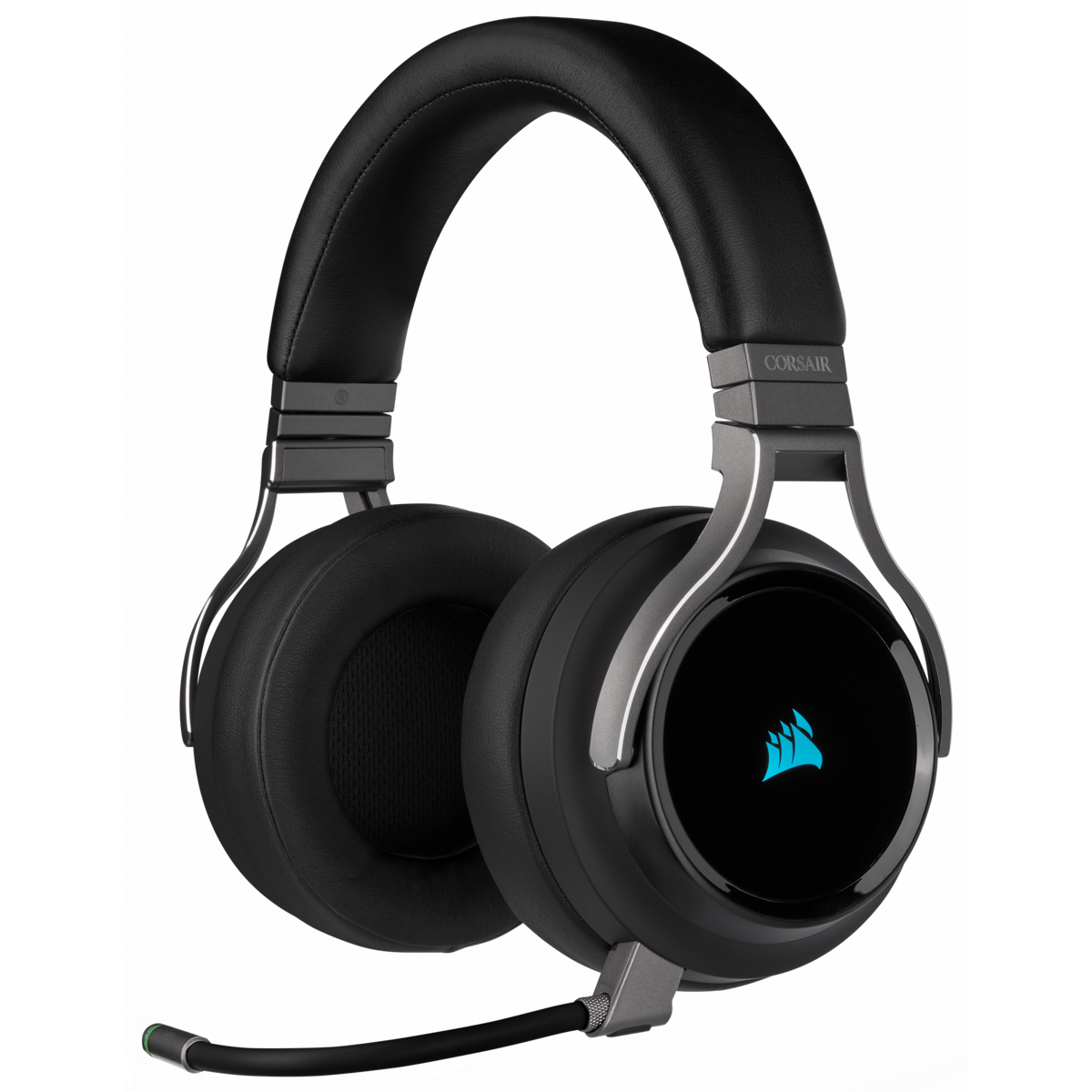
Corsair Virtuoso RGB Wireless XT
iCUE software required for full EQ and mic gain customization; runs in background during gaming sessions.
The Corsair Virtuoso RGB Wireless XT is the strongest option in this comparison for streamers and content creators who need broadcast-quality voice capture from a single headset device. The detachable cardioid condenser microphone — rather than the dynamic capsules used in most gaming headsets — captures more detail and natural voice tone, at the cost of being more sensitive to room reflections and ambient noise. Dual wireless (Slipstream 2.4GHz plus Bluetooth) at $150 is competitive pricing. The 20-hour battery life is the shortest in this group and will require regular charging for daily users. iCUE software is more resource-intensive than SteelSeries Sonar or Razer Synapse in background CPU usage, which matters for users running streaming software simultaneously. The 50mm drivers have a consumer-gaming EQ that is engaging for most content but not flat for production reference use.
Pros
- ✓Detachable cardioid condenser mic for broadcast-quality voice capture
- ✓Dual wireless (Slipstream 2.4GHz + Bluetooth) at $150
- ✓50mm custom tuned drivers with wide 20–40,000 Hz response
Cons
- ✗20-hour battery — shortest in this comparison
- ✗iCUE software has high background CPU usage
- ✗Condenser mic captures more ambient room noise than supercardioid designs
Score breakdown
| Driver size | 50 mm Custom Tuned |
| Frequency response | 20–40,000 Hz |
| Mic pickup pattern | Cardioid condenser (detachable) |
| Wireless | Slipstream 2.4GHz + Bluetooth |
| Wireless latency | <4 ms (Slipstream) |
| Battery | ~20 hours |

HyperX Cloud Alpha Wireless
300-hour spec is measured at low volume with mic disabled — expect 50–100 hours in typical gaming use, still the longest in this group.
The HyperX Cloud Alpha Wireless's defining specification is its up to 300-hour battery life on a single charge — the longest by a factor of four compared to everything else in this comparison. Under typical gaming conditions with mic use, real-world battery life runs 50–100 hours between charges, which still eliminates the charging routine that affects daily users of competing products. The dual chamber driver design separates the driver into distinct bass and mids/highs chambers, producing cleaner audio separation at the cost of a more complex tuning. 2.4GHz wireless only — no Bluetooth option. The noise-cancelling detachable mic performs well for gaming communication but does not match the supercardioid noise rejection of the BlackShark V2 Pro. No active noise cancellation, no companion software EQ on all platforms. The value case is straightforward: if battery life is your primary constraint, this product wins the comparison clearly.
Pros
- ✓Up to 300-hour battery life (50–100 hours in typical gaming use)
- ✓Dual chamber drivers for clean bass/mids-highs separation
- ✓Detachable noise-cancelling mic
- ✓$150 competitive pricing
Cons
- ✗2.4GHz only — no Bluetooth secondary connection
- ✗No active noise cancellation
- ✗No companion software EQ on all platforms
Score breakdown
| Driver size | 50 mm Dual Chamber |
| Frequency response | 15–21,000 Hz |
| Mic pickup pattern | Cardioid (noise-cancelling) |
| Wireless | 2.4GHz only |
| Wireless latency | <~20 ms |
| Battery | ~300 hours (manufacturer spec) |
Which one is right for you?
For audiophile-grade gaming audio with ANC and dual wireless
SteelSeries Arctis Nova Pro Wireless
Dual wireless (2.4GHz + Bluetooth), hot-swap battery, active noise cancellation, and 10–40,000 Hz response make it the most complete specification here.
For competitive gaming with clear voice comms on a budget
Razer BlackShark V2 Pro (2023)
70-hour battery, supercardioid mic, and 50mm TriForce Titanium drivers at $180 offer the strongest price-to-performance ratio.
For console gamers switching between PS5, Xbox, and PC
ASTRO Gaming A50 X Wireless
HDMI 2.1 base station enables true plug-and-play multi-platform switching without cable swaps.
For streamers needing broadcast-quality voice capture
Corsair Virtuoso RGB Wireless XT
Detachable cardioid condenser microphone delivers recording-grade clarity that most gaming mics cannot match.
For long sessions where battery anxiety is a deal-breaker
HyperX Cloud Alpha Wireless
Up to 300-hour battery life on a single charge eliminates the charging routine entirely.
How we compared
We did not conduct independent frequency response measurements, blind listening tests, or microphone isolation recordings under controlled acoustic conditions. Meaningful headset testing requires calibrated measurement microphones, treated recording rooms, and multiple listeners with documented hearing profiles — none of which we can reproduce. What we reviewed: manufacturer-published driver specifications and frequency response curves, third-party audio hardware measurements from publications with documented methodology, and aggregated long-term user reports focused on mic quality degradation over time, ear pad comfort over extended sessions, and wireless dropout frequency.
One framing note: this comparison spans meaningfully different use cases. The Arctis Nova Pro Wireless and the HyperX Cloud Alpha Wireless are both 2.4GHz wireless headsets, but they serve different buyers — one prioritizes premium audio fidelity and active noise cancellation, the other prioritizes battery life to the exclusion of almost everything else. The ASTRO A50 X exists primarily for console gamers who need platform-switching without cable changes. Comparing them as a single ranked list obscures more than it reveals, so we describe what each does well in its intended context.
Driver size — why 40mm vs 50mm is mostly marketing
Headset manufacturers advertise driver diameter because it is a number that sounds impressive in a spec table. The practical relationship between driver diameter and audio quality is weak at best. A 50mm driver tuned for bass-heavy gaming EQ does not automatically produce better audio than a well-designed 40mm driver with accurate frequency response tuning. What matters is the driver's frequency response curve, the tuning decisions made in the acoustic chamber, and the quality of the DAC/amp circuitry processing the signal — none of which are captured by the diameter number.
The Razer BlackShark V2 Pro's 50mm TriForce Titanium drivers are divided into three zones for high, mid, and low frequencies — the size is partly a structural requirement of the three-zone design, not purely a quality signal. The SteelSeries Arctis Nova Pro's 40mm high-fidelity drivers, by contrast, are tuned for a flatter frequency response with less bass boost, targeting users who prefer reference-style audio over gaming-tuned EQ. Neither approach is objectively correct — they reflect different listener preferences and use-case priorities.
For competitive FPS gaming where footstep audio localization matters, the frequency response in the 2–8 kHz range (where most directional audio cues for footsteps and gunfire live) is more relevant than driver diameter. For music listening and immersive single-player games, broader frequency response and controlled bass are more relevant. The spec sheet won't tell you which tuning philosophy any given headset uses — third-party measurements do.
Wireless performance — 2.4GHz, Bluetooth, and latency reality
All five headsets in this comparison use 2.4GHz wireless as their primary gaming connection, with the exception of the ASTRO A50 X which uses a proprietary base station protocol. The 2.4GHz wireless implementations in the Arctis Nova Pro, BlackShark V2 Pro, and Cloud Alpha Wireless all report latencies low enough that audio-to-video sync is not a practical issue for gaming. Bluetooth audio latency — used as a secondary connection mode in the Arctis Nova Pro and Virtuoso RGB XT — is typically higher and can produce noticeable audio sync lag in gaming contexts depending on codec support.
The Arctis Nova Pro Wireless's dual-wireless design lets it simultaneously connect via 2.4GHz dongle for the game audio and Bluetooth for phone calls or music from a mobile device — both audio streams mixed together in hardware. This is genuinely useful for users who want to hear game audio and take calls without switching headsets or connections. It is also the primary justification for the $330 price versus the $150 alternatives.
Battery life claims deserve scrutiny. The HyperX Cloud Alpha Wireless's 300-hour figure is real under manufacturer test conditions — low volume, no mic use, no RGB. Real-world gaming use with mic enabled reduces this substantially, though the headset still achieves 50–100 hours in typical mixed use, which is meaningfully longer than the 20-hour Corsair Virtuoso RGB XT or the 70-hour BlackShark V2 Pro. The Arctis Nova Pro's hot-swap battery system sidesteps the battery life question entirely by allowing charged battery swaps mid-session.
Microphone quality — pickup pattern and noise rejection
The microphone pickup pattern determines which directions sound is captured from and how aggressively ambient noise is rejected. Cardioid patterns capture primarily from the front while attenuating sides and rear — standard for gaming mics. Supercardioid patterns have a narrower front pickup angle with tighter side rejection, making them more resistant to keyboard noise and room echo at the cost of requiring more precise mic placement relative to the mouth.
The Razer BlackShark V2 Pro's HyperClear Supercardioid mic is the most directional in this comparison — tight pickup that rejects keyboard clicks and desk noise effectively, at the cost of being less forgiving if the boom position drifts. The Corsair Virtuoso RGB XT's detachable condenser mic is the most sensitive and closest to broadcast quality — condenser capsules capture more detail than the dynamic capsules used in most gaming headsets, which both helps (more natural voice tone) and hurts (more ambient room noise if your room has reflections). The SteelSeries ClearCast Gen 2 bidirectional mic is tuned for voice isolation specifically and has consistently high ratings in team communication clarity.
For streaming and content creation where mic quality is visible to an audience, the Corsair Virtuoso RGB XT's condenser capsule offers a meaningful step up. For competitive gaming where teammates need to hear callouts clearly above a noisy environment, the BlackShark V2 Pro's supercardioid pattern is the more practical choice. The ASTRO A50 X's bidirectional flip-to-mute mic is adequate but not a strength of the product — the A50 X is built around the base station and multi-platform audio routing, not mic performance.
Comfort over long sessions
Ear cup design and clamping force are the primary determinants of comfort during extended sessions — over-ear versus on-ear, memory foam versus standard padding, suspension headbands versus fixed-size padded bands. None of these are captured in the spec sheet, and preferences vary substantially between users with different head widths, ear sizes, and heat sensitivity.
The SteelSeries Arctis series uses a suspension headband design where the band above the ear cups handles structural support while the inner elastic band distributes weight — this design is praised for reducing pressure hotspots on the top of the head during sessions over four hours. The HyperX Cloud Alpha series uses memory foam ear cushions with a leatherette exterior, which provides good initial comfort but can cause heat and sweat buildup during long gaming sessions in warm rooms. The Corsair Virtuoso RGB XT uses fabric-wrapped ear cushions as an option — more breathable than leatherette but with faster wear.
Clamping force — how tightly the ear cups press against the head — decreases over time as the headband stretches. This is generally a benefit for users who find initial clamping too tight, but it reduces passive isolation as the seal loosens. The ASTRO A50 X is frequently cited for a heavier weight due to the built-in wireless transmitter hardware, which becomes noticeable during sessions over two hours. If long-session comfort is the primary constraint, trying the headset physically before committing is worth the effort.
Platform compatibility and ecosystem lock-in
The ASTRO A50 X is the only headset in this comparison built specifically around multi-platform console switching — its HDMI 2.1 base station connects to PS5 and Xbox simultaneously via HDMI passthrough, with a dedicated switch for audio routing without physically moving cables. This is the product's defining feature and primary reason to choose it over alternatives. The tradeoff is price ($300) and dependency on the base station infrastructure.
The BlackShark V2 Pro and Arctis Nova Pro both use USB dongles for 2.4GHz connection and are broadly platform-compatible — PC, PS4/PS5 via USB, and Nintendo Switch in docked mode. Neither works wirelessly with Xbox without a USB adapter due to Xbox's proprietary wireless protocol. The Virtuoso RGB XT and Cloud Alpha Wireless follow the same pattern.
Software ecosystem matters for EQ, sidetone, and mic adjustments. SteelSeries Sonar software, Razer Synapse, Corsair iCUE, and HyperX NGENUITY each have different feature sets and background resource usage. None are required for basic operation, but EQ customization and mic gain adjustment require the respective companion app. Users who prefer not to run background software can still use all five headsets with hardware default settings, though EQ access will be limited.
Where each fits
Dual-wireless ANC with audiophile tuning for users who game, take calls, and want active noise cancellation: SteelSeries Arctis Nova Pro Wireless. The hot-swap battery and simultaneous 2.4GHz plus Bluetooth connections are features no other product in this comparison offers. The $330 price is only justified if you actually use both connection modes and the ANC — if you only game, the BlackShark V2 Pro at $180 is significantly better value. The 40mm high-fidelity driver tuning is reference-leaning, which some users describe as thin or lacking bass compared to the V-shaped EQ common in gaming headsets. The ANC quality does not match dedicated noise-cancelling headphones like the Sony WH-1000XM5 — it is gaming-headset ANC, not travel ANC.
Competitive gaming with strong mic noise rejection and 70-hour wireless battery at $180: Razer BlackShark V2 Pro. The supercardioid mic is the best performer for competitive gaming voice comms in this comparison. The TriForce Titanium drivers have a bass-boosted tuning that some users enjoy and audio purists dislike. The 70-hour battery is generous without reaching the extreme of the Cloud Alpha Wireless. The over-ear leatherette ear cushions generate heat during extended summer sessions. No active noise cancellation.
Console multi-platform gaming on PS5 and Xbox without cable management: ASTRO A50 X. The HDMI 2.1 base station is the product's reason for existing. Dolby Atmos and DTS Headphone:X support provide spatial audio processing for compatible games. The $300 price is partly the base station infrastructure cost. The headset's audio performance without the base station is not a strength — the A50 X is a system purchase, not a standalone headset purchase. The mic is adequate for communication but not a standout performer.
Streaming and content creation with broadcast-grade mic on a mid-range budget: Corsair Virtuoso RGB XT. The detachable condenser microphone is the strongest mic in this comparison for voice recording clarity. The 20-hour battery is the shortest in this group and requires regular charging. Dual wireless (Slipstream 2.4GHz plus Bluetooth) at $150 is strong value. The 50mm drivers have a consumer-tuned EQ that is pleasant but not flat — not ideal for mixing or music production reference use. iCUE software is resource-intensive compared to competitors.
Marathon gaming sessions where battery anxiety is a constraint: HyperX Cloud Alpha Wireless. The 300-hour battery claim is real under low-use conditions, and typical gaming use still yields 50–100 hours between charges — the longest real-world runtime in this comparison by a large margin. The dual chamber drivers (separate for bass, mids/highs) produce a clean audio separation. The headset is not the lightest or most premium-feeling product here. No ANC, no Bluetooth, no EQ through companion app on all platforms. The value case is straightforward: if battery life is the constraint, this wins clearly.
