Best Waist Trainers 2026: 5 Tested & Compared
Waist trainers are worn for two distinct reasons: core support and posture awareness during workouts, or the belief that consistent wear will permanently reduce waist circumference. The evidence supports the first use. The second is not supported by research. Five waist trainers from $28 to $85, compared honestly on what they actually do.
Waist trainers were assessed on boning type (steel vs plastic — determines structural integrity and how the garment holds shape under movement), compression level and fabric construction, core support during exercise, breathability and thermal properties, durability through repeated use, and comfort for extended wear — with explicit assessment of the claims made for each product relative to available evidence.

Squeem Perfect Waist Cincher
Best Core Support: Squeem's double steel boning (9 bones: flat steel at back, spiral steel front and sides) and natural rubber core provide the most structurally rigid compression in this comparison — functionally the closest to a flexible lifting belt for core support during compound lifts. Honest about what it does: core support and posture cue during training.
Top picks ↓| Product | Price | Link |
|---|---|---|
| 78〜92 | View deal → | |
| 48〜62 | View deal → | |
| 30〜42 | View deal → |
Top picks
Related articles
Squeem Perfect Waist Cincher
Squeem's double steel boning (9 bones: flat steel at back, spiral steel front and sides) and natural rubber core provide the most structurally rigid compression in this comparison — functionally the closest to a flexible lifting belt for core support during compound lifts. Honest about what it does: core support and posture cue during training. It does not permanently reduce waist size. The latex core makes it unbreathable; heat accumulation becomes uncomfortable after 45 minutes of vigorous exercise.
Pros
- ✓9-bone double steel boning — most structural rigidity in this comparison
- ✓Natural rubber core provides high compression return force
- ✓Hook-and-eye closure with 3 rows for adjustable compression
Cons
- ✗Latex core is not breathable — significant heat accumulation after 45 minutes
Score breakdown
| Boning | 9 steel bones (flat + spiral) |
| Core material | Natural rubber (latex) |
| Outer fabric | Cotton |
| Closure | Hook-and-eye, 3 rows |
| Compression level | High |
| Price | ~$85 |
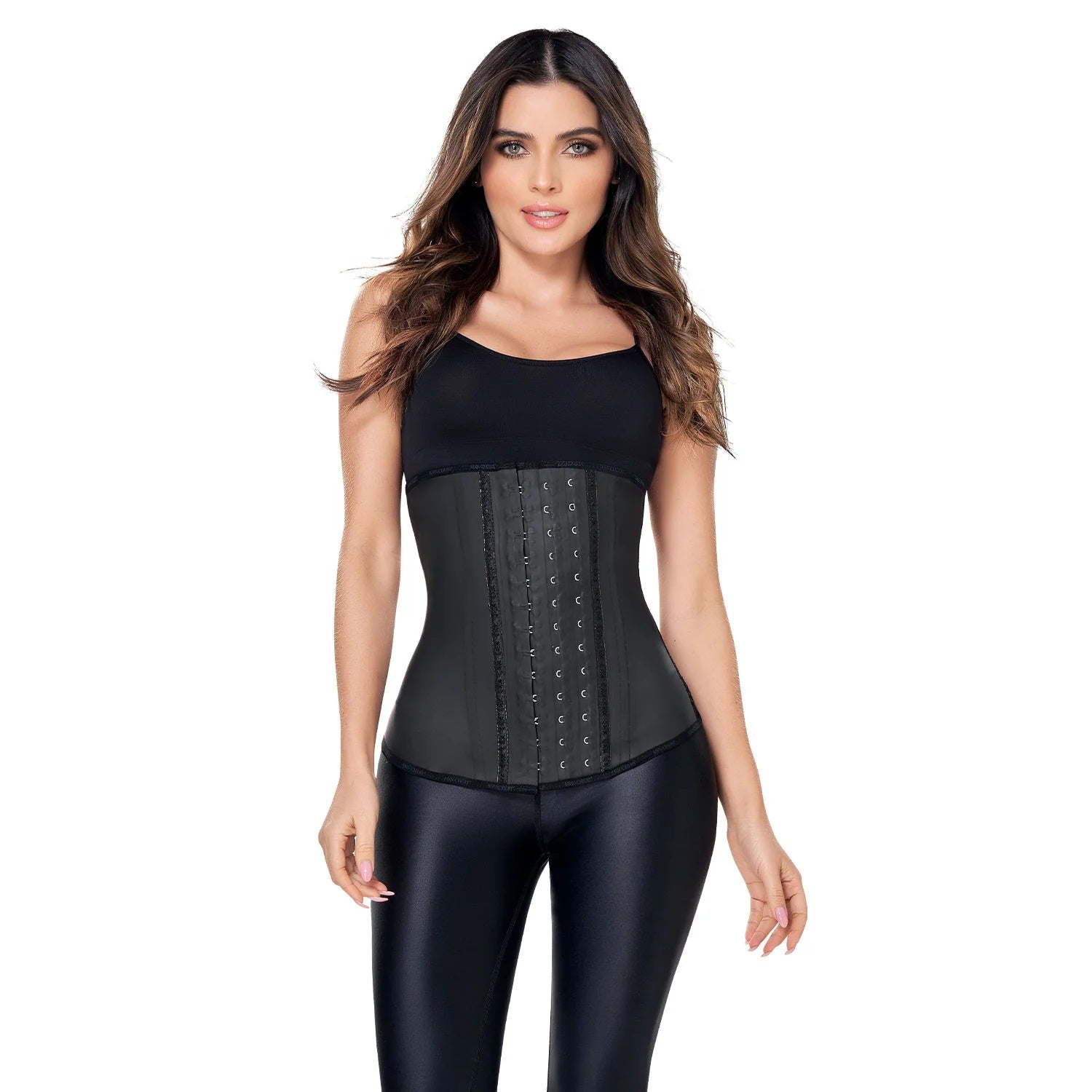
Ann Chery Classic Waist Cincher
Ann Chery's 3-hook closure system provides three distinct compression levels in one garment — useful as the body warms and expands through a workout. The 9-bone steel construction maintains shape throughout a session. Like the Squeem, it uses a latex core and accumulates heat; it does not create permanent waist reduction. The adjustable closure is a practical advantage over fixed-zip designs for extended wear.
Pros
- ✓3-hook closure provides three adjustable compression levels
- ✓9-bone steel maintains shape through full workout sessions
- ✓Adjustable compression adapts as body temperature changes
Cons
- ✗Latex core: shares Squeem's breathability limitation — heat accumulation during vigorous exercise
Score breakdown
| Boning | 9 steel bones |
| Core material | Latex |
| Outer fabric | Cotton/polyester blend |
| Closure | 3-hook-and-eye (3 compression levels) |
| Compression level | High |
| Price | ~$55 |

Sweet Sweat Premium Waist Trimmer
Sweet Sweat's wide neoprene design (lower rib to hip) covers the full lumbar and lower oblique region — more coverage area than narrower cincher-style trainers. The wide coverage provides lower-back support for functional movements that narrower waist trainers miss. The separately sold Sweet Sweat gel is marketed as amplifying the thermogenic effect, but there is no clinical evidence supporting additional fat reduction beyond placebo from topical application.
Pros
- ✓Wide neoprene covers lower rib to hip — full lumbar and oblique support
- ✓Velcro closure adjustable across wide range of waist sizes
- ✓Wide coverage provides support for functional movements
Cons
- ✗Sweet Sweat gel (sold separately) has no clinical evidence for additional fat reduction
Score breakdown
| Boning | None |
| Material | Neoprene |
| Coverage | Lower rib to hip |
| Closure | Velcro |
| Width | Wider than standard cincher |
| Price | ~$35 |
Which one is right for you?
For core support during heavy lifting
Squeem Perfect Waist Cincher
Squeem's double steel boning (9 bones) and natural rubber core provide genuine intra-abdominal pressure support during compound lifts — closer in function to a lifting belt than a fashion garment.
For posture awareness during daily activity
Ann Chery Classic Waist Cincher
Ann Chery's 3-row hook-and-eye closure and 9-bone structure provides adjustable compression that serves as a proprioceptive posture cue without the thermal intensity of neoprene designs.
For thermogenic sweating during cardio
waist-trainer-chumian-neoprene
Chumian's neoprene construction generates the highest local skin temperature of any belt in this comparison — if your goal is increased local sweat output during cardio sessions, this is the design for that specific purpose.
For lower-back support during workouts
Sweet Sweat Premium Waist Trimmer
Sweet Sweat's wide neoprene design covers from lower rib to hip, providing lower-back and oblique support across a wider area than narrower cincher designs.
For gym performance support without extreme compression
waist-trainer-nebbia-power
Nebbia Power's moderate compression and breathable fabric construction provide core support without the circulation-restricting pressure of steel-boned latex designs — more appropriate for extended gym wear.
What waist trainers actually do — and what they do not do
The most important clarification before comparing waist trainers: wearing a waist trainer does not permanently reduce waist circumference. This claim — which drives a significant proportion of waist trainer marketing — is not supported by clinical evidence. The human waist is bounded by the lumbar vertebrae (which cannot be compressed), the floating ribs (ribs 11 and 12, which have some mobility but cannot be permanently displaced), and the soft tissue of the abdomen and obliques. External compression from a waist trainer temporarily compresses the soft tissue and shifts organ position slightly — you may appear 2-4 cm smaller in circumference while wearing the garment. When the garment is removed, the soft tissue and organs return to their resting position. Repeated compression over months does not cause the floating ribs or soft tissue to permanently adopt a new position — the tissues are elastic and return to baseline. There is no peer-reviewed clinical research demonstrating that waist trainer use produces lasting anatomical changes in waist circumference independent of body fat reduction through diet and exercise.
What waist trainers do provide: core support through intra-abdominal pressure during exercise, posture awareness through proprioceptive feedback (the compression creates a sensation that encourages upright posture — similar to how kinesiology tape creates body awareness), and in neoprene designs, increased local skin temperature that increases sweat output from the covered area. The core support benefit is real but functionally different from a purpose-built lifting belt: a lifting belt is rigid and designed to brace against directly, while a waist trainer is flexible enough to deform under load. The posture awareness benefit is real but temporary — when the garment is removed, the proprioceptive cue is removed with it, and posture reverts to the individual's baseline. The thermogenic sweat benefit is real in that neoprene increases local skin temperature and increases sweat volume from that area — but increased sweat output does not cause fat loss from that specific area. Spot fat reduction through local sweat increase is not physiologically possible; fat is mobilised systemically through caloric deficit, not locally through sweating.
The health risks of waist trainer misuse are worth stating clearly. Wearing a waist trainer at high compression during exercise reduces thoracic expansion, which restricts breathing depth. At mild compression, this creates a sensation of breathlessness during high-intensity work without significant oxygen delivery impact. At high compression, breathing restriction is meaningful and can cause lightheadedness, reduced performance, and in rare cases with underlying conditions, can exacerbate acid reflux by increasing intra-abdominal pressure. Wearing a steel-boned waist trainer for extended periods (8+ hours daily, as some waist training programs recommend) causes compression of the lower rib and abdominal soft tissue that can be uncomfortable and, over prolonged periods, may affect organ positioning in ways that cause discomfort or digestive issues. If you choose to wear a waist trainer, start with short sessions (30-60 minutes), do not wear it at a compression level that restricts normal breathing, and stop use if you experience persistent pain, numbness, or digestive symptoms.
Steel boning vs plastic boning: what the construction means
Boning (the rigid or semi-rigid vertical strips inside a corset-style waist trainer) determines how the garment holds its shape under body movement and compression load. Steel boning comes in two types: spiral steel (flexible in all directions, used in curved sections of the garment that need to follow body curves) and flat steel (rigid along its length but can flex slightly across its width, used in the back panels where maximum rigidity is needed). Plastic boning flexes under less force than steel and is more prone to warping after repeated use — it bends and folds rather than holding shape. The practical implication: a steel-boned waist trainer maintains its structured silhouette through a workout or extended wear period; a plastic-boned waist trainer may buckle or fold at the front during movement, which creates pressure ridges and reduces the consistency of compression.
The number of bones determines how much of the waist circumference is structurally supported. A 9-bone design (Squeem Perfect Waist, Ann Chery Classic) typically uses 2 flat steel bones at the back closure, 4-6 spiral steel bones along the sides and front, creating an evenly structured corset shape. A 4-6 bone design uses fewer support points, which allows more fabric flex between bones — more comfortable but less structurally precise. Neoprene designs (Chumian, Sweet Sweat) typically have no boning at all — their compression comes from the stretch resistance of the neoprene material rather than structural bones, making them more flexible and more comfortable for dynamic movement but less precise in compression profile.
Fabric composition affects breathability, durability, and thermal properties significantly. Latex (used in Squeem Perfect Waist under the outer fabric) provides high compression return force — the material pulls back toward its original shape with significant force, creating the firm compression that latex-core garments are known for. The trade-off: latex is not breathable, traps heat and moisture, and causes allergic reactions in individuals with latex sensitivity. Neoprene (used in Chumian and Sweet Sweat) is a synthetic rubber that generates heat through thermal insulation of the covered skin area — the trapped body heat causes increased sweating. Neoprene is more breathable than latex but causes more heat accumulation than fabric-only designs. Polyester-elastane blends (Nebbia Power) provide moderate compression without thermal insulation — more breathable and more comfortable for extended wear but less compressive than latex or neoprene.
Posture support and core function during exercise
The core support claim for waist trainers during exercise is the most defensible benefit, and it is worth distinguishing from the weight-loss claims. During compound strength training movements (deadlifts, squats, overhead press), increasing intra-abdominal pressure provides spinal stabilisation — this is the mechanism behind lifting belts, which are worn specifically to brace against during heavy loads. A waist trainer worn during lifting provides some of this stabilisation benefit, but less effectively than a purpose-built lifting belt because waist trainers are designed to be flexible enough to be worn throughout a workout or daily activity, while lifting belts are rigid and designed to brace against directly on individual lifts. The practical conclusion: if your goal is spinal support during heavy compound lifts, a purpose-built lifting belt (covered in our separate best-lifting-belt article) provides this benefit more effectively than any waist trainer. If your goal is general core support and posture awareness across a full workout including warm-up, lighter accessory work, and conditioning, a waist trainer's less rigid compression may be more appropriate for wearing throughout.
Posture awareness through proprioception is a genuine benefit of wearing any firm garment around the torso. When the waist trainer compresses the skin and superficial soft tissue, it creates a tactile sensation that the nervous system interprets as postural information — the sensation of compression is a cue to maintain upright posture, engage the core, and avoid forward collapse of the torso. This is functionally similar to how kinesiology tape creates postural awareness by pulling on the skin. The limitation: this proprioceptive benefit exists only while the garment is worn. It does not create lasting postural changes after the garment is removed, because no structural adaptation of the postural muscles or connective tissue occurs from wearing a compression garment. The benefit is in the session, not in long-term physical adaptation.
Thermal effects during cardio are the least well-understood and most frequently misrepresented benefit. Neoprene waist trainers and belts generate significant local heat in the covered area — skin temperature under a neoprene belt during a 45-minute cardio session can be 4-8°C higher than the uncovered surrounding skin. This causes localised sweating. The weight lost through this sweating is water weight, not fat — it is replaced immediately upon rehydration. There is no research evidence that local fat reduction occurs through localised sweating. The relevant question is whether the increased core temperature has any performance effect: for some athletes, elevated core temperature before an explosive effort can improve muscle activation, but this is a subtle effect at best and is not the use case for which most waist trainers are marketed.
Where each fits
If you want a waist trainer for core support during heavy compound lifts, you want the most structurally rigid garment in this comparison, and you are not latex-sensitive, the Squeem Perfect Waist at around $85 is the maximum-structure pick. The double-steel boning (9 bones total) and natural rubber core provide the closest functional approximation to a flexible lifting belt in this comparison. The honest limitation: the latex core makes this garment breathable only through the cotton outer layer — during an intense lifting session, heat and moisture accumulate under the garment at a rate that most users find uncomfortable after 45-60 minutes. The second limitation: Squeem's sizing requires measuring at the natural waist (narrowest point) and following their specific size chart — standard S/M/L will not produce the correct fit, and a garment that is one size too large provides minimal compression while one size too small creates uncomfortable pressure on the lower ribs.
If you want a structured waist trainer for posture awareness during daily activity or moderate exercise, you want a hook-and-eye closure for adjustable compression as your body warms up, and you want a durable garment for long-term use, the Ann Chery Classic Waist Cincher at around $55 is the adjustable-structure pick. The 3-hook closure system allows three different compression levels across a single garment — useful for the first 30 minutes of a workout when the body has not yet warmed up versus the last 30 minutes when thermal expansion makes the garment feel tighter. The honest limitation: the Ann Chery Classic is a latex-core garment and shares the breathability limitations of the Squeem — heat accumulation under the garment becomes significant during vigorous exercise. The second limitation: the hook-and-eye closure requires attention when moving from tighter to looser positions mid-workout; fumbling with hooks under a barbell is less practical than a zipper or velcro closure.
If you specifically want increased sweating in the midsection during cardio sessions, you train at moderate intensity and are not concerned about the thermal discomfort of neoprene during vigorous effort, the Chumian Neoprene Waist Trainer at around $28 is the thermogenic pick. The neoprene material generates the highest local skin temperature of any design in this comparison. The honest limitation: as stated above — the weight lost during a session in a neoprene waist trainer is water weight from increased sweating, not fat. The water is replaced upon drinking. Increased sweating in the midsection is the result, and this has no documented effect on spot fat reduction. The second limitation: neoprene accumulates significant heat and sweat during vigorous cardio; wearing it at high intensity above 80% max heart rate is uncomfortable and may impair performance due to core overheating.
If you want a wide support garment that covers the lower back and obliques during gym sessions rather than targeting just the waist cincher region, and you find narrower cincher-style trainers insufficient for lower-back support during functional movement, the Sweet Sweat Premium Waist Trimmer at around $35 is the lower-back coverage pick. The wider neoprene band covers from the lower ribcage to the hip, providing support across the entire lumbar and lower oblique region. The honest limitation: Sweet Sweat markets their accompanying gel (sold separately) as amplifying the thermogenic effect — the gel is a topical mixture of ingredients claimed to increase sweating. There is no clinical evidence that topical application of Sweet Sweat gel produces additional fat reduction beyond the placebo effect; the gel is an unnecessary add-on purchase for the physical support function of the belt. The second limitation: the wide neoprene band is the most uncomfortable in hot conditions (above 25°C) because of the large surface area of thermal insulation it provides.
If you want a gym support garment with moderate compression and breathable fabric rather than the thermal intensity of neoprene, you train for extended sessions (90+ minutes) where thermal comfort matters more than maximum compression, and you want a garment that can be worn comfortably across a full workout including warm-up and cool-down, the Nebbia Power Slim Waist Belt at around $45 is the breathable-support pick. The polyester-elastane construction provides core support without the latex or neoprene thermal intensity — you can train at high intensity without overheating the covered area. The honest limitation: the compression level is the lowest in this comparison — for runners or lifters who want the maximum proprioceptive feedback or intra-abdominal pressure support, the Nebbia Power provides less of both than the steel-boned or latex alternatives. The second limitation: the polyester-elastane fabric is less durable through washing than latex or neoprene — the elastic fibres begin to lose tension within 12 months with regular use and washing.
