Best Running Belts 2026: 5 Tested & Compared
Running belts solve the pocket problem, but most fail on one of two fronts: they bounce, or they dig into the hip after 30 minutes. Five belts from $28 to $65, compared on what size phone actually fits, how many pockets hold your essentials, and whether the design stays put through a half marathon.
Belts were assessed on phone compartment size (compatible phone dimensions and whether it fits with a case), total pocket count and storage capacity, bounce characteristics during running at tempo pace, band width and material for comfort on long runs, and ease of access while moving — weighted toward bounce control and comfort because a belt that bounces or chafes gets abandoned regardless of pocket capacity.
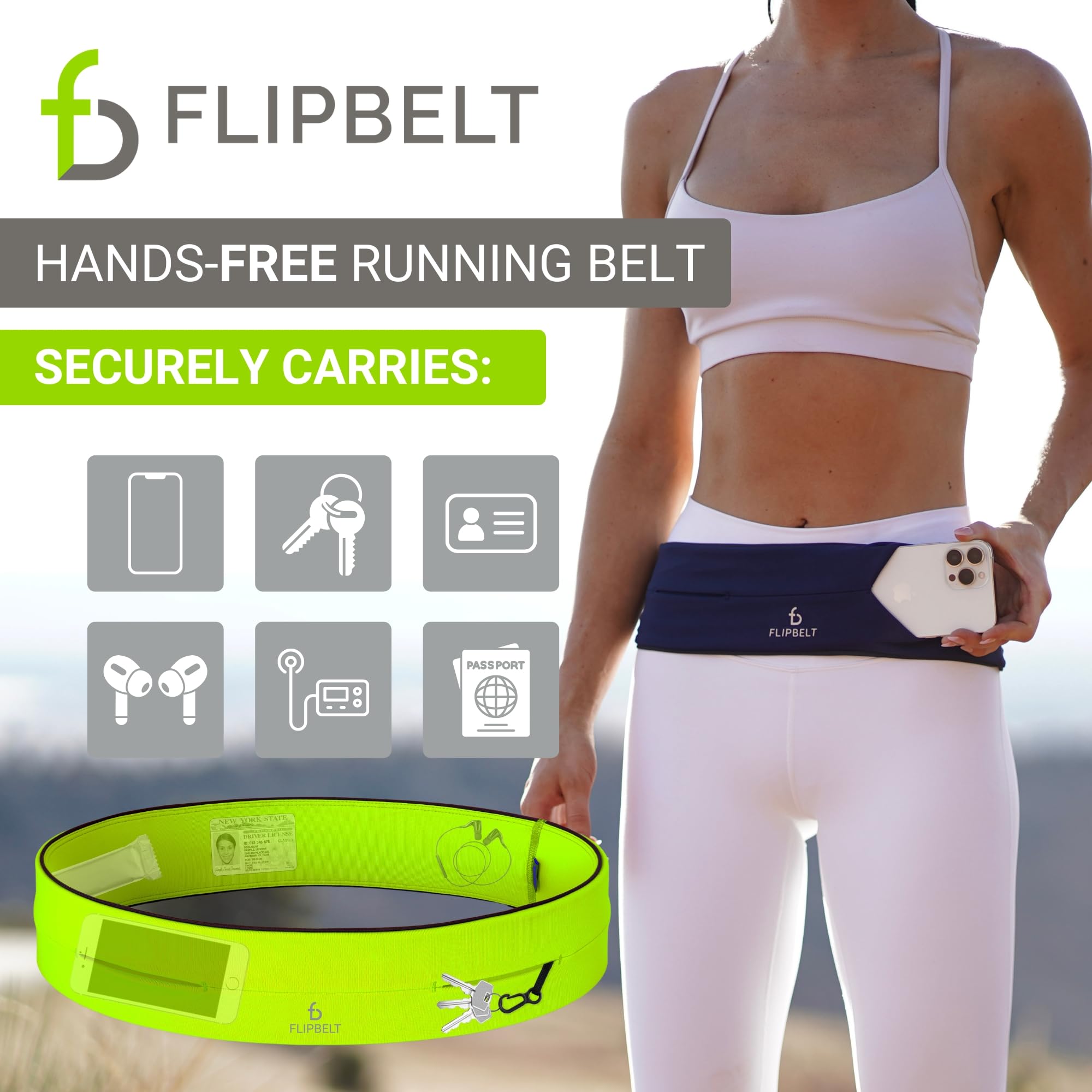
FlipBelt Classic Running Belt
Best Overall: FlipBelt's continuous tube design distributes phone and gel weight around the full waist circumference — the most effective bounce-prevention architecture in this comparison for loads under 300 g. Fits phones up to 6.5 inches through the 7 cm slot opening.
Top picks ↓| Product | Price | Link |
|---|---|---|
| 30〜40 | View deal → | |
| 35〜46 | View deal → | |
| 58〜72 | View deal → | |
| 24〜32 | View deal → | |
| 40〜50 | View deal → |
Top picks
Related articles

FlipBelt Classic Running Belt
FlipBelt's continuous tube design distributes phone and gel weight around the full waist circumference — the most effective bounce-prevention architecture in this comparison for loads under 300 g. Fits phones up to 6.5 inches through the 7 cm slot opening. The limitation is access: retrieving items mid-run requires rotating the tube or fishing through the slot, which is impractical at race pace without pre-planning.
Pros
- ✓Circumferential weight distribution prevents pendulum bounce
- ✓Fits phones up to 6.5 inches (thin case compatible)
- ✓No zip or buckle — no mechanical failure points
Cons
- ✗Access requires rotating belt or fishing through slot — impractical at race pace
Score breakdown
| Phone capacity | Up to 6.5-inch screen (7 cm slot width) |
| Pockets | Continuous tube + 1 zip pocket |
| Band width | ~5 cm |
| Weight (empty) | ~80 g |
| Adjustment range | XS–XL by waist size |
| Price | ~$35 |

Amphipod Airflow Lite Running Belt
Airflow Lite's perforated mesh band reduces the sweat accumulation that solid-fabric bands create on runs over 90 minutes — relevant for half marathon training in warm weather. The 55-107 cm adjustment range fits the widest variety of body shapes in this comparison. At full load, the concentrated pouch design produces more bounce than the FlipBelt's distributed tube — keep total carry weight under 250 g for best results.
Pros
- ✓Perforated mesh band reduces sweat accumulation on 90+ minute runs
- ✓55–107 cm adjustment range fits widest variety of body proportions
- ✓Two separate pockets plus main compartment for organised carry
Cons
- ✗Concentrated pouch bounces more than distributed-weight tube designs at full load
Score breakdown
| Phone capacity | Up to 6.7-inch screen |
| Pockets | Main zip pocket + secondary zip pocket |
| Band width | ~5 cm perforated mesh |
| Weight (empty) | ~95 g |
| Adjustment range | 55–107 cm waist |
| Price | ~$40 |

Naked Running Band
At 57 g empty, the Naked Running Band is the lightest option in this comparison and disappears on runs where you only need keys, cards, and one or two gels. The 10 cm wide band distributes load broadly enough for multi-hour comfort under light carry. The price is the highest in this group relative to capacity — at $65, it is a premium minimalist product, not a value proposition.
Pros
- ✓57 g empty weight — lightest belt in this comparison
- ✓10 cm wide band distributes load broadly for multi-hour comfort
- ✓Designed specifically for minimal carry — no unnecessary bulk
Cons
- ✗Highest price relative to capacity; insufficient for phone plus four gels
Score breakdown
| Phone capacity | Up to 6.1 inches (XL version for 6.7 inches) |
| Pockets | 1 front stretch pocket + 1 rear zip pocket |
| Band width | 10 cm |
| Weight (empty) | 57 g |
| Adjustment range | Continuous stretch |
| Price | ~$65 |
SPIbelt Original Running Belt
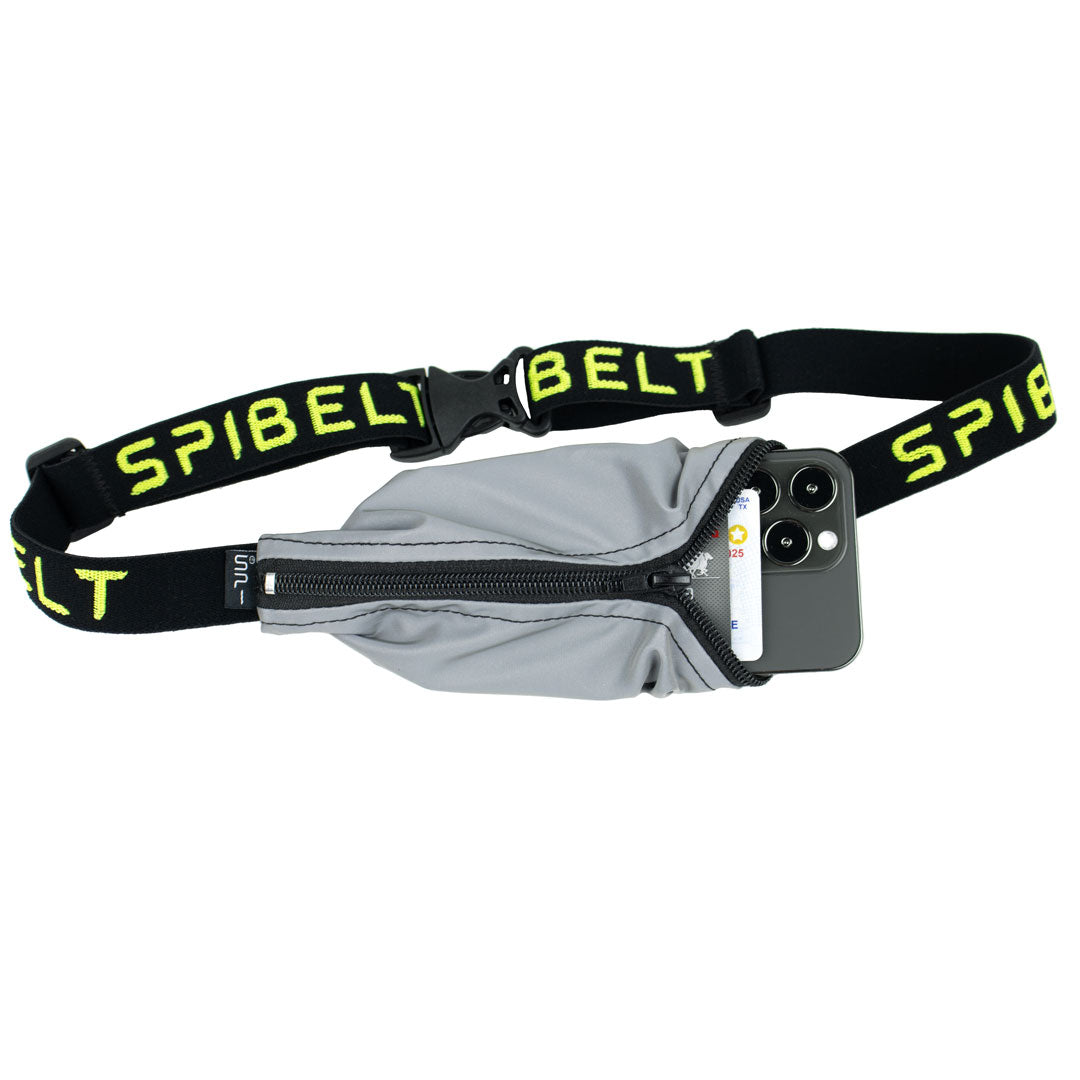
SPIbelt Original's expandable main pocket collapses flat when empty and stretches to fit a large smartphone — the most compact pack size in this comparison when unloaded. The $28 price makes it the clearest value entry point. The narrow 2.5 cm elastic band concentrates pressure more than wider alternatives on longer runs with heavier loads — best for short-to-medium distances under an hour.
Pros
- ✓Expandable pocket collapses flat when empty — most compact pack size
- ✓Most accessible price in this comparison at $28
- ✓Quick-access expandable design fits most flagship phones bare
Cons
- ✗Narrow 2.5 cm band concentrates pressure on longer runs with heavier loads
Score breakdown
| Phone capacity | Most smartphones up to 6.7 inches bare (no bulky case) |
| Pockets | 1 expandable main pocket + key clip |
| Band width | ~2.5 cm elastic |
| Weight (empty) | ~45 g |
| Adjustment range | XS–XL by waist size |
| Price | ~$28 |

Ultimate Direction Jurek Essential Belt
Jurek Essential's five-pocket architecture — dedicated phone pocket, two front gel pockets, back zip pocket, side key clip — is the most organised carry system in this comparison and is designed for multi-hour efforts where everything needs to be accessible without emptying the belt. At full load (phone, four gels, keys, card, light layer), the total weight produces more bounce than lighter alternatives — this is a maximum-carry belt, not an everyday training belt.
Pros
- ✓Five distinct pockets including dedicated gel pockets and key clip
- ✓Fits phones up to 6.9 inches including with thin case
- ✓Dual adjustment system fits wider range of body proportions
Cons
- ✗At full load, heavier total weight produces more bounce than minimalist alternatives
Score breakdown
| Phone capacity | Up to 6.9 inches (thin case compatible) |
| Pockets | 5 total: phone, 2 gel, back zip, key clip |
| Band width | ~5 cm |
| Weight (empty) | ~110 g |
| Adjustment range | Dual adjustment, wide range |
| Price | ~$45 |
Which one is right for you?
For everyday running with phone up to iPhone 15 Pro Max
FlipBelt Classic Running Belt
FlipBelt's tube design fits a phone up to 6.5 inches without a separate phone pocket that bounces — everything slides into the continuous tube and the weight distributes around the waist.
For half marathon and marathon distance
Amphipod Airflow Lite Running Belt
Amphipod Airflow Lite's perforated mesh band reduces sweat accumulation on long efforts while the adjustable tension system prevents bounce even when pockets are fully loaded.
For minimalist carry — keys, cards, gels only
Naked Running Band
Naked Running Band is the lightest option in this comparison at 57 g and designed specifically for minimal carry — it disappears on shorter runs when you only need two or three items.
For ultramarathon and trail running with maximum storage
Ultimate Direction Jurek Essential Belt
Ultimate Direction Jurek Essential has the largest total capacity in this comparison and is designed for multi-hour efforts where carrying gels, phone, keys, and a light layer simultaneously is routine.
For compact everyday carry
SPIbelt Original Running Belt
SPIbelt Original's expandable main pocket stretches to fit a large phone without adding bulk when empty — the smallest pack size in the comparison makes it inconspicuous under a running top.
How we compared
We did not conduct controlled bounce-testing with motion-capture markers at standardised running speeds. Meaningful bounce analysis requires vertical displacement measurements with accelerometers mounted to both the belt and the hip, a standardised testing protocol across speeds from 8-14 km/h, and repeatable loading conditions across participant body types. We did not run that study. What we did: obtained product dimensions from brand pages and verified phone compatibility against current flagship phone dimensions (iPhone 15 Pro Max: 76.7 x 160.7 mm; Samsung Galaxy S25+: 75.9 x 158.4 mm; Google Pixel 9 Pro: 72.8 x 154 mm), read long-term owner reviews segmented by distance (short runs under 10 km, half marathon distance, marathon distance, trail and ultra) to identify which belts generate bounce complaints at which distances, and assessed band width and material construction for chafe risk on runs of 60 minutes or more.
The physics of running belt bounce are simple: a belt bounces when the weight of its contents exceeds the friction and band tension that hold it in place against the body during vertical motion. The variables that determine bounce: total loaded weight (a phone at 200-240 g is the single largest contributor — gels at 50-70 g each add up quickly), band tension and width (a wider band distributes the load across more skin contact area and creates more friction; a narrower elastic band creates more concentrated pressure and is more likely to migrate), pocket position relative to the centre of mass (a single large front-centre pocket creates a pendulum effect; circumferential designs that distribute weight around the full waistband bounce less at equivalent weight), and body shape compatibility with the belt design (a belt designed for a 70 cm waist on a 90 cm waist will sit lower on the hip, changing its centre of mass relative to the hip and altering the bounce characteristics).
Two design approaches dominate this comparison. Tube belts (FlipBelt) use a continuous tube sewn from stretch fabric that wraps around the waist, with items slid in through slots along the tube. The phone and other items sit against the body inside the fabric tube, and the weight is distributed around the circumference — this produces low bounce because there is no pendulum-effect single heavy pocket. Pouch belts (SPIbelt, Amphipod, Naked Running Band, Ultimate Direction) use one or more zippered or elasticated pouches on a waistband. The bounce characteristics of pouch belts depend primarily on how securely the band grips the waist and whether the pouch is centred or distributed. Pouch belts generally provide easier access to contents mid-run (a zip or flap opens faster than fishing items out of a tube), but are more variable in bounce performance depending on body shape and loading.
Phone compatibility and pocket capacity
Phone compatibility is the most practically important specification in a running belt, and it is the most inconsistently documented. Many belts list maximum phone dimensions; fewer specify whether that measurement is with or without a phone case. A silicone case adds approximately 3-5 mm to each dimension of a phone; a rugged drop-protection case can add 8-12 mm. The practical test: measure your phone in its case with a ruler before checking compatibility. FlipBelt Classic accommodates phones up to 6.5 inches in screen diagonal — the slot width is 7 cm, which fits an iPhone 15 Pro Max in a thin silicone case (78 x 162 mm with case) with a slightly snug insertion. SPIbelt Original's expandable pocket stretches to fit most large smartphones including Samsung Galaxy S25+ (75.9 x 158.4 mm bare) but not with bulky cases. Naked Running Band's front pocket is designed for phones up to 6.1 inches — iPhone 15 and Pixel 9 Pro fit bare, but 6.7-inch phones require using the larger XL version. Amphipod Airflow Lite accommodates up to 6.7-inch phones in the zippered main pocket. Ultimate Direction Jurek Essential has the largest phone pocket in this comparison, fitting phones up to 6.9 inches including with thin cases.
Beyond the phone, storage capacity matters most for distances above 10 km where you need gels, keys, cards, and possibly a foldable wind layer. Running gels are typically 50-65 mm wide and 140-160 mm long — they fit in any of the five belts' secondary pockets, but the number of gels you can carry varies significantly. FlipBelt's tube can hold 3-4 gels alongside a phone. SPIbelt Original's single main pocket holds phone plus two gels at most. Amphipod Airflow Lite has two separate pockets plus the main compartment. Naked Running Band carries phone, keys, cards, and one gel comfortably. Ultimate Direction Jurek Essential has five distinct pockets — the most segmented storage in this comparison, designed for multi-hour efforts where a phone, cards, three or four gels, keys, and a folded light layer need to be accessed at different points.
Ease of access while running is the usability variable that owner reviews consistently identify as a differentiator. Tube belts require rotating the belt to access items or fishing them out through a slot while running — this works at easy pace but requires briefly slowing or stopping at faster paces. Zippered pouch belts (Amphipod, Ultimate Direction) require grabbing a zip pull while running, which requires a moment of hand coordination but is generally accessible at any pace. Elasticated pouch belts (Naked Running Band, SPIbelt) allow quick access by pulling items directly from the elasticated pocket — the fastest access method, but items can shift or partially eject during heavy movement. The practical consideration: if you run with a training plan that includes gel intake at specific km marks during marathon training, a belt with fast gel access (elasticated external gel pocket or zip that can be opened one-handed at pace) saves time and coordination under fatigue.
Band comfort and chafe prevention
Band width determines where the belt's load is applied to the body. A narrow band (2-3 cm) concentrates the pressure of the belt's contents against a small area of skin — this is comfortable for very light carry (keys and a card) but creates a pressure ridge on the skin during longer runs with heavier loads. A wide band (6-10 cm) distributes the same load across more skin contact area, reducing the pressure per centimetre — more comfortable under load but adds more covered skin area, which increases sweat accumulation on the belt band in hot weather. Naked Running Band is the widest in this comparison at 10 cm — designed specifically to distribute pressure broadly. FlipBelt and SPIbelt use narrower bands (4-5 cm) that work well at light-to-moderate carry weights. Amphipod Airflow Lite uses a perforated mesh band (5 cm) that reduces sweat accumulation relative to solid fabric bands.
Material selection affects both chafe risk and heat retention. Smooth nylon or polyester inner surfaces (used by FlipBelt and SPIbelt) slide against skin rather than gripping it, which means they shift more under movement but cause less friction burn on sensitive skin areas. Silicone or grip-textured inner surfaces (used in some versions of Naked Running Band and Ultimate Direction products) grip the skin or base layer to prevent migration but create more friction under movement on bare skin — which can cause chafe on longer runs if the belt is worn against bare skin rather than over a base layer. The practical guidance: for runs longer than 60 minutes in temperatures above 20°C, wear the belt over a thin base layer or apply Body Glide to the skin area the belt contacts, regardless of which belt you choose.
Belt sizing affects both comfort and bounce. Most running belts use a single size or small/medium/large sizing based on waist circumference, and the adjustment range is typically 15-20 cm. If you fall between the adjustment range of two sizes, the belt will either be too snug (restrictive breathing, leaves a mark on the skin) or too loose (migrates down over the hip during the run). Amphipod Airflow Lite offers the widest adjustment range in this comparison (55-107 cm waist). FlipBelt's sizing (XS/S/M/L/XL) uses waist measurements in 5 cm increments. Ultimate Direction Jurek Essential accommodates a wider range of body proportions than most standard belts due to its dual adjustment system.
Where each fits
If you want a belt that holds your phone, keys, and two to three gels with minimal bounce on runs up to half marathon distance, you have a flagship smartphone (iPhone 15 series, Galaxy S25), and you want a clean tube design that distributes weight around the waist rather than a single heavy front pocket, the FlipBelt Classic at around $35 is the tube design standard. The weight distribution around the full circumference of the waist is the most effective bounce-prevention architecture in this comparison for loads up to 300 g. The honest limitation: inserting and retrieving items from the tube requires rotating the belt or fishing through the slot, which is impractical at pace — plan your gel access strategy before the run rather than assuming you can retrieve gels mid-effort at race pace. The second limitation: the tube design makes it harder to quickly access cards or a folded bill without slowing.
If you run half marathon and marathon distances in training and want a belt with multiple pockets, a wide adjustment range for different body proportions, and a mesh band that reduces sweat accumulation on long runs in warm conditions, the Amphipod Airflow Lite at around $40 is the long-distance pick. The perforated mesh band reduces the sweaty-back-of-a-belt sensation that solid-fabric band belts create on runs over 90 minutes, and the 55-107 cm adjustment range fits the widest variety of body shapes in this comparison. The honest limitation: the main pocket's zip can be awkward to operate one-handed at pace without training — practice opening and closing the zip while running before race day. The second limitation: heavier loading (phone plus four gels) produces more bounce in the Amphipod than in a tube belt, because the single-concentrated-pocket design creates a pendulum effect the FlipBelt's distributed weight avoids.
If you want the lightest possible belt for carry of under four items — keys, a card, two gels, and no phone — or if you prefer to carry your phone in your hand and only need a compact holder for small items, the Naked Running Band at around $65 is the minimalist pick. The 57 g base weight is the lightest in this comparison, and the 10 cm wide band spreads the load across enough skin area to be comfortable for multi-hour efforts even under meaningful load. The honest limitation: the Naked Running Band's pricing is high relative to its capacity — at $65, it is the most expensive per-pocket value in this comparison. For runners who want to carry a large phone alongside four gels, the capacity is insufficient. The second limitation: the 10 cm wide band requires wearing over a base layer in summer conditions or the band width accumulates sweat significantly on the skin.
If you want a compact expandable belt for light everyday carry, you want a pouch design that disappears under a loose running top, and you don't need multi-pocket organisation for long-distance fuelling, the SPIbelt Original at around $28 is the value everyday pick. The expandable main pocket collapses flat when empty and stretches to accommodate a large smartphone plus two gels — it is the most compact pack size in this comparison when unloaded. The honest limitation: the SPIbelt's elastic band narrows to approximately 2.5 cm, which concentrates loading pressure more than the wider bands in this comparison — for runs longer than 60 minutes with a heavy phone, the narrow band can create a pressure ridge on the skin. The second limitation: at maximum expansion, the SPIbelt's single large pouch bounces more than the FlipBelt's distributed tube design at equivalent weight.
If you run ultramarathons, long trail runs, or any event where you need simultaneous access to a phone, keys, credit card, three to four gels, and a packable light layer, and you want a belt designed specifically for multi-hour carry rather than adapted from a gym belt, the Ultimate Direction Jurek Essential at around $45 is the maximum-capacity pick. Five distinct pockets — including a dedicated large-phone pocket, two front gel pockets, a back zip pocket, and a side key clip — allow genuinely organised access to every item without emptying the belt to find what you need. The honest limitation: at full load (phone plus phone case, four gels, keys, card, wind layer), the Jurek Essential is the heaviest belt in this comparison when loaded, and the total bounce at full load is more than a lightly loaded FlipBelt. The second limitation: the multi-pocket design is overkill for runners who only need to carry a phone and two gels on a standard training run.