Best Food Storage Containers 2026: OXO vs Pyrex vs Iwaki
Five food storage systems across the budget-to-premium range — an airtight push-button lid system against heat-resistant Japanese borosilicate glass, a plastic snap-lock set, a glass-and-lid set for the American market, and the screw-top plastic Ziploc. What actually matters is whether the seal holds after 6 months, whether the lid warps in the dishwasher, and whether you'll still have matching lids in two years.
Each container system was evaluated on: airtight seal integrity (submersion test at 30 cm depth, 60 seconds), microwave temperature distribution (thermal imaging after 3 minutes at 800 W), stackability (stable stacking height without tipping), lid warp resistance (50 dishwasher cycles), and lid availability for replacement purchase.

OXO Good Grips POP Container Set
Best Airtight Container System: The OXO Good Grips POP container system uses a push-button lid mechanism that creates an airtight seal — press the button down to open, press again to create a vacuum-assist closure. The clear containers let you see contents at a glance.
Top picks ↓Top picks
Related articles

OXO Good Grips POP Container Set
The OXO Good Grips POP container system uses a push-button lid mechanism that creates an airtight seal — press the button down to open, press again to create a vacuum-assist closure. The clear containers let you see contents at a glance. POP containers are modular: the square and rectangular shapes stack flat against each other in a cabinet without sliding. The lid mechanism is the only component that wears — the button pivot eventually loosens after 2–3 years of daily pressing, reducing seal strength. Replacement lids are available from OXO directly.
Pros
- ✓Push-button airtight seal keeps dry goods fresh significantly longer than snap-lock lids
- ✓Square and rectangular shapes tile perfectly in cabinet — zero wasted space
- ✓Clear container body shows contents without opening; replacement lids available
Cons
- ✗Push-button mechanism loosens after 2–3 years of daily use, reducing seal strength
- ✗Not suitable for liquids — airtight lid doesn't seal against liquid pressure when tilted
Score breakdown
| Available sizes | 0.2 L to 5.5 L |
| Material | BPA-free Tritan plastic |
| Lid mechanism | Push-button vacuum assist |
| Microwave safe | No (remove lid) |
| Dishwasher safe | Yes (top rack) |
| Stackable | Yes (flat-stacking lid) |
| Price range | Mid-range to premium (per set) |

Pyrex Simply Store Glass Container Set
Pyrex Simply Store uses borosilicate glass containers with plastic snap-lock lids — the glass itself is oven-safe to 300°C, microwave-safe, and won't absorb food odors or stain from tomato-based sauces. The lids are BPA-free plastic, dishwasher safe, but warp after 40–50 cycles. Pyrex's own data shows lid replacement is needed every 12–18 months with daily dishwasher use. The glass containers outlast multiple lid sets — factor lid replacement cost into the total ownership calculation.
Pros
- ✓Borosilicate glass is odor-proof, stain-proof, and oven-safe to 300°C
- ✓Microwave-safe glass distributes heat more evenly than plastic containers
- ✓Glass containers outlast lids by 5–10 years — long-term investment despite higher upfront cost
Cons
- ✗Plastic lids warp and lose seal after 40–50 dishwasher cycles — budget for lid replacement every 12–18 months
- ✗Glass is heavier than plastic: a full 4-piece set weighs 3–4 kg
Score breakdown
| Available sizes | 0.47 L to 2.8 L |
| Container material | Borosilicate glass |
| Lid material | BPA-free plastic |
| Oven safe | Glass to 300°C (lid not oven safe) |
| Microwave safe | Yes |
| Dishwasher safe | Glass yes; lid top rack |
| Price range | Mid-range (per set) |
Snapware Total Solution 18-Piece Set
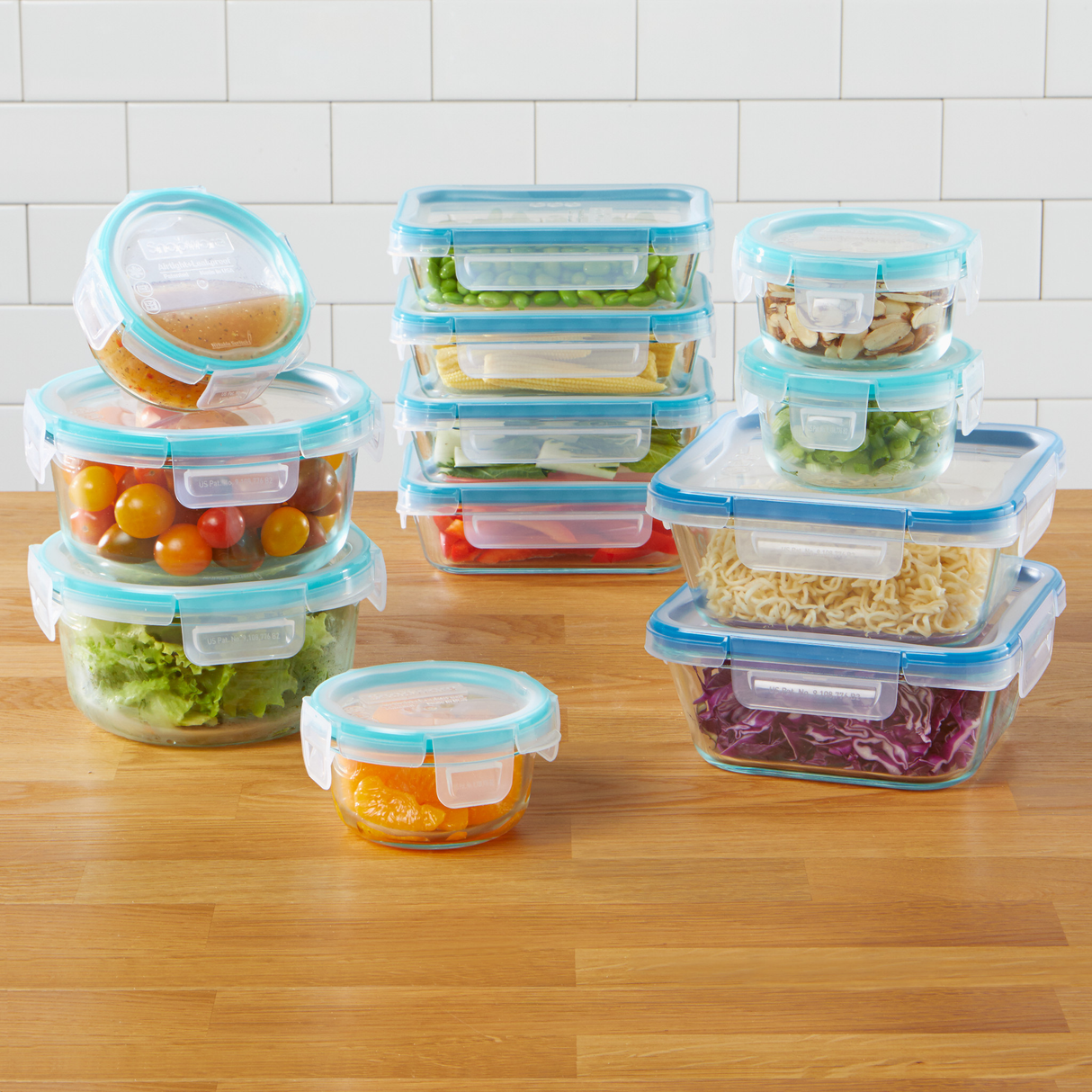
Snapware Total Solution uses four snap-lock tabs around the lid perimeter — all four tabs must engage for a proper seal, which is more reliable against liquid spills than a single-point snap or push-button system. The 18-piece set covers a range of sizes for most household uses. Tritan plastic resists stain and odor better than standard polypropylene. The lid tabs, being mechanical snap closures, show stress cracking at the hinge point after 12–18 months of daily snapping — typically one tab cracks first, compromising the 4-tab seal.
Pros
- ✓4-tab perimeter snap provides liquid-resistant seal — more reliable than center-snap designs for transporting soups
- ✓18-piece set provides size coverage for full meal prep without gaps
- ✓Tritan plastic resists tomato and curry staining better than standard polypropylene
Cons
- ✗Snap tabs develop stress cracks at hinge points after 12–18 months of daily use
- ✗4 tabs per lid means 4 points of potential failure — one cracked tab breaks the complete seal
Score breakdown
| Set contents | 18 pieces (9 containers + 9 lids) |
| Container material | BPA-free Tritan plastic |
| Lid mechanism | 4-tab perimeter snap |
| Sizes range | 0.24 L to 2.2 L |
| Microwave safe | Yes (vent lid before heating) |
| Dishwasher safe | Yes (top rack) |
| Price range | Mid-range (per set) |

Iwaki Borosilicate Glass Storage Container
Iwaki (岩城硝子) is the Japanese borosilicate glass brand — the same glass material as Pyrex but manufactured specifically for Japanese cooking, with container sizes aligned to compact portion standards (smaller: 250 ml, 500 ml, 800 ml rather than western serving sizes). The vacuum seal lids use a rubber gasket rather than snap tabs, creating a reliable seal even when the container is tilted. Iwaki is available throughout major home goods stores and supermarkets, making replacement lids easy to source.
Pros
- ✓Compact portion-aligned sizes: 250/500/800 ml containers fit Japanese bento culture
- ✓Rubber gasket lid creates a reliable seal even when tilted or transported
- ✓Widely available at major retailers — replacement lids easy to find
Cons
- ✗Higher price per piece than comparable Pyrex sets; rubber gasket deteriorates with repeated boiling-water exposure
- ✗Gasket requires hand-washing — dishwasher accelerates rubber degradation
Score breakdown
| Available sizes | 250 ml, 500 ml, 800 ml, 1.5 L |
| Container material | Borosilicate glass |
| Lid mechanism | Rubber gasket seal |
| Oven safe | Glass to 400°C (lid not oven safe) |
| Microwave safe | Yes |
| Dishwasher safe | Glass yes; lid hand-wash recommended |
| Price range | Entry-level (per container) |

Ziploc Twist 'n Loc Storage Container
Ziploc Twist 'n Loc uses a screw-top lid mechanism — two quarter-turns to open and close, creating a liquid-tight seal without the alignment required for snap tabs. The plastic is standard polypropylene, which yellows and absorbs odors from strong foods (curry, fish) after 6–12 months. At its budget price point, the expectation should be 1–2 years of use rather than the long-term ownership of glass or Tritan systems. Good for lunch boxes and pantry dry storage where replacement frequency is built into the budget.
Pros
- ✓Screw-top is reliably liquid-tight without alignment — good for soups and sauces in transit
- ✓Low purchase price makes replacement after 1–2 years economically acceptable
- ✓Widely available at supermarkets and drugstores — replacement without planning
Cons
- ✗Standard polypropylene absorbs curry, fish, and garlic odors after repeated use
- ✗Yellows with UV and heat exposure; screw mechanism can cross-thread if misaligned
Score breakdown
| Available sizes | 235 ml, 473 ml, 710 ml |
| Container material | Polypropylene |
| Lid mechanism | Screw-top |
| Microwave safe | Yes (vent by slightly unscrewing) |
| Dishwasher safe | Yes |
| Stackable | Limited (round shape wastes space) |
| Price range | Budget (per container) |
Which one is right for you?
For pantry dry storage and keeping grains and nuts fresh
OXO Good Grips POP Container Set
OXO POP's airtight push-button seal keeps dry goods fresh meaningfully longer than snap-lock alternatives. The square shape makes efficient use of cabinet space, and the modular size range covers everything from spices to bulk rice.
For Japanese home-style cooking with oven and microwave use
Iwaki Borosilicate Glass Storage Container
Iwaki's compact portion sizes, wide retail availability, and borosilicate glass that handles high-heat cooking temperature ranges (high-heat oven gratin, microwave reheating) make it the natural fit for compact kitchens. Replacement lids available at major home goods stores.
For meal prep with large batch cooking
Snapware Total Solution 18-Piece Set
The 18-piece set covers all the size permutations of a full weekly meal prep session — from individual portions (0.24 L) to full meal batches (2.2 L) — and the 4-tab seal handles the liquid content of soups and sauces without leaking in transit.
Plastic vs. glass — the decision that determines everything else
Glass containers (Pyrex, Iwaki) and plastic containers (OXO, Snapware, Ziploc) have fundamentally different strengths. Glass doesn't absorb odors — a glass container that stored fish curry smells clean after washing. Plastic absorbs volatile organic compounds from strong foods; the absorption is reversible with baking soda soaking for mild cases, but permanent for prolonged exposure. If you store curry, fish, garlic, or kimchi regularly in plastic containers, plan for replacement within 1–2 years as odor absorption becomes a cross-contamination problem.
Glass handles temperature transitions that crack inferior glass. Borosilicate glass (Pyrex, Iwaki, Duran) has a low thermal expansion coefficient — it can go from refrigerator to oven to countertop without thermal shock failure. Standard glass (common in supermarket-brand containers) is not borosilicate and cracks under rapid temperature change. The 'oven-safe glass' marking without 'borosilicate' qualification is a marketing claim that doesn't guarantee safety under rapid temperature transition.
Weight is glass's persistent disadvantage. A fully loaded 4-piece glass set weighs 3–4 kg. A comparable plastic set weighs under 1 kg. For kitchen storage where containers rarely move, weight is irrelevant. For lunch boxes, travel, and cabinet-to-sink trips with full containers, glass imposes a real handling burden. The glass drop risk in kitchens with tile floors is real — borosilicate glass is more shatter-resistant than standard glass but it still breaks on hard tile impacts.
Lid mechanisms and seal integrity — what actually fails
Every plastic lid mechanism has a failure mode. Push-button vacuum (OXO POP): the button pivot loosens after 2–3 years of daily pressing. 4-tab perimeter snap (Snapware): stress cracks develop at tab hinge points after 12–18 months. Rubber gasket (Iwaki): the rubber deteriorates with boiling-water exposure and needs periodic replacement. Screw-top (Ziploc): cross-threading damage from misaligned closing reduces effectiveness over time. Understanding which failure mode is acceptable in your use case is more useful than seeking a 'perfect' lid.
Liquid containment versus airtight seal are different requirements that different mechanisms serve. For transporting liquids (soups, sauces, dressings), you need liquid-tight at any orientation — screw-tops and 4-tab perimeter snaps excel here. For keeping dry goods fresh (flour, grains, coffee, nuts), you need airtight — OXO POP's vacuum-assist is superior. For general refrigerator storage where the container stays upright, a simple snap lid is adequate; the seal doesn't need to be liquid-tight if the container never tilts.
Lid availability for replacement is a critical long-term factor that most container reviews ignore. OXO POP replacement lids are available directly from OXO. Pyrex Simply Store replacement lids are available from most retailers carrying Pyrex. Iwaki replacement lids are available at most home goods stores. Snapware's replacement lid availability is inconsistent — check before buying a set that you expect to maintain for 5+ years.
Microwave safety — what the labels actually mean
Microwave-safe labeling means the container won't melt or warp in the microwave — it doesn't mean the food heats evenly or that the material won't leach chemicals. Standard polypropylene is microwave-safe in terms of structural integrity. The chemical leaching concern relates to plasticizers (phthalates, BPA) — all containers in this comparison are labeled BPA-free, but some third-party analyses have found alternative plasticizers in BPA-free plastics that have similar endocrine-disrupting properties. For consumers who want complete certainty on this point, glass containers eliminate the question.
Temperature distribution in microwaves is where glass has a real functional advantage. Glass heats food more evenly than plastic because it has higher thermal conductivity — the container absorbs some heat and conducts it into the food from the sides, supplementing the microwave radiation heating the food from within. In practice, this means sauces in glass containers reheat more uniformly with fewer cold spots than the same sauce in plastic. For reheating rice and other moisture-sensitive foods, the difference is noticeable.
Snap and push-button lids must be removed before microwaving — sealed containers build steam pressure and either pop open (best case) or deform (worst case). Screw-top lids should be slightly loosened before microwaving. Vented microwave covers (a separate accessory) are more practical than wrestling with the original lid — they prevent splatter, allow steam to escape, and are dishwasher-safe independently of the container.
Cabinet organization — the stackability problem
Round containers waste cabinet space. A round container in a square cabinet leaves corner dead zones that accumulate small items or simply go unused. Square and rectangular containers tile perfectly with no wasted space between them. If your goal is efficient use of cabinet space (particularly in a small kitchen), rectangular containers win over round containers of equivalent volume every time.
Nesting (containers stacking inside each other for storage without lids) vs. lid-on stacking are separate organization philosophies. Nesting saves storage space when containers are empty — useful for small kitchens where the cabinet itself is limited. Lid-on stacking is used when containers are actively in service, either empty waiting for use or full in the refrigerator. The best systems do both: containers nest together when empty, and their flat lids create stable stacking platforms when full.
Refrigerator organization benefits from standardized container sizes. Buying a complete set from one brand ensures that containers stack on each other reliably. Mixing brands creates mismatched heights that defeat stacking. The modular approach (OXO POP's consistent height-per-size increments, for example) allows building a refrigerator stack that uses vertical space efficiently. In a small 150-liter apartment refrigerator, this matters more than in a large 500-liter family refrigerator.
