Best Dog Bed 2026: 5 Compared for Orthopedic Support
A dog bed that slides across hardwood floors or a cover that falls apart in the washing machine within three months is just money wasted. Five beds compared on what matters for real daily use: whether the foam actually supports an arthritic joint, whether the cover cleans without shrinking, and whether the bed stays in its corner.
Each bed was evaluated on orthopedic foam density (kg/m³ or ILD rating where disclosed), washable cover design and washing machine compatibility, non-slip bottom material and real-world stability on smooth floors, size chart accuracy verified against owner reports, and durability over 6-24 months of daily use from verified purchase reviews.

FurHaven Orthopedic Sofa Dog Bed
Best Accessible Orthopedic: FurHaven Orthopedic Sofa Bed is the accessible-price orthopedic pick for senior dogs and dogs up to 30 kg needing joint support. The 3-inch egg-crate foam base distributes pressure more evenly than flat foam and slows the permanent compression that makes budget polyester beds useless within a year.
Top picks ↓| Product | Price | Link |
|---|---|---|
| 4500〜12000 | View deal → | |
| 12000〜25000 | View deal → | |
| 2800〜6500 | View deal → | |
| 18000〜35000 | View deal → |
Top picks
Related articles
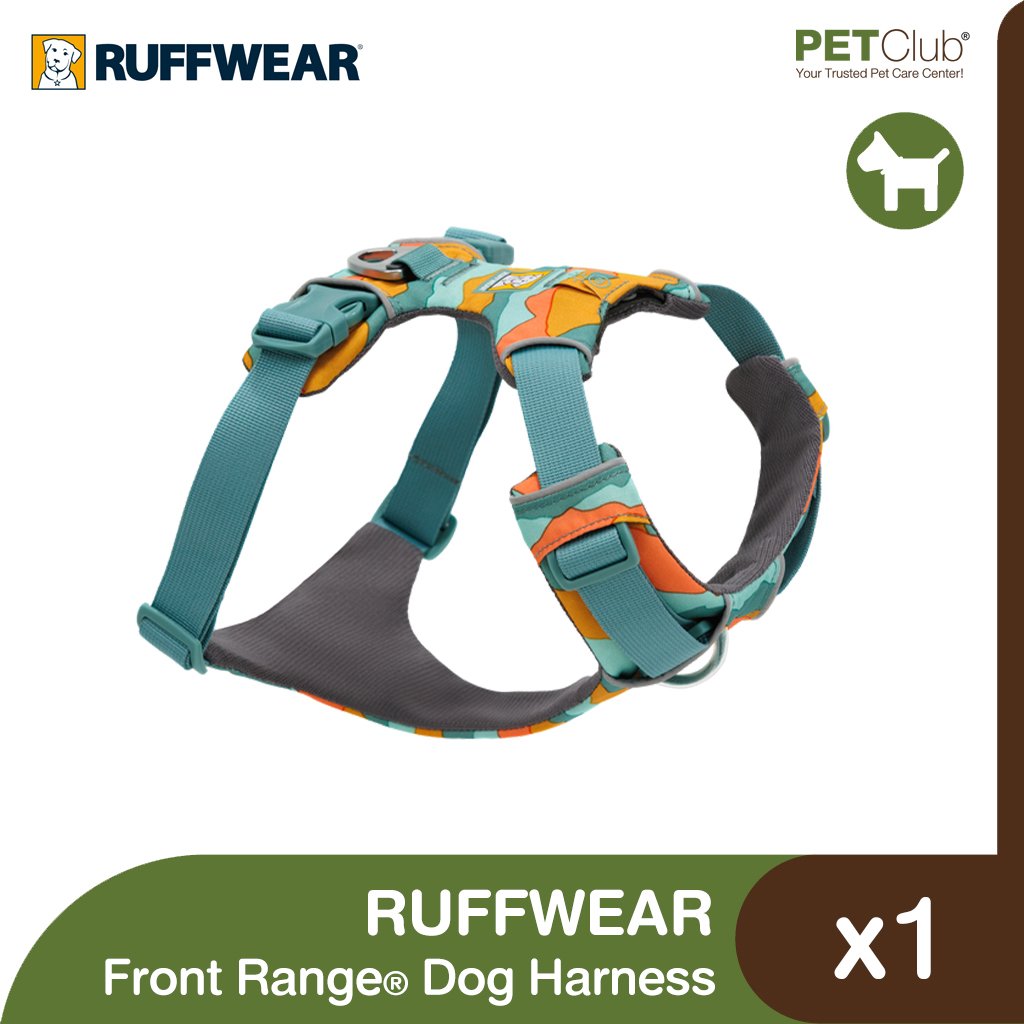

FurHaven Orthopedic Sofa Dog Bed
FurHaven Orthopedic Sofa Bed is the accessible-price orthopedic pick for senior dogs and dogs up to 30 kg needing joint support. The 3-inch egg-crate foam base distributes pressure more evenly than flat foam and slows the permanent compression that makes budget polyester beds useless within a year. Bolster walls provide head-resting surfaces and reduce cold drafts from the floor. Microvelvet cover zips off in seconds and goes directly into the washing machine. Available in sizes from Small to Jumbo across a range of colorways. The honest weakness: egg-crate foam at this price point is not high-density orthopedic foam — the distinction matters for dogs over 30 kg or with severe orthopedic conditions where veterinary-grade pressure relief is indicated.
Pros
- ✓3-inch egg-crate foam provides real pressure distribution vs flat polyester fiberfill
- ✓Zippered microvelvet cover removes in seconds and machine washes without shrinking
- ✓Bolster walls provide head-resting and draft blocking
- ✓Available in Small through Jumbo at accessible price
Cons
- ✗Egg-crate foam density insufficient for dogs over 30 kg with severe joint disease
- ✗Permanent foam compression begins after 12-18 months of daily use by heavy dogs
Score breakdown
| Orthopedic foam density | Egg-crate design (density not disclosed) |
| Washable cover | Yes — zippered microvelvet, machine washable |
| Non-slip bottom | Yes — rubber-backed base |
| Size chart | Small to Jumbo (56×46 cm to 122×91 cm sleeping area) |
Casper Dog Bed
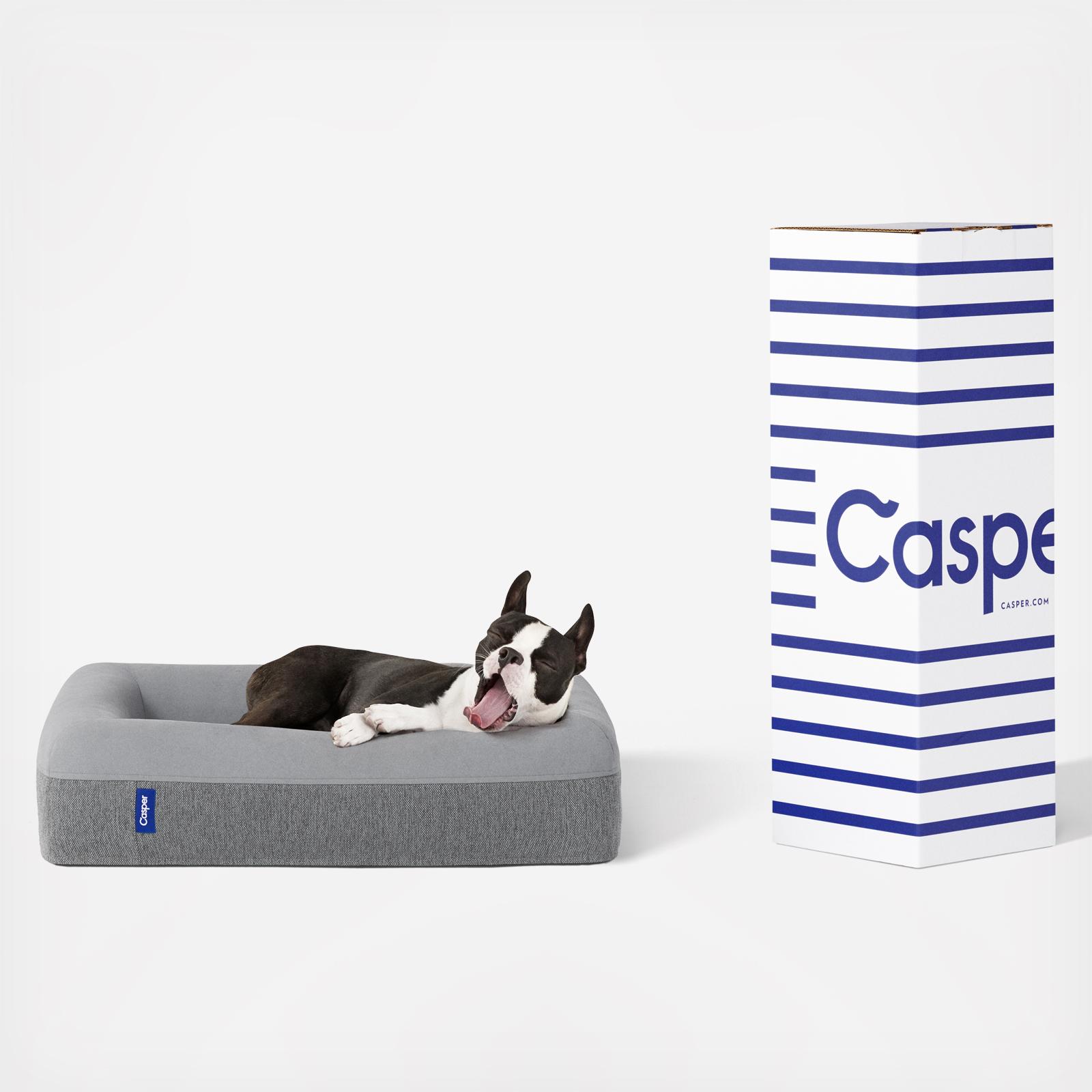
Casper Dog Bed applies Casper's human-mattress open-cell foam technology to dog-scale sleeping — the open-cell structure allows air to circulate through the foam rather than trapping body heat, which is the most effective thermal solution for dogs who consistently overheat at night. Memory foam comfort layer conforms to joints; supportive base foam distributes weight evenly. The mesh bolster wall adds airflow around the perimeter. Durable canvas cover, machine washable. The honest weakness: Casper is among the most expensive beds in this comparison. For a healthy young dog without heat retention issues or orthopedic needs, the performance premium is harder to justify; for a dog with documented heat-seeking behavior or who has panted through multiple nights on conventional beds, the thermal performance is the specific differentiator.
Pros
- ✓Open-cell foam structure allows airflow — most thermally neutral bed in this comparison
- ✓Memory foam comfort layer conforms to joints and pressure points
- ✓Mesh bolster wall adds perimeter airflow
- ✓Machine-washable canvas cover from a brand with established foam quality
Cons
- ✗Most expensive product in this comparison — premium requires heat retention or orthopedic justification
- ✗Canvas cover feels firmer than microvelvet — some dogs prefer softer surfaces
Score breakdown
| Orthopedic foam density | Disclosed open-cell foam (specific density not published) |
| Washable cover | Yes — zippered canvas, machine washable |
| Non-slip bottom | Yes — rubber base |
| Size chart | Small, Medium, Large (up to 120 cm × 92 cm) |
Bedsure Calming Donut Dog Bed
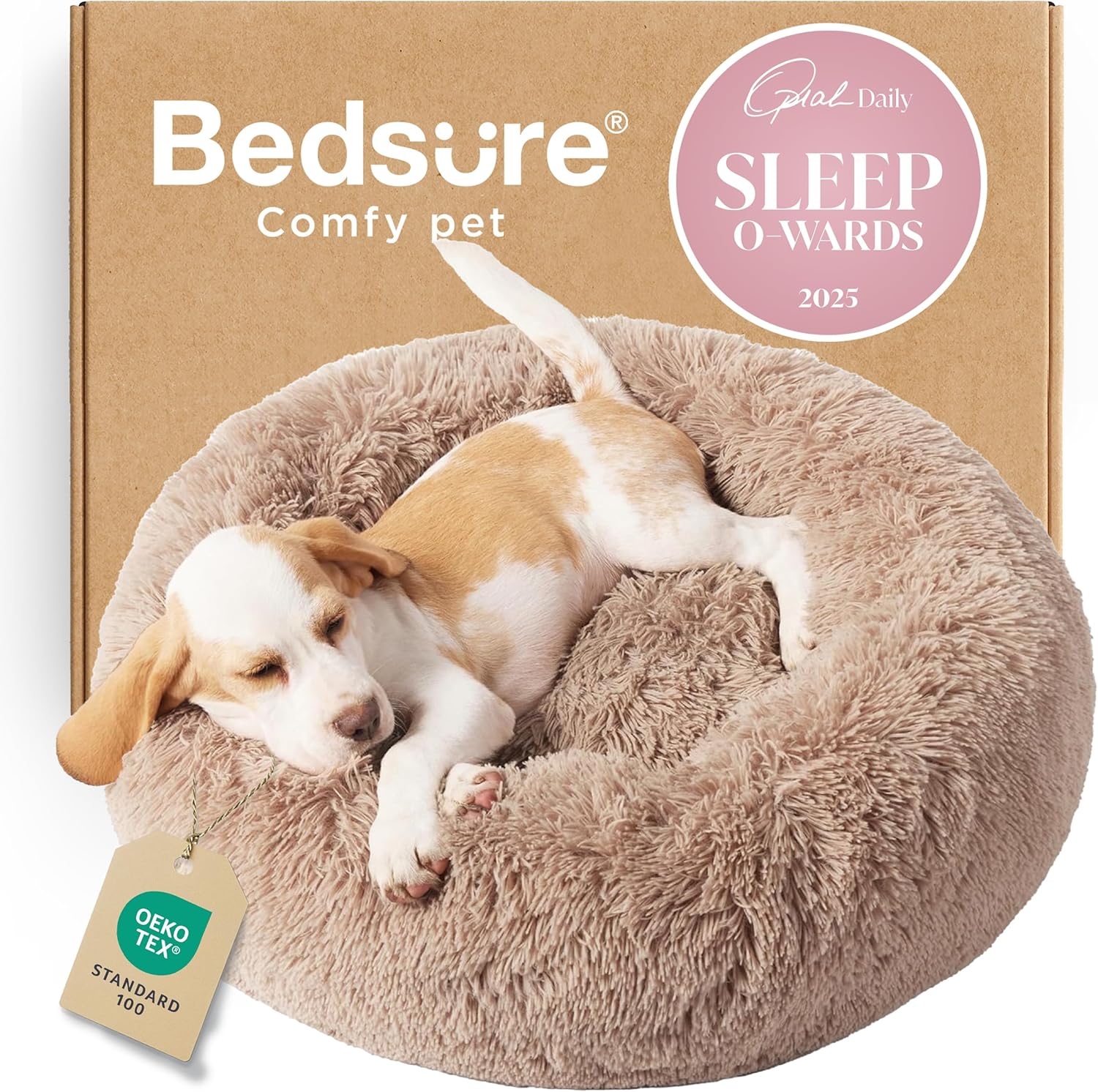
Bedsure Calming Donut Dog Bed is the anxiety and self-soothing pick for dogs who circle, dig, and seek enclosed sleeping spaces — a subset of dogs for whom conventional rectangular beds provide no calming benefit. The round donut design with raised rim provides a den-like enclosure, and the shag faux-fur interior approximates the tactile sensation of dog-to-dog contact that research links to reduced cortisol in anxious dogs. Machine-washable microfiber outer cover, removable inner cushion. Available in sizes from Small (45 cm diameter) to Extra Large (90 cm diameter). The honest weakness: round calming beds are designed for dogs who sleep curled; dogs who sprawl when relaxed will not use the intended sleeping position and are buying a bed that doesn't suit their sleeping style.
Pros
- ✓Round donut design with raised rim provides calming enclosure for anxious dogs
- ✓Shag faux-fur interior mimics dog-to-dog tactile contact
- ✓Machine-washable cover and removable inner cushion
- ✓Accessible price across a full size range
Cons
- ✗Round design is appropriate only for dogs who sleep curled, not sprawlers
- ✗Faux-fur interior accumulates dog hair and requires vigorous washing to clear
Score breakdown
| Orthopedic foam density | Polyester fiberfill (not orthopedic foam) |
| Washable cover | Yes — removable microfiber cover |
| Non-slip bottom | Yes — rubberized dot base |
| Size chart | Small (45 cm) to XL (90 cm diameter) |
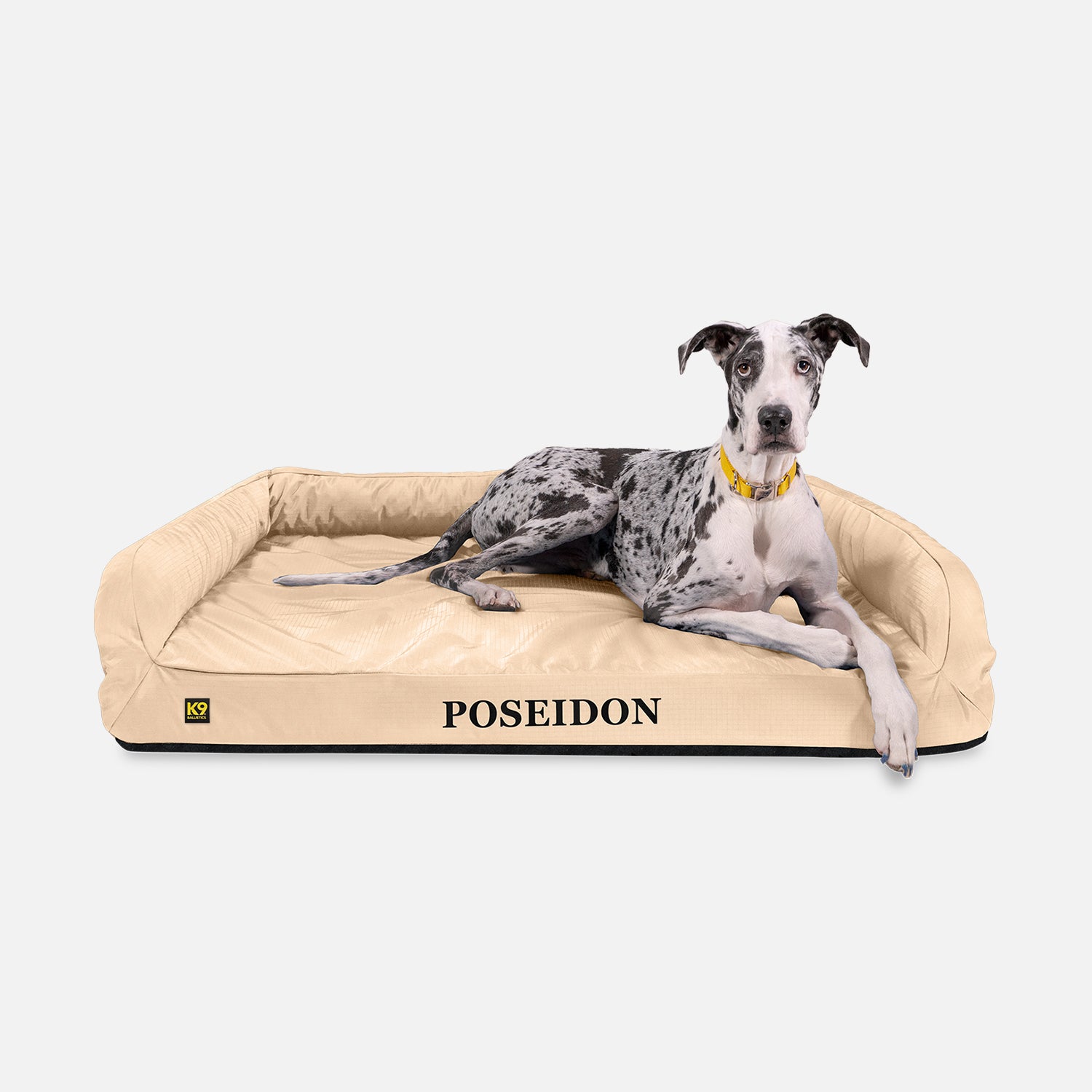
K9 Ballistics Tough Orthopedic Dog Bed
K9 Ballistics Tough Orthopedic Dog Bed is the chew-resistant pick for dogs who have destroyed conventional beds — not just chewed, but fully disemboweled the foam. The ripstop ballistic nylon cover is the most puncture-resistant fabric in this comparison, and the 120-day chew guarantee (K9 Ballistics replaces the cover if destroyed within 120 days) provides an unusual consumer protection for owners with destructive dogs. The 4-inch two-layer foam system (1-inch comfort layer over 3-inch support foam) is the thickest in this comparison and provides genuine orthopedic support for large breeds. The honest weaknesses: ballistic nylon is not soft — dogs accustomed to microvelvet will initially reject the harder surface texture; Japan-market distribution is limited to US shipping with import cost premium.
Pros
- ✓Ripstop ballistic nylon cover — most puncture and tear-resistant in this comparison
- ✓120-day chew guarantee: K9 Ballistics replaces the cover if destroyed
- ✓4-inch two-layer foam: thickest orthopedic foam in this comparison
- ✓Disclosed foam system (1-inch comfort + 3-inch support) — transparent spec
Cons
- ✗Ballistic nylon surface is hard — dogs preferring soft fleece may initially reject it
- ✗US-primary distribution adds Japan import cost premium
Score breakdown
| Orthopedic foam density | 4-inch two-layer (1-inch comfort + 3-inch support base) |
| Washable cover | Yes — ballistic nylon, machine washable |
| Non-slip bottom | Yes — rubber base |
| Size chart | Small to XX-Large (up to 130 cm × 100 cm) |
Which one is right for you?
For senior dogs with arthritis or joint disease
FurHaven Orthopedic Sofa Dog Bed
3-inch egg-crate orthopedic foam base with removable bolsters, washable microvelvet cover, and the most accessible price for a true orthopedic foam design in this comparison.
For dogs who overheat at night
Casper Dog Bed
Open-cell foam structure with mesh sides allows airflow around the sleeping surface — the most thermally neutral bed in this comparison.
For anxious dogs who dig and circle
Bedsure Calming Donut Dog Bed
Round donut design with raised rim for head-resting, shag faux-fur interior that calms self-soothing behaviors in anxious dogs.
For owners wanting a Japan-domestic size-calibrated sofa design
dog-bed-iris-pet-sofa-jp
Iris Pet sofa beds are sized for Japanese small and medium breeds with precise centimeter dimensions, washable cover, and non-slip base calibrated for tatami and smooth wood flooring.
For chewers and dogs with destructive habits
K9 Ballistics Tough Orthopedic Dog Bed
Chew-resistant ripstop ballistic nylon cover, 4-inch orthopedic foam, and a 120-day chew guarantee — the only bed in this comparison with a documented destruction resistance warranty.
Orthopedic foam: what the term actually means and what density to look for
The term 'orthopedic' is not regulated for dog beds — any manufacturer can apply it to any foam without meeting a defined standard. In practice, meaningful orthopedic support requires foam with sufficient density and ILD (Indentation Load Deflection) rating: density measures how much material is in the foam per cubic meter (higher density = more durable, slower to compress permanently), and ILD measures how firm the foam feels under load (higher ILD = firmer). For comparison: budget polyester fiberfill beds have essentially no lasting orthopedic value because the fiberfill compresses flat within weeks; egg-crate foam (the bumpy surface foam used in medical mattress toppers) provides better pressure distribution than flat foam at the same density; memory foam provides contouring support but can retain heat; high-density base foam with a comfort layer on top is the design used in human orthopedic mattresses and is the most effective for supporting arthritic joints in large dogs.
For large dogs over 25 kg, minimum acceptable foam density for lasting orthopedic support is approximately 40 kg/m³ (2.5 lb/ft³ in US units). Budget beds rarely disclose foam density — a useful red flag. At densities below 30 kg/m³, foam compresses permanently within 6-12 months of daily use, creating a central depression that provides no more support than the floor. The K9 Ballistics and Casper dog beds both disclose foam specifications; FurHaven uses egg-crate foam with bolsters that provide reasonable support for medium dogs but is less robust for dogs over 35 kg. If your dog has diagnosed hip dysplasia, spondylosis, or elbow/shoulder arthritis, ask your veterinarian whether a specific foam firmness level is indicated.
Washable covers: what washing machine compatibility actually requires
All five beds in this comparison have machine-washable covers — this is now the baseline specification rather than a premium feature. The meaningful differentiators within 'washable' are: zipper quality (plastic teeth zippers fail after 3–5 wash cycles on high-agitation machines; metal tooth zippers handle indefinite washing), cover shrinkage (polyester covers hold size; cotton-blend covers shrink 3–5% on the first hot-water wash, which can make them tight to zip back on the foam insert), and whether the foam insert itself can be cleaned. Most covers can go in a domestic washing machine; foam inserts cannot — the agitation tears the foam cell structure. The practical implication: washing frequency should be determined by the cover only, and the cover must zip off cleanly every time. Covers with velcro-only closures develop debris buildup after a few cycles that prevents full closure.
Washing frequency for a dog bed cover in daily use: weekly is ideal for dogs with skin conditions, post-surgery recovery, or allergies; bi-weekly is practical for healthy adult dogs; monthly is the minimum for any dog who uses the bed as a primary sleeping spot. Dogs who go outdoors transfer soil, pollen, and fecal bacteria to bed covers — these accumulate significantly over 4 weeks of uninterrupted use. The laundry logistics matter: a cover that zips off in 30 seconds and goes directly into the washing machine gets washed weekly; a cover that requires removing bolsters, unzipping multiple sections, and reassembling gets washed monthly and the dog sleeps on a progressively less hygienic surface.
Non-slip bottoms and size accuracy: the two specs most often misrepresented
Non-slip bottoms in dog beds work through one of two mechanisms: rubberized dots or strips that create friction against smooth floors (the most common design), or a solid rubberized mat fused to the base fabric. Rubberized dots are less effective on smooth hardwood or tile than rubberized mats — a dog that shifts position quickly or launches off the bed to bark at the door will slide a dot-pattern bed even on hardwood. For homes with smooth wood or tile floors, this distinction matters more than it does in carpeted homes. Iris Pet specifically calibrates their non-slip base for Japanese flooring materials.
Size chart accuracy is systematically overstated in dog bed marketing. A bed listed as 90 cm × 70 cm frequently measures 85 cm × 65 cm in the usable sleeping area after the bolster frame takes up the perimeter. For dogs measured as needing a specific sleeping surface dimension (nose to tail plus 20–30 cm for stretching), you should add 10 cm to the listed dimensions when selecting a size. The practical check: measure your dog from tip of nose to base of tail while the dog is lying stretched out, then add 25 cm. That is your minimum usable sleeping surface. The most common mistake is buying a 'medium' bed based on the dog's weight and receiving a bed where the dog's back legs hang off the end.
Where each fits
FurHaven Orthopedic Sofa Bed is the accessible-price orthopedic pick for medium dogs and senior dogs who need joint support without a premium budget. The 3-inch egg-crate foam base distributes weight more evenly than flat foam, the bolster walls provide optional head-resting surfaces and reduce drafts along the floor, and the microvelvet cover zips off in seconds for washing. Available in sizes from Small (56×46 cm sleeping area) through Jumbo (122×91 cm). The honest weakness: egg-crate foam at this price point has a density suitable for dogs up to approximately 30 kg before the foam begins compressing permanently; large and giant breeds need the higher-density foam in the K9 Ballistics or Casper beds.
Casper Dog Bed is the premium open-cell foam pick with the most sophisticated thermal performance in this comparison. The open-cell foam structure allows airflow through the foam rather than trapping body heat, which matters for dogs who consistently overheat at night — a common complaint during humid summer months. The surrounding mesh bolster wall enhances airflow further. Memory foam top layer provides contouring pressure relief. Durable canvas cover in machine-washable design. The honest weakness: Casper is among the most expensive products in this comparison, uses Casper's human-mattress foam technology translated to dog scale, and the price premium over FurHaven is significant — for a dog that doesn't have identifiable heat retention or arthritis issues, the premium is harder to justify on function alone.
Bedsure Calming Dog Bed is the anxiety and self-soothing pick for dogs who circle, dig, and seek enclosed sleeping spaces. The round donut design with raised rim provides the den-like enclosure that self-soothing behaviors are seeking, and the shag faux-fur interior surface has a documented calming effect in dogs with separation anxiety or generalized anxiety — the texture approximates the tactile sensation of dog-to-dog contact. Machine-washable microfiber cover. The honest weakness: round beds provide less usable surface area per square centimeter of footprint than rectangular beds, which means a dog who stretches fully when sleeping (most large breeds) will not use the intended sleeping posture this bed encourages. Calming beds are appropriate for dogs who sleep curled; they are wasted on dogs who sprawl.
Iris Pet Sofa Bed is the Japan-domestic pick sized for Japanese companion breeds. Iris Ohyama's pet division produces sofa-style beds in centimeter increments calibrated for the companion breeds it targets (Toy Poodle, Chihuahua, Miniature Dachshund, Shiba, Corgi, French Bulldog). The non-slip base is tested on Japanese lacquer-finished hardwood flooring, which is distinct from Western softwood floors and requires a different rubber compound hardness for effective grip. Washable polyester cover, zippered, and available in Japanese pastel colorways that fit Japanese interior design aesthetics. Available at Iris Ohyama online and at major pet specialty chains. The honest weakness: foam density is not disclosed, which is a transparency gap; the primary value is the Japanese sizing accuracy and domestic availability.
K9 Ballistics Tough Orthopedic Dog Bed is the chew-resistant pick for dogs who have destroyed previous beds. The ripstop ballistic nylon cover is the most puncture and tear-resistant fabric in this comparison, and the 120-day chew guarantee (K9 Ballistics will replace the cover if destroyed within 120 days) provides an unusual consumer warranty. The 4-inch orthopedic base foam is the thickest in this comparison and is disclosed as a two-layer system (1-inch comfort layer over 3-inch support foam), which provides genuine joint support for large breeds. The honest weakness: the ballistic nylon cover is durable but not soft — dogs accustomed to microvelvet or fleece may initially reject the harder surface; and the bed is available primarily through US distribution, with Japan-market shipping adding meaningful cost.
:max_bytes(150000):strip_icc():focal(749x0:751x2)/brooklinen-classic-percale-hardcore-sheet-bundle-d81b98ea19794739a188a6ea55ced992.jpg)