Best Water Filter Pitcher 2026: Brita vs PUR vs ZeroWater
Five water filter pitchers from $25 to $100. What each actually removes from tap water, how much the filters cost annually, and which pitcher is right for your tap water quality.
Contaminant reduction claims were cross-checked against NSF International certification records and independent third-party testing reports published by consumer testing organizations. Annual filter cost estimates are based on manufacturer replacement schedules and retail pricing as of May 2026. Flow rate assessments draw from structured owner review analysis.

Brita Standard 10-Cup Water Filter Pitcher
Best Overall: Brita Standard 10-cup is the default pick for households that want reliable chlorine and taste improvement at low cost. NSF 42 certified for chlorine, taste, and odor, with the Longlast+ filter upgrade adding NSF 53 lead coverage.
Top picks ↓| Product | Price | Link |
|---|---|---|
| 23〜30 | View deal → | |
| 28〜35 | View deal → | |
| 40〜50 | View deal → | |
| 45〜75 | View deal → | |
| 90〜110 | View deal → |
Top picks
Related articles

Brita Standard 10-Cup Water Filter Pitcher
Brita Standard 10-cup is the default pick for households that want reliable chlorine and taste improvement at low cost. NSF 42 certified for chlorine, taste, and odor, with the Longlast+ filter upgrade adding NSF 53 lead coverage. Filter replacement is the widest-available of any pitcher in this comparison — sold in supermarkets, drugstores, and through major online retailers. The flow rate is fast, the pitcher fits most refrigerator door shelves, and the filter status indicator removes the guesswork from replacement timing. The honest limitation: NSF 42 covers chlorine and taste; it does not cover lead, pharmaceuticals, or PFAS, which the more expensive options in this comparison address.
Pros
- ✓NSF 42 certified; Longlast+ filter adds NSF 53 lead coverage
- ✓Widest filter replacement availability — supermarkets, drugstores, Amazon
- ✓Fast flow rate and refrigerator-door-compatible dimensions
- ✓Electronic filter status indicator removes replacement guesswork
Cons
- ✗Standard filter is NSF 42 only — no lead or emerging contaminant coverage
- ✗Monthly filter replacement needed at standard capacity — costs add up
Score breakdown
| Capacity | 10 cups (~2.4 L) |
| Filter life | 40 gallons / 2 months |
| Contaminants reduced | Chlorine (taste & odor), mercury, copper, cadmium, zinc — NOT lead |
| Certification | NSF/ANSI 42 certified (chlorine taste & odor); NOT certified for lead |
| Filter type | Activated carbon + ion exchange resin |

PUR Plus 11-Cup Lead-Reducing Water Filter Pitcher
PUR Plus 11-cup is the right pick when lead is a specific concern — it is NSF 53 certified for lead reduction alongside NSF 42 for chlorine, at a price point only $5 above the base Brita. The MAXION filter technology combines activated carbon with ion exchange resin, addressing a broader range of contaminants than activated carbon alone. The 11-cup capacity is slightly larger than the Brita Standard. The honest limitation is filter replacement cost: at around $15 per filter lasting 40 gallons, annual cost runs higher than Brita's Longlast+ option. The filter is also slightly slower than Brita, which some owners flag in reviews. For households near older plumbing infrastructure where lead leaching is a genuine risk, PUR Plus is the right budget-conscious upgrade from Brita.
Pros
- ✓NSF 42 and 53 certified — adds lead coverage over base Brita
- ✓MAXION ion exchange resin addresses more contaminants than carbon alone
- ✓11-cup capacity — slightly larger than Brita Standard
- ✓Available widely through major retailers
Cons
- ✗Annual filter cost higher than Brita Longlast+ at equivalent coverage
- ✗Slightly slower flow rate than Brita
Score breakdown
| Capacity | 11 cups |
| Filter life | 40 gallons / 2 months |
| Contaminants reduced | 20+ substances incl. chlorine, mercury, copper, zinc, microplastics, lead |
| Certification | NSF/ANSI 42, 53 & 401 certified; WQA certified for lead reduction |
| Filter type | Activated carbon + ion exchange (MAXION) |

ZeroWater 10-Cup 5-Stage Water Filter Pitcher with TDS Meter
ZeroWater 10-cup is the pick for households who want total dissolved solids removed to measurable near-zero levels and want to track it. The 5-stage ion exchange filtration brings TDS from typical tap levels (100-400 ppm) to 0-2 ppm — included TDS meter lets you measure this directly. NSF 42 and 53 certified. The taste is noticeably flat compared to mineral-containing water, which some people prefer and others dislike. Filter cost is the highest in this comparison at around $30 per filter, with shorter lifespan in high-TDS source water areas where the ion exchange medium exhausts faster — annual cost can exceed $200. For households with high-mineral or high-hardness tap water, ZeroWater is uniquely positioned to address it.
Pros
- ✓5-stage ion exchange reduces TDS to near-zero — unique in this comparison
- ✓Includes TDS meter to measure and verify filtration performance
- ✓NSF 42 and 53 certified for chlorine and lead
- ✓Addresses hard water mineral content other pitchers don't
Cons
- ✗Ultra-filtered water tastes flat — mineral content that makes water taste refreshing is removed
- ✗Filter lifespan shorter in high-TDS areas — annual cost can exceed $200
Score breakdown
| Capacity | 10 cups |
| Filter life | Varies with TDS (~25–40 gallons typical) |
| Contaminants reduced | Removes 99.6% of TDS; lead, chromium, mercury, PFOA/PFOS |
| Certification | IAPMO certified to NSF/ANSI 42 & 53 (lead, chromium, PFOA/PFOS) |
| Filter type | 5-stage ion exchange + activated carbon |
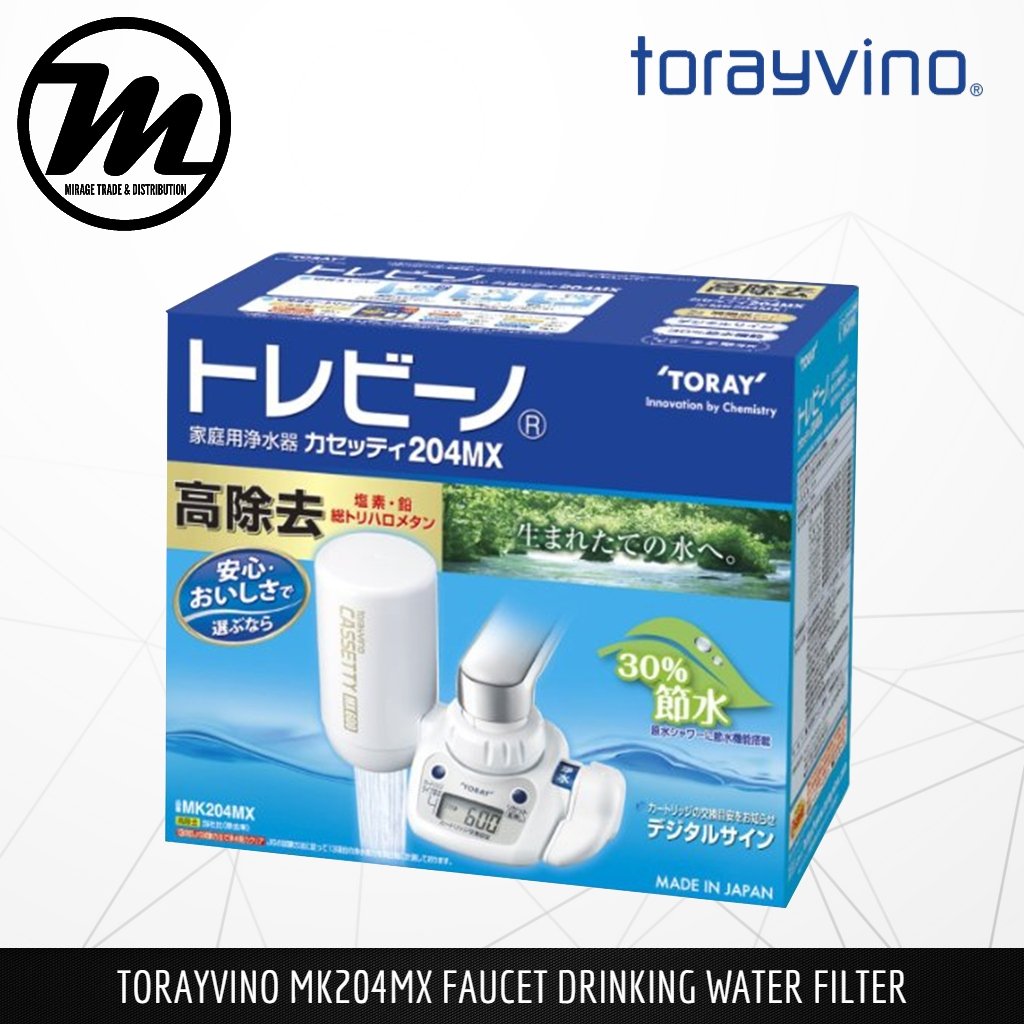
Torayvino Pitcher Water Purifier
Torayvino pitcher by Toray Industries uses hollow-fiber membrane filtration developed from industrial water treatment technology — a materially different approach from the activated carbon used in Brita, PUR, and ZeroWater. The 2026 filter is certified under JIS standards equivalent to NSF 42 and 53, with updated emerging contaminant coverage added in 2025. Filter lifespan of 400L per cartridge produces the lowest annual filter cost in this comparison. The flow rate is slower than Brita — this is a consistent owner complaint. Filter cartridges are sold in major supermarkets, drugstores, and electronics retailers, making replacement practical without special ordering. For households who want domestic-brand technical credentials and a service network, Torayvino is the right pick.
Pros
- ✓Hollow-fiber membrane technology from Toray's industrial filtration expertise
- ✓Lowest annual filter cost in this comparison
- ✓Filter replacement available at supermarkets, drugstores, electronics retailers
- ✓2026 filter updated to cover wider emerging contaminant range
Cons
- ✗Slower flow rate than Brita — owner reviews consistently flag this
- ✗JIS certification equivalent rather than US NSF certification may not satisfy some buyers
Score breakdown
| Capacity | 1.1 L filtered (1.9 L total) |
| Filter life | 200 L / 2 months (at 3 L/day) |
| Contaminants reduced | 17 substances (JIS 16 items + PFOS/PFOA) |
| Certification | JIS S 3201 compliant; no NSF/WQA certification (JP market product) |
| Filter type | Activated carbon + ion exchange media |
Clearly Filtered Water Filter Pitcher
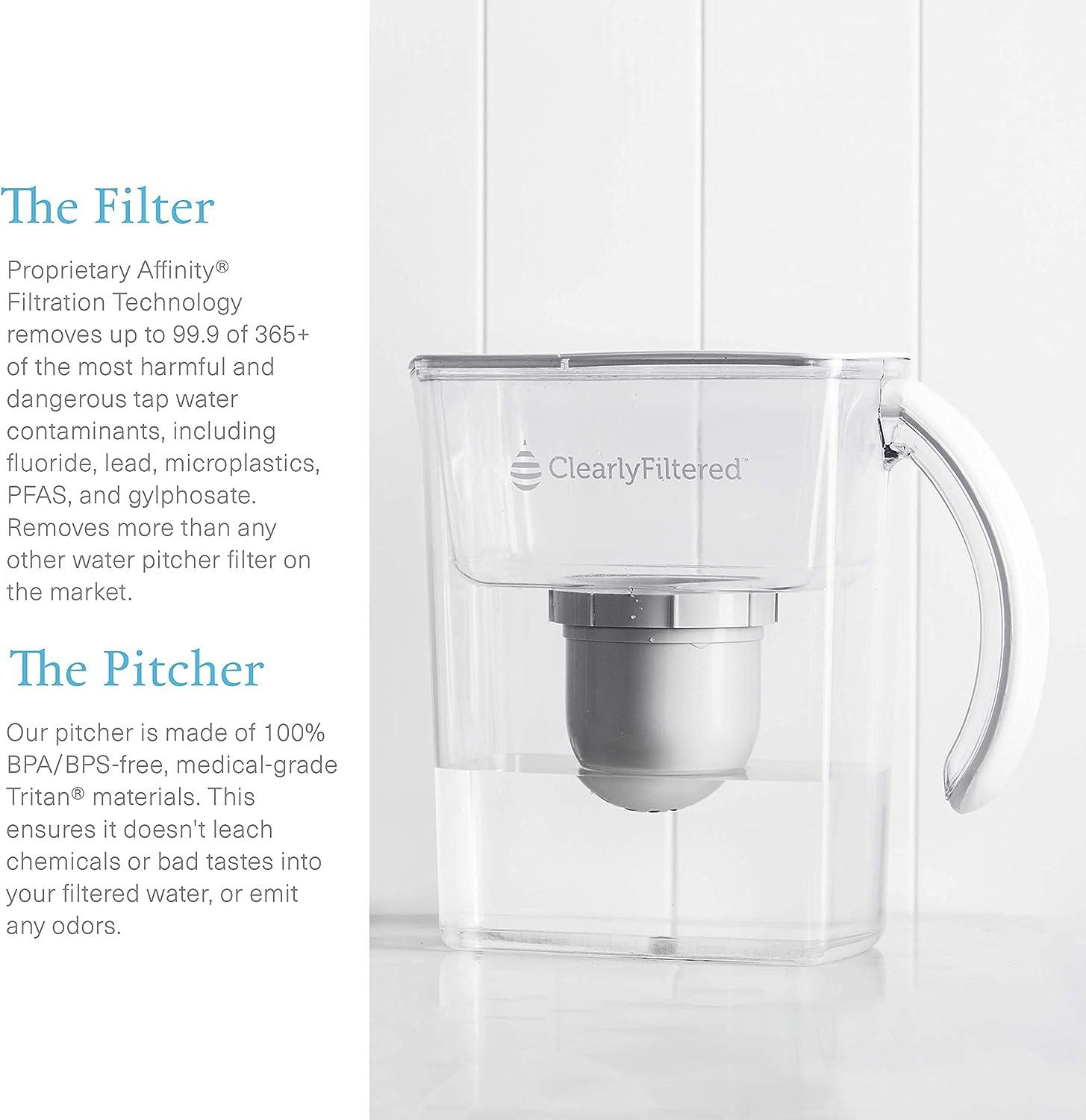
Clearly Filtered pitcher is the premium option for households tracking specific contaminants — the only pitcher in this comparison certified under NSF P473 for PFAS reduction and NSF 401 for pharmaceuticals, alongside NSF 42 and 53. Following 2024 EPA PFAS regulations, this is the certification that differentiated Clearly Filtered from the field. The Affinity Filtration Technology layers activated carbon, ion exchange resin, and mechanical filtration stages. At $100 purchase price and $45 per filter lasting 100 gallons (annual cost around $160), it's the most expensive option in this comparison by a significant margin. For households with specific contamination concerns — near industrial sites, on wells, or simply tracking PFAS coverage — the certification portfolio justifies the premium.
Pros
- ✓Certified NSF 42, 53, 244, 401, and P473 — broadest coverage in this comparison
- ✓Only pitcher here certified for PFAS reduction (NSF P473) after 2024 EPA changes
- ✓100-gallon filter life is longer than most pitchers in this comparison
- ✓Covers pharmaceuticals and emerging contaminants other pitchers don't
Cons
- ✗$100 purchase price and $160 annual filter cost is the highest in this comparison
- ✗PFAS coverage is only necessary in specific geographic and source water contexts
Score breakdown
| Capacity | 10 cups (80 oz / ~2.36 L filtered reservoir) |
| Filter life | 100 gallons / ~4 months |
| Contaminants reduced | 365+ contaminants up to 99.99% (fluoride, PFAS, lead, chlorine, microplastics) |
| Certification | NSF certified to NSF/ANSI 42 & 372; independently lab-tested to NSF/ANSI 53 & 401 protocols (not formally certified to 53/401) |
| Filter type | Coconut-shell activated carbon block (proprietary multi-media blend) |
Which one is right for you?
For most households wanting reliable chlorine and taste improvement
Brita Standard 10-Cup Water Filter Pitcher
Brita Standard is the most widely available filter pitcher with low annual filter cost, certified chlorine and particulate reduction, and the widest replacement filter availability worldwide.
For households concerned about lead and heavy metals
PUR Plus 11-Cup Lead-Reducing Water Filter Pitcher
PUR Plus is NSF 53 certified for lead reduction alongside chlorine and sediment — meaningfully more contaminant coverage than the Brita Standard at a similar price.
For households wanting dissolved solids measured to zero
ZeroWater 10-Cup 5-Stage Water Filter Pitcher with TDS Meter
ZeroWater uses a 5-stage ion exchange system that reduces TDS (total dissolved solids) to near-zero — the only pitcher in this comparison that does so, and it includes a TDS meter.
For households wanting a domestic-brand alternative
Torayvino Pitcher Water Purifier
Torayvino uses hollow-fiber membrane filtration developed by Toray Industries, with NSF-equivalent JIS certification and a wide service network — the domestic-brand alternative with genuine technical credentials.
For households with specific contamination concerns and budget for premium filtration
Clearly Filtered Water Filter Pitcher
Clearly Filtered at $100 is NSF 42, 53, 244, 401, and P473 certified — the broadest contaminant coverage in this comparison including pharmaceuticals and PFAS compounds.
How we compared
Water filter pitchers are a category where marketing claims dramatically outrun verified performance. 'Removes 99% of contaminants' is a meaningless statement without specifying which contaminants, at which starting concentration, under what test conditions. We structured our comparison around NSF International certification as the baseline — NSF 42 covers chlorine, taste, and odor; NSF 53 covers health-affecting contaminants including lead; NSF 244 covers emerging contaminants like pharmaceuticals; NSF P473 covers PFAS compounds. A pitcher certified under NSF 53 for lead has passed standardized testing; one that only claims 'reduces heavy metals' without certification has not.
Annual filter cost matters more than purchase price for most households. A $25 pitcher with $40-per-year filter replacements costs more over three years than a $50 pitcher with $25-per-year replacements. We calculated annual filter cost at the manufacturer's recommended replacement schedule (typically 40-60 gallons per filter) and retail pricing from major online retailers as of May 2026. Flow rate — how fast water passes through the filter — is an underrated usability factor: pitchers that take 8-10 minutes to filter a full pitcher have meaningfully worse daily usability than 3-4 minute pitchers, and this shows up clearly in owner reviews.
What changed in 2026
Two shifts shaped the 2026 pitcher market. First, PFAS (per- and polyfluoroalkyl substances, sometimes called 'forever chemicals') moved from a fringe concern to mainstream coverage following EPA regulation changes in 2024 that set maximum contaminant levels for several PFAS compounds in US drinking water. This created demand for pitchers that specifically address PFAS — which most standard pitcher filters do not. Clearly Filtered is currently the only pitcher in this comparison with NSF P473 certification for PFAS reduction. Second, Japanese pitcher filtration standards were updated in 2025 to include new emerging contaminant categories, prompting Toray to update its Torayvino filter cartridge specification. The 2026 Torayvino cartridge is rated for a wider range of contaminants than the 2023-2024 version.
Brita updated its Longlast+ filter in 2025 to add NSF 401 certification (emerging contaminants) to its existing NSF 42 and 53 certifications, closing part of the gap with Clearly Filtered. The standard Brita filter (not Longlast+) remains NSF 42 only. If you're using a Brita, the distinction between the standard filter and the Longlast+ filter matters: they look similar but have materially different certifications.
Where each fits
Brita Standard 10-cup at around $25 is the right pick if your tap water smells or tastes of chlorine and you want reliable improvement at low cost. The Brita Standard filter is NSF 42 certified for chlorine, taste, and odor reduction — not NSF 53 for lead, not NSF 401 for pharmaceuticals, just the basics. The filter lasts 40 gallons / approximately 1 month of typical household use, at around $7 per filter, putting annual cost at roughly $84 for the standard filter. The Longlast+ filter (sold separately, same pitcher) is NSF 42 and 53 certified, costs around $18 per filter, but lasts 120 gallons — roughly 3 months — reducing annual cost to $72 while adding lead coverage. The honest limitation: Brita coverage ends at the basics. For households on municipal water systems where lead is not a concern, this is likely sufficient. For households near older plumbing infrastructure where lead leaching from pipes is possible, the standard Brita is not the right tool.
PUR Plus 11-cup at around $30 is the right pick if lead is a specific concern. PUR Plus is NSF 53 certified for lead alongside NSF 42 for chlorine — meaningfully more coverage than the base Brita for a similar price. The MAXION technology combines activated carbon with ion exchange resin that addresses more contaminants than activated carbon alone. Filter lifespan is 40 gallons at around $15 per filter, putting annual cost at around $180 — higher than Brita. The honest limitation: PUR Plus filter replacement cost is the highest among the volume-per-filter calculation, and the filter housing is rigid enough that it can feel slow compared to Brita.
ZeroWater 10-cup at around $45 is the right pick for households that want dissolved solids removed to the lowest possible level and want to measure it. The 5-stage filtration combines activated carbon and ion exchange resin to reduce TDS (total dissolved solids) to near-zero — water that registers 0-2 parts per million on the included TDS meter, compared to typical tap water at 100-400 ppm in most US cities. The honest limitation: near-zero TDS water tastes flat to many people — mineral content is part of what makes water taste refreshing, and ultra-filtered water can taste like distilled water (which is correct, because the process is similar). Filter cost is the highest in this comparison at around $30 per filter lasting 25-40 gallons depending on source water quality — annual cost can reach $200+ in high-TDS areas.
Torayvino Pitcher at around $40-60 is the domestic-brand pick with genuine technical credentials. Toray Industries developed hollow-fiber membrane filtration technology used in industrial water treatment, and the Torayvino consumer pitcher uses a scaled-down version of that membrane process rather than activated carbon alone. The 2026 filter is NSF-equivalent certified under JIS standards for chlorine, sediment, and an updated list of emerging contaminants. Filter lifespan is 400L per cartridge, putting per-liter filtering cost lower than any US-brand option in this comparison at equivalent volume. Refill speed is slower than Brita, which some owners flag. For households that want domestic-brand support and service, and for whom filter availability at supermarkets and drugstores matters, Torayvino is the practical choice.
Clearly Filtered Pitcher at around $100 is the right pick for households with specific contamination concerns and the budget for premium filtration. Clearly Filtered is certified under NSF 42, 53, 244, 401, and P473 — the broadest certification portfolio of any pitcher in this comparison, including PFAS reduction that no other pitcher here addresses. The pitcher uses an 'Affinity Filtration Technology' that the company describes as a combination of activated carbon, ion exchange resin, and mechanical filtration layers. Filter lifespan is 100 gallons at around $45 per filter, annual cost around $160. The honest limitation: the $100 purchase price and $160 annual filter cost position this as the premium option; the legitimate question is whether your tap water quality requires PFAS coverage, which varies significantly by location and water source.
Verdict
For most households on municipal water systems where the primary concern is taste and chlorine odor, Brita Standard with the Longlast+ filter upgrade covers the practical bases at the lowest total cost. For households near older plumbing where lead is a real concern, PUR Plus adds NSF 53 lead certification at a reasonable price step.
As a domestic-brand alternative, Torayvino earns the pick for filter availability, lower annual cost, and Toray's genuine industrial filtration credentials. For households following PFAS coverage closely after 2024 EPA changes, Clearly Filtered is the only certified option in this comparison. ZeroWater is for the specific buyer who wants measured zero TDS and accepts the taste trade-off.