Best Soundbars 2026: Sonos Arc Ultra vs Q990D vs Beam
Your new TV sounds thin and dialogue gets buried under the soundtrack — that's not your imagination, it's physics. Flat panels have no room for real speakers, and the fix is a soundbar. The hard part is deciding how much of the Dolby Atmos marketing actually reaches your ears in a normal living room.
We compared each soundbar on Dolby Atmos rendering (physical up-firing vs virtualised), dialogue clarity, bass output, room-correction quality, HDMI eARC and input flexibility, and upgrade path. Manufacturer specifications were cross-checked against independent measurements and long-term owner reviews, with weight given to real-room performance over peak lab figures.

Sonos Arc Ultra
Best Overall: The Sonos Arc Ultra is the best single-bar Atmos system you can buy — a 9.1.4 enclosure with fourteen drivers including up-firing height channels and Sonos's new Sound Motion woofer for genuinely deep bass from a slim bar. Trueplay room correction (now on Android too) tunes it to your room, and the multi-level Speech Enhancement is the best here at keeping dialogue intelligible during loud scenes.
Top picks ↓Related articles

Sonos Arc Ultra
The best single-bar Atmos experience — a 9.1.4 enclosure with Sound Motion bass, class-leading speech enhancement, Trueplay tuning, and a clean upgrade path to add a Sub and surrounds later. Single eARC port and the Sonos app are the only real gripes.
The Sonos Arc Ultra is the best single-bar Atmos system you can buy — a 9.1.4 enclosure with fourteen drivers including up-firing height channels and Sonos's new Sound Motion woofer for genuinely deep bass from a slim bar. Trueplay room correction (now on Android too) tunes it to your room, and the multi-level Speech Enhancement is the best here at keeping dialogue intelligible during loud scenes. It grows into a full 9.1.4 setup if you add a Sonos Sub and Era 300 surrounds, all managed by the bar with no receiver. The single HDMI eARC port can't switch sources, and the Sonos app is the ecosystem's weak point, but for one premium bar that sounds excellent alone and upgrades cleanly, nothing else matches it.
Pros
- ✓Class-leading single-bar Atmos with real up-firing drivers
- ✓Best-in-test dialogue clarity and Speech Enhancement
- ✓Sound Motion woofer delivers deep bass from a slim bar
- ✓Clean upgrade path to Sub and wireless surrounds
Cons
- ✗Single HDMI eARC port — no input switching
- ✗Sonos app remains frustrating

Samsung Hw Q990d
The most complete out-of-the-box home theatre — true 11.1.4 with wireless sub and rear speakers, four physical up-firing channels, two HDMI inputs, and Q-Symphony. Buy it for a dedicated room where you can place all four boxes.
The Samsung HW-Q990D is the most complete home-theatre-in-a-box here — a true 11.1.4 system with a large wireless subwoofer and two wireless rear speakers that have their own up-firing and side-firing drivers. Out of the box it produces a genuinely enveloping surround field with real overhead height, not a virtualised approximation. Two HDMI inputs plus eARC let it switch a console and a streamer for you, and Q-Symphony plays it in concert with a compatible Samsung TV's speakers. The cost is four wireless boxes to place and power, rears tied to Samsung's ecosystem, and a roughly $1,000–$1,200 price. Buy it for a dedicated room where the surrounds can go where they belong.
Pros
- ✓True 11.1.4 with wireless sub and rear speakers included
- ✓Four physical up-firing channels for real overhead effects
- ✓Two HDMI inputs — switches sources like a receiver
- ✓Q-Symphony adds the TV's speakers to the soundstage
Cons
- ✗Four boxes to place and power behind seating
- ✗Rear speakers locked to Samsung's ecosystem

Sonos Beam Gen2
The value pick for most living rooms — compact, clear, room-filling sound with virtual Atmos, Trueplay, and the same Sonos upgrade path at half the Arc Ultra's price. Sized for 43–55 inch TVs and small-to-medium rooms.
The Sonos Beam Gen 2 is the right soundbar for most living rooms at around $500. It's a compact bar sized for 43–55 inch TVs that renders Dolby Atmos height cues through psychoacoustic processing rather than physical up-firing drivers — no real overhead throw, but a wide, clear, room-filling sound that dwarfs any TV's built-in speakers. It carries the full Sonos toolkit: Trueplay tuning, excellent speech enhancement, AirPlay 2, and the same upgrade path to add a Sub Mini and surrounds. In small-to-medium rooms its size is a feature. The single eARC port and virtual-only Atmos are the limits, but as a half-price entry into the Sonos ecosystem it's the smart buy.
Pros
- ✓Compact size disappears under 43–55 inch TVs
- ✓Trueplay tuning and strong dialogue clarity
- ✓AirPlay 2 and the full Sonos upgrade path
- ✓Half the price of the Arc Ultra
Cons
- ✗Virtualised Atmos — no real overhead effect
- ✗Single eARC port, no input switching
Vizio M Series Elevate
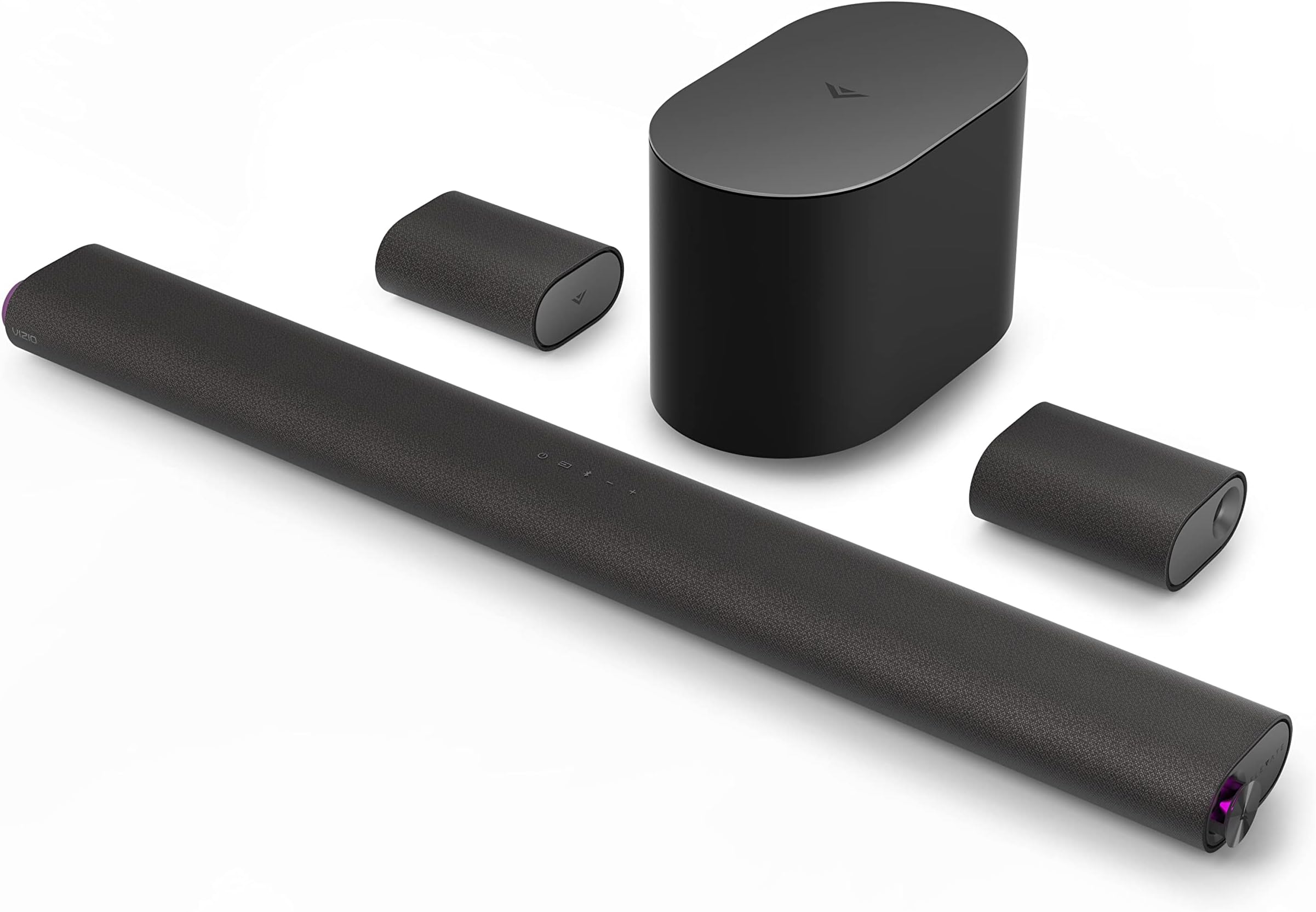
A strong budget-to-mid Atmos option with rotating up-firing drivers and an included subwoofer and rears, often heavily discounted. Less refined software and tuning than Sonos or Samsung, but the most physical channels per dollar.
The Vizio M-Series Elevate is the most physical channels per dollar in this comparison and the budget-to-mid Atmos pick, frequently discounted well below its list price. It ships with rotating up-firing drivers that pivot upward for Atmos content and forward for stereo, plus an included wireless subwoofer and rear speakers — a real surround package for far less than Sonos or Samsung. The trade-off is software and tuning: there's no Trueplay-grade room correction, the app and EQ are basic, and refinement lags the premium bars. If you want a complete physical surround system on a tight budget and don't mind rougher edges, it's a lot of hardware for the money.
Pros
- ✓Rotating up-firing drivers for real Atmos height
- ✓Subwoofer and rear speakers included
- ✓Frequently discounted — strong value
- ✓Complete physical surround package
Cons
- ✗Basic room correction and EQ vs Sonos/Samsung
- ✗Less refined overall sound and app

Yamaha Sr C30a
The honest small-room and bedroom pick — a compact bar with a wireless subwoofer, clear dialogue mode, and a low price. No real Atmos and no input switching, but a clean, simple upgrade over TV speakers where space and budget are tight.
The Yamaha SR-C30A is the honest small-room, bedroom, and tight-budget pick. It's a compact bar bundled with a wireless subwoofer, a Clear Voice dialogue mode, and Bluetooth, at a price well under the premium bars. It does not do Atmos and won't switch HDMI sources, but for upgrading a small TV's thin built-in speakers it delivers clear dialogue and welcome low-end weight without dominating the room. Set realistic expectations — this is a clean, simple step up, not a home theatre — and it's an easy recommendation where space and money are limited.
Pros
- ✓Wireless subwoofer included at a low price
- ✓Clear Voice mode for dialogue
- ✓Compact — ideal for bedrooms and small rooms
- ✓Simple setup, Bluetooth streaming
Cons
- ✗No Dolby Atmos
- ✗No HDMI input switching
Which one is right for you?
For the best single bar that upgrades over time
Sonos Arc Ultra
Class-leading single-bar Atmos and dialogue clarity now, with a clean path to add a Sub and wireless surrounds for a full 9.1.4 system later — no receiver required.
For a dedicated movie room with the biggest sound
Samsung Hw Q990d
A true 11.1.4 package with wireless sub and rears in the box gives the most enveloping out-of-the-box home theatre, with HDMI input switching as a bonus.
For most living rooms on a sensible budget
Sonos Beam Gen2
Compact, clear, room-filling Sonos sound at half the Arc Ultra's price, with the same tuning and upgrade path — the right fit for 43–55 inch TVs and medium rooms.
For maximum surround hardware on a budget
Vizio M Series Elevate
Rotating up-firing drivers plus an included subwoofer and rear speakers deliver a complete physical Atmos system for far less than the premium bars.
For a bedroom or small room
Yamaha Sr C30a
A compact bar with a wireless subwoofer and a clear dialogue mode is a clean, affordable upgrade over a small TV's speakers without overwhelming the space.
Top pick: Sonos Arc Ultra
The Sonos Arc Ultra is the soundbar to buy if you want the best single-bar Atmos experience without managing a box of satellite speakers and cables. It is a 9.1.4 system in one enclosure — fourteen drivers including up-firing units that bounce height channels off the ceiling — and Sonos's new Sound Motion woofer delivers genuinely deep bass from a bar slim enough to sit in front of a wall-mounted TV. Trueplay room correction (now available on Android as well as iOS) measures your room's acoustics and tunes the output, which matters far more than spec sheets suggest.
Where the Arc Ultra separates itself is dialogue clarity and the upgrade path. The Speech Enhancement feature has multiple levels and is the best in this comparison at keeping voices intelligible during loud action scenes without making everything sound thin. And because it is a Sonos, you can add a Sonos Sub and a pair of Era 300 surrounds later to build a full 9.1.4 setup that the bar manages automatically — no receiver, no calibration disc.
The honest weaknesses: it costs around $1,000, it has a single HDMI eARC port (no passthrough, so it can't switch multiple sources for you), and the Sonos app remains the most-complained-about part of the ecosystem. If you want one premium bar that sounds excellent on its own and grows with you, the Arc Ultra is the pick. If you want maximum theatre impact out of the box, keep reading.
Maximum impact: Samsung HW-Q990D
The Samsung HW-Q990D is the most complete home-theatre-in-a-box in this comparison and the one to buy if you want the biggest sound the night you unbox it. It ships as a true 11.1.4 system: the main bar, a large wireless subwoofer, and two wireless rear speakers that themselves have up-firing and side-firing drivers. That is a genuine surround field with overhead height effects from four physical up-firing channels, not a virtualised approximation. In a dedicated movie room it is dramatically more enveloping than any single bar.
It also wins on connectivity, with two HDMI inputs plus eARC out, so it can sit at the centre of your setup and switch a game console and a streaming box for you — something the Sonos cannot do. Q-Symphony lets it play in concert with the speakers in a compatible Samsung TV rather than muting them, adding even more drivers to the soundstage. SpaceFit room correction handles calibration.
The trade-offs are physical and ecosystem-shaped. You are placing four wireless boxes and running power to the rears, which is a real consideration in a tidy living room or a rental. The wireless rears are tied to Samsung's ecosystem and don't double as music speakers the way Sonos surrounds do. At roughly $1,000–$1,200 it is priced like the Arc Ultra but spends the money on more boxes rather than a better single bar. Buy it for the home theatre; skip it if 'one neat bar' is the goal.
Best value: Sonos Beam (Gen 2)
The Sonos Beam Gen 2 is the right soundbar for most living rooms and the value pick of this group at around $500. It is a compact bar — about 65 cm wide, sized for TVs in the 43–55 inch range — that uses psychoacoustic processing to render Dolby Atmos height cues without physical up-firing drivers. It will not throw sound over your head the way the Arc Ultra or Q990D do, but for a normal-sized room it produces a wide, clear, room-filling sound that is a massive upgrade over any TV's built-in speakers.
It carries the same Sonos advantages: Trueplay tuning, excellent speech enhancement, AirPlay 2, and the same upgrade path to add a Sub Mini and surrounds later. For apartment dwellers and anyone whose TV wall is small, the Beam's size is a feature, not a compromise — it disappears under the screen and still fills the room.
Manage expectations on two fronts: the virtualised Atmos is convincing but not the real overhead effect of a bar with up-firing drivers, and the single HDMI eARC port means no input switching. If your room is small-to-medium and you want the Sonos software and a clear upgrade path at half the price of the Arc Ultra, the Beam Gen 2 is the smart buy.
How to choose: room size, Atmos, and the rear-speaker question
Match the bar to the room, not the spec sheet. A 9.1.4 or 11.1.4 system in a small apartment living room is overkill that you cannot place properly — up-firing drivers need a flat 2.4–3 m ceiling to reflect off, and rear speakers need somewhere to go. For rooms under about 25 m², the Beam Gen 2 or Yamaha SR-C30A is the honest fit. For a dedicated 30 m²+ media room with a normal ceiling, the Q990D's physical surrounds and the Arc Ultra's up-firing array pay off.
Understand what Dolby Atmos actually requires. Real height effects come from up-firing drivers (Arc Ultra, Q990D) bouncing sound off the ceiling, or from in-ceiling speakers you won't be installing. 'Virtual' Atmos (Beam, Yamaha) uses processing to fake the cue — better than nothing, convincing in a small room, but not the same. A vaulted, sloped, or very high ceiling defeats up-firing drivers entirely, in which case spend the money elsewhere.
Decide on rear speakers honestly. The single biggest jump in immersion is real rear channels, which only the Q990D includes in the box. The Arc Ultra and Beam can add them later as a wireless Sonos pair; the Yamaha and Vizio's approach varies. If you will never run wires or place boxes behind the sofa, don't pay for a system built around rears you won't deploy — a great front bar like the Arc Ultra is the better use of the budget.