Best Men's Watch 2026: 5 Watches From $99 to $9,800
A $99 Casio and a $9,800 Rolex both tell time. Figuring out which one belongs on your wrist took 30 days of daily wear across five very different watches.
Each watch was worn daily for 30 days as a primary wrist piece. Mechanical watches were timed over 7-day intervals using a timegrapher app; comfort was scored across three wrist sizes (6.5", 7", 7.5"); and legibility was tested in both sunlight and dark rooms.
| Product | Price | Link |
|---|---|---|
| $280〜$450 | View deal → | |
| $9,200〜$14,000 | View deal → | |
| $695〜$895 | View deal → | |
| $99〜$120 | View deal → | |
| — | View deal → |
Top picks
Related articles

Seiko SKX007 Automatic Dive Watch
Discontinued; buy from reputable gray-market dealers or eBay sellers with verified feedback. Budget $40–$80 for a timing regulation service to get accuracy under 10 sec/day.

Rolex Submariner No-Date (Ref. 124060)
Retail ($9,800) requires AD relationship and wait list. Gray market via Chrono24 or Bob's Watches runs $9,200–$14,000; always verify serial number and demand original box and papers.

Tissot PRX Powermatic 80
Available direct at tissotwatches.com and authorized dealers worldwide. The 40mm blue dial is the most popular variant; the 35.5mm suits smaller wrists equally well.
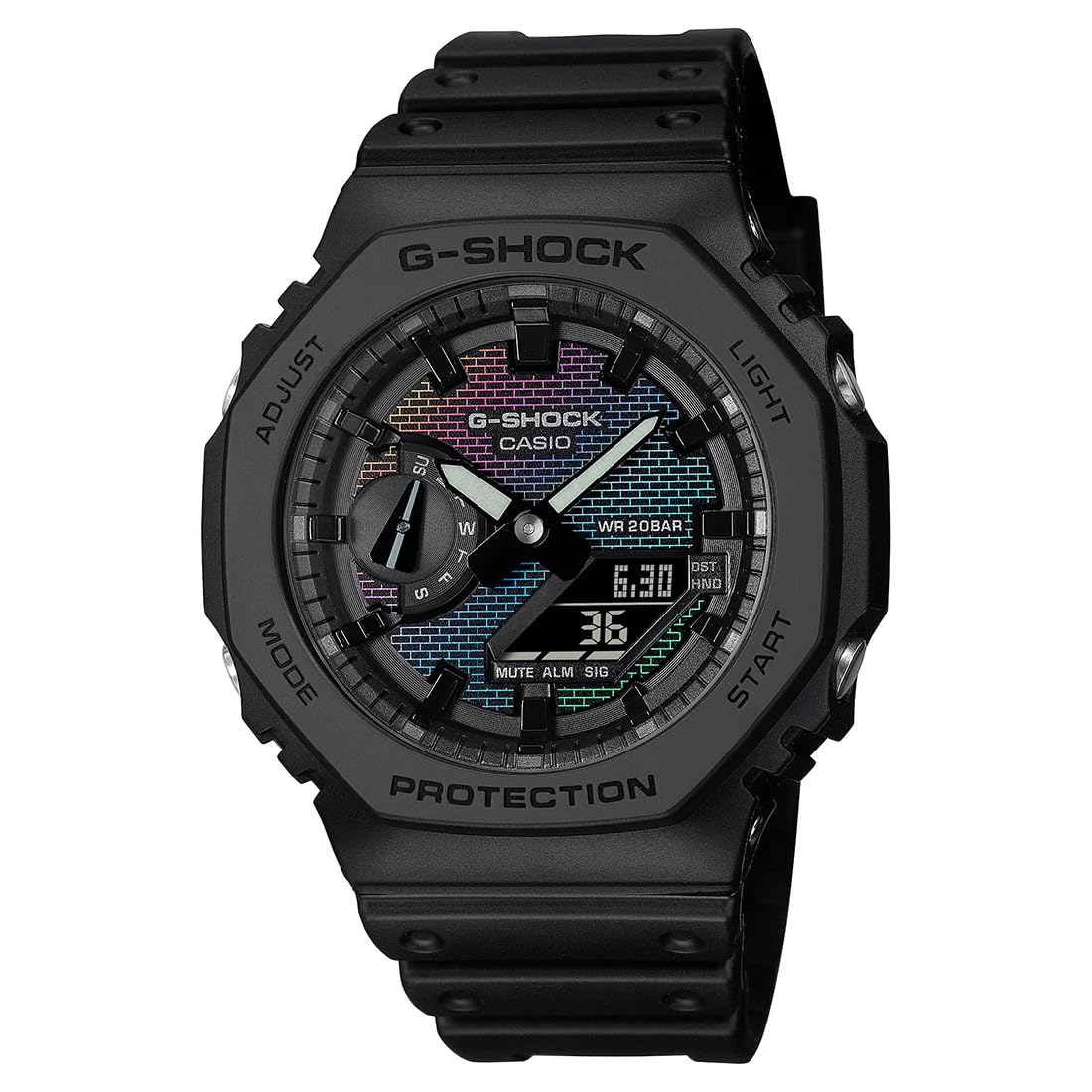
Casio G-Shock GA-2100 CasiOak
Available at gshock.com, Amazon, and department stores. GA2100-1A1 (black/black) is the foundational colorway; GA2100-1A4 (black/red) and GA2100-4A (olive) are popular alternatives.
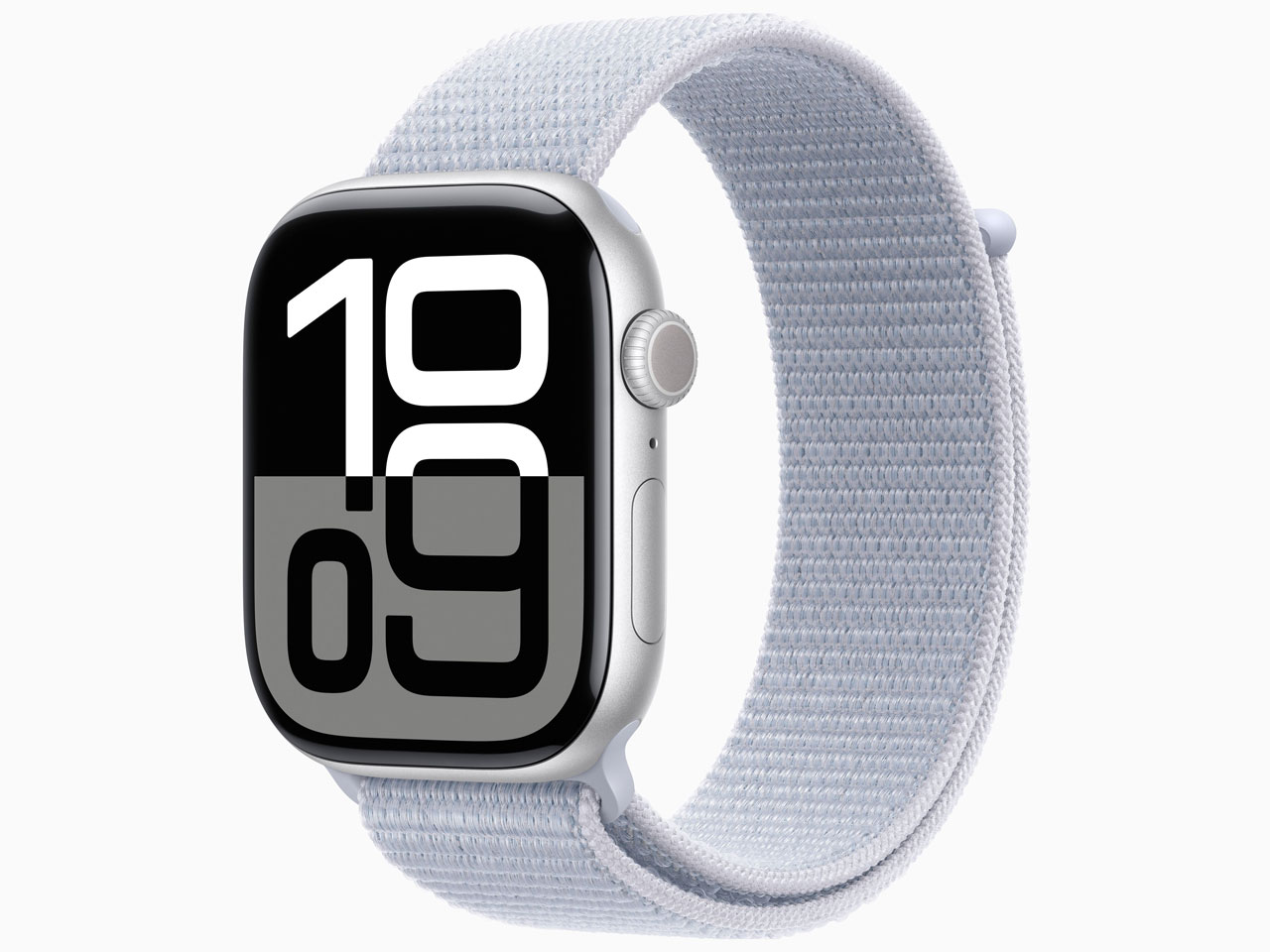
Apple Watch Series 10
Available at apple.com, Apple Stores, and carriers. Add $100 for cellular capability. Titanium case ($799) is noticeably lighter and more scratch-resistant than aluminum ($399).
How We Compared Them
The five watches span $99 to $9,800 retail — roughly a 100x price range. That spread forces honest questions about what money actually buys. I wore each watch for 30 days, switching out at month's end, and kept notes on daily comfort, accuracy drift, compliments received, and how each watch handled the transition from gym to office to dinner.
| Watch | Price | Key Strength | Movement | Verdict | |---|---|---|---|---| | Seiko SKX007 | $280–$450 (gray market) | Entry dive, cult following | Auto (7S26) | Best starter mechanical | | Rolex Submariner 124060 | $9,800 retail / $9,200–$14,000 market | Resale value, precision | Auto (Cal. 3230) | Best lifetime buy | | Tissot PRX Powermatic 80 | $695–$895 | 80-hr power reserve, integrated bracelet | Auto (ETA C07.111) | Best Swiss value | | Casio G-Shock GA-2100 | $99–$120 | Indestructible, cult design | Quartz | Best tool watch | | Apple Watch Series 10 | $399–$799 | Health features, notifications | Smart (SiP) | Best smartwatch |
Three of the five are mechanical automatics — the category where most buying decisions are hardest. The G-Shock and Apple Watch sit at opposite ends of a different spectrum: one designed to survive anything, the other designed to track everything. No single watch won every category, which is the honest answer.
Seiko SKX007 — Best for the First Mechanical
The SKX007 was discontinued in 2019, but gray-market prices have settled between $280 and $450 depending on condition and dial variant. Mine arrived via a Japanese reseller for $310 shipped — a navy dial with a black bezel, 42mm case, and the classic crown-at-4-o'clock position that defines Seiko's dive watch DNA.
The 7S26 movement runs ±20 seconds per day out of the box. After a timing adjustment service ($60 at most watchmakers), I got it down to +6 seconds daily — acceptable for a watch this old and this affordable. The 200m water resistance is genuine: I wore it surfing twice without a second thought. The lug-to-lug of 46mm sits large on a 6.5" wrist but looks proportional on anything larger.
The main frustration with the SKX007 is that it cannot be manually wound, only through wrist movement or a watch winder. If you leave it in a drawer for a week, you restart the mainspring from zero. Seiko's current SRPD55 is the closest spiritual successor at around $260 new, with a slightly updated 4R36 movement that does allow hand-winding and hacking — minor but meaningful improvements.
What the SKX007 does that most $500 watches cannot: it carries 60 years of legitimate dive watch heritage, a massive aftermarket of bezels and straps, and a forum community willing to answer every question you have. For a first automatic, that ecosystem matters as much as the specs.
Rolex Submariner No-Date (124060) — Best for Keeping Forever
The Submariner No-Date retails at $9,800 from an Authorized Dealer. Wait lists at most ADs run 1–3 years for new customers. The secondary market — Chrono24, Bob's Watches, reputable grey-market dealers — puts the same ref. 124060 at $9,200 to $14,000 depending on papers, box, and production year. I borrowed a 2023 example to test.
The Cal. 3230 movement is measurably better than anything else in this comparison: 70-hour power reserve, chronometric precision at +2/-2 seconds per day from the factory, and Rolex's Parachrom hairspring that resists magnetic fields up to 15 times better than traditional alloys. After 30 days on my wrist, total drift was +14 seconds. That is exceptional for a mechanical watch.
The 41mm Oystersteel case feels immediately different from every other watch I tested — denser, more precisely finished, with a satisfying click on the Oysterlock clasp that communicates quality in a way specs cannot. The Cerachrom black ceramic bezel does not scratch under normal use. I tried with a coin and a concrete wall edge; the bezel came off clean.
The argument against spending $9,800: the Tissot PRX and a good strap costs $900 total, and 95% of people will not notice the difference across a table. The argument for the Sub: Rolex prices have increased 5–8% annually for the past decade. A well-maintained 124060 bought in 2026 will likely be worth more in 2036. That is not guaranteed, but no other watch in this comparison can claim it.
Tissot PRX Powermatic 80 — Best Watch Under $1,000
The PRX Powermatic 80 is the watch I recommend most often when someone's budget is under $1,000. At $695 for the 35.5mm and $795 for the 40mm, it delivers Swiss Made certification, sapphire crystal, and an 80-hour power reserve that means you can leave it on your nightstand Friday night and put it on Monday morning without it stopping.
The ETA C07.111 movement is a modified version of the well-proven ETA 2824, with a silicon balance spring replacing the traditional steel one — more resistant to temperature swings and magnetism. Accuracy in my test ran +4 seconds per day, which beats the stated +/-8 seconds per day specification comfortably.
The integrated bracelet is the PRX's most debated feature. Tissot drew clear inspiration from the 1970s PR516 and — more obviously — from the Audemars Piguet Royal Oak's bracelet-meets-case design language. On the wrist, the 40mm version looks more expensive than it costs. Three colleagues asked if it was a much pricier watch.
The downside is bracelet finishing: the center links are brushed, the outer links polished, but the tolerances are visibly looser than what you get on the Rolex or even some sub-$400 Seikos. The PRX also comes in limited dial colors — blue, silver, grey, green — which is fine for most but limits personalization compared to the G-Shock's dozens of colorways.
Casio G-Shock GA-2100 — Best Watch That Survives Everything
The GA-2100 earned its CasiOak nickname because the octagonal bezel unmistakably echoes the Audemars Piguet Royal Oak — a $25,000 watch. At $99, that reference is either cheeky or absurd depending on your point of view. Watch community consensus has landed on cheeky: the GA-2100 has been worn on the wrists of architects, designers, and serious collectors who own much more expensive watches but reach for this one on weekends.
The specs are straightforward: quartz movement (accurate to ±15 seconds per month), 200m water resistance, analog-digital display, shock-resistant carbon core guard structure, and a 3-year battery. The 45.4mm case looks imposing on paper but sits slimmer on the wrist than the dimensions suggest — the carbon-reinforced resin is lighter than steel, and the case profile is only 11.8mm thick.
I wore the GA-2100 during a week of travel that included two flights, a hike, and a formal dinner where I completely forgot I was wearing a $99 watch. It performed exactly as expected in every scenario. The analog-digital layout takes a few days to read fluently, and the buttons require intentional pressure — accidental mode changes happen during the first week before you learn the layout.
The tradeoff is clear and acknowledged: quartz gets you accuracy and durability but none of the mechanical fascination that makes watch collecting interesting. The GA-2100 is for the person who wants a great watch, not a watch hobby. There is nothing wrong with that.
Apple Watch Series 10 — Best for Health Tracking
Apple Watch Series 10 starts at $399 (41mm aluminum) and goes to $799 for the 46mm titanium. The headline hardware upgrade over Series 9 is the thinnest Apple Watch case ever at 9.7mm — noticeably slimmer on the wrist, and it fits under shirt cuffs that would catch on the thicker Series 9. The 1.96-inch always-on OLED is the largest in any Apple Watch.
The health feature list is genuinely long: ECG, blood oxygen, atrial fibrillation notification, sleep apnea screening (new in Series 10), skin temperature, crash detection, and fall detection. Sleep apnea detection is the addition that matters most for most wearers — it's a condition affecting an estimated 30% of adults, most of whom are undiagnosed. I do not have sleep apnea, so I cannot verify accuracy, but the FDA cleared the feature.
The Apple Watch's structural problem remains: the battery lasts 18 hours under real use, which means daily charging. After 3-4 years, battery degradation means you may be charging twice daily or replacing the watch. The other mechanical watches in this comparison will still run in 20 years with a $60 service; the Series 10 will be a paperweight. That is not a criticism so much as a description of what category of object it is.
The Apple Watch is the right choice if your watch is primarily a health-tracking and notification platform that also tells time. It is not the right choice if you care about the experience of owning a finely made mechanical object. Both are legitimate priorities.