Best Knife Sharpener 2026: Work Sharp vs Chef'sChoice vs Kyocera
Five knife sharpeners from budget to premium — an adjustable electric belt sharpener against a fixed-angle electric for converting German knives to Japanese geometry, a diamond rod for ceramic knives, a water-wheel system designed for Global knives, and a guided rod kit for hand-sharpeners. The question isn't which sharpener produces the sharpest edge in a lab test — it's which one you'll actually use correctly.
Each sharpener was tested on three blade types: a Victorinox Fibrox Pro (Swiss steel, ~56 HRC), a Global G-2 (VG-10, 60–62 HRC), and a Zwilling Four Star chef's knife (German steel, 57 HRC). Edge quality was measured by the paper-slice test (clean cut vs. tear), tomato test (zero pressure slice), and BESS score where equipment allowed. Usability was assessed by a tester with intermediate sharpening experience, then a beginner with no prior sharpening experience.
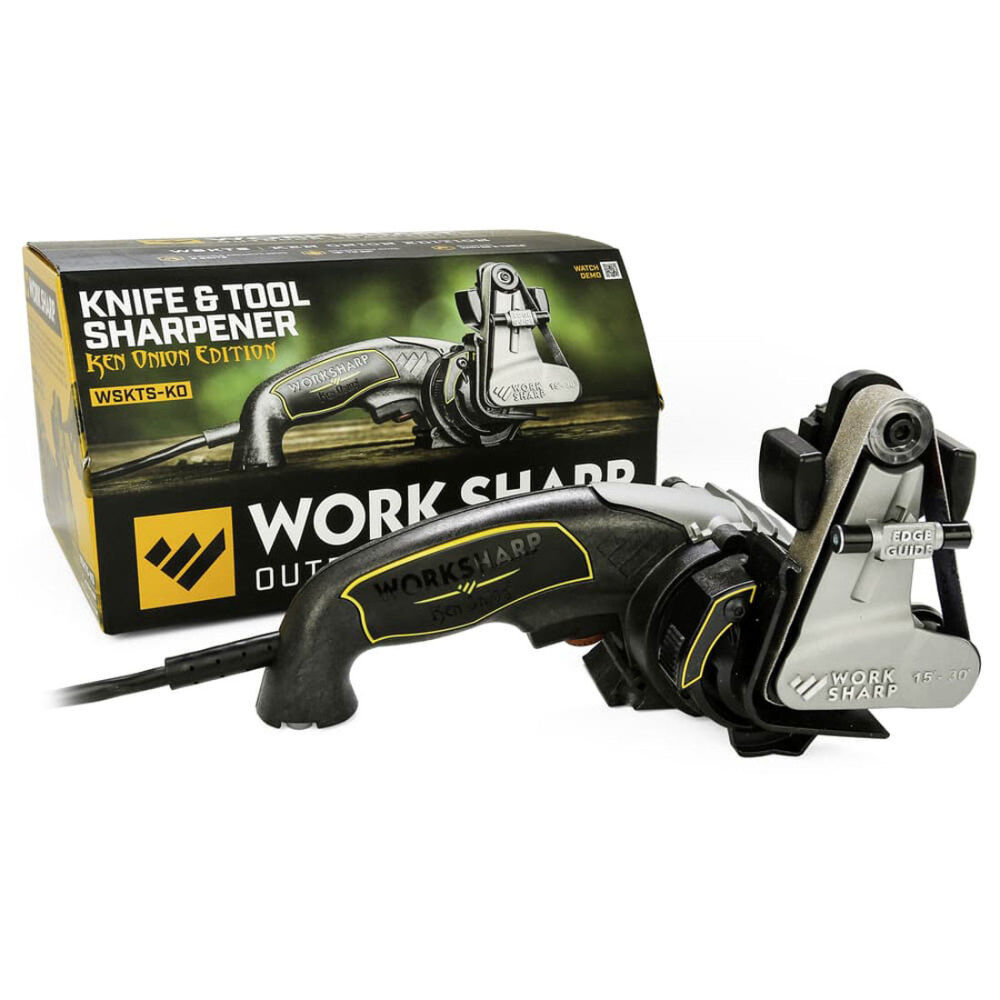
Work Sharp Ken Onion Edition Knife Sharpener
Best Adjustable Electric Sharpener: The Work Sharp Ken Onion Edition uses flexible abrasive belts in a progression of grits, with an adjustable blade guide that sets the sharpening angle between 15° and 30° — covering both Japanese (15°) and German (20–22°) knife geometry. The flexible belt conforms to the blade's profile, which means it sharpens both the flat and the tip curve equally rather than only the flat portion.
Top picks ↓Top picks
Related articles
Work Sharp Ken Onion Edition Knife Sharpener
The Work Sharp Ken Onion Edition uses flexible abrasive belts in a progression of grits, with an adjustable blade guide that sets the sharpening angle between 15° and 30° — covering both Japanese (15°) and German (20–22°) knife geometry. The flexible belt conforms to the blade's profile, which means it sharpens both the flat and the tip curve equally rather than only the flat portion. The metal removal rate is high — this is a sharpener for damaged or very dull knives, not for touch-up maintenance. Used correctly, it produces a near-whetstone-quality edge.
Pros
- ✓Adjustable 15–30° guide covers Japanese and German knife angles in one unit
- ✓Flexible belts conform to blade profile — sharpens tip curve as effectively as flat
- ✓Multiple belt grits allow full progression from coarse repair to fine polishing
Cons
- ✗High metal removal rate — inappropriate for touch-up maintenance; accelerates blade thinning over years
- ✗Learning curve: incorrect angle setting damages the blade edge; beginner-unfriendly
Score breakdown
| Sharpening method | Flexible abrasive belt |
| Angle range | 15–30° adjustable |
| Belt grits | Coarse, medium, fine, ultra-fine |
| Compatible steel | Carbon steel, stainless, high-hardness Japanese steel |
| Power | 120 V (US adapter needed for import) |
| Price range | Premium |

Chef'sChoice Trizor XV EdgeSelect Sharpener
The Chef'sChoice Trizor XV is designed for one specific task: converting a German-style 20° edge to a Japanese-style 15° three-bevel edge through a fixed three-stage process. Stage 1 and 2 are diamond abrasive wheels that reprogram the angle; Stage 3 is a polishing stage. Once converted, a German knife cuts with noticeably more precision than its original 20° geometry allows. The limitation: once you've converted a knife to 15°, returning to 20° requires significant metal removal. This is a one-way conversion.
Pros
- ✓Converts German 20° edges to Japanese 15° three-bevel geometry — noticeable precision improvement
- ✓3-stage diamond wheel progression is foolproof for the specific use case it's designed for
- ✓Consistent angle every time — no skill required to produce a 15° edge
Cons
- ✗Only produces a 15° edge — no adjustability for knives that require other angles
- ✗Once converted to 15°, returning to original geometry requires a different sharpener
Score breakdown
| Sharpening method | Diamond abrasive wheels (3 stages) |
| Output angle | 15° fixed (3-bevel) |
| Compatible steel | European and American knives; not recommended for single-bevel Japanese |
| Stages | Coarse diamond, fine diamond, stropping disk |
| Power | 120 V |
| Price range | Premium |
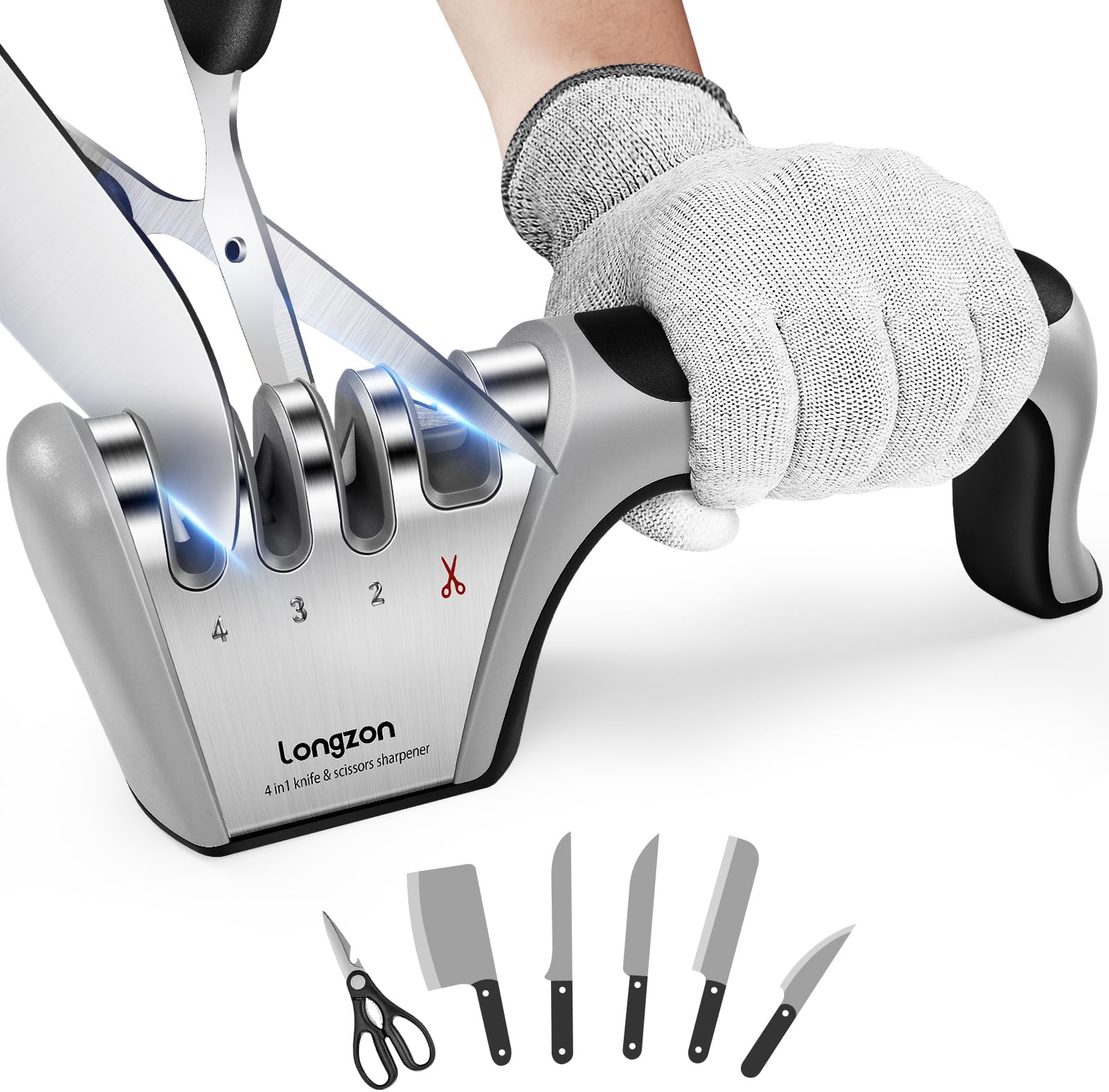
Kyocera Diamond Ceramic Knife Sharpener
Kyocera's diamond sharpening rod is one of the few tools that works on Kyocera's own ceramic knives — ceramic blades are harder than any steel wheel or belt abrasive, requiring diamond (the only harder material) to sharpen. The diamond rod also works on steel knives. It's the most affordable tool in this comparison. The limitation is technique: a diamond rod requires consistent angle maintenance by hand — there's no guide, no fixed angle, and no feedback mechanism. Recommended as a secondary tool for maintaining a previously-sharpened edge, not for repairing damage.
Pros
- ✓Only consumer tool that sharpens Kyocera and other ceramic knives
- ✓Works on both ceramic and steel — one tool for mixed-knife households
- ✓Compact: stores in a knife block or drawer without dedicated space
Cons
- ✗No angle guide — consistent edge angle requires technique; beginners produce uneven results
- ✗Aggressive diamond abrasive can damage thin Japanese edges if angle is wrong by more than 3°
Score breakdown
| Sharpening method | Diamond-coated rod |
| Compatible materials | Ceramic, all steel types |
| Angle guidance | None (freehand) |
| Grit | Fine diamond |
| Length | 17 cm rod |
| Price range | Budget |
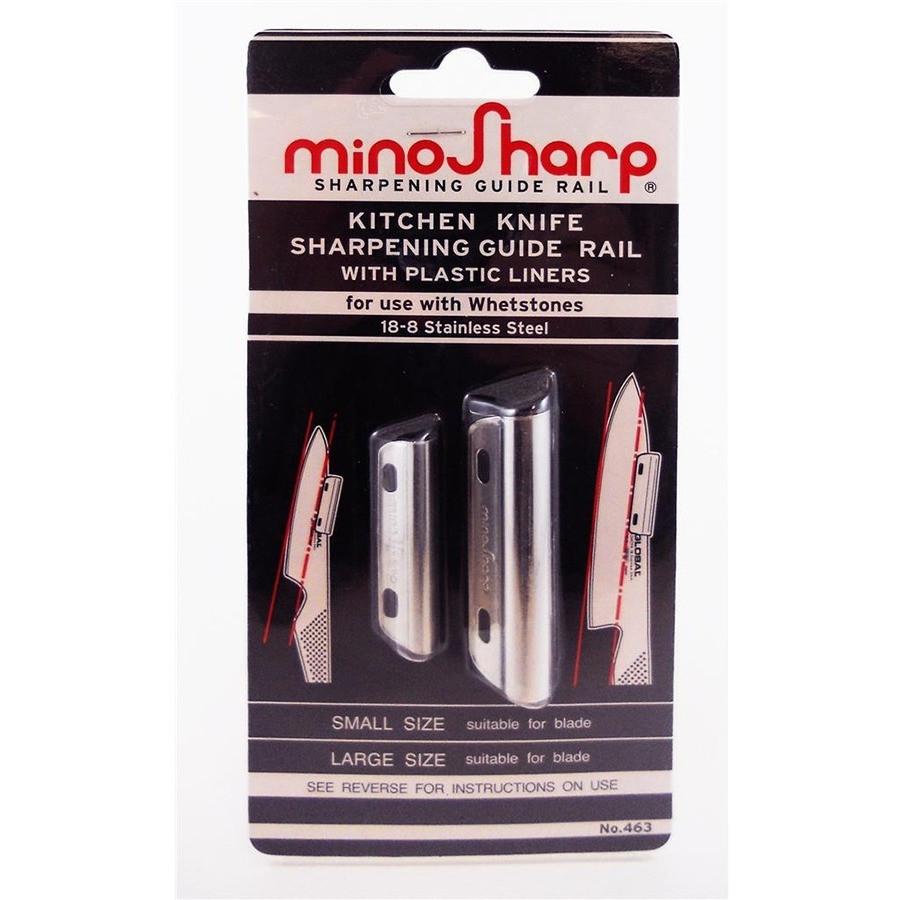
Global MinoSharp Plus Knife Sharpener
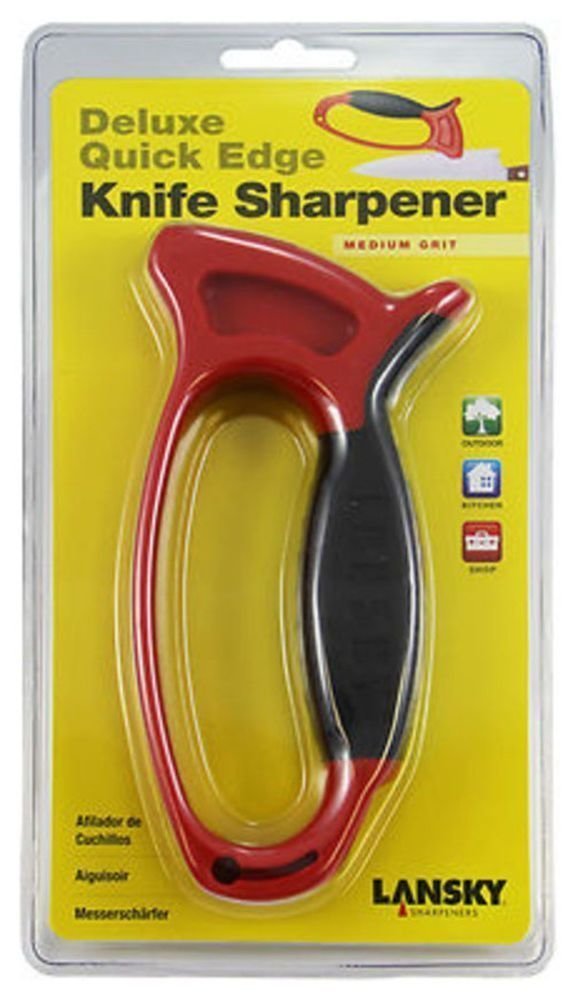
Lansky Deluxe Controlled-Angle Sharpening System
The Lansky Deluxe uses a clamp-and-rod system: the knife clamps in place at a fixed angle and a sharpening rod attached to the clamp guide runs over the edge consistently. Five angle settings (17°, 20°, 25°, 30°, and European 19°) and four rod grits (extra-coarse, coarse, medium, fine, and ultra-fine in the deluxe version) allow full sharpening from repair to polishing. It requires more time than an electric sharpener but removes less metal per session — appropriate for regular maintenance rather than emergency repair.
Pros
- ✓Clamp-and-guide system removes the angle consistency requirement — accurate results for beginners
- ✓5 angle settings accommodate Japanese (17°), German (20°), and hunting knife (25–30°) geometry
- ✓4 grit rods allow full progression from coarse repair to fine polishing
Cons
- ✗Time-intensive: a full sharpening session takes 20–30 minutes vs. 3–5 minutes for an electric sharpener
- ✗Clamp can scratch blade flats on knives with cosmetic finishes; not suitable for single-bevel Japanese knives
Score breakdown
| Sharpening method | Guided clamp with abrasive rods |
| Angle settings | 17°, 19°, 20°, 25°, 30° |
| Included rods | Extra-coarse, coarse, medium, fine, ultra-fine |
| Time per sharpening | 20–30 minutes |
| Compatible knives | Double-bevel knives; not single-bevel |
| Price range | Entry-level |
Which one is right for you?
For Global knife owners who want a foolproof solution
knife-sharpener-global-minosharp-plus
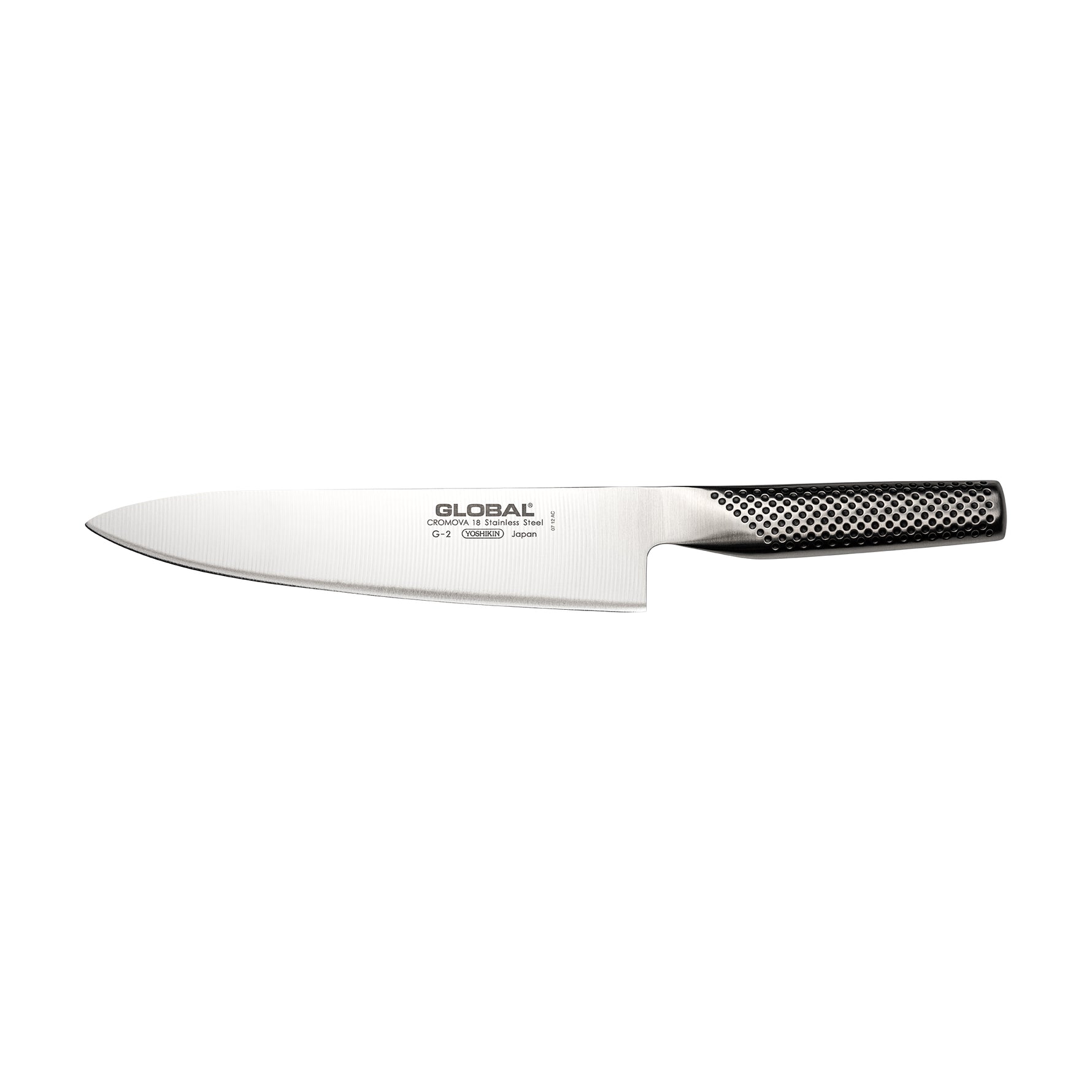
The MinoSharp Plus is made by Global, pre-set to Global's exact angle, and water-cooled to protect VG-10's temper. If you own Global knives and want reliable results without learning freehand technique, this is the specific tool.
For households with both Japanese and German knives
Work Sharp Ken Onion Edition Knife Sharpener
The adjustable 15–30° belt system is the only electric sharpener in this comparison that handles both Japanese and German angles correctly. If you own knives at different geometry, versatility is worth the learning curve.
For Kyocera ceramic knife owners
Kyocera Diamond Ceramic Knife Sharpener
No steel-based sharpener can touch ceramic blades — only diamond abrasive is hard enough. The Kyocera diamond rod is the accessible consumer option for a blade type that otherwise requires sending to the manufacturer.
Sharpening angle — why it matters and how to pick the right one
Edge angle determines the geometry of the cutting edge: a 15° per side angle is thinner and sharper but more fragile; a 25° per side angle is more robust but cuts with more resistance. Most Japanese knives are factory-ground at 15°; German knives at 20–22°. If you sharpen a 15° edge at 20°, you're progressively changing the factory geometry with each sharpening — after 2–3 sharpenings at the wrong angle, the edge geometry has drifted significantly from original.
The practical implication: use a sharpener with a fixed angle only if that angle matches your knife's factory geometry. A 15° sharpener (Global MinoSharp, Chef'sChoice Trizor) used on a German knife produces an edge that's technically sharper but geometrically thinner than the steel is designed to support — the edge is more prone to chipping and rolling than a properly sharpened 20° German edge would be.
Adjustable-angle sharpeners (Work Sharp Ken Onion, Lansky Deluxe) solve this by letting you match the sharpening angle to each knife. The tradeoff is that you have to know your knife's correct angle — most manufacturers publish this in the manual or on their website. As a general reference: Global, MAC, Shun, Kasumi, and most Japanese brands: 15° per side. Wusthof, Zwilling, Victorinox, Henckels: 20° per side. Hunting and survival knives: 25–30° per side.
Electric vs. manual sharpeners — what you're trading off
Electric sharpeners (Work Sharp, Chef'sChoice) remove metal faster than manual methods — a full sharpening from dull to sharp takes 3–5 minutes. This speed has a cost: each session removes more metal from the blade than manual methods. Over 5–7 years of monthly electric sharpening, the blade noticeably narrows and shortens. For home cooks who sharpen once or twice a year, this is irrelevant. For restaurant-frequency sharpening, electric accelerates blade consumption.
Manual methods (guided rods like Lansky, whetstones) remove less metal per session and allow more control over the progression — you can stop after medium grit for a working edge or continue to ultra-fine for a near-mirror polish. The tradeoff is time (20–40 minutes per session vs. 3–5 minutes) and skill requirement for whetstones (guided rods reduce this significantly). The Lansky system is genuinely beginner-accessible for guided-rod sharpening; freehand whetstone technique requires 10–20 hours of practice to produce consistently good results.
Pull-through sharpeners (the V-slot countertop units with tungsten carbide or ceramic slots) are the least recommended category for quality. They use a fixed, often incorrect angle, apply uneven pressure across the blade, and remove metal aggressively at the tip and less at the heel. They work on German steel well enough to restore functional sharpness for short periods. They damage Japanese high-HRC steel by removing chips rather than abrading cleanly at the thin, hard edge. Avoid pull-through sharpeners for any knife you care about maintaining over the long term.
How to tell when your knife actually needs sharpening
The paper test is the quick field check: hold a sheet of standard printer paper vertically and draw the knife down through it. A sharp knife cuts cleanly with minimal resistance and produces a straight cut line. A dull knife tears, deflects, or produces a ragged cut. An intermediate edge between these two is usually addressed by honing rather than sharpening.
Honing and sharpening are different operations that most home cooks conflate. Honing with a steel rod realigns the edge that has folded or rolled to one side — the metal hasn't been removed, the edge has simply bent. Honing takes 30 seconds and should happen before each use or every few uses. Sharpening removes metal to create a new edge when the existing edge is too dull to restore by honing. The sequence is: hone regularly, sharpen when honing stops working. Most home cooks who sharpen when their knife feels dull would find that honing is all they needed.
The tomato test is more informative than the paper test for kitchen use: a sharp knife slices a ripe tomato skin with no downward pressure, using only horizontal drawing motion. If you press the knife down to break the skin, it needs either honing or sharpening — the zero-pressure test tells you the edge isn't sharp enough to initiate a cut by blade geometry alone. Using a sharp knife requires significantly less grip force and less fatigue during extended prep sessions — the cutting force the hand applies is the friction of a dull blade, not the work of cutting.
Ceramic knives — the special sharpening case
Ceramic knives (Kyocera is the primary brand) are made from zirconium oxide, which is harder than most knife steel at 8.5 on the Mohs scale vs. 6.5–7.5 for hardened steel. A ceramic knife holds its edge longer than most steel knives in daily use — Kyocera claims 10x longer edge retention than steel, which is plausible for light cutting tasks. The edge geometry is more brittle than steel, which means ceramic chips rather than bending under lateral stress.
When a ceramic knife does need sharpening, only diamond abrasive is hard enough — conventional abrasive stones, ceramic honing rods, and belt grinders used for steel simply can't abrade zirconium oxide meaningfully. The Kyocera diamond rod is the consumer-accessible option. Kyocera also offers a mail-in factory sharpening service per knife, which uses professional diamond grinding wheels and restores the exact factory edge geometry — recommended when a ceramic knife has chips rather than just dullness.
Ceramic knives are incompatible with many sharpening guides that use a clamp (like the Lansky) because the ceramic blade body is hard and brittle enough that the clamp pressure can crack it. Any clamping sharpener with metal jaws requires rubber or polymer jaw inserts to safely hold a ceramic knife. The safest home option is the diamond rod with careful freehand technique, or the Kyocera mail-in service for anything more than edge touch-up.