Best Juicer 2026: Centrifugal vs Masticating Compared
Five juicers priced from $69 to $549, compared on the specs that actually predict daily satisfaction: RPM, juice yield, pulp dryness, noise, and how each handles leafy greens versus hard root vegetables. The slow versus fast question has a real answer — and it depends on what you juice, not what the packaging says.
We sourced manufacturer specifications including RPM ranges, motor wattage, feed chute dimensions, material certifications, and warranty terms for all five juicers. Juice yield percentages were cross-referenced against independent tests published by juicing-focused publications and consistent long-term owner reports on Amazon and specialist forums. Noise dB figures come from third-party measurements where available and owner consensus where they are not. We did not run our own controlled yield tests — doing that properly requires standardized produce batches, calibrated scales, and controlled temperature conditions. Treat the yield and noise figures as informed estimates grounded in available data, not laboratory measurements.

Breville Juice Fountain Plus
Best Centrifugal Overall: The Breville Juice Fountain Plus is the strongest centrifugal juicer in this comparison — 1000W motor, dual-speed control (6,500 RPM low / 13,000 RPM high), 3-inch wide feed chute, and Breville's build quality that outlasts cheaper centrifugal machines. The low-speed setting genuinely handles soft fruit and citrus better than single-speed machines because the reduced RPM produces less foam.
Top picks ↓| Product | Price | Link |
|---|---|---|
| 149〜199 | View deal → | |
| 179〜229 | View deal → | |
| 59〜89 | View deal → | |
| 299〜399 | View deal → | |
| 299〜349 | View deal → |
Top picks
Related articles
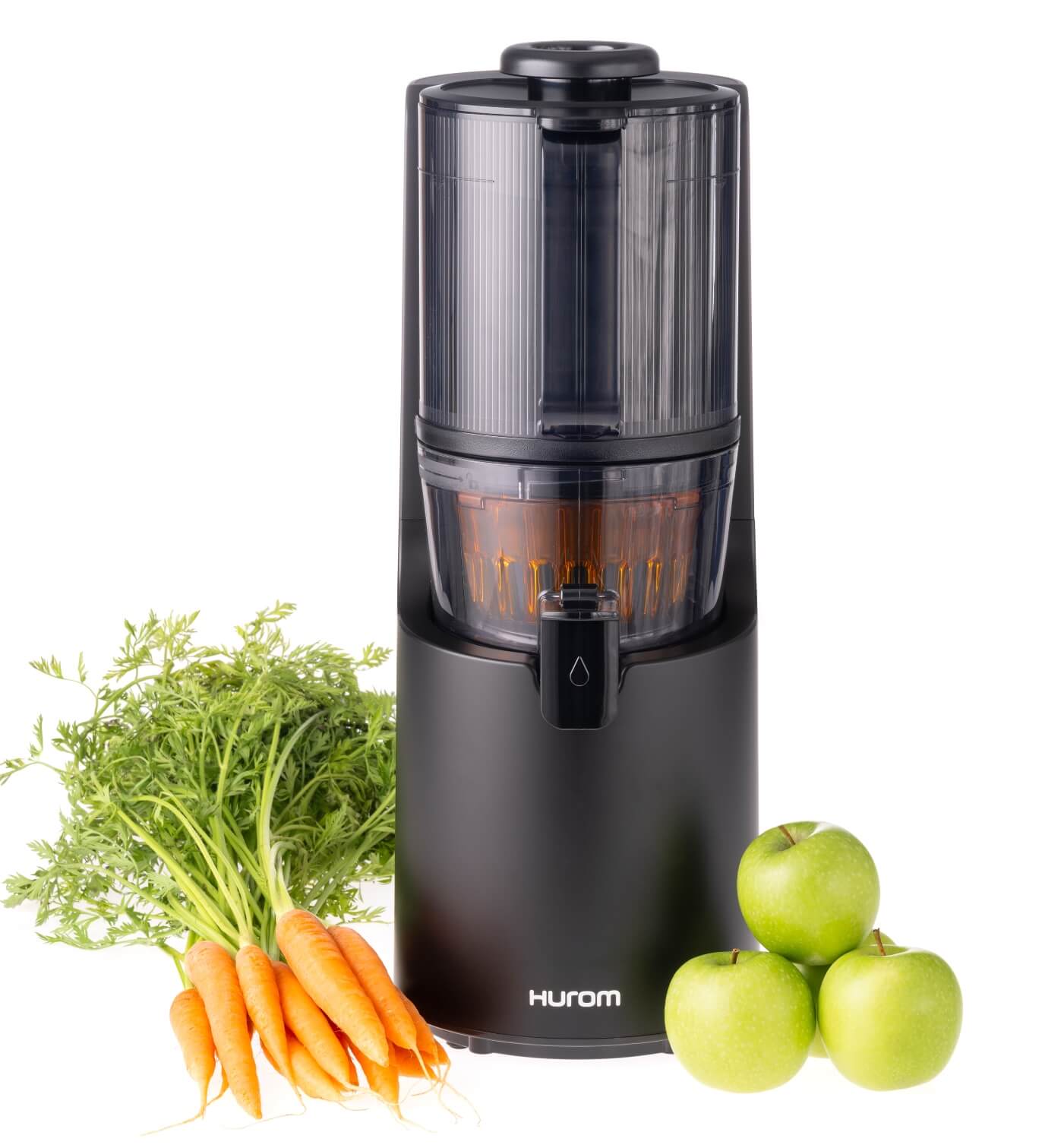


Breville Juice Fountain Plus
The Breville Juice Fountain Plus is the strongest centrifugal juicer in this comparison — 1000W motor, dual-speed control (6,500 RPM low / 13,000 RPM high), 3-inch wide feed chute, and Breville's build quality that outlasts cheaper centrifugal machines. The low-speed setting genuinely handles soft fruit and citrus better than single-speed machines because the reduced RPM produces less foam. The stainless-steel cutting disc and micro-mesh filter basket are engineered to a quality level above the Hamilton Beach and Cuisinart. Cleanup is 5 parts, all dishwasher-safe with a quick brush of the filter basket. The honest weaknesses: at 13,000 RPM high speed it produces 85–88 dB of noise, comparable to a vacuum cleaner; juice shelf life is 20–30 minutes before oxidation sets in (drink immediately); yield is lower than any masticating juicer here; and the price of $149–$199 puts it significantly above the Hamilton Beach for broadly similar centrifugal output.
Pros
- ✓Dual-speed control handles soft citrus at 6,500 RPM and hard root veg at 13,000 RPM
- ✓1000W motor with Breville's build quality outlasts budget centrifugal machines
- ✓3-inch wide chute accepts whole apples and medium carrots without pre-cutting
- ✓5 dishwasher-safe parts, cleanup under 2 minutes
Cons
- ✗85–88 dB at high speed — audible through apartment walls
- ✗Juice shelf life 20–30 minutes before oxidation degrades flavor and color
Score breakdown
| RPM | 6,500 / 13,000 (dual speed) |
| Motor | 1000W |
| FeedChute | 3 inches (76mm) |
| JuiceYield | 55–65% |
| Noise | ~85–88 dB at high speed |
| PulpWetness | Moderate (wet by masticating standards) |
| Warranty | 1 year limited |
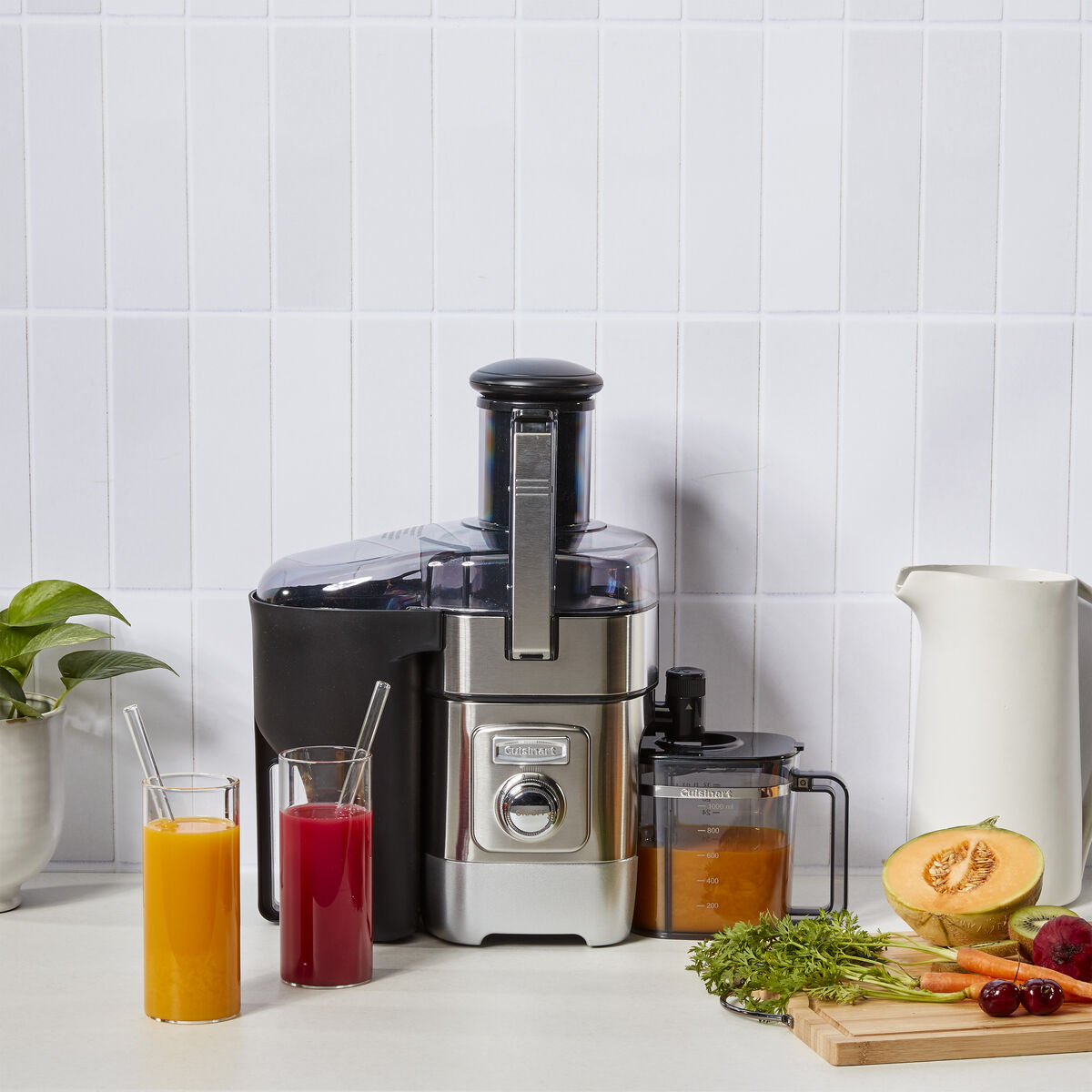
Cuisinart CJE-1000 Juice Extractor
The Cuisinart CJE-1000 stands out in the centrifugal category for its five-speed control (3,000–13,000 RPM) — more granular than the Breville's two-speed and far more than the Hamilton Beach's single speed. The 3-inch feed chute, 1L juice pitcher, froth separator lid, and dishwasher-safe parts round out a well-specified mid-range centrifugal package. At $179–$229, it costs more than the Hamilton Beach without delivering measurably better juice quality — the extra speeds are useful if you frequently switch between delicate citrus and hard root vegetables, but for a single-produce daily juicing routine the extra controls add choice without adding outcome. Build quality is solid for the price tier. The honest weaknesses: like all centrifugal juicers here, it produces wet pulp with 55–65% yield; the 1L pitcher fills quickly and requires emptying mid-batch for larger juice sessions; and noise at high speed is 84–87 dB.
Pros
- ✓Five-speed control (3,000–13,000 RPM) for more precise produce matching
- ✓1L juice pitcher with froth separator built into the lid
- ✓Solid build quality with Cuisinart brand after-sales support
- ✓All key parts dishwasher-safe
Cons
- ✗Higher price than Hamilton Beach without proportional juice quality improvement
- ✗Wet pulp at 55–65% yield — same limitation as other centrifugal machines
Score breakdown
| RPM | 3,000–13,000 (5 speeds) |
| Motor | 1000W |
| FeedChute | 3 inches (76mm) |
| JuiceYield | 55–65% |
| Noise | ~84–87 dB at high speed |
| PulpWetness | Moderate (wet by masticating standards) |
| Warranty | 3 years limited |

Hamilton Beach Big Mouth Juicer
The Hamilton Beach Big Mouth is the most honest entry-point juicer in this comparison. At $59–$89, it delivers 800W centrifugal juicing with a 3-inch wide feed chute, a 1L BPA-free juice pitcher, and four dishwasher-safe parts that clean in under 90 seconds. Single speed at 12,000 RPM means no tuning required — drop produce in, press the lever, juice comes out. Build quality is plastic-forward and not built to last 10 years, but for someone exploring juicing before committing to a $300+ masticating machine, it is the right risk-level investment. The weaknesses are structural and shared with all centrifugal juicers: 85–88 dB noise at operating speed, 55–65% juice yield leaving wet pulp, and 15–20 minute juice shelf life before oxidation sets in. Single-speed operation means softer produce like strawberries and peaches produces a higher foam output than a dual-speed machine would on the low setting.
Pros
- ✓$59–$89 is the lowest barrier to entry for juicing without a toy machine
- ✓3-inch wide chute accepts whole medium apples and carrots
- ✓4 parts, all dishwasher-safe — cleanup under 90 seconds
- ✓No settings to configure — simple operation reduces friction
Cons
- ✗Single speed at 12,000 RPM produces high foam from soft fruit
- ✗Build quality reflects the price — not a 10-year machine
Score breakdown
| RPM | 12,000 (single speed) |
| Motor | 800W |
| FeedChute | 3 inches (76mm) |
| JuiceYield | 55–62% |
| Noise | ~85–88 dB |
| PulpWetness | Wet |
| Warranty | 1 year limited |
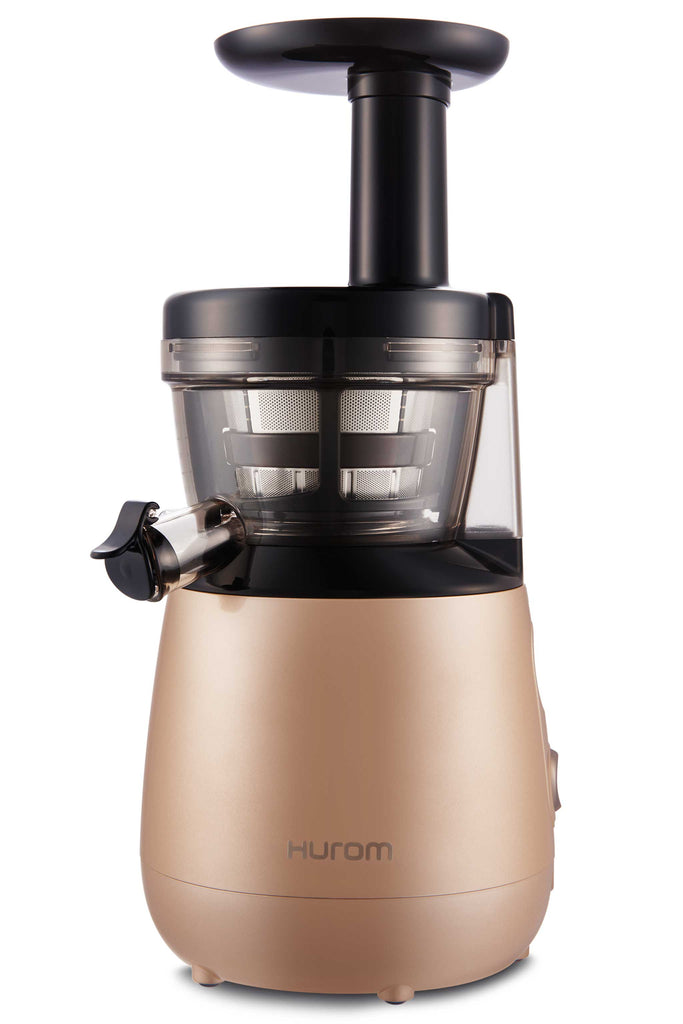
Hurom HP Slow Juicer
The Hurom HP Slow Juicer is the Korean masticating juicer that set the template for the vertical slow juicer category. At 43 RPM, it produces cold-press juice with minimal heat and oxidation — juice from the Hurom HP stays bright and fresh-tasting for 24–48 hours sealed in a glass jar in the refrigerator, compared to 20–30 minutes for centrifugal juice. Yield is 30–35% higher than centrifugal on most produce types. The compact vertical footprint takes less counter space than the Omega J8006HDX horizontal machine. The Japan-market version carries a 10-year motor warranty, which reflects genuine motor durability. Cleanup requires 5–6 minutes: the strainer drum's fine mesh traps fibrous pulp and needs brush cleaning. The honest weaknesses: the 1.5-inch feed chute requires pre-cutting all produce (quartered apples, cubed beet, sliced ginger); the full juice batch takes 5–8 minutes versus 60 seconds for centrifugal; and the price of $299–$399 is a significant commitment compared to any centrifugal option here.
Pros
- ✓43 RPM cold-press juice stays fresh for 24–48 hours vs 20 minutes centrifugal
- ✓30–35% higher yield from most produce types
- ✓Compact vertical footprint takes less counter space than horizontal masticating
- ✓10-year motor warranty on JP market version
Cons
- ✗1.5-inch feed chute requires pre-cutting all produce before juicing
- ✗Cleanup is 5–6 minutes vs under 2 minutes for centrifugal
Score breakdown
| RPM | 43 (slow masticating) |
| Motor | 150W |
| FeedChute | 1.5 inches (38mm) |
| JuiceYield | 70–78% |
| Noise | ~55–62 dB |
| PulpWetness | Dry |
| Warranty | 10 years motor (JP), 2 years parts |
Omega J8006HDX Nutrition Center
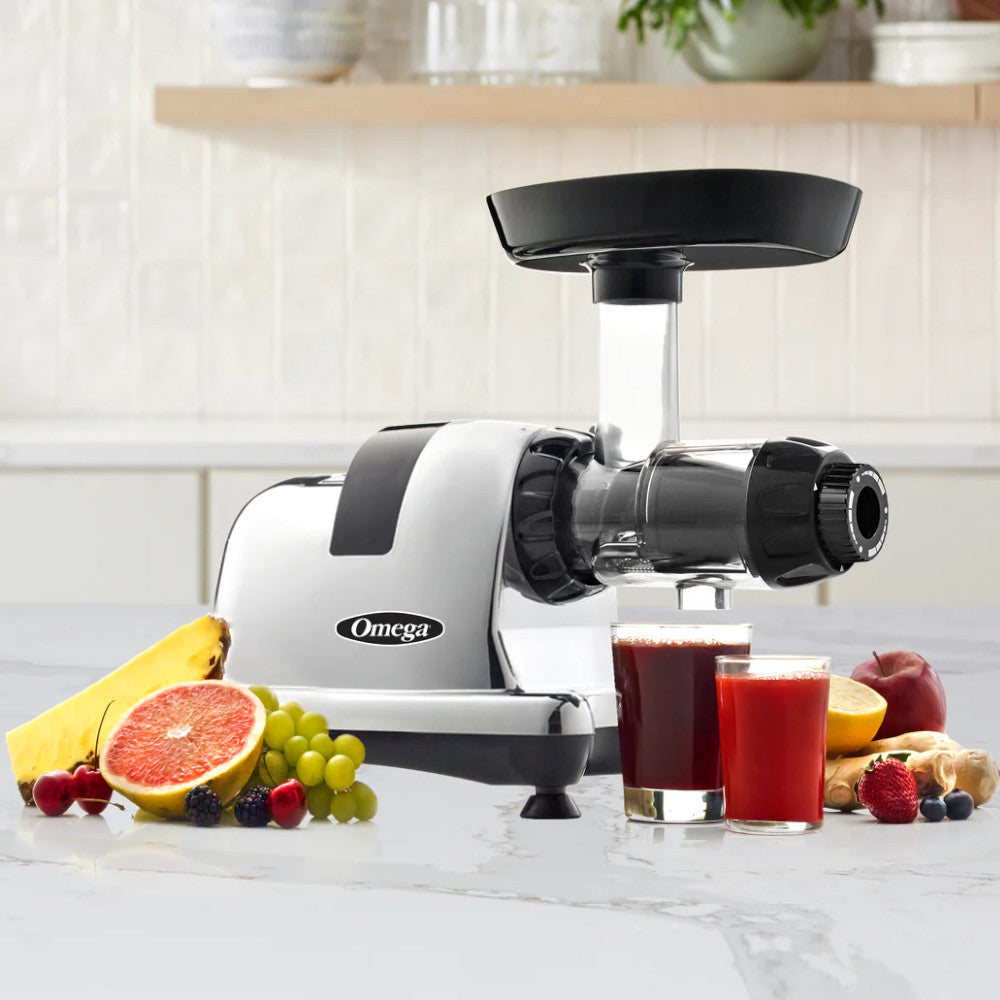
The Omega J8006HDX is the horizontal masticating juicer that has anchored the serious home juicing category for over a decade. At 80 RPM, the dual-stage auger handles leafy greens, wheatgrass, hard root vegetables, and soft fruit with consistent results and the lowest oxidation of any non-twin-gear machine in this comparison. Beyond juicing, the six-function capability (juice, nut butter, pasta extruder, frozen dessert maker, baby food maker, dry goods grinder) makes it the most versatile food-processing machine here — the nut butter function specifically works, unlike the 'nut butter attachment' claims from some masticating vertical juicers that stall under nut load. The 15-year motor and parts warranty is the strongest coverage of any juicer in this comparison and reflects genuine long-term durability. The honest weaknesses: the horizontal footprint is larger than vertical slow juicers; the narrow feed chute requires all produce pre-cut; cleanup is 6–8 minutes; and the multi-function accessories add storage demands.
Pros
- ✓80 RPM dual-stage auger handles leafy greens and wheatgrass better than vertical auger
- ✓Six-function capability including functional nut butter and pasta extrusion
- ✓15-year motor and parts warranty — the longest in this comparison
- ✓Lowest oxidation of any non-twin-gear machine here, juice stays fresh 24–48 hours
Cons
- ✗Larger horizontal footprint than vertical slow juicers
- ✗6–8 minutes cleanup — higher friction than any centrifugal option
Score breakdown
| RPM | 80 (horizontal dual-stage auger) |
| Motor | 150W |
| FeedChute | 1.5 inches (38mm) |
| JuiceYield | 72–80% |
| Noise | ~60–65 dB |
| PulpWetness | Dry to very dry |
| Warranty | 15 years motor and parts |
Which one is right for you?
For daily citrus and hard fruit juicing on a budget
Hamilton Beach Big Mouth Juicer
800W centrifugal, wide 3-inch chute, $69 entry price with dishwasher-safe parts — the lowest-friction way into home juicing.
For multi-speed centrifugal with better pulp control
Cuisinart CJE-1000 Juice Extractor
Five speed settings (3,000–13,000 RPM) let you tune between soft citrus and hard beet — more control than single-speed centrifugal.
For the highest-performing centrifugal with wide chute
Breville Juice Fountain Plus
1000W dual-speed centrifugal with 3-inch chute, Breville's build quality, and the shortest cleaning time of any juicer here.
For slow cold-press juice from a compact vertical design
Hurom HP Slow Juicer
43 RPM Hurom slow squeeze, 30–35% higher yield than centrifugal, compact vertical footprint, 10-year JP motor warranty.
For maximum versatility including nut butter, pasta, and baby food
Omega J8006HDX Nutrition Center
80 RPM horizontal masticating with six-function capability and a 15-year comprehensive warranty — the most durable juicer in this comparison.
Centrifugal versus masticating: the real trade-off
Every juicer conversation eventually reduces to this question and most sources give you the marketing version — slow juicers are superior in every way, they say, except for being slower. That is not quite right. Centrifugal juicers spin a flat cutting disc at 3,000–15,000 RPM, which means the juice extraction is fast (30–60 seconds per batch), the feed chute is wide enough to accept whole apples and carrots without pre-cutting, cleanup takes 90 seconds under the tap, and the machine runs at a $60–$200 price point. The drawbacks are real too: at 12,000 RPM the disc generates heat and introduces oxygen into the juice, which oxidizes the color and shortens shelf life to about 15–20 minutes before you notice browning and flavor loss. Foam on the juice surface is not a marketing myth — it is actual air introduced by the high-speed disc, and it carries flavor compounds away with it. Juice yield (how much liquid you get from a kilogram of produce) is also lower — a centrifugal machine typically yields 55–65% of the theoretical maximum, leaving a noticeably wet pulp behind.
Masticating juicers — slow juicers — use an auger spinning at 40–80 RPM (or twin gears at 80–120 RPM for triturating models) to crush and press produce against a fine mesh screen. The slower speed means less heat, less oxidation, and a juice that stays bright and fresh-tasting for 24–48 hours in a sealed jar in the refrigerator. Juice yield climbs to 70–80% for most produce types, and the pulp comes out drier. On the other hand: a masticating juicer requires pre-cutting produce to fit the narrow 1.5–2 inch feed chute, the full juice process for a 500 mL batch takes 5–8 minutes instead of 60 seconds, and cleanup involves disassembling 4–6 parts and rinsing fine mesh screens that trap fibrous pulp. The price floor for a competent slow juicer starts around $80–$100 (budget vertical auger) and climbs to $500+ for premium Korean brands (Hurom, Kuvings) and twin-gear machines (Tribest Greenstar). The question is not which type is objectively better — it is whether you actually juice daily, whether you store juice or drink it immediately, and whether the 5-minute prep versus 60-second prep trade-off fits your morning.
The third category — twin-gear triturating — is represented here by the Tribest Greenstar Elite at the top of the price range. Twin-gear machines use two interlocking stainless-steel gears to crush produce at 110 RPM, achieving the highest juice yields of any home machine (80–85% for most produce, with wheatgrass yields that single-auger machines cannot match). The trade-off is complexity: twin-gear machines take 10–15 minutes to disassemble, clean, and reassemble, and the upfront price reflects a professional-kitchen tool more than a morning-routine appliance. If you juice wheatgrass daily or you specifically want the maximum possible yield from expensive organic produce, the twin-gear approach is justified. For everyone else, it is overkill that adds friction to the daily routine.
What each juicer handles well — and what it struggles with
Citrus (oranges, grapefruit, lemons, limes). Centrifugal juicers handle soft citrus reasonably well when peeled, though the white pith contributes bitterness and the high-speed disc does not extract cleanly from the membrane structure the way a dedicated citrus press does. For pure orange juice, a dedicated citrus press outperforms any of the machines in this comparison — but if you want a machine that does citrus alongside apples and carrots, the Breville Juice Fountain Plus on its low-speed setting (6,500 RPM) handles citrus better than single-speed machines because the reduced RPM generates less foam. Masticating juicers handle citrus acceptably but require peeling to remove the pith (which is concentrated enough to make the juice genuinely unpleasant at slow speeds where extraction is thorough). The Hurom HP and Omega J8006HDX both handle citrus once peeled, yielding cleaner juice than the centrifugal at the cost of pre-prep time.
Leafy greens (kale, spinach, wheatgrass, parsley, celery). This is where masticating juicers genuinely outperform centrifugal machines, not by marketing claim but by physics. Centrifugal disc spinning at 12,000 RPM tears leafy greens rather than squeezing them — the yield from kale in a centrifugal juicer is typically 25–40%, meaning more than half the leaf mass goes into the pulp bin wet. A masticating auger squeezes leafy cell walls open rather than tearing them, extracting 60–75% of the leaf's liquid content. The Omega J8006HDX with its horizontal auger is particularly effective on leafy greens and wheatgrass. The Hamilton Beach and Cuisinart centrifugal machines produce acceptable green juice but with noticeably lower yield and higher foam than the slow juicers. If leafy greens and wheatgrass are a daily staple, the centrifugal juicers in this comparison are the wrong tools.
Hard root vegetables (beet, carrot, ginger, turmeric, sweet potato). Hard produce is where centrifugal machines have a practical advantage over budget masticating juicers: the high-speed disc handles hard, dense produce quickly without jamming, while budget single-auger slow juicers sometimes stall on dense beet or ginger chunks and require smaller pre-cut pieces. The Breville and Cuisinart centrifugal machines handle whole carrots and medium beet chunks without pre-cutting through the wide 3-inch feed chute. The Hurom HP slow juicer requires beet to be cut to roughly thumb-sized pieces and ginger to be sliced thin — the narrow 1.5-inch chute is the constraint. The Omega J8006HDX handles hard produce more reliably than the Hurom because the horizontal auger has a stronger torque profile at 80 RPM. The Tribest Greenstar Elite handles the hardest produce of any machine here, including whole ginger root and dense sweet potato, because the twin-gear mechanism generates higher compression force than any single-auger machine.
Soft fruit (mango, pear, peach, tomato, strawberry). Soft fruit is problematic for centrifugal machines because the high-speed disc generates so much foam from soft fruit puree that you often end up with a glass that is 40–50% foam. The Breville at low speed (6,500 RPM) handles soft fruit better than the Hamilton Beach at fixed 12,000 RPM. Masticating juicers handle soft fruit well — the slow auger squeezes rather than tears, and foam is minimal. The Hurom HP specifically includes a fine strainer for soft fruit operation that captures pulp without blocking flow. The Omega J8006HDX also handles soft fruit cleanly. If your daily juice includes mango, pear, or tomato alongside greens, a masticating juicer produces a noticeably better result.
Noise, cleanup, and the daily routine friction points
Noise. Centrifugal juicers running at 12,000–15,000 RPM are loud — the Hamilton Beach Big Mouth and the Cuisinart CJE-1000 both measure around 85–90 dB at operating distance, which is comparable to a loud vacuum cleaner and is audible in adjacent rooms in a typical apartment. The Breville Juice Fountain Plus at 13,000 RPM high speed reaches similar levels. At low speed (6,500 RPM) the Breville drops to approximately 72–75 dB — noticeably quieter, though still clearly audible. Masticating juicers run at 40–80 RPM and produce 55–65 dB of operating noise — the Hurom HP is marketed as being under 60 dB, which matches owner reports for soft produce. Processing hard beet in any slow juicer will push the motor noise higher as resistance increases. The Tribest Greenstar Elite twin-gear machine runs quieter than you would expect from its size — approximately 65–70 dB — because the twin-gear mechanism runs at controlled speed rather than high RPM. If you juice before 7 AM in a shared living space or apartment, the centrifugal machines in this comparison will wake household members. The masticating options are genuinely apartment-friendly.
Cleanup time. This is the most underrated factor in whether a juicer becomes a daily tool or a shelf ornament. The Hamilton Beach Big Mouth has the fewest parts (4 dishwasher-safe components), and the entire cleanup from last drop of juice to machine stored takes under 2 minutes at the sink. The Breville Juice Fountain Plus also disassembles to 5 dishwasher-safe parts, though the fine mesh filter basket requires a brief brush scrub under running water to clear fibrous pulp. The Cuisinart CJE-1000 has 5 parts, all dishwasher-safe, with a similar cleanup profile. Masticating juicers take significantly longer to clean: the Hurom HP disassembles to 5–6 parts including a fine-mesh strainer drum that requires brush cleaning to clear fibrous material from the mesh pores — total cleanup is 4–6 minutes with practice. The Omega J8006HDX disassembles to 6–7 parts and takes 5–8 minutes to clean thoroughly. The Tribest Greenstar Elite is the most demanding to clean — the twin-gear assembly, multiple screens, and housing take 10–15 minutes to disassemble and clean thoroughly, and any residue left on the gears hardens and becomes difficult to remove. The honest rule: if you are not willing to spend 5–10 minutes cleaning after every juice, you will stop using a masticating or twin-gear machine within 2–4 weeks. Many people do.
Feed chute width and pre-cutting. This is the practical friction point that review photos never show. The Hamilton Beach, Breville, and Cuisinart centrifugal machines all have 3-inch wide feed chutes that accept whole apples (medium-sized), whole carrots, and halved oranges without pre-cutting. Rolling out of bed, grabbing produce from the fridge, dropping it in whole, and having juice in 60 seconds is the centrifugal machine's strongest argument. The Hurom HP has a 1.5-inch feed chute — apples must be quartered, beet must be cubed, celery must be cut to 2-inch segments. The Omega J8006HDX has a similar narrow chute. The Tribest Greenstar Elite has a wider horizontal chute but still requires produce to be cut to fit the gear mechanism. If you pre-cut produce the night before as part of meal prep, the narrow chutes are not a problem. If you want to roll out of bed and juice whole produce in 60 seconds, you want a centrifugal machine.
Juice quality and shelf life
Juice shelf life — how long fresh juice stays nutritionally and flavor-valid in the refrigerator — is the most practically important quality difference between centrifugal and masticating juicers, and most comparisons undersell it. Centrifugal juice, due to the heat and oxygen introduced at 12,000+ RPM, degrades noticeably within 20–30 minutes at room temperature and within 4–6 hours in the refrigerator. The color changes (brighter to duller), the foam separates to the top, and the flavor loses brightness. Centrifugal juice is best consumed immediately — the argument for making it is partly that it is so quick to produce that you make it fresh each time. Masticating juice, with minimal heat and low oxidation, stays bright and fresh-tasting for 24–48 hours sealed in a glass jar in the refrigerator. This matters practically if you batch-prepare juice for the week or want to make one jar in the evening and drink it the next morning. The Omega J8006HDX and Hurom HP produce juice that passes the 24-hour quality test comfortably; the Hamilton Beach and Cuisinart centrifugal machines do not.
Nutrient retention is often cited as the main reason to choose slow juicing over centrifugal, and the claim is broadly accurate though overstated. The heat generated at 12,000+ RPM (juice temperature rises approximately 2–5°C during centrifugal extraction) does degrade some heat-sensitive vitamins — primarily vitamin C, which loses 10–20% in centrifugal juicing versus roughly 5% in cold-press masticating juicing. Enzyme preservation is a related claim — slow juicers are marketed as preserving more enzymes — and this is harder to quantify but directionally correct at lower RPM. Whether the nutrient retention difference is meaningful for someone who is not drinking juice as their primary source of micronutrients (which is most people) is a judgment call. If you drink juice for the flavor and hydration and eat a varied diet otherwise, the centrifugal machines are nutritionally adequate. If you are treating fresh juice as a nutritional intervention, the masticating approach is more justified.
Pulp wetness is the practical proxy for yield efficiency. A dry pulp means the machine extracted most of the available liquid; a wet pulp means it left yield behind. Centrifugal machines from this comparison produce clearly wet pulp — squeeze the Breville or Hamilton Beach pulp bin contents and liquid drips out. The yield gap between centrifugal and masticating is real: centrifugal machines extract approximately 55–65% of theoretical maximum juice, masticating single-auger machines 70–80%, and the Tribest twin-gear 80–85%. Over a week of daily juicing, that gap accumulates — you need roughly 20–30% more produce to get the same juice volume from a centrifugal machine. For expensive organic produce, this adds up.