Best Green Powder 2026: 5 Greens Ranked by Transparency
The green powder category is dominated by proprietary blends — brands that list ingredient names without amounts, making it impossible to know whether you're getting a clinically relevant dose of anything. AG1 lists over 75 ingredients; whether any of them appear at therapeutic concentrations is not disclosed. Meaningful evaluation requires looking at what the formula reveals about itself, what it hides, and whether the health claims are traceable to actual research. These five represent the genuine range.
Each product was evaluated on ingredient list transparency (full amounts vs. proprietary blends), third-party testing for heavy metals and contamination, nutrient density relative to whole food alternatives, taste and mixability, and cost per serving against disclosed nutritional value.

Athletic Greens AG1
Best All-in-One Blend: AG1's 75+ ingredient formula tastes better than any competitor and mixes effortlessly — daily compliance is its strongest selling point. The proprietary blend structure hides individual doses, making clinical verification impossible from the label.
Top picks ↓| Product | Price | Link |
|---|---|---|
| 79〜99 | View deal → | |
| 18〜30 | View deal → | |
| 25〜40 | View deal → | |
| 60〜80 | View deal → |
Top picks
Related articles



Athletic Greens AG1
AG1's 75+ ingredient formula tastes better than any competitor and mixes effortlessly — daily compliance is its strongest selling point. The proprietary blend structure hides individual doses, making clinical verification impossible from the label. At $3–4 per serving, you're paying a significant premium for convenience and taste over ingredient transparency.
Pros
- ✓Best-in-category taste and mixability — the compliance advantage is real for daily habit formation
- ✓Comprehensive formula including probiotics, digestive enzymes, adaptogens, and greens in one serving
- ✓NSF Certified for Sport for banned substance testing
Cons
- ✗Proprietary blends throughout — individual ingredient doses not disclosed; cannot verify therapeutic amounts
Score breakdown
| Ingredients | 75+ (greens, adaptogens, probiotics, enzymes) |
| Greens blend | Proprietary — total disclosed, individual amounts not |
| Probiotics | 7.2B CFU (L. acidophilus, B. bifidum) |
| Certification | NSF Certified for Sport |
| Serving | 1 scoop (12g) daily |
| Price per serving | ~$3–4 on subscription |
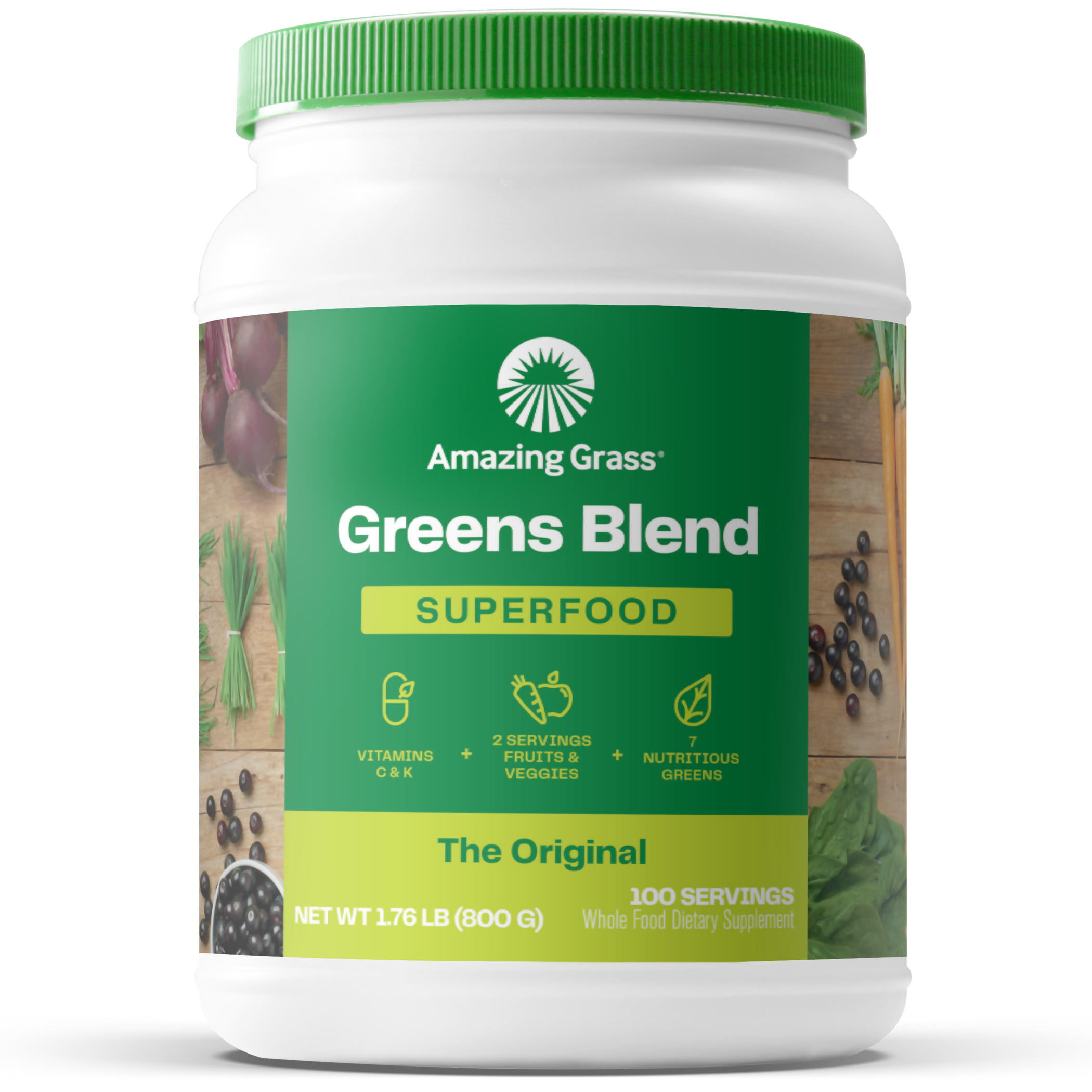
Amazing Grass Greens Blend
Amazing Grass discloses individual ingredient amounts for the greens blend — wheat grass 3,000mg, spirulina 1,000mg, barley grass 1,000mg, chlorella 300mg. NSF certified. Taste is authentically grassy, which signals real greens content. At 60–75% lower cost per serving than AG1, it's the most defensible everyday greens supplement for budget-conscious buyers who want to know what they're taking.
Pros
- ✓Individual greens amounts disclosed — wheat grass 3g, spirulina 1g, barley grass 1g, chlorella 300mg
- ✓NSF certified and Non-GMO Project Verified — meaningful third-party purity confirmation
- ✓60–75% lower cost per serving than premium brands for comparable core greens content
Cons
- ✗More pronounced grassy flavor than premium brands — requires some adjustment for sensitive palates
Score breakdown
| Ingredients | Greens blend + antioxidant blend |
| Greens blend | Wheat grass 3g, spirulina 1g, barley grass 1g, chlorella 300mg (disclosed) |
| Probiotics | None in base formula |
| Certification | NSF certified, Non-GMO Project Verified |
| Serving | 1 scoop (8g) daily |
| Price per serving | ~$0.75–1.00 |

Bloom Nutrition Greens and Superfoods
Bloom adds a functional digestive enzyme and probiotic layer (2B CFU) to a standard greens base — the digestive support component genuinely differentiates it from pure greens powders. Fruity flavors are among the most palatable in the category. Mid-range price. The proprietary blend structure for some components limits full dose verification, but the digestive utility is real for people experiencing post-meal bloating.
Pros
- ✓Digestive enzyme complex (amylase, protease, lipase, bromelain, papain) adds real gut support utility
- ✓2 billion CFU probiotics (L. acidophilus, B. longum) complement the greens formula
- ✓Best-in-class flavors (watermelon, mango coconut) — highest palatability for daily compliance
Cons
- ✗Proprietary blend structure for several components limits full ingredient amount verification
Score breakdown
| Ingredients | Greens + digestive enzymes + probiotics + adaptogens |
| Greens blend | Spirulina, spinach, barley grass, kale, chlorella |
| Probiotics | 2B CFU (L. acidophilus, B. longum) |
| Certification | Third-party tested |
| Serving | 1 scoop daily |
| Price per serving | ~$1.25–1.75 |

Organifi Green Juice
Organifi delivers USDA certified organic with an adaptogen-forward formula — ashwagandha, moringa (standardized to 4% isothiocyanates), and turmeric alongside spirulina and chlorella. Mild, naturally sweet taste from coconut water. Proprietary blend structure limits dose verification, but organic certification requires supply-chain documentation that generic brands don't provide. For organic-prioritizing buyers, this is the premium category benchmark.
Pros
- ✓USDA Certified Organic — supply-chain documentation and periodic audit requirements
- ✓Adaptogens (ashwagandha, moringa standardized 4% isothiocyanates, turmeric) add stress-response utility
- ✓Mild, naturally sweet taste — coconut water base makes it easy to drink without added sweetener
Cons
- ✗Proprietary blend — individual ingredient amounts not disclosed despite organic certification
Score breakdown
| Ingredients | Greens + adaptogens (ashwagandha, moringa, turmeric) + coconut water |
| Greens blend | Spirulina, chlorella, wheatgrass, moringa — proprietary amounts |
| Probiotics | None |
| Certification | USDA Certified Organic |
| Serving | 1 scoop (9g) daily |
| Price per serving | ~$2.00–2.50 on subscription |
Which one is right for you?
For people who want an all-in-one formula and prioritize taste and compliance
Athletic Greens AG1
AG1's broad ingredient profile and excellent taste make daily compliance easier — the tradeoff is proprietary blend opacity and a premium price.
For budget-conscious buyers who want basic greens nutrition without the markup
Amazing Grass Greens Blend
Amazing Grass delivers whole-food greens nutrition at a fraction of the premium brand price, with transparent ingredient amounts and NSF certification.
For women focused on gut health, bloating, and digestive support alongside greens
Bloom Nutrition Greens and Superfoods
Bloom combines greens with a meaningful digestive enzyme and probiotic blend at an accessible price point — the digestive support component is genuinely useful.
For buyers who want aojiru (barley grass) in traditional Japanese form
green-powder-fancl-aojiru-jp
FANCL Aojiru is the most trusted Japanese green supplement, using young barley grass standardized for chlorophyll and available through Japan's most trusted additive-free brand.
For people who want USDA organic certification with a moderate ingredient list
Organifi Green Juice
Organifi's formula is USDA certified organic, uses full-spectrum spirulina and chlorella alongside adaptogens, and is one of the cleaner proprietary blends in the premium category.
Athletic Greens AG1 — 75+ Ingredients, All-In-One Positioning, Subscription-Optimized
AG1 is the best-known premium green powder, and its commercial success is legitimate — the product tastes better than most competitors, mixes smoothly, and is formulated with real attention to palatability. The formula includes a greens and phytonutrient blend, a nutrient-dense extract blend, a digestive enzyme and mushroom blend, and probiotics (Lactobacillus acidophilus and Bifidobacterium bifidum). Total ingredient count exceeds 75.
The core limitation is ingredient transparency. AG1 uses proprietary blends throughout, disclosing the blend totals but not the individual ingredient amounts. The 'Alkalising Greens, Phytonutrients, and Antioxidants' blend weighs in at 7,388mg — distributed across spirulina, lecithin, inulin, apple powder, broccoli flower, papaya, pineapple, bilberry fruit extract, and others without individual disclosure. Whether any of these appear at a dose with clinical relevance is unknown from the label.
The price is the highest in the category at roughly $3–4 per serving on subscription. AG1 markets itself as a meal-supplement complement, essentially positioning it against taking 5–10 separate supplements daily. The honest assessment: it is a high-quality, well-formulated supplement with genuine taste advantage, but the proprietary blend structure means you cannot verify therapeutic dosing from the label alone. For people who value convenience and compliance and accept the opacity, it's a legitimate choice. For people who want to know exactly what they're taking, it is not.
Amazing Grass Greens Blend — Whole-Food Greens, NSF Certified, Transparent Ingredients
Amazing Grass is the accessible standard for whole-food green powder supplementation. The original Greens Blend lists individual ingredient amounts for the greens blend — wheat grass (3,000mg), spirulina (1,000mg), barley grass (1,000mg), chlorella (300mg), spinach (200mg), and alfalfa (200mg) among the key components. This level of transparency allows for direct comparison to clinical dosing thresholds, which most competitors don't permit.
NSF certified and Non-GMO Project Verified, the formula does not use a fully proprietary blend structure for the primary greens component. The supplement facts panel is readable in a way that AG1's is not. The greens blend is plant-based, vegan, and free of artificial colors, flavors, and sweeteners. Taste is more 'grassy' than premium brands — the chlorophyll flavor is present and unmistakable — which some buyers prefer as a signal of actual greens content.
The price is the strongest argument: Amazing Grass typically costs 60–75% less per serving than AG1 for a formula that delivers documented amounts of the core greens. For the majority of buyers whose primary goal is supplementing dietary vegetable intake with meaningful greens nutrition, Amazing Grass delivers what the label promises at a price that allows consistent use.
Bloom Nutrition Greens and Superfoods — Digestive Focus, Women's Market, Accessible Price
Bloom Nutrition built its brand through social media and positions itself primarily at women interested in gut health and bloating relief alongside general greens supplementation. The formula combines a greens blend (spirulina, spinach, barley grass, kale, chlorella) with a digestive enzyme complex (amylase, protease, lipase, bromelain, papain), a probiotic blend (2 billion CFU, L. acidophilus and B. longum), and an adaptogen blend (ashwagandha, maca, rhodiola).
The digestive enzyme and probiotic additions are genuinely useful if digestive support is a co-primary goal — particularly for people who experience bloating after meals or have difficulty absorbing nutrients from food. The evidence for digestive enzymes in supplement form ranges from modest to meaningful depending on the specific enzyme and the underlying digestive challenge. Including them in a greens powder at a reasonable dose adds real utility.
Bloom uses proprietary blends for most components but is more transparent than AG1 about greens quantities in some SKUs. The taste — particularly the fruity flavors like watermelon and mango coconut — is among the best in the category for accessibility. Price is mid-range, significantly below AG1 but slightly above Amazing Grass. For women who want a greens supplement that also supports daily digestive function and comes in genuinely pleasant flavors, Bloom is well-positioned.
FANCL Aojiru (Young Barley Grass) — Japan's Classic Green Supplement, Additive-Free
Aojiru — literally 'green juice' in Japanese — has been a staple of Japanese health culture since the 1960s. FANCL's version uses young barley grass (大麦若葉) harvested at the peak chlorophyll period, dried at low temperature to preserve heat-sensitive nutrients, and packaged in individual stick sachets without preservatives, artificial colors, or additives of any kind. FANCL's founding commitment to additive-free supplementation is the brand's core identity and meaningful product differentiator.
Barley grass is rich in chlorophyll, vitamins C and K, folic acid, calcium, and iron in whole-food bioavailable form. The Japanese research base on barley grass — particularly on glycemic response, cholesterol levels, and antioxidant activity — is more extensive than English-language literature reflects, with clinical studies conducted in Japanese research institutions. FANCL standardizes chlorophyll content across batches, which is an unusual quality control measure for plant-based supplements.
The format — individual stick sachets mixed in water — allows convenient portioning. International availability is primarily through major online retailers. For those importing Japanese supplements, FANCL Aojiru is the most credible and transparent Japanese green supplement with the longest track record.
Organifi Green Juice — USDA Organic, Ashwagandha + Moringa, Lower Sugar Proprietary Blend
Organifi occupies the 'clean premium' space — USDA certified organic with a focus on adaptogen integration alongside greens. The formula includes spirulina, chlorella, wheatgrass, moringa (standardized to 4% isothiocyanates), ashwagandha, turmeric, matcha, mint, lemon, and coconut water. The adaptogen-forward design distinguishes it from straightforward greens powders.
Like AG1, Organifi uses proprietary blends — the specific amounts of each ingredient aren't disclosed. The organic certification is the primary quality signal, and it's meaningful: USDA organic requires documented supply chain practices, periodic third-party audits, and prohibition of synthetic pesticides and fertilizers. For buyers who prioritize organic sourcing above ingredient amount transparency, Organifi delivers the strongest certification combination in the premium category.
The taste is mild and naturally sweet from the coconut water and fruit elements, making it among the easier premium greens to drink daily without added sweetener. Price per serving is roughly $2–2.50 on subscription — below AG1 but above Amazing Grass. For people who want organic-certified greens with adaptogens and can accept proprietary blend structure, Organifi is a reasonable premium choice.
Proprietary Blends vs. Full Disclosure: What to Look for in a Greens Powder
A proprietary blend discloses the combined weight of multiple ingredients without specifying how much of each is present. This practice is legal under FDA labeling rules and is used by the majority of premium supplement brands. The business justification is formula protection — but the consumer implication is that you cannot evaluate whether any individual ingredient appears at a dose with clinical relevance.
Spirulina has documented antioxidant and lipid-lowering effects at 1–8 grams per day in clinical studies. If a greens powder's proprietary blend totals 2 grams across 10 ingredients, spirulina may appear at 200mg — one-fifth of the minimum therapeutic dose. The label 'contains spirulina' is technically accurate but the clinical relevance is nil. Third-party testing for heavy metals and contamination addresses purity but not dose.
The honest minimum standard for greens powder evaluation: look for full ingredient disclosure (not proprietary blend) for the primary greens component, third-party testing for heavy metals (spirulina and chlorella in particular concentrate heavy metals from contaminated water sources), and a realistic serving-to-price ratio that doesn't assume the label claim is sufficient without questioning the dose.