Best Composting Bin 2026: OXO vs Lomi vs Bamboozle
Five composting options from a $25 countertop crock to a $500 electric machine. What actually controls odor in your kitchen, how fast each processes scraps, and which approach is right for your space and composting volume.
Odor control performance was assessed from structured long-term owner review analysis with particular attention to hot summer months when smell intensifies. Processing time and output quality draw from manufacturer specifications cross-checked against verified owner reports. Capacity estimates are based on manufacturer listings and adjusted for practical fill-to-empty cycles.

Full Circle Breeze Odor-Free Countertop Compost Bin
Best Countertop Collection: Full Circle Breeze is the countertop collection bin for people who want their compost bin to look like it belongs in the kitchen. The carbon filter plus ventilation combination controls odor reliably for 5-7 days of scrap accumulation for a 2-person household — tested in owner reviews through summer months when smell intensifies.
Top picks ↓| Product | Price | Link |
|---|---|---|
| 30〜40 | View deal → | |
| 35〜45 | View deal → | |
| 22〜28 | View deal → | |
| 450〜550 | View deal → | |
| 85〜125 | View deal → |
Top picks
Related articles
Full Circle Breeze Odor-Free Countertop Compost Bin
Full Circle Breeze is the countertop collection bin for people who want their compost bin to look like it belongs in the kitchen. The carbon filter plus ventilation combination controls odor reliably for 5-7 days of scrap accumulation for a 2-person household — tested in owner reviews through summer months when smell intensifies. 1-gallon / 3.8-liter capacity accommodates a week's worth of vegetable peelings, coffee grounds, and eggshells. The charcoal filter needs replacement every 2-3 months. Available in colors including charcoal, white, and blue that read as kitchen decor rather than utilitarian bins. Hand wash or machine wash. The honest limitation is what every countertop collection bin shares: it collects, it doesn't compost — scraps accumulate unchanged until you empty it.
Pros
- ✓Carbon filter plus ventilation controls odor reliably for 5-7 days
- ✓1-gallon capacity accommodates a 2-person household's weekly scraps
- ✓Available in kitchen-appropriate colors — doesn't look like a waste bin
- ✓Machine washable
Cons
- ✗Collection only — scraps don't break down inside
- ✗Carbon filter replacement needed every 2-3 months at around $8
Score breakdown
| capacity | 1 gallon / 3.8 liters |
| material | Recycled plastic body, carbon filter |
| odorControl | Carbon filter + ventilation |
| dishwasherSafe | Yes |
| filterReplacement | Every 2-3 months (~$8) |
Bamboozle Food Compost Bin
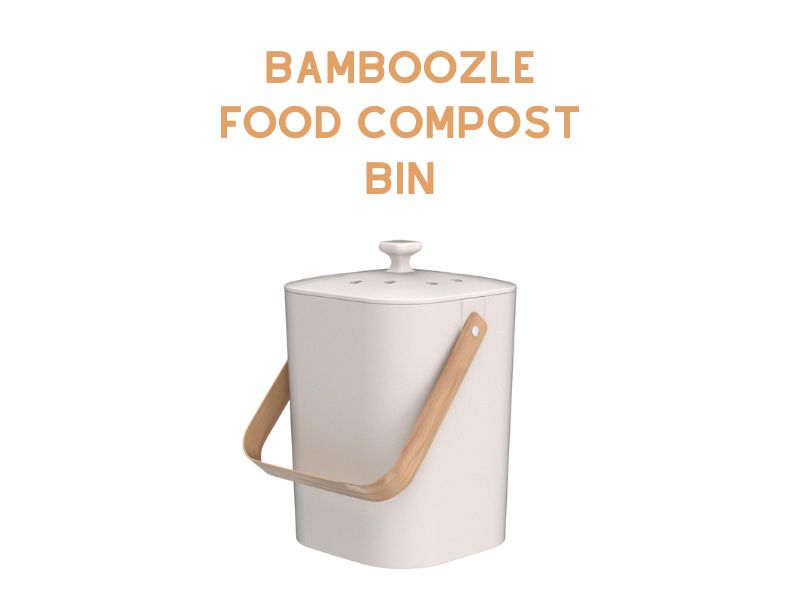
Bamboozle Food Compost Bin is the only fully non-plastic option in this comparison — the body and lid are bamboo fiber composite, with carbon filter inserts as the only non-bamboo component. For households making a conscious effort to avoid plastic in food contact areas, Bamboozle is the qualifying pick. The 2-liter capacity is modest compared to the OXO crock, requiring emptying every 3-5 days for a 2-person household's scrap volume. The natural bamboo fiber aesthetic suits both modern and traditional kitchen styles. Dishwasher-safe for the body. The honest limitation is durability: bamboo fiber composite shows visible wear at rims and edges after 18+ months of daily use, and the capacity is limited for heavy-vegetable-cook households.
Pros
- ✓Bamboo fiber composite construction — no plastic in food contact surfaces
- ✓Carbon filter controls odor effectively for short collection cycles
- ✓Dishwasher-safe body, natural aesthetic
- ✓Certified compostable option for the bin itself at end of life
Cons
- ✗2-liter capacity requires more frequent emptying than other options
- ✗Bamboo fiber shows wear at rims after 18+ months of daily use
Score breakdown
| capacity | 2 liters |
| material | Bamboo fiber composite, carbon filter inserts |
| odorControl | Carbon filter |
| dishwasherSafe | Yes |
| filterReplacement | Every 2-3 months (included pack) |
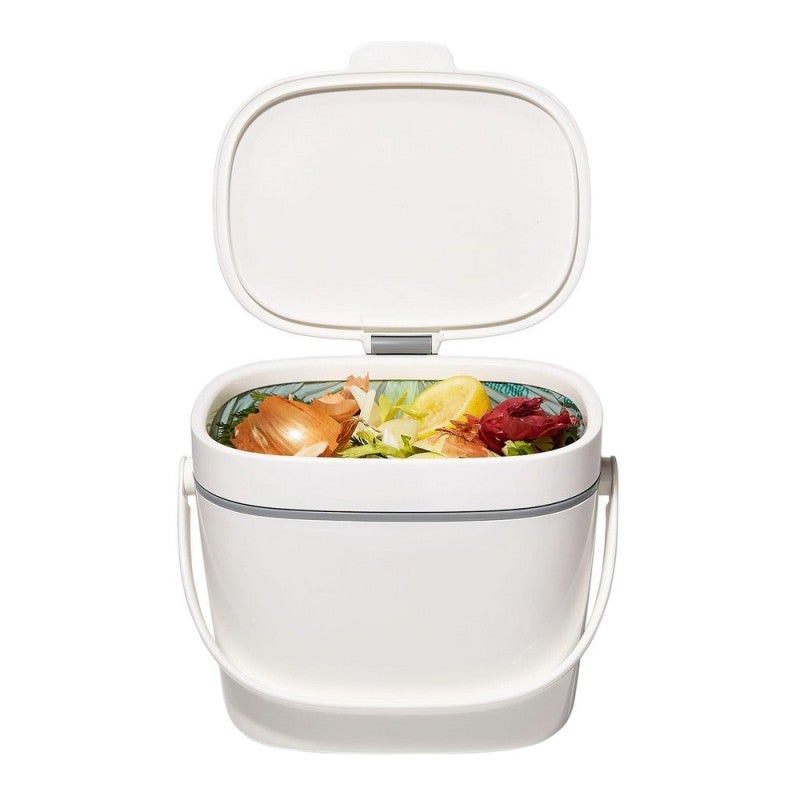
OXO Good Grips Easy-Clean Compost Bin
OXO Good Grips Compost Crock is the pragmatic kitchen composting solution — the same OXO design competence applied to a collection bin. The stainless or white body with swing-top lid looks kitchen-appropriate, the activated charcoal filter in the lid absorbs odor for 1-2 months per filter, and the smooth interior surface cleans completely in a dishwasher cycle or a 30-second hand rinse. At $25 it's the cheapest in this comparison. The 1.75-liter capacity is the smallest here — for a 2-person household producing moderate kitchen scraps, you're emptying it every 4-5 days. Available everywhere OXO is sold, from major kitchen retailers to online stores. The honest limitation is the sealed non-ventilated design: without airflow, scraps produce more moisture and smell faster than ventilated designs.
Pros
- ✓$25 — cheapest in this comparison
- ✓OXO design quality: smooth interior, dishwasher-safe, clean aesthetic
- ✓Charcoal filter controls odor for 1-2 months between replacements
- ✓Available at major kitchen retailers and online stores
Cons
- ✗1.75-liter capacity is the smallest in this comparison
- ✗Non-ventilated sealed design accumulates moisture faster than vented options
Score breakdown
| capacity | 1.75 liters |
| material | Stainless steel body, activated charcoal filter |
| odorControl | Activated charcoal filter |
| dishwasherSafe | Yes |
| filterReplacement | Every 1-2 months |

Lomi Electric Kitchen Composter
Lomi is the only product in this comparison that actively processes food scraps rather than collecting them for external disposal. The electric grinding and heating cycle reduces a load of food scraps to dry, brown, reduced-volume material in 4-8 hours (Eco Express mode). The key clarification: Lomi's output is not finished compost — it's dehydrated ground material that needs 4-6 additional weeks in soil or a compost pile to become biologically active. For urban households without outdoor access who want to divert food waste from incineration, Lomi accomplishes that: 90% volume reduction, no smell, dry output that can go into a garden mix or designated compost bin. At $500 purchase price plus filter pod costs ($25 per 45 cycles), it's the most expensive option in this comparison by a wide margin.
Pros
- ✓Processes scraps to dry output in 4-8 hours — only option that works indoors at scale
- ✓90% volume reduction means less frequent emptying than any collection bin
- ✓Output doesn't smell — suitable for apartment dwellers without outdoor access
- ✓Accepts most food scraps including meat and dairy that outdoor composting avoids
Cons
- ✗$500 purchase price plus ongoing filter pod costs is the highest in this comparison
- ✗Output requires additional 4-6 weeks in soil to become biologically active garden compost
Score breakdown
| capacity | 3 liters per cycle |
| material | Plastic body, metal grinding elements |
| odorControl | Heating and filter pods |
| dishwasherSafe | Bucket yes, outer unit no |
| powerConsumption | ~1 kWh per cycle |

FCMP Outdoor Dual Chamber Tumbling Composter
FCMP Outdoor Dual-Chamber Tumbler is the right pick for households with garden access who want genuine finished compost at meaningful volume. The dual-chamber design solves the common single-chamber problem: one side accepts fresh material while the other finishes — you always have a chamber that's actively composting, not a single bin you can't add to while it completes. BPA-free black recycled plastic absorbs solar heat to keep the compost pile above the temperature threshold that accelerates microbial activity. Turning handle spins every 2-3 days. The output — given a balanced mix of greens (food scraps, fresh grass clippings) and browns (dry leaves, cardboard) and 4-6 weeks in summer — is genuine finished compost that improves garden soil. The honest limitation: it requires outdoor space and active management. It does nothing useful in an apartment.
Pros
- ✓Dual-chamber design lets you add fresh material while one side finishes
- ✓Produces genuine finished garden compost — better output than any other option here
- ✓BPA-free recycled plastic, pest-resistant airtight construction
- ✓$90-120 produces far more garden value than a $500 electric composter
Cons
- ✗Requires outdoor space — not applicable to apartment dwellers
- ✗Requires active management: turning every 2-3 days and balancing greens/browns
Score breakdown
| capacity | 37 gallons / 140 liters total (2 chambers) |
| material | BPA-free recycled UV-stabilized polypropylene |
| odorControl | Airtight design, natural decomposition |
| dishwasherSafe | N/A — outdoor unit |
| compostingTime | 4-6 weeks summer / 8-12 weeks cooler weather |
Which one is right for you?
For city dwellers with countertop space wanting stylish odor control
Full Circle Breeze Odor-Free Countertop Compost Bin
Full Circle Breeze's carbon filter and ventilation design genuinely controls odor for weekly emptying cycles without looking like a utilitarian bucket on the counter.
For zero-plastic kitchen setups
Bamboozle Food Compost Bin
Bamboozle uses bamboo fiber composite construction with no plastic — the only fully non-plastic option in this comparison, designed for households avoiding plastic in food contact surfaces.
For households wanting no-fuss weekly collection with a trusted brand
OXO Good Grips Easy-Clean Compost Bin
OXO Good Grips crock with activated charcoal filters is the pragmatic pick — easy to clean, OXO design quality, carbon filter odor control, and available everywhere.
For households who want finished compost in hours rather than months
Lomi Electric Kitchen Composter
Lomi electric composter produces dry, reduced-volume output from food scraps in 4-8 hours — the only option in this comparison that genuinely closes the composting loop on a daily basis without outdoor access.
For households with outdoor space who want to compost at volume
FCMP Outdoor Dual Chamber Tumbling Composter
FCMP Outdoor tumbler produces genuine finished garden compost from kitchen scraps and yard waste at the highest volume capacity in this comparison — the right pick for anyone with a garden.
How we compared
Composting products span a wider performance range than almost any other kitchen category because they address fundamentally different use cases: countertop collection (gathering scraps to take to municipal composting or an outdoor bin), indoor electric processing (turning scraps into dehydrated material or actual compost indoors), and outdoor composting (converting scraps plus yard waste into garden-ready compost over weeks to months). A countertop crock and a Lomi electric composter are both 'composting bins' in the product category sense, but they do different things for different users in different living situations.
We evaluated each product on the criteria that matter for its specific use case: for countertop collection bins (Full Circle, Bamboozle, OXO), we focused on odor control reliability, cleaning ease, and capacity for a household's weekly scrap volume. For the electric composter (Lomi), we focused on cycle time, output quality, electricity cost, and the honest question of whether the output is real compost or just dehydrated scraps. For the outdoor tumbler (FCMP), we focused on capacity, turning mechanism effectiveness, pest resistance, and realistic time to finished compost in temperate climates.
What changed in 2026
Electric kitchen composters had a significant market moment in 2023-2024 driven by Lomi's marketing campaign and several viral social media posts showing scraps turned to dry brown material in a few hours. By 2026, the reality check has arrived: electric composters are effective at dehydrating and grinding food scraps, but the output — often called 'Lomi earth' by the manufacturer — is not finished compost in the garden-science sense. It lacks the microbial activity of properly composted material and needs to be added to a larger compost pile or mixed with soil over several weeks before plants can use it effectively. This is not a dealbreaker for urban households without outdoor composting access, but it's an important clarification. Owner reviews are clearer on this distinction in 2026 than they were in 2023.
Municipal composting programs expanded significantly between 2023 and 2026, with many city food waste collection programs reaching a meaningful share of urban households by 2025. This changes the calculus for city-dwelling households: if your municipality collects food waste separately from general trash, a simple countertop collection bin that you empty weekly is all you need — there's no need to process scraps at home. If your municipality still sends food waste to incineration, an electric composter or outdoor tumbler reduces your environmental impact more meaningfully.
Where each fits
Full Circle Breeze Countertop Bin at around $35 is the stylish collection pick for apartment dwellers who empty their scraps into a municipal collection bin or outdoor composter weekly. The ventilated design with a carbon filter allows some airflow while capturing odor-causing volatile compounds — the combination genuinely controls smell for 5-7 days of scrap accumulation for a 2-person household. 1-gallon / 3.8-liter capacity. Available in colors that pass for kitchen decor rather than a waste bucket. The honest limitation: it's a collection bin, not a composter — scraps don't break down inside it, and at 7+ days accumulation the smell control degrades noticeably. The carbon filter needs replacement every 2-3 months at around $8.
Bamboozle Food Compost Bin at around $40 is the no-plastic pick. The body and lid are bamboo fiber composite — no plastic in construction, no plastic lid, no plastic liner. The carbon filter inserts are the only non-bamboo component. For households avoiding plastic in food contact areas, Bamboozle is the only option in this comparison that qualifies. The 2-liter capacity is smaller than the OXO crock, requiring emptying every 3-5 days for a 2-person household. Dishwasher-safe. The honest limitation: the bamboo fiber body is less durable than injection-molded plastic or stainless steel — owners report visible wear at the rim after 18+ months of daily use. The capacity is also modest for households producing more than light scrap volumes.
OXO Good Grips Compost Crock at around $25 is the pragmatic no-fuss pick — the same OXO design quality applied to a kitchen collection bin. 1.75-liter capacity, stainless or white body, swing-top lid with activated charcoal filter. The charcoal filter absorbs odor compounds for 1-2 months per filter, and the smooth interior walls clean completely in a dishwasher cycle or a quick hand rinse. Available in OXO's full retail network — major kitchen stores and online. The honest limitation: it's the smallest in this comparison at 1.75 liters, requiring more frequent emptying for households producing significant scrap volumes. No ventilation — scraps accumulate without airflow, which limits the effective collection window to about 4-5 days before smell intensifies.
Lomi Electric Composter at around $500 is the electric processing pick for households who want to close the food waste loop indoors without outdoor access. The electric grinding and heating cycle produces dry, reduced-volume output from food scraps in 4-8 hours in Eco Express mode. The output is not finished garden compost — it's dehydrated ground material that benefits from addition to a soil mix or compost pile and 4-6 additional weeks to become biologically active. For urban households who genuinely have no outdoor composting access and want to divert food waste from landfill, Lomi does that effectively: 90% volume reduction, dried output that doesn't smell and can go in the recycling bin or garden. Electricity cost runs approximately $0.02-0.05 per cycle. Filter pods ($25 for 45 pods) can be added to the cycle to further reduce odor and accelerate breakdown. At $500 purchase price plus ongoing filter costs, it's a premium environmental choice rather than an economical one.
FCMP Outdoor Tumbler at around $90-120 is the outdoor composting pick for households with garden access who want high-volume composting of both food scraps and yard waste. Dual-chamber design lets you add fresh material to one side while the other side finishes — preventing the 'never turn finished because you keep adding fresh' problem with single-chamber designs. BPA-free recycled black plastic absorbs solar heat to accelerate decomposition. Airtight construction prevents pest access. Turning handle spins the chamber every 2-3 days to aerate the pile. Realistic time to finished compost: 4-6 weeks in summer, 8-12 weeks in cooler weather, with active turning and a balanced mix of greens and browns. At $90-120 it's the second-most expensive in this comparison but produces genuine finished garden compost at the highest volume of any product here.
Verdict
For urban households with municipal composting collection, OXO Good Grips at $25 or Full Circle Breeze at $35 covers everything you need — scraps go in, carbon filter controls the smell, you empty it to the collection point weekly. Don't buy a $500 Lomi if your city already collects food waste separately.
For households without outdoor access or municipal collection who genuinely want to divert food waste from landfill, Lomi at $500 is the only option in this comparison that works indoors at scale — with the honest caveat that the output requires additional processing before it's garden-usable. For households with garden access, FCMP Outdoor Tumbler at $90-120 produces better finished compost at higher volume for a fraction of the price, with the trade-off of requiring outdoor space and active management.