Best Closet Organizer 2026: PAX vs Elfa vs Rubbermaid
Five closet systems spanning budget to premium tiers — a flat-pack wardrobe against a wall-track modular system, a wire-shelf kit, a Japanese drawer tower, and a budget double-rod rack. The right system depends on whether you own or rent, how often your storage needs change, and whether you're storing a capsule wardrobe or a full seasonal rotation.
Each system was assessed on usable capacity (liner dimensions vs. advertised), component availability for future expansion, installation complexity without professional help, stability under 20 kg distributed load, and visible wear after 12 months of daily access.

IKEA PAX Wardrobe System
Best Full Wardrobe System: IKEA PAX delivers the most enclosed, furniture-grade wardrobe at this price — the 58 cm deep frames accommodate hanging garments without compression, and the modular interior fittings (KOMPLEMENT rails, shoe shelves, drawer units) can be reconfigured as needs change. The white melamine surface resists most household humidity, though the particleboard substrate will swell if exposed to direct moisture.
Top picks ↓Top picks
Related articles


IKEA PAX Wardrobe System
IKEA PAX delivers the most enclosed, furniture-grade wardrobe at this price — the 58 cm deep frames accommodate hanging garments without compression, and the modular interior fittings (KOMPLEMENT rails, shoe shelves, drawer units) can be reconfigured as needs change. The white melamine surface resists most household humidity, though the particleboard substrate will swell if exposed to direct moisture. Assembly requires two people and 3–4 hours.
Pros
- ✓Enclosed wardrobe with door options hides clutter completely — no visual noise in the room
- ✓Interior fittings are swappable: add drawers, pull-out trousers racks, or shoe shelves without buying a new frame
- ✓58 cm depth accommodates folded sweaters on shelves without double-stacking
Cons
- ✗Particleboard substrate swells in high-humidity environments — not suitable near bathrooms without ventilation
- ✗Two-person assembly required; relocating after installation is impractical
Score breakdown
| Frame width options | 50, 75, 100 cm |
| Frame depth | 35 or 58 cm |
| Frame height options | 201 or 236 cm |
| Material | Particleboard, melamine foil |
| Load per shelf | Up to 30 kg |
| Door options | Hinged or sliding |
| Price tier | Mid-range per unit |
Container Store Elfa Shelving System
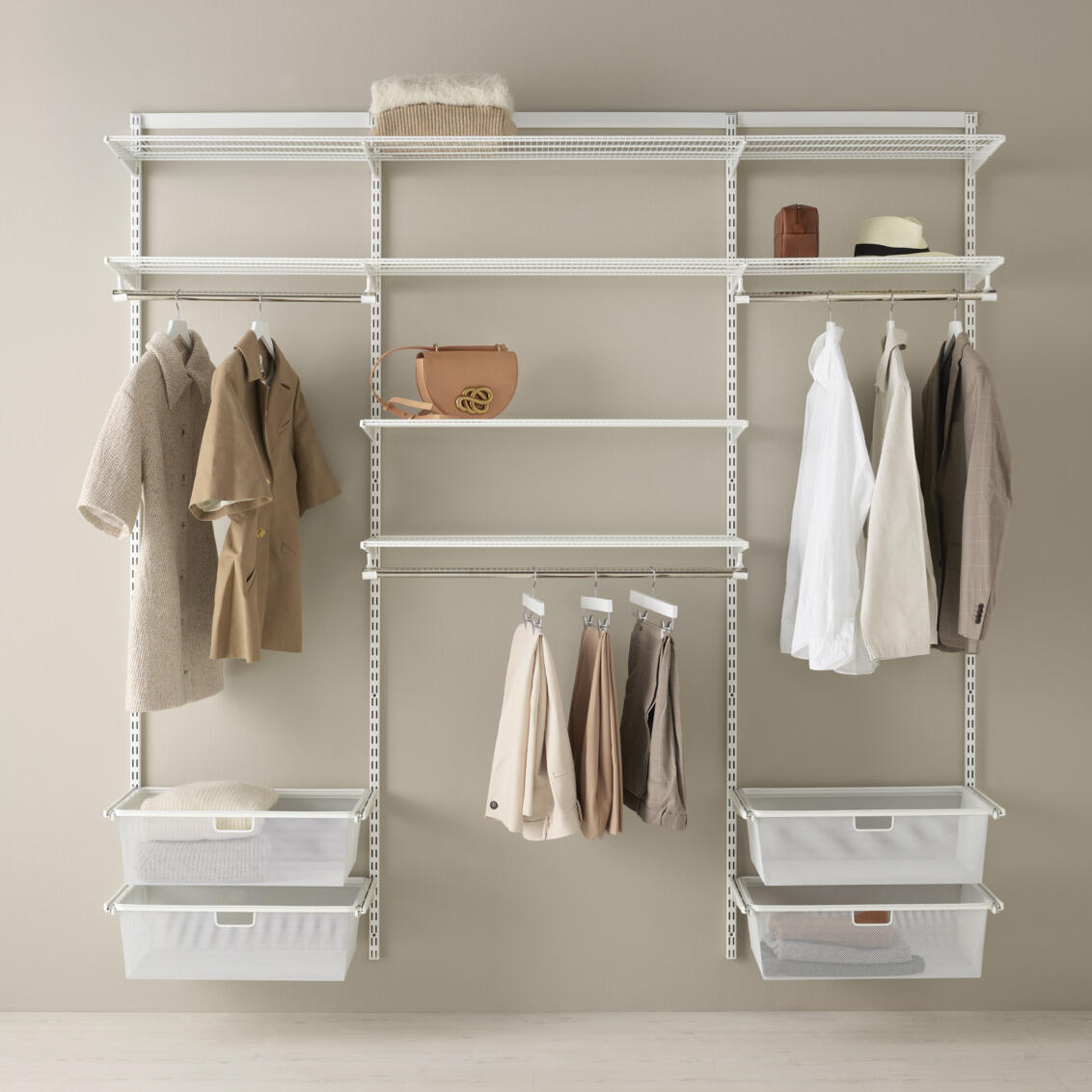
The Container Store's Elfa system mounts to a wall-mounted top track, from which all vertical uprights and shelf brackets hang — meaning you can reconfigure shelf heights, add drawers, or extend the system without re-drilling into walls. The steel components are powder-coated and hold 23 kg per bracket. The honest limitation is cost: an Elfa setup that replaces a single PAX wardrobe routinely runs 2–3x the price.
Pros
- ✓Top-track mounting allows infinite reconfiguration without new wall anchors
- ✓Steel components rated to 23 kg per bracket — significantly stronger than wire shelf systems
- ✓Lifetime guarantee on all Elfa components from Container Store
Cons
- ✗2–3x the price of IKEA PAX for equivalent coverage; open design shows all stored items
- ✗Requires solid stud or masonry for top track — plasterboard-only walls need toggle bolts and load reduction
Score breakdown
| Upright spacing | 30 cm increments |
| Shelf depths available | 30, 40, 51 cm |
| Bracket load rating | 23 kg per bracket |
| Material | Powder-coated steel |
| Drawer options | Mesh or solid in 5 widths |
| Installation | Wall-mounted top track |
| Price tier | Premium per wall section |

Rubbermaid Configurations Closet Kit
Rubbermaid Configurations uses coated wire shelving that wall-mounts without studs via their TightMesh bracket system — the brackets spread load across a larger drywall area and support 45 kg per 90 cm shelf. Wire construction allows air circulation (useful for sneakers and damp sports gear) and the shelves cut to length with standard wire cutters. The aesthetic is unambiguously utilitarian.
Pros
- ✓TightMesh brackets support 45 kg per 90 cm shelf without stud anchoring
- ✓Wire construction allows airflow — prevents moisture buildup under folded items
- ✓Shelves cut to exact length on-site; no leftover gaps
Cons
- ✗Wire shelves leave imprints on folded cashmere and thin fabrics over time
- ✗Industrial aesthetic doesn't suit bedroom display; visible wall anchors
Score breakdown
| Shelf depth | 30 or 40 cm |
| Max shelf length | 120 cm per run |
| Load per 90 cm shelf | 45 kg |
| Material | Epoxy-coated steel wire |
| Wall anchor type | TightMesh no-stud brackets |
| Finish options | White, black |
| Price tier | Entry-level per kit |

Whitmor Double Rod Closet Organizer
The Whitmor Double Rod Closet Organizer is a freestanding steel tube rack — no wall anchors, no tools, assembly in under 10 minutes. At 152 × 45 × 174 cm it holds a meaningful volume of hanging garments on two rails plus a shelf. The trade-off is stability: it rocks when the top shelf is loaded, and any contact with the frame tips the entire unit. Suitable for renters who need temporary hanging space, not a primary long-term storage system.
Pros
- ✓Tool-free assembly in under 10 minutes — fully reversible for renters
- ✓Two hanging rails accommodate shirts, jackets, and longer garments simultaneously
- ✓Chromium-plated steel is wipe-clean and resists most clothing dye transfer
Cons
- ✗Rocks when top shelf is loaded beyond 10 kg; lacks floor anchoring
- ✗No drawer or enclosed shelf option — all items remain visible and open to dust
Score breakdown
| Dimensions | 152 × 45 × 174 cm |
| Rod count | 2 (upper + lower) |
| Top shelf capacity | 10 kg |
| Material | Chrome-plated steel tube |
| Assembly | No tools, 10 minutes |
| Price tier | Budget |
Which one is right for you?
For homeowners who want a permanent wardrobe
IKEA PAX Wardrobe System
PAX gives the most furniture-grade wardrobe at the price — enclosed, door options, reconfigurable interior, and widely available replacement parts. If you're staying in a space for 3+ years, nothing at this price point competes.
For renters who need to reconfigure frequently
Container Store Elfa Shelving System
Elfa's top-track system means new shelf heights and drawer configurations require no new wall holes — ideal for seasonal reconfigurations or shared spaces where storage needs shift.
For compact apartments
closet-organizer-muji-jp
Muji's 26 cm-deep drawers fit inside existing closet spaces where a PAX frame won't close — and the stackable design means you can start with one unit and add more without replacing anything.
Modular wall systems vs. freestanding furniture — the real differences
Wall-mounted systems like Elfa transfer weight directly to wall studs or masonry — the shelves themselves bear no structural load, which is why they can hold significantly more than freestanding furniture of equivalent price. A single Elfa bracket rated to 23 kg per bracket means a 120 cm shelf run can theoretically support six brackets holding 138 kg total, distributed across a masonry wall. Freestanding furniture like IKEA PAX relies on the cabinet's own structure: the particleboard sides, back panel, and shelf pins take all the load, which is why PAX specifies 30 kg per shelf rather than per bracket.
The installation commitment differs accordingly. Elfa requires accurate stud location (or toggle bolt calculation for plasterboard), a level top track, and a willingness to live with screw holes. PAX requires floor space for the footprint, two people for assembly, and accepting that once it's placed, moving it is a significant project. For renters on short leases, neither is ideal — which is where freestanding wire systems and no-tools racks earn their place despite the capacity tradeoff.
Reconfiguration is the sleeper issue. Most closet systems look equally flexible in the catalog but differ dramatically in practice. Elfa: move a clip, lift a bracket, reposition a shelf — five minutes, no tools. IKEA KOMPLEMENT fittings: remove the shelf pin, reposition in a new hole, replace the shelf — five minutes, a screwdriver. Rubbermaid wire: remove wall bracket screws, reposition the bracket, rehang the shelf — 20 minutes with a drill. Understanding how often your storage needs actually change is the most useful question before committing to a system.
Capacity calculation: what the numbers don't tell you
Every closet system advertises total capacity in liters or linear hanging centimeters. What they don't advertise is usable capacity — the volume actually accessible given door swing clearance, drawer runner clearance, and the dead space at the back of deep shelves. A PAX unit with 58 cm depth shelves technically holds more than one with 35 cm depth shelves, but folded items pushed to the 58 cm back wall require removing everything in front to access them. In practice, most users use the front 35 cm of a 58 cm shelf and treat the back 23 cm as dead storage for rarely accessed items.
Hanging capacity is frequently overstated by assuming every item is 5 cm wide. A standard shirt on a wooden hanger is closer to 3 cm. A padded winter jacket on a hanger is 8–12 cm. A mix of seasonal garments averages around 6 cm per item. A 100 cm hanging rod holds approximately 16 mixed garments, not the 20 that catalog math implies. Plan for 70% of the catalog capacity as realistic usable space.
Drawer systems (Muji, IKEA KOMPLEMENT) have a different capacity trap. A 37 × 26 cm drawer holds approximately 5–6 T-shirts folded vertically in the KonMari style, or 3–4 folded horizontally. The 17.5 cm drawer height is enough for single-layer vertical folding but not for stacked horizontal folding. If you have a large wardrobe with multiple bulky items (hoodies, jeans), calculate how many drawers you actually need before buying a 5-drawer unit.
Rental vs. ownership — what changes about the decision
In a rented apartment, any wall modification that leaves evidence — drill holes, anchor damage, adhesive residue — is a deposit risk. The practical options narrow quickly: freestanding furniture (PAX, Muji drawer towers, Whitmor racks), over-the-door organizers, or Elfa installed carefully with the landlord's agreement and patched on departure. Rubbermaid's TightMesh bracket claims no-stud installation, but it does leave wall anchors behind, which are a cosmetic issue even if structurally sound.
Ownership unlocks the full range of systems, but the real constraint becomes planned tenure. A 3-year owner should choose differently from a 15-year owner. For 3–5 years: invest in PAX, which is disassemblable and retains value for resale or reuse. For 5+ years: Elfa is worth the higher upfront cost because the reconfiguration value compounds over time — a family's closet needs at age 35 look nothing like at age 45. For 10+ years in a fixed home: consider professional built-ins, which have their own category of tradeoffs (higher cost, non-portable, highest aesthetic integration).
Built-in closet note: some rental units come with existing wooden closet structures rather than open walls. These have fixed dimensions (often around 91 cm wide, 82 cm deep) that neither PAX nor Elfa fits neatly. Muji's polypropylene units are designed around these dimensions and stack inside such a built-in closet without modification. If you have a rental with an existing built-in closet structure, the Muji system frequently beats all other options for compatibility reasons alone.
Longevity and what wears out first
In PAX, the first failures are drawer runners and hinge mechanisms — not the frames themselves. IKEA KOMPLEMENT drawer runners are nylon-on-nylon at the budget end and ball-bearing at the premium end. The nylon runners develop play after 3–4 years of daily use under full load, causing drawers to droop and scrape. Replacing runners is inexpensive per drawer but requires knowing the exact runner width. Keep the original packaging dimensions.
In Elfa, the steel components themselves outlast virtually any other system — the powder coating resists chips and the steel gauge is substantial. What wears out are the hang brackets (the plastic clips that connect components to the upright) under repeated reconfiguration. Ordering replacement brackets from Container Store is straightforward but adds cost over time if you reconfigure frequently.
Muji polypropylene yellows slightly over years under UV exposure — placing units near south-facing windows accelerates this. The drawer runners show wear before the cabinet structure does. Replacements require the exact model number, which Muji stocks for approximately 7 years after discontinuation.
Wire systems (Rubbermaid) have the simplest longevity profile: the wire coating either chips or it doesn't. Chips at anchor points are cosmetically acceptable but can leave rust marks on wall paint. The brackets and mounting hardware outlast the wire itself. Total lifespan with normal use: 10–15 years before the coating degradation becomes significant.
