Best Bookshelves 2026: IKEA Billy vs Sauder vs Walker Edison
The bookshelf nobody warns you about is the one whose shelves bow into a sad smile under a row of hardbacks within a year. Books are deceptively heavy, so the specs that actually matter are shelf material and weight capacity — not how good it looks empty in the showroom.
We compared each bookshelf on weight capacity and shelf-sag resistance, assembly, anti-tip safety, capacity (closed vs open), style and footprint, and price. Bookcases were assessed against owner reviews and real-world loaded use, weighting durable book storage and safety alongside style and value.

Ikea Billy Bookcase
Best Overall: The IKEA Billy is the proven, affordable, endlessly adaptable standard that has furnished bookshelves for decades. It's a clean, tall bookcase with adjustable shelves in many widths, heights, and finishes that holds a serious quantity of books, and it combines, extends with height units, takes doors, and arranges into whole walls — a flexibility no other single bookcase here matches, at exceptional value with a huge ecosystem of add-ons.
Top picks ↓Top picks
Related articles
Ikea Billy Bookcase
The proven standard — a clean, adjustable-shelf bookcase in many sizes and finishes that holds a lot of books, combines and extends into whole walls, and offers exceptional value. Particleboard (don't overload wide spans), functional-minimalist look, and must be wall-anchored, but unbeatable for capacity, adaptability, and price.
The IKEA Billy is the proven, affordable, endlessly adaptable standard that has furnished bookshelves for decades. It's a clean, tall bookcase with adjustable shelves in many widths, heights, and finishes that holds a serious quantity of books, and it combines, extends with height units, takes doors, and arranges into whole walls — a flexibility no other single bookcase here matches, at exceptional value with a huge ecosystem of add-ons. The shelves adjust to fit different book heights, capacity is generous for the cost, and it's slim against a wall. It's particleboard (so don't overload wide spans, where it can sag over years), functional-minimalist in look, and must be wall-anchored like any tall bookcase, but for capacity, adaptability, looks, and unbeatable value, nothing dethrones it.
Pros
- ✓Generous, adjustable book capacity for the price
- ✓Endlessly combinable and extendable
- ✓Many sizes and finishes; huge add-on ecosystem
- ✓Exceptional value
Cons
- ✗Particleboard can sag on wide spans if overloaded
- ✗Functional-minimalist look; must be wall-anchored
Sauder 5 Shelf Bookcase
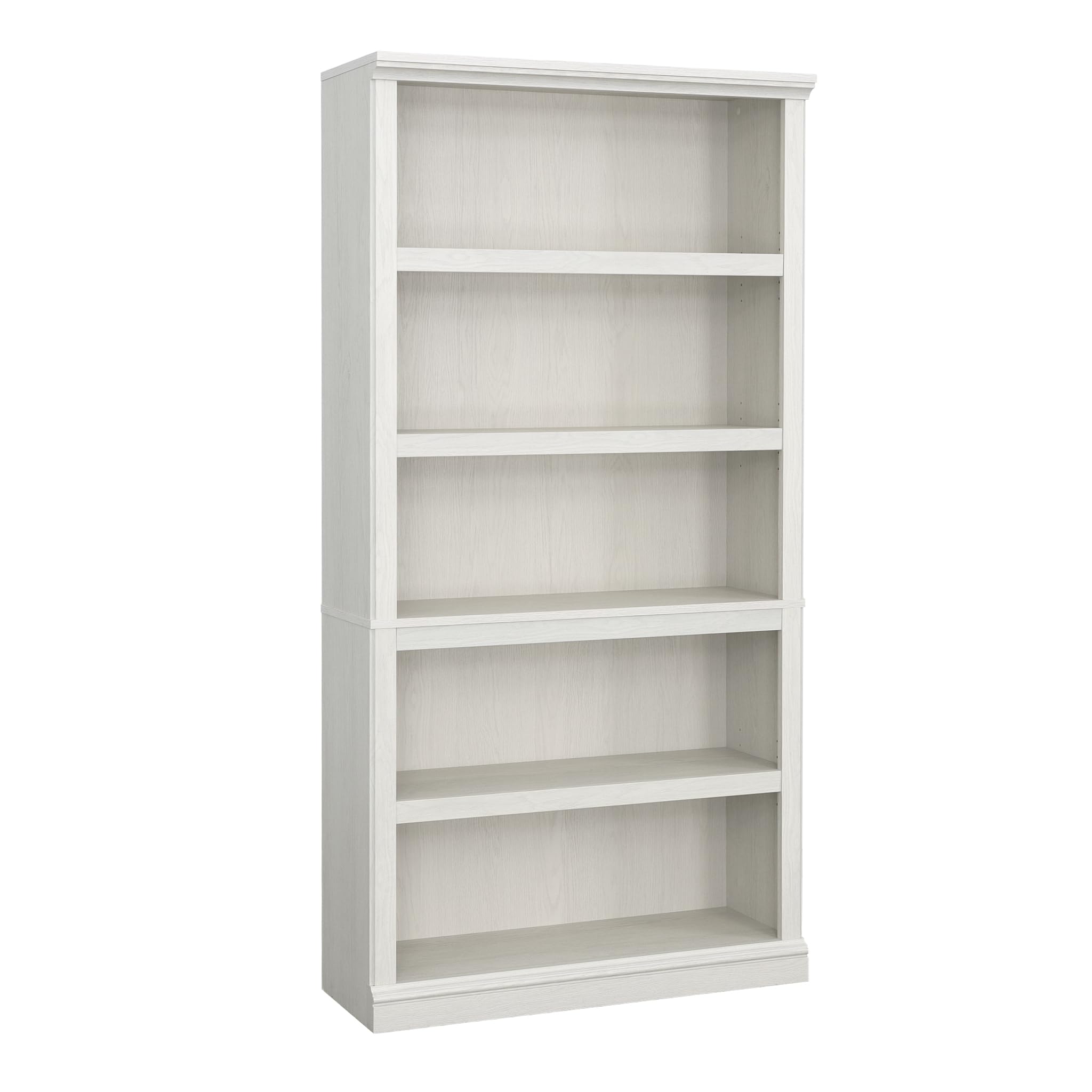
The value workhorse — a tall, high-capacity bookcase with adjustable shelves and warmer traditional/woodgrain finishes from a long-established maker, at an affordable price. A more substantial, traditional feel than the Billy; engineered wood, requires assembly and wall-anchoring.
The Sauder 5-Shelf Bookcase is the value workhorse alternative — a tall, generous-capacity bookcase from a long-established American maker, often with a more traditional or woodgrain look than the Billy, at an affordable price. It typically offers adjustable shelves, solid capacity, warmer wood-tone finishes that suit traditional and transitional decor, and dependable construction. It's the pick for a large, practical bookcase with a slightly more substantial or traditional feel than the Billy at a similar value price. Like the Billy it's engineered wood requiring assembly and wall-anchoring, with the same caution about not overloading wide shelves, but for traditional-leaning high-capacity book storage on a budget, it's a dependable choice.
Pros
- ✓Tall, high-capacity with adjustable shelves
- ✓Warmer traditional/woodgrain finishes
- ✓Dependable construction at a value price
- ✓Substantial feel
Cons
- ✗Engineered wood; don't overload wide shelves
- ✗Requires assembly and wall-anchoring

Nathan James Theo
The design-forward open pick — wood-tone shelves on a slim black metal frame in the popular modern industrial/mid-century look, displaying books and objects attractively and airily. Holds fewer books than a closed unit (display over capacity), but the standout for style.
The Nathan James Theo is the design-forward pick for an attractive open feature rather than just storage. It's typically an open-frame bookcase combining wood-tone shelves with a slim black metal frame — the popular modern industrial/mid-century look — that displays books and objects attractively while feeling light and airy rather than bulky. Nathan James specialises in stylish, accessible furniture, and the Theo suits living rooms, home offices, and spaces where the shelf is on display. The open design holds fewer books than a closed unit like the Billy and is more about curated display than maximum capacity (and collects more dust), but for style and a featured open bookcase, it's the standout, bringing a designer look at an accessible price.
Pros
- ✓Stylish modern industrial/mid-century open look
- ✓Light, airy frame displays books and objects well
- ✓Accessible designer aesthetic
- ✓Great as a featured piece
Cons
- ✗Lower capacity than a closed bookcase
- ✗Open design collects dust; may need bookends

Walker Edison Ladder Shelf
The space-conscious stylish pick — a leaning/A-frame ladder shelf with stepped shelves that displays books, plants, and objects with a light, contemporary look, ideal for small spaces and accent walls. Far lower capacity (display over storage); must be secured to the wall.
The Walker Edison Ladder Shelf is the pick for a stylish, space-conscious leaning or A-frame bookshelf that's as much decorative display as storage. Ladder shelves lean against the wall with shelves stepping back as they rise, creating a light, contemporary look that displays books, plants, and objects without the visual bulk of a full bookcase — ideal for smaller spaces, accent walls, and an airy, curated aesthetic. Walker Edison is known for affordable, on-trend furniture, and its ladder shelves are a popular way to add stylish display storage. They hold far fewer books than a full bookcase and are about display over capacity, and leaning units must be secured to the wall for safety, but for style and small-space display, they're a strong, affordable pick.
Pros
- ✓Light, airy leaning design for small spaces
- ✓Stylish display of books, plants, and objects
- ✓Affordable and on-trend
- ✓Low visual bulk
Cons
- ✗Low book capacity — display over storage
- ✗Leaning unit must be secured to the wall

Tribesigns Industrial Bookshelf
The industrial statement — tall, wide open shelving combining thick wood-tone shelves and sturdy black metal frames for a bold loft look with serious open display capacity. Higher-capacity and sturdier than a ladder shelf; needs floor space, wall-anchoring, and more involved assembly.
The Tribesigns Industrial Bookshelf is the statement pick for large, open, industrial-style shelving with serious open display capacity. Tribesigns specialises in tall, wide open bookcases combining thick wood-tone shelves with sturdy black metal frames in the industrial/loft aesthetic — often multi-tier, wall-spanning units that hold a lot of books and decor while making a strong design statement. It's the pick for furnishing a home office, studio, or living wall with substantial open shelving and industrial character. The open metal-and-wood build is sturdier and higher-capacity than a ladder shelf, though as a large open unit it needs wall-anchoring and floor space and the assembly is more involved. For an industrial statement with real capacity, it delivers more than the lighter open options.
Pros
- ✓Bold industrial/loft statement look
- ✓Substantial open display capacity
- ✓Sturdy thick shelves and metal frame
- ✓Great for offices, studios, living walls
Cons
- ✗Large — needs floor space and wall-anchoring
- ✗More involved assembly
Which one is right for you?
For the most book storage and value
Ikea Billy Bookcase
Generous adjustable capacity, endless adaptability into whole walls, and unbeatable value make it the proven standard for serious book storage — just don't overload wide spans and anchor it.
For a traditional high-capacity bookcase
Sauder 5 Shelf Bookcase
Tall capacity, adjustable shelves, and warmer woodgrain finishes give a more substantial, traditional feel than the Billy at a similar value price.
For a stylish open feature
Nathan James Theo
Wood-and-metal open shelving in a modern industrial look displays books and objects airily as a design feature in living rooms and offices.
For small spaces and airy display
Walker Edison Ladder Shelf
A light leaning ladder shelf displays books and plants with low visual bulk, ideal for small rooms and accent walls at an affordable price.
For a bold industrial statement with capacity
Tribesigns Industrial Bookshelf
Tall, wide wood-and-metal open shelving makes a loft-style statement while holding substantial books and decor — sturdier than a ladder shelf.
Top pick: IKEA Billy Bookcase
The IKEA Billy is the best bookshelf for most people because it's the proven, affordable, endlessly adaptable standard that has furnished bookshelves for decades for good reason. It's a simple, clean, tall bookcase with adjustable shelves, available in multiple widths, heights, and finishes, that holds a serious quantity of books, and it can be combined, extended with height units, fitted with doors, and arranged into whole walls of storage — a flexibility no other single bookcase here matches. At its price, the value is exceptional, and its ubiquity means a huge ecosystem of add-ons, hacks, and matching pieces.
It's genuinely practical: the shelves are adjustable to fit different book heights, the capacity is generous for a unit of its cost, and it's deep enough for most books while remaining slim against a wall. Assembly is the familiar IKEA flat-pack process — more involved than premium ready-built furniture but well-documented and manageable. For sheer book-storage value, adaptability, and a clean look that suits almost any room, the Billy is the default recommendation.
The honest caveats: it's particleboard/laminate (not solid wood), so very heavy loads on a wide span can eventually sag over many years (using narrower units or not overloading mitigates this), the look is functional-minimalist rather than a design statement, and — critically — like all tall bookcases it must be anchored to the wall to prevent tipping (IKEA includes the hardware). But for the best combination of capacity, adaptability, looks, and unbeatable value, nothing dethrones the Billy.
Best value workhorse and design-forward pick: Sauder 5-Shelf and Nathan James Theo
The Sauder 5-Shelf Bookcase is the value workhorse alternative — a tall, generous-capacity bookcase from a long-established American furniture maker, often with a more traditional or woodgrain look than the IKEA Billy, at an affordable price. Sauder bookcases typically offer adjustable shelves, solid capacity, a range of finishes (including warmer wood tones that suit traditional and transitional decor), and dependable construction. It's the pick for someone who wants a large, practical bookcase with a slightly more substantial or traditional feel than the Billy, at a similar value price point. Like the Billy it's engineered wood (laminate over particleboard/MDF) requiring assembly and wall-anchoring, with the same caution about not overloading wide shelves.
The Nathan James Theo is the design-forward pick for someone who wants their bookshelf to be an attractive open feature, not just storage. It's typically an open-frame bookcase combining wood-tone shelves with a slim black metal frame — the popular modern industrial/mid-century look — that displays books and decorative objects attractively while feeling light and airy rather than bulky. Nathan James specialises in stylish, accessible furniture, and the Theo and similar open shelving suit living rooms, home offices, and spaces where the shelf is on display. The open design holds fewer books than a closed unit like the Billy and is more about curated display than maximum capacity, but for style and a featured open bookcase, it's the standout.
Choose between them by priority. The Sauder wins as a large, traditional-leaning, high-capacity value bookcase. The Nathan James Theo wins on modern open-frame style and display appeal over raw capacity. The Sauder is the practical traditional workhorse; the Theo the stylish open feature.
The ladder shelf and the industrial statement: Walker Edison and Tribesigns
The Walker Edison Ladder Shelf is the pick for a stylish, space-conscious leaning or A-frame bookshelf that's as much decorative display as storage. Ladder bookshelves lean against the wall (or stand as an A-frame) with shelves that step back as they go up, creating a light, contemporary look that displays books, plants, and objects without the visual bulk of a full bookcase — ideal for smaller spaces, accent walls, and a curated, airy aesthetic. Walker Edison is known for affordable, on-trend furniture, and its ladder shelves are a popular way to add stylish display storage to a room. They hold far fewer books than a full bookcase and are about display over capacity, and leaning units must be secured to the wall for safety, but for style and small-space display, they're a strong pick.
The Tribesigns Industrial Bookshelf is the statement pick for large, open, industrial-style shelving that makes a bold feature and offers serious open display capacity. Tribesigns specialises in tall, wide, open bookcases combining thick wood-tone shelves with sturdy black metal frames in the industrial/loft aesthetic — often as multi-tier, wall-spanning units that hold a lot of books and decor while making a strong design statement. They're the pick for someone furnishing a home office, studio, or living wall who wants substantial open shelving with industrial character. The open metal-and-wood construction is sturdier and higher-capacity than a ladder shelf, though as large open units they need wall-anchoring and floor space, and assembly is more involved. For an industrial statement with real capacity, Tribesigns delivers.
Choose by space and look. The Walker Edison ladder shelf wins for small spaces and light, airy decorative display. The Tribesigns wins for a large, bold industrial statement with substantial open capacity. The ladder is the compact stylish accent; the Tribesigns the big industrial feature.
How to choose: capacity, shelf sag, assembly, safety, and style
Prioritise weight capacity and shelf material, because books are heavy and sagging shelves are the most common bookshelf failure. A row of books weighs a surprising amount, and over time inadequate shelves bow in the middle — so look at the shelf material and span: solid wood and thick, well-supported shelves resist sagging best, while thin particleboard/MDF laminate shelves (common in budget units like Billy and Sauder) can sag over years under heavy loads on wide spans. Mitigate it by choosing narrower units, not overloading shelves, and keeping the heaviest books low. If you have a large, heavy book collection, prioritise sturdier construction and shorter shelf spans; if you store lighter loads or display objects, engineered-wood shelves are fine.
Factor in assembly and, critically, anti-tip safety. Most affordable bookcases (Billy, Sauder, and the metal-frame units) arrive flat-packed and require assembly — more involved than ready-built furniture but manageable with the instructions; premium or simpler units are quicker. Far more important: tall bookcases are a serious tip-over hazard, especially around children and pets, and must be anchored to the wall with the included (or separately purchased) anti-tip straps or brackets — this is non-negotiable for safety, and every tall unit here should be secured. Never skip wall-anchoring a tall bookcase; tip-overs cause real injuries, and it takes only a couple of screws.
Match capacity, style, and footprint to your needs and space. Decide first whether you want maximum enclosed book storage (a full closed bookcase like the Billy or Sauder holds the most) or a stylish open display piece (ladder shelves and open metal-frame units like Nathan James, Walker Edison, and Tribesigns show off books and objects but hold fewer and collect more dust). Match the style to your decor — minimalist (Billy), traditional/woodgrain (Sauder), modern open (Nathan James), leaning/airy (Walker Edison), or industrial (Tribesigns) — and measure your space, including height (anchor to a stud) and the unit's depth against your books. Buy for capacity if you have many books, for display style if the shelf is a feature, always secure it to the wall, and don't overload the shelves.