Best Turkish Coffee Makers 2026: Cezve vs Electric
Turkish coffee is brewed in a cezve (also called ibrik) — a small, long-handled copper or stainless pot with a wide base that tapers to a narrow neck. The method. The grind, water temp, and ratio matter far more than which brewer you choose.
Each product was evaluated on brew quality, material durability, ease of foam control, grind capability, and cost per serving — covering both stovetop and electric brewing methods.

Copper Cezve / Ibrik by Shiritek
Best Traditional Cezve: Authentic copper heat conductivity and the classic aesthetic make this the ritual-first choice for Turkish coffee. The tin-lined interior protects coffee from copper reactivity and brews 1–2 cups precisely.
Top picks ↓| Product | Price | Link |
|---|---|---|
| $15 | View deal → | |
| $10 | View deal → | |
| $60 | View deal → | |
| $60 | View deal → | |
| $8 | View deal → |
Top picks
Related articles

Copper Cezve / Ibrik by Shiritek
Traditional copper, tin-lined interior, 1-2 cup size. $15-35. Best traditional cezve — authentic copper heat conductivity, classic aesthetic. Tin lining will eventually need re-tinning with heavy regular use. Correct for ritual-oriented Turkish coffee.
Authentic copper heat conductivity and the classic aesthetic make this the ritual-first choice for Turkish coffee. The tin-lined interior protects coffee from copper reactivity and brews 1–2 cups precisely. With heavy daily use, the tin lining will eventually need professional re-tinning — a real cost and effort over years.
Pros
- ✓Authentic copper heat conductivity for even foam rise
- ✓Classic aesthetic central to the ritual
- ✓Correct 1–2 cup sizing for traditional preparation
Cons
- ✗Tin lining requires re-tinning with heavy regular use
Score breakdown
| Material | Copper with tin lining |
| Capacity | 1–2 cups (~180ml) |
| Heat source | Stovetop (any except induction) |
| Maintenance | Re-tin lining over time |
| Country of origin | Turkey |
| Price range | $15–$35 |
| Style | Traditional long handle |
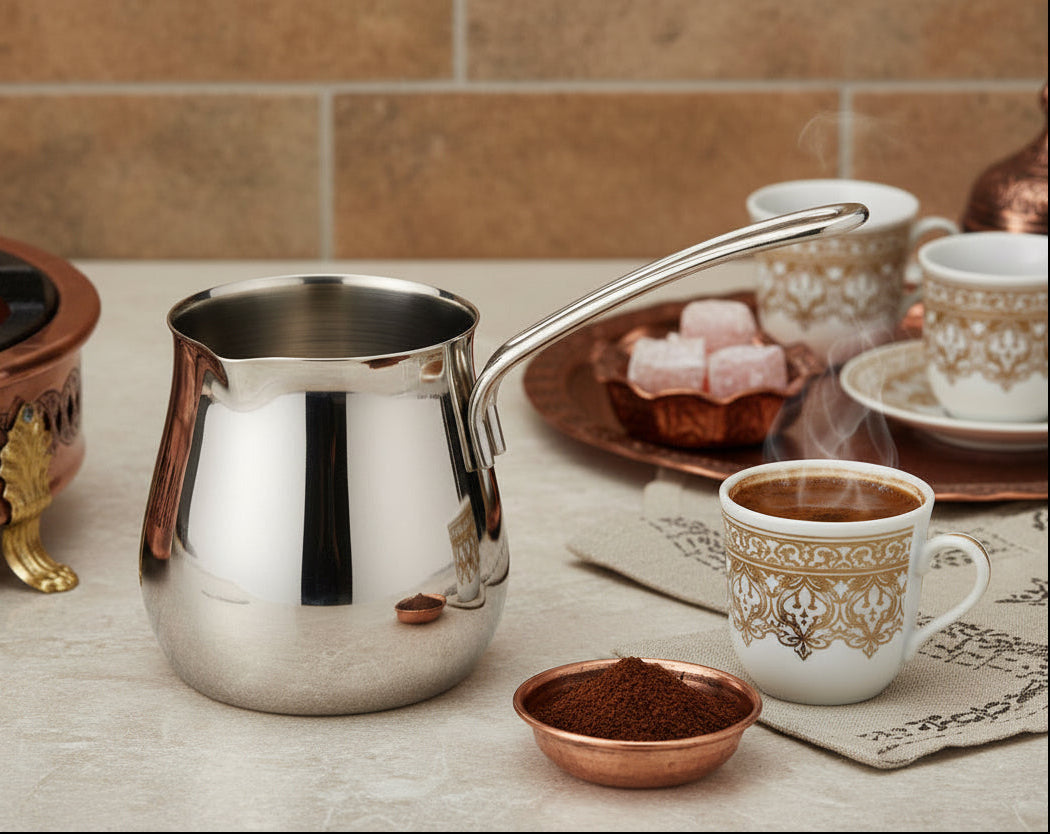
Stainless Cezve by Bosphorus
Stainless steel, no re-tinning required, durable. $10-25. Best practical cezve — same brewing results as copper, lower maintenance, dishwasher-safe (hand wash recommended). Correct if durability matters more than aesthetic.
Stainless steel delivers the same brew quality as copper with zero re-tinning, dishwasher-safe construction, and a longer practical lifespan for daily users. Heat distribution is slightly less even than copper on gas flames but the difference is minimal for home stove use. The more modern aesthetic suits contemporary kitchens.
Pros
- ✓No re-tinning required — dishwasher-safe
- ✓Same brew results as copper
- ✓More durable for daily use
Cons
- ✗Slightly less even heat distribution than copper on gas
Score breakdown
| Material | Stainless steel (no lining needed) |
| Capacity | 1–2 cups (~180ml) |
| Heat source | Stovetop including induction |
| Maintenance | Minimal |
| Dishwasher-safe | Yes (hand wash recommended) |
| Price range | $10–$25 |
| Style | Modern |
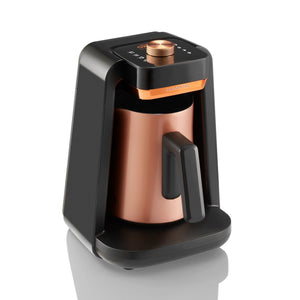
Arzum Okka Electric Turkish Coffee Maker
Electric, automated foam management, sweetness control. $60-90. Best electric Turkish coffee maker — automates stovetop process, preserves foam, correct for households brewing Turkish coffee regularly without monitoring the stovetop.
Automates the stovetop process — water to reservoir, coffee to pot, select sweetness, press start — and detects foam formation to pour automatically without boiling over. The Okka produces authentic foam and concentration comparable to stovetop brewing. It requires electricity, takes counter space, and removes some of the meditative ritual of manual brewing.
Pros
- ✓Fully automated foam management
- ✓Sweetness level selection
- ✓Authentic cup quality without monitoring
Cons
- ✗Counter space required; removes stovetop ritual
Score breakdown
| Type | Electric automated |
| Capacity | 2 cups per cycle |
| Sweetness settings | 3 levels (sade / az şekerli / çok şekerli) |
| Foam detection | Automatic |
| Power | ~500W |
| Price range | $60–$90 |
| Portability | Counter appliance |
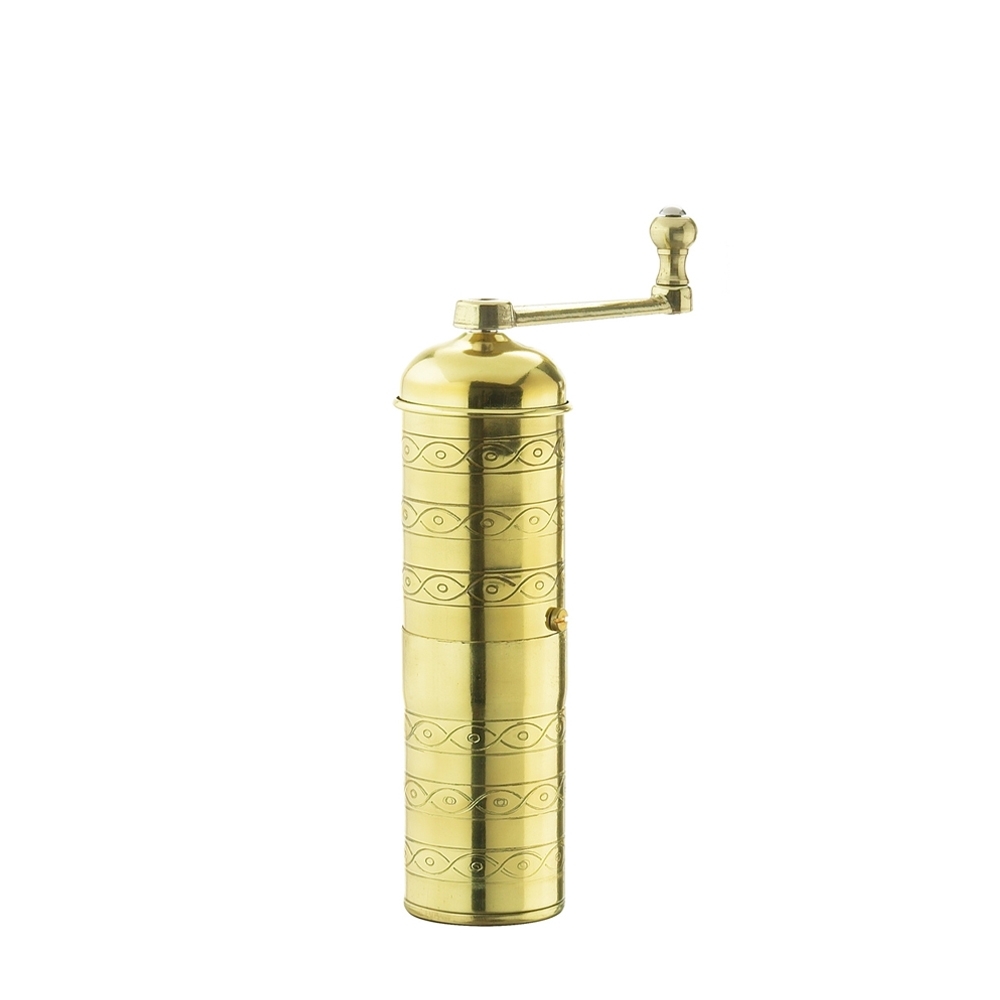
Zassenhaus Turkish Coffee Hand Grinder
Hand grinder, Turkish-fine adjustment range, cylindrical design. $60-90. Best grinder for Turkish coffee — achieves Turkish-fine grind that electric home grinders cannot. Required if brewing from whole bean.
Achieves genuine Turkish-fine grind that electric home grinders cannot reach — essential if you brew from whole bean. The cylindrical design and Turkish-fine adjustment range produce consistent powder-level fineness for cezve brewing. Slower than electric grinding, but grind quality at this fineness level surpasses electric options in the same price range.
Pros
- ✓Reaches Turkish-fine grind beyond electric home grinders
- ✓Consistent grind quality at powder fineness
- ✓Traditional cylindrical design
Cons
- ✗Slower grinding than electric — time investment per brew
Score breakdown
| Type | Hand grinder |
| Grind range | Turkish-fine (powder level) |
| Body material | Beech wood and metal |
| Burrs | Steel conical burrs |
| Capacity | ~30g per grind |
| Price range | $60–$90 |
| Country of origin | Germany |
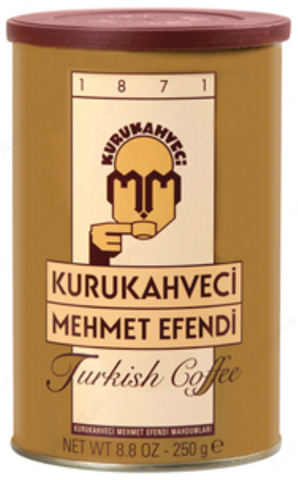
Mehmet Efendi Turkish Ground Coffee
Mehmet Efendi pre-ground Turkish coffee, traditional Istanbul roaster. ~$8-15 per 250g. Best pre-ground Turkish coffee — correct fineness for cezve brewing, widely available online, use within 1-2 weeks of opening.
Istanbul's most recognized traditional roaster, pre-ground to exactly the fineness cezve brewing requires. Available online internationally and the most practical starting point for anyone without a Turkish-capable grinder. Use within 1–2 weeks of opening — the fine particle size means rapid oxidation once the vacuum seal is broken.
Pros
- ✓Pre-ground to correct Turkish fineness
- ✓Widely available online internationally
- ✓Authentic Istanbul roaster and flavour profile
Cons
- ✗Oxidizes quickly after opening — use within 1–2 weeks
Score breakdown
| Grind | Turkish-fine (pre-ground) |
| Weight per pack | 250g |
| Roast level | Medium-dark |
| Origin | Istanbul, Turkey (Mehmet Efendi roastery) |
| Price range | $8–$15 per 250g |
| Shelf life opened | 1–2 weeks |
| Packaging | Vacuum-sealed pouch |
Which one is right for you?
For ritual-oriented Turkish coffee drinkers
Copper Cezve / Ibrik by Shiritek
Copper heat conductivity and traditional aesthetic deliver the full meditative stovetop experience.
For daily users who prioritise durability over aesthetics
Stainless Cezve by Bosphorus
Same brew results as copper with no re-tinning maintenance and dishwasher-safe convenience.
For households brewing Turkish coffee regularly
Arzum Okka Electric Turkish Coffee Maker
Automated foam management makes consistent results repeatable without monitoring the stovetop.
For whole-bean brewers
Zassenhaus Turkish Coffee Hand Grinder
The only way to achieve true Turkish-fine grind at home — electric grinders cannot reach this fineness.
For beginners or travellers without a grinder
Mehmet Efendi Turkish Ground Coffee
Pre-ground to the correct fineness and ready to brew immediately — no equipment needed beyond the cezve.
Turkish coffee mechanics: no filter, all foam
The cezve method fundamentals: cold water and extremely fine-ground coffee (finer than espresso, approaching powder) are combined in the cezve. Sugar is added at this stage if desired — Turkish coffee is traditionally served in three sweetness levels: sade (unsweetened), az şekerli (slightly sweet), and çok şekerli (very sweet). The cezve is placed over very low heat. As temperature rises slowly, the coffee-water mixture begins to extract and foam forms on the surface.
The foam is the critical indicator: as the liquid approaches boiling (around 90-95°C), a thick foam of coffee oils and fine particles rises to the surface. The cezve must be removed from heat before this foam breaks and the liquid boils — boiling destroys the foam and creates a harsh, over-extracted cup. Traditional technique: spoon some of the foam into each cup first, then return the cezve to heat briefly, then pour the remaining coffee. This preserves the foam on each cup.
Why Turkish coffee is different from other methods: the extremely fine grind provides massive surface area for extraction without needing filtration or pressure. The slow, gentle heating extracts coffee compounds in a specific ratio — high in coffee oils (since no paper filter removes them), full-bodied, and intensely concentrated. The sediment at the bottom of the cup is expected and traditional — you stop drinking when you reach the grounds.
Copper vs stainless cezve: material comparison
Copper cezve ($15-35): copper is the traditional material for cezve — excellent heat conductivity, heats evenly and quickly, and the copper aesthetic is part of the Turkish coffee ritual. Copper cezves are typically lined with tin on the interior to prevent the copper from reacting with the acidic coffee. Over time, the tin lining wears and must be re-tinned (a traditional craft service in Turkey). For occasional home use, a quality copper cezve will last years before needing re-tinning. The visual appeal of a copper cezve is significant — it's part of the ritual.
Stainless steel cezve ($10-25): stainless is a practical alternative to copper — doesn't require re-tinning, dishwasher-safe (though hand washing is better), and no concern about the tin lining wearing. Heat distribution in stainless is slightly less even than copper, but for home stove use the difference is minimal. Stainless cezves are more durable and lower-maintenance than copper. The aesthetic is more modern.
Size matters: cezve sizes are matched to the number of cups being brewed — a 1-2 cup cezve is the standard single-serving size (Turkish cups are small, approximately 60-90ml each). Most home users should have a 2-cup cezve (approximately 180-200ml). Brewing more than 2-3 cups per batch in a larger cezve is possible but harder to manage the foam precisely.
Electric Turkish coffee makers: the Arzum Okka
Arzum Okka Electric Turkish Coffee Maker ($60-90) is the dominant electric alternative to stovetop cezve brewing — a purpose-built Turkish coffee machine that automates the slow heating and foam management. You add water to the reservoir, add fine-ground coffee to the pot, select your sweetness level, and the Okka handles the rest. It detects when foam forms and automatically pours to preserve it.
The Okka produces authentic Turkish coffee quality — the foam, concentration, and sediment characteristics are comparable to stovetop brewing. For households where multiple people regularly want Turkish coffee and don't want to monitor the stovetop process, the Okka is a significant convenience improvement. The trade-off: it's less portable, requires electricity, and removes some of the meditative ritual of stovetop brewing.
The Okka works best with coffee ground specifically for Turkish brewing (extremely fine grind). Pre-ground Turkish coffee (like Mehmet Efendi) in airtight packaging is the most practical option — Turkish coffee degrades quickly after grinding due to the fine particle size and high surface area.
Grinding for Turkish coffee: why it matters more than any other method
Turkish coffee requires the finest grind of any coffee method — finer than espresso, approaching the fineness of powder. A standard burr grinder cannot achieve Turkish grind; it requires either a dedicated Turkish coffee grinder or a grinder with a specific 'Turkish' or 'Turkish fine' setting. Most home grinders (including entry-level espresso grinders) stop before reaching Turkish grind fineness.
Zassenhaus Turkish Coffee Hand Grinder ($60-90) is one of the most reliable hand grinders for Turkish grind — a traditional cylindrical hand grinder with a Turkish-fine adjustment range. The Zassenhaus produces consistent Turkish-fine grind that stovetop cezve brewing requires. It's slower than electric grinding but produces better grind consistency for Turkish than most electric grinders in the same price range.
Pre-ground Turkish coffee: Mehmet Efendi ground coffee (the most recognized Turkish coffee brand, available in international grocery stores and online) is the most practical starting point. Pre-ground Turkish coffee is extremely fine and ready to use — the compromise is that it oxidizes faster than whole bean. For regular Turkish coffee drinkers, using a Turkish-capable grinder with fresh beans is worth the upgrade.
