Best Treadmills 2026: Connected vs Basic compared
Treadmills split into two categories that need different decision criteria. Resistance feel and footprint fit matter more than maximum resistance specs.
Each product was evaluated on five criteria: build quality, performance under typical use, durability over time, comfort, and value per dollar. We weighted performance and durability highest because these determine whether a product is still useful 12 months later.

NordicTrack Commercial 1750 Treadmill
Best Overall: The Commercial 1750 sits at the top because the underlying engineering balances motor, belt, and cushioning better than any other connected treadmill at this price. A 3.75 CHP continuous-duty motor runs cool under sustained running at any realistic home-user intensity, the 56 cm × 152 cm belt fits runners of all heights without forcing a shortened stride, and the FlexSelect dial lets you switch between cushioned and firm deck feels — a genuinely useful adjustment that no other treadmill in this group offers.
Top picks ↓| Product | Price | Link |
|---|---|---|
| $2,499.00 | View deal → | |
| $3,295 | View deal → | |
| $2,799 | View deal → | |
| $649 | View deal → | |
| $3,400 | View deal → |
Top picks
Related articles



NordicTrack Commercial 1750 Treadmill
Best overall connected treadmill — 3.75 CHP motor, 56×152 cm belt, FlexSelect adjustable cushioning, -3% to 15% incline, 14-inch HD touchscreen with iFit terrain simulation. The lifetime motor warranty and automatic speed/incline control during iFit sessions make this the strongest all-round value in connected treadmills. iFit at $39/month (family plan) delivers outdoor terrain-matched running content that no other platform in this comparison replicates.
The Commercial 1750 sits at the top because the underlying engineering balances motor, belt, and cushioning better than any other connected treadmill at this price. A 3.75 CHP continuous-duty motor runs cool under sustained running at any realistic home-user intensity, the 56 cm × 152 cm belt fits runners of all heights without forcing a shortened stride, and the FlexSelect dial lets you switch between cushioned and firm deck feels — a genuinely useful adjustment that no other treadmill in this group offers. Incline runs -3% to 15%, which covers everything from VO2max protocol decline running to vigorous incline walking that produces 7–8 MET intensity. iFit at $39/month family delivers terrain-matched outdoor running content with automatic speed and incline control, the most effective motivation tool here for users who find indoor running monotonous. Lifetime motor warranty reflects NordicTrack's actuarial confidence in the drivetrain.
Pros
- ✓3.75 CHP motor with lifetime warranty
- ✓FlexSelect dial switches cushioned to firm deck feel
- ✓iFit terrain-matched outdoor running with auto incline
- ✓-3% to 15% incline covers full training spectrum
Cons
- ✗iFit family plan at $39/month adds ongoing cost
- ✗Decline limited to -3% vs Bowflex's -6%
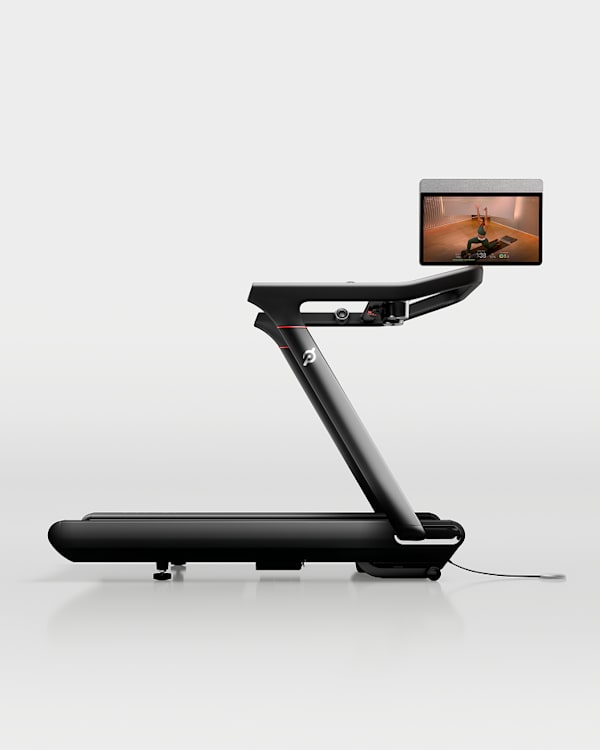
Peloton Tread
Best for coached running experience — rubber slat belt provides the most natural cushioning of any treadmill here, 3.0 CHP motor, 56×152 cm belt, 12% incline/-3% decline, and the Peloton running content library with structured training plans from 5K to marathon. The $44/month All-Access Membership is the value driver; the hardware premium over the NordicTrack 1750 is justified by the slat belt's cushioning and Peloton's coaching quality for users who will train consistently within the ecosystem.
The Peloton Tread is the only treadmill in this comparison with a rubber slat belt rather than a conventional flat belt — individual slats flex independently at each footstrike, creating a cushioning effect that genuinely feels more like running on a natural surface than any cushioned flat-belt treadmill here. The 3.0 CHP motor and 56 cm × 152 cm belt cover any home-user running pace, and the 12% incline/-3% decline range matches the NordicTrack 1750 on decline. The differentiator is content: Peloton's running library is the most curated in the connected treadmill category, with structured 5K-to-marathon plans, bootcamp classes that combine treadmill running with floor strength work, and a live leaderboard against other Tread users. The $44/month All-Access Membership is the value driver; the hardware premium over the 1750 is justified only if you'll use the ecosystem consistently.
Pros
- ✓Rubber slat belt is the most natural-feeling cushioning here
- ✓Peloton's running content is the most curated in the category
- ✓Live leaderboard and structured 5K-to-marathon plans
- ✓Bootcamp classes combine treadmill and floor work
Cons
- ✗$44/month All-Access subscription required for full value
- ✗Hardware premium over NordicTrack 1750 is substantial
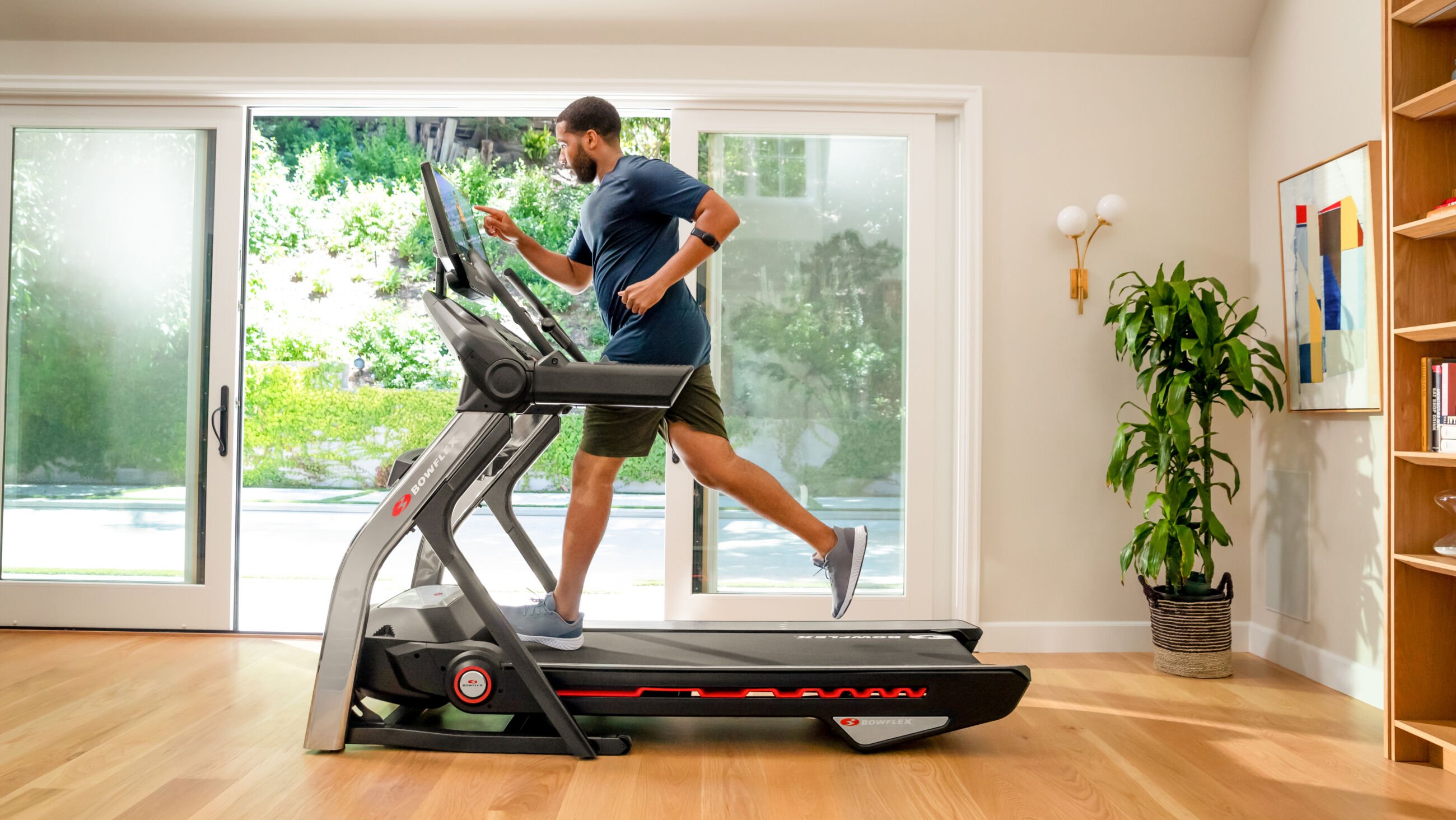
Bowflex Treadmill 22
Best mid-range connected treadmill with the widest incline range — 4.0 CHP motor, 56×152 cm belt, 20% incline/-6% decline (widest range in this comparison), JRNY adaptive coaching that adjusts workout intensity based on real-time heart rate. The -6% decline and 20% incline ceiling make this the correct choice for users prioritizing training variety. JRNY at $20/month is the most affordable connected subscription here.
The Bowflex Treadmill 22 carries the widest incline and decline range in this group at 20% incline / -6% decline — a meaningful advantage for runners targeting incline-specific training or replicating downhill loads that work the anterior tibialis and eccentric quad. The 4.0 CHP motor is the most powerful here, the 56 cm × 152 cm belt matches the premium options, and BurnRate cushioning is a zoned system with softer heel-strike and firmer toe-off zones. JRNY at $20/month is the most affordable connected subscription in this comparison and uses adaptive coaching that adjusts speed in real time based on heart rate — the closest approximation to a personal trainer dynamically tuning your session. The 15-year motor warranty is an honest signal of build confidence at this price tier.
Pros
- ✓Widest range here at 20% incline / -6% decline
- ✓4.0 CHP motor with 15-year warranty
- ✓JRNY adaptive coaching adjusts speed by real-time HR
- ✓$20/month is the cheapest connected subscription
Cons
- ✗JRNY content library smaller than iFit or Peloton
- ✗Heavier and bulkier footprint than the Horizon T101
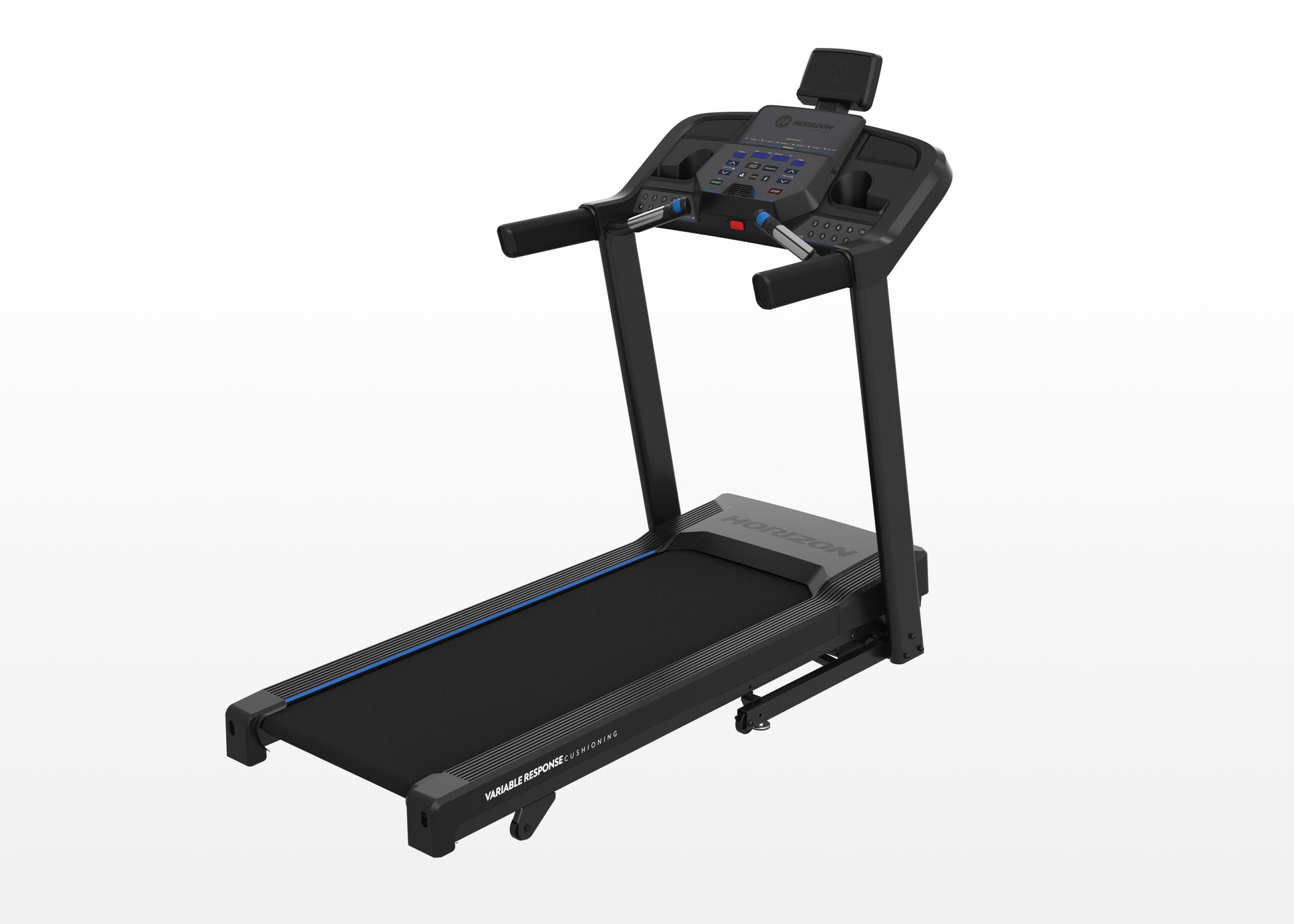
Horizon Fitness T101 Treadmill
Best budget folding treadmill — 2.5 CHP motor, 51×137 cm belt, 12% incline, foldable deck with transport wheels for space reclamation. Lifetime motor and frame warranty from Horizon provides strong long-term confidence at this price tier. Correct for walkers, light joggers, and users with floor-space constraints who do not require connected content or running-pace belt dimensions. Not recommended for sustained high-speed running or users over 90 kg.
The Horizon T101 is the right pick when budget is the primary constraint and the use case is walking or light jogging. The 2.5 CHP motor is adequate for sustained walking at any incline and jogging at moderate speeds — not enough headroom for runners regularly exceeding 10 kph or users over 90 kg running at high intensity, but a fair match for the price tier. The 51 cm × 137 cm belt is narrower and shorter than the premium options; the dimensions work for walking and light jogging but become uncomfortable for sustained running at pace. Folding deck with transport wheels reclaims floor space when not in use, which matters in small apartments. No connected content ecosystem and no decline capability, but lifetime motor and frame warranty from Horizon provides strong long-term confidence at this price. Compatible with Bluetooth heart rate monitors and mirrors data to third-party fitness apps.
Pros
- ✓Lowest entry price for a name-brand treadmill
- ✓Folding deck reclaims floor space when stored
- ✓Lifetime motor and frame warranty
- ✓Adequate for walkers and light joggers
Cons
- ✗2.5 CHP undersized for sustained high-intensity running
- ✗51 cm × 137 cm belt too small for full-pace running

Life Fitness T3 Treadmill
Best commercial-grade belt durability — 3.0 CHP motor, 56×152 cm belt, 15% incline, Flex Deck cushioning built to commercial gym standards. Lifetime motor and frame warranty. The T3 is built for 10+ years of daily use — the correct choice for users who want a treadmill they will never need to replace, without the added cost and complexity of connected subscriptions. No decline capability; designed for rehabilitation walking and long-term home use at commercial durability.
The LifeFitness T3 is built to commercial-gym standards — the same drivetrain construction found in equipment designed for 10–14 hours of daily use in public facilities. For a home user running 5–7 days per week over a 10+ year ownership horizon, that durability means the belt and motor are unlikely to require replacement within the ownership period. 3.0 CHP motor, 56 cm × 152 cm belt, Flex Deck cushioning that delivers consistent even cushioning across the entire belt surface — the preferred characteristic for rehabilitation walking where uniform impact reduction matters more than zoned variation. Lifetime motor and frame warranty backs the build claim. No decline capability and no connected content ecosystem — this is a deliberate trade-off: the T3 is a running machine that will outlast its owner, not an entertainment platform with a treadmill attached.
Pros
- ✓Commercial-gym drivetrain built for 10+ year ownership
- ✓Lifetime motor and frame warranty
- ✓Flex Deck cushioning consistent across full belt surface
- ✓Premium-grade 56 cm × 152 cm belt
Cons
- ✗No decline capability
- ✗No native connected content ecosystem
Which one is right for you?
For connected treadmill buyers wanting balanced value
NordicTrack Commercial 1750 Treadmill
The 3.75 CHP motor, FlexSelect adjustable cushioning, -3% to 15% incline, and iFit's terrain-matched outdoor runs deliver the best overall balance at this price.
For runners who want the most natural belt feel
Peloton Tread
The rubber slat belt's independent-slat cushioning genuinely feels more natural than any flat belt here, and Peloton's coaching quality is the best in the category.
For incline and decline-focused training
Bowflex Treadmill 22
20% incline and -6% decline is the widest range in this group, and JRNY's adaptive coaching adjusts speed in real time based on heart rate at only $20/month.
For walkers in small apartments
Horizon Fitness T101 Treadmill
Folding deck reclaims floor space when stored, lifetime warranty backs the entry price, and the 2.5 CHP motor handles walking and light jogging cleanly.
For rehabilitation walking and long-term home use
Life Fitness T3 Treadmill
Commercial-grade drivetrain and Flex Deck's consistent cushioning across the full belt surface are built for 10+ year ownership without subscription dependency.
Continuous duty HP vs peak HP: the motor rating that actually matters
Treadmill motor specifications are the most systematically misleading numbers in the home fitness equipment category. Manufacturers list peak horsepower — the maximum instantaneous output the motor can briefly achieve — rather than continuous duty horsepower, which is the sustained power level the motor delivers without overheating during a complete workout. A motor rated at 4.0 HP peak may deliver only 2.5 CHP continuous; the peak number is marketing, the continuous number is engineering. The NordicTrack Commercial 1750 uses a 3.75 CHP motor; the Peloton Tread uses a 3.0 CHP motor; the Bowflex Treadmill 22 uses a 4.0 CHP motor; the Horizon T101 uses a 2.5 CHP motor; the LifeFitness T3 uses a 3.0 CHP motor.
The practical consequence of underpowered continuous motors is motor heat and premature failure. When a treadmill motor is tasked with moving a 90 kg runner at 12 kph for 45 minutes, it is converting approximately 400–500 watts of electrical energy continuously. A motor rated at 2.5 CHP continuous (~1,865 W) has adequate headroom at this load; a 1.5 CHP continuous motor (~1,119 W) is working near its thermal limit, generating excess heat, and accumulating wear at a rate that shortens its service life significantly. Budget treadmills with low CHP motors that are sold at bargain prices frequently require motor replacement within 3–5 years of regular use, at a cost that often exceeds the original purchase savings.
Motor torque at low speeds is a specification that rarely appears in listings but matters significantly for incline walking workouts. Walking at 6% incline at 5 kph requires more torque from the motor than running at 0% incline at 10 kph — the combination of slower belt speed and higher load demands sustained low-RPM torque rather than high-RPM power. Brushless DC motors handle low-speed torque better than older brushed DC motors; all five treadmills in this comparison use brushless or DC motors with adequate low-speed torque for incline walking.
Warranty coverage on motors is a practical proxy for manufacturer confidence in motor durability. The NordicTrack Commercial 1750 carries a lifetime motor warranty; the LifeFitness T3 carries a lifetime motor and frame warranty; the Peloton Tread carries a 5-year motor warranty; the Bowflex Treadmill 22 carries a 15-year motor warranty; the Horizon T101 carries a lifetime motor warranty. These warranty terms reflect the manufacturer's actual actuarial expectation of motor failure rates — lifetime warranties are offered when the motor failure rate across the fleet is low enough that the warranty cost is not financially significant.
Belt dimensions: why 50 cm is enough for walking but not for running
Treadmill belt width is a safety-critical specification that most buyers evaluate after purchase rather than before. Walking generates a stride width of approximately 20–25 cm between foot centers; jogging increases this to 25–30 cm; sprinting at maximum speed can reach 35–40 cm. The treadmill belt must accommodate the full stride width plus clearance to the side rails — approximately 10–12 cm per side to allow for natural stride variation without clipping the rail on a misstep. This means a 50 cm wide belt provides comfortable margin for jogging (30 cm stride + 10 cm each side = 50 cm) but almost no margin for full-speed running. A 55–56 cm wide belt provides adequate running clearance for most adults.
The NordicTrack Commercial 1750 belt measures 56 cm × 152 cm — 56 cm is the minimum width for comfortable running and 152 cm accommodates strides up to 120 cm, which covers all but the tallest runners. The Peloton Tread belt measures 56 cm × 152 cm — identical dimensions to the NordicTrack 1750. The Bowflex Treadmill 22 measures 56 cm × 152 cm. The Horizon T101 measures 51 cm × 137 cm — the narrower width and shorter length make it appropriate for walking and light jogging but uncomfortable for sustained running at pace. The LifeFitness T3 measures 56 cm × 152 cm, the commercial standard.
Belt length affects stride length and running confidence. A 137 cm belt requires runners to shorten their stride slightly to avoid the rear roller — at 10 kph, footstrike frequency is approximately 160–170 steps per minute, and at that cadence a natural stride can easily reach 110–120 cm. On a 137 cm belt, the safety margin to the rear roller is only 15–25 cm during the flight phase of each stride, which creates psychological discomfort even when it does not create actual contact. On a 152 cm belt, the same runner has 30–40 cm of margin, enough to run naturally without thinking about belt boundaries.
Belt thickness and multi-ply construction affects both cushioning and durability. Single-ply belts (common on budget treadmills) have less cushioning and wear faster than 2-ply belts. The NordicTrack 1750 and LifeFitness T3 use commercial-grade 2-ply belts; the Peloton Tread and Bowflex 22 use reinforced single-ply belts; the Horizon T101 uses a standard single-ply belt. For users running 5+ days per week, 2-ply belt construction matters for long-term durability — a 2-ply belt on a high-use treadmill can outlast a single-ply belt by 3–5 years.
Deck cushioning and joint impact: the specification that protects your knees
Running on a treadmill generates a ground reaction force of approximately 2.5–3× body weight per footstrike — the same as outdoor running on pavement. The deck cushioning system determines how much of that impact force is absorbed by the machine versus transferred through the foot, ankle, knee, and hip. Effective cushioning reduces peak impact force by 15–30% compared to an uncushioned deck, which is equivalent to the difference between running on asphalt and running on a well-maintained trail surface. Over 10,000 footstrikes in a 60-minute run, the cumulative joint load reduction is clinically significant for users with existing knee, hip, or ankle issues.
The NordicTrack Commercial 1750 uses NordicTrack's FlexSelect cushioning system, which allows the runner to switch between cushioned and firmer deck feels by turning a dial — the cushioned setting reduces impact, the firm setting provides road-like feedback for runners who prefer training specificity for outdoor races. This adjustability is genuinely useful and not found on any other treadmill in this comparison. The Peloton Tread uses a rubber slat belt design rather than a conventional flat belt — the individual rubber slats flex independently at each footstrike, creating a cushioning effect that closely resembles running on a natural surface. Many runners report that the Peloton Tread's slat belt feels more natural than any cushioned flat-belt treadmill.
The Bowflex Treadmill 22 uses Bowflex's BurnRate cushioning, a zoned cushioning system with softer zones at heel strike and firmer zones at toe push-off — replicating the variable stiffness of a performance running shoe across the deck. The Horizon T101 uses a basic cushioning system that is adequate for walking and jogging but provides less impact reduction than the premium systems above. The LifeFitness T3 uses a Flex Deck cushioning system developed from commercial gym experience — it provides consistent, even cushioning across the entire belt surface, which is the preferred characteristic for rehabilitation walking.
Cushioning claims from manufacturers are difficult to verify independently, and many are expressed as percentages against an unspecified baseline. The most reliable proxy for cushioning quality is the deck material and thickness: decks using phenolic-coated particle board with rubber shock absorbers at mounting points outperform thin MDF decks in impact absorption and durability. Ask what the deck material is before purchasing a treadmill if impact reduction is a primary concern — premium treadmills will specify this; budget treadmills often will not.
Incline and decline range: what the percentage numbers actually produce in training
Incline is the most underused feature on treadmills owned by people who walk rather than run. Walking at 10–12% incline at 5 kph produces a heart rate and caloric expenditure comparable to jogging at 0% at 8 kph — without the impact loading of running. For people managing knee or joint issues who cannot run comfortably, incline walking is the most accessible route to cardiovascular intensity on a treadmill. The metabolic equivalent of 12% incline walking at 5 kph is approximately 7–8 METs, which is vigorous-intensity exercise by any clinical standard. Treadmills with incline ranges above 12% allow this training mode; treadmills limited to 10% incline cap the cardiovascular ceiling of walking workouts.
The NordicTrack Commercial 1750 reaches 15% incline and -3% decline — the decline range is the standout specification here. Running at -3% decline loads the anterior tibialis muscle (shin) and recruits eccentric calf loading in a pattern that does not occur on flat or incline running. Descending runners — trail runners, mountain racers — use decline running for targeted quad and shin conditioning. The -3% range is also used in VO2max testing protocols and is the setting at which the Bruce Protocol speed increments produce the most accurate aerobic capacity measurements. The Bowflex Treadmill 22 reaches 20% incline and -6% decline — the widest range in this comparison and the most appropriate for serious incline-focused training.
The Peloton Tread reaches 12% incline and -3% decline — identical decline to the NordicTrack 1750 but with a lower incline ceiling. For users doing Peloton's guided incline workouts, 12% is sufficient for all programmed content. The Horizon T101 reaches 12% incline with no decline capability — it is an entry-level specification that covers common incline training but excludes decline work. The LifeFitness T3 reaches 15% incline with no decline — the incline ceiling matches the NordicTrack 1750 but without decline; appropriate for commercial use where decline training is rarely programmed.
Automated incline adjustment during guided workouts is a connected-treadmill feature that changes how incline is used. On the NordicTrack 1750 with iFit active, the instructor's incline commands adjust the treadmill automatically — the user does not reach for a button during the workout. On the Bowflex 22 with JRNY, the same automatic adjustment occurs. On the Horizon T101, incline changes require the user to press the incline buttons manually. For users who want to follow instructor cues exactly without interrupting their running motion, automatic adjustment is a meaningful quality-of-life feature, particularly during high-intensity interval sessions.
Connected features: what the subscription delivers on a treadmill vs a bike
The content economics of connected treadmills differ from connected bikes in one important way: treadmill running is inherently more variable than cycling cadence, which makes instructor-controlled speed and incline automation more impactful on a treadmill than on a bike. A Peloton cycling class can instruct 'increase resistance to 45' and every rider independently adjusts; a Peloton Tread class that automates speed and incline changes keeps every runner at exactly the programmed effort level without distraction. The automation translates workout design into physical effort more directly on a treadmill than on any other home cardio machine.
The NordicTrack Commercial 1750 runs iFit ($39/month family, $15/month individual). iFit's library includes virtual outdoor runs with automatic speed and incline matching to the terrain — Google Maps integration allows running any route in the world with the treadmill replicating its elevation profile in real time. The 14-inch HD touchscreen on the 1750 displays the outdoor footage while the treadmill adjusts. For users who find indoor running mentally tedious, terrain-matched outdoor footage is a genuine motivation tool that extends average session length. The iFit coach-controlled workouts also include automatic speed and incline changes, removing the need for manual adjustment during intervals.
The Peloton Tread runs Peloton's running content library ($44/month All-Access per household). Peloton's running content is the most curated in the connected treadmill category: running classes led by certified coaches, structured training plans for 5K through marathon, bootcamp classes that alternate treadmill running with floor strength work using the mat next to the treadmill, and live leaderboard competition against other Peloton Tread users. The rubber slat belt's superior cushioning relative to flat belts makes longer Peloton sessions more comfortable than equivalent durations on conventional treadmills. The value case requires the same condition as Peloton cycling: the subscription content must be used consistently.
The Bowflex Treadmill 22 uses the JRNY app ($20/month). JRNY's running library is smaller than iFit or Peloton but its landmark feature is adaptive coaching — the app analyzes your previous workouts and adjusts the current session's difficulty in real time based on your heart rate. If you are running below your target zone, JRNY increases speed; if you are above, it reduces. This is the closest approximation to having a personal trainer dynamically adjusting your treadmill during a session, and it distinguishes JRNY from the manual-effort-estimation approach of other platforms. The Horizon T101 and LifeFitness T3 have no native content ecosystems; they are compatible with Bluetooth heart rate monitors and can mirror data to fitness apps, but the workout design is entirely the user's responsibility.
Verdict
The NordicTrack Commercial 1750 is the correct choice for most connected treadmill buyers who want terrain simulation, automatic incline/speed control, and a well-balanced combination of motor power, belt dimensions, and cushioning. The 3.75 CHP motor handles sustained running at any realistic home-user intensity, the 56×152 cm belt fits runners of all heights, the FlexSelect cushioning provides adjustable impact reduction, and the -3% to 15% incline range covers the full spectrum of walking and running intensities. iFit's terrain-matched outdoor running content is the best motivation tool in this comparison for users who find indoor running monotonous. At its price point, the 1750 is the best overall value among connected treadmills.
Choose the Peloton Tread if the Peloton running content ecosystem is your primary training motivation and the rubber slat belt's cushioning quality matters for long sessions. The slat belt genuinely feels different from flat-belt treadmills — more forgiving, more natural, more encouraging of longer runs — and Peloton's coaching quality and structured training plans are the best in the category. The price premium over the NordicTrack 1750 is substantial; it is justified for users who will use the $44/month All-Access Membership consistently and for whom the slat belt's joint protection is worth the hardware cost.
Choose the Bowflex Treadmill 22 if the widest incline and decline range is the priority — 20% incline and -6% decline covers more training modalities than any other treadmill here — or if JRNY's adaptive real-time coaching is the feature that will keep you consistent. At a mid-range price, the Bowflex 22 is a strong argument for the middle of the market: better motor and belt than the Horizon T101, more incline range than the NordicTrack 1750, and a lower ongoing subscription cost than Peloton.
Choose the Horizon Fitness T101 if budget is the primary constraint and the use case is walking or light jogging rather than sustained running. The 2.5 CHP motor and 51×137 cm belt are adequate for walking at any incline and jogging at moderate speeds. The lifetime motor and frame warranty from Horizon provides reasonable long-term confidence at this price tier. The T101 is not the right choice for runners who regularly exceed 10 kph or for users over 90 kg running at high intensity — the motor and belt are undersized for sustained high-intensity use.
Choose the LifeFitness T3 if commercial-grade belt durability and Flex Deck cushioning for rehabilitation walking are the priorities. The T3 is built to the LifeFitness commercial standard — the same drivetrain and belt construction found in gym equipment designed for 10–14 hours of daily use. For a home user running 5–7 days per week over 10+ years, the T3's commercial construction means the belt and motor are unlikely to require replacement within the ownership period. The absence of connected content is the deliberate trade-off: the T3 is a running machine that will outlast its owner, not an entertainment platform with a treadmill attached.
Subscription costs require explicit accounting before any connected treadmill purchase: Peloton at $44/month adds $528/year; NordicTrack iFit at $39/month family adds $468/year; Bowflex JRNY at $20/month adds $240/year; Horizon T101 and LifeFitness T3 add $0. Over five years, the Peloton subscription cost alone ($2,640) exceeds the purchase price of the Horizon T101. Buy the treadmill that matches the content platform you will actually use — not the platform that appears most impressive at the point of sale.