Best Travel Wallet 2026: RFID Blocking & Slim Security
RFID skimming in transit-heavy Asian cities is real but overstated — the bigger threat is physical theft on crowded trains. The wallet you choose should address both, and most don't handle both equally well.
Each wallet was evaluated on RFID blocking certification (Faraday cage construction vs. unverified claims), card slot count and usability when fully loaded, slim profile thickness in mm, cash and boarding pass access speed, and anti-theft construction (zipper vs. snap, slash-resistant materials).

Bellroy Travel Wallet
Best Overall: Bellroy's Travel Wallet holds 12 cards, boarding passes, and a passport in a 13 mm profile — slim enough for a jacket inside pocket and organized enough to function as a complete travel document holder. The pull-tab mechanism on the front slot is genuine quick-access that works at Suica turnstiles without opening the wallet.
Top picks ↓| Product | Price | Link |
|---|---|---|
| 99〜120 | View deal → | |
| 35〜50 | View deal → | |
| 65〜80 | View deal → | |
| 18〜25 | View deal → |
Top picks
Related articles


Bellroy Travel Wallet
Most complete travel wallet — passport + 12 cards + boarding pass. Pull-tab quick access. Full RFID blocking. Better in jacket than jeans at full load.
Bellroy's Travel Wallet holds 12 cards, boarding passes, and a passport in a 13 mm profile — slim enough for a jacket inside pocket and organized enough to function as a complete travel document holder. The pull-tab mechanism on the front slot is genuine quick-access that works at Suica turnstiles without opening the wallet. Full-length RFID blocking liner throughout. The honest weakness: at full capacity it's not a slim wallet by any measure, and the 13 mm profile is noticeable in a jeans front pocket. It's an inside-jacket-pocket wallet, not a front-pocket wallet.
Pros
- ✓Pull-tab quick access for transit cards
- ✓Full-length RFID blocking liner
- ✓Holds passport + 12 cards + boarding pass
Cons
- ✗13 mm at full load — jacket pocket, not jeans pocket
Score breakdown
| RFID blocking | Full-length metallic liner, all card slots |
| Card slots | 12 |
| Slim profile | 8 mm (6 cards) / 13 mm (passport + full load) |
| Closure | Internal snap + flap |
| Materials | Leather exterior, metallic RFID liner |
| Price | $99.00 |

Travelon Anti-Theft RFID Blocking Wallet
Best physical security. Slash-resistant panels, hidden zipper. Bulkier than standard wallets. Worth it for Southeast Asia markets.
Travelon's RFID-blocking travel wallet is the most physically secure option in this comparison — slash-resistant woven steel mesh panels, a zipper pull hidden inside a flap, and a wire cable loop for attaching to a bag strap or belt loop. This level of physical security is meaningful in high-risk transit environments. The RFID blocking covers all card slots. The honest weakness: the security features add bulk and weight that make this feel more like a small bag than a wallet. It's the right choice for Southeast Asia street markets or European tourist zones; it's overbuilt for low-risk transit cities like Singapore.
Pros
- ✓Slash-resistant steel mesh panels
- ✓Hidden zipper pull for anti-theft
- ✓Full RFID blocking + wire attachment loop
Cons
- ✗Bulkier and heavier than standard wallets
- ✗Zipper access slower than pull-tab designs
Score breakdown
| RFID blocking | All card slots, certified blocking |
| Card slots | 8 |
| Slim profile | 15 mm (mid load) |
| Closure | Zipper (hidden pull) |
| Materials | Slash-resistant woven steel mesh + polyester |
| Price | $39.99 |
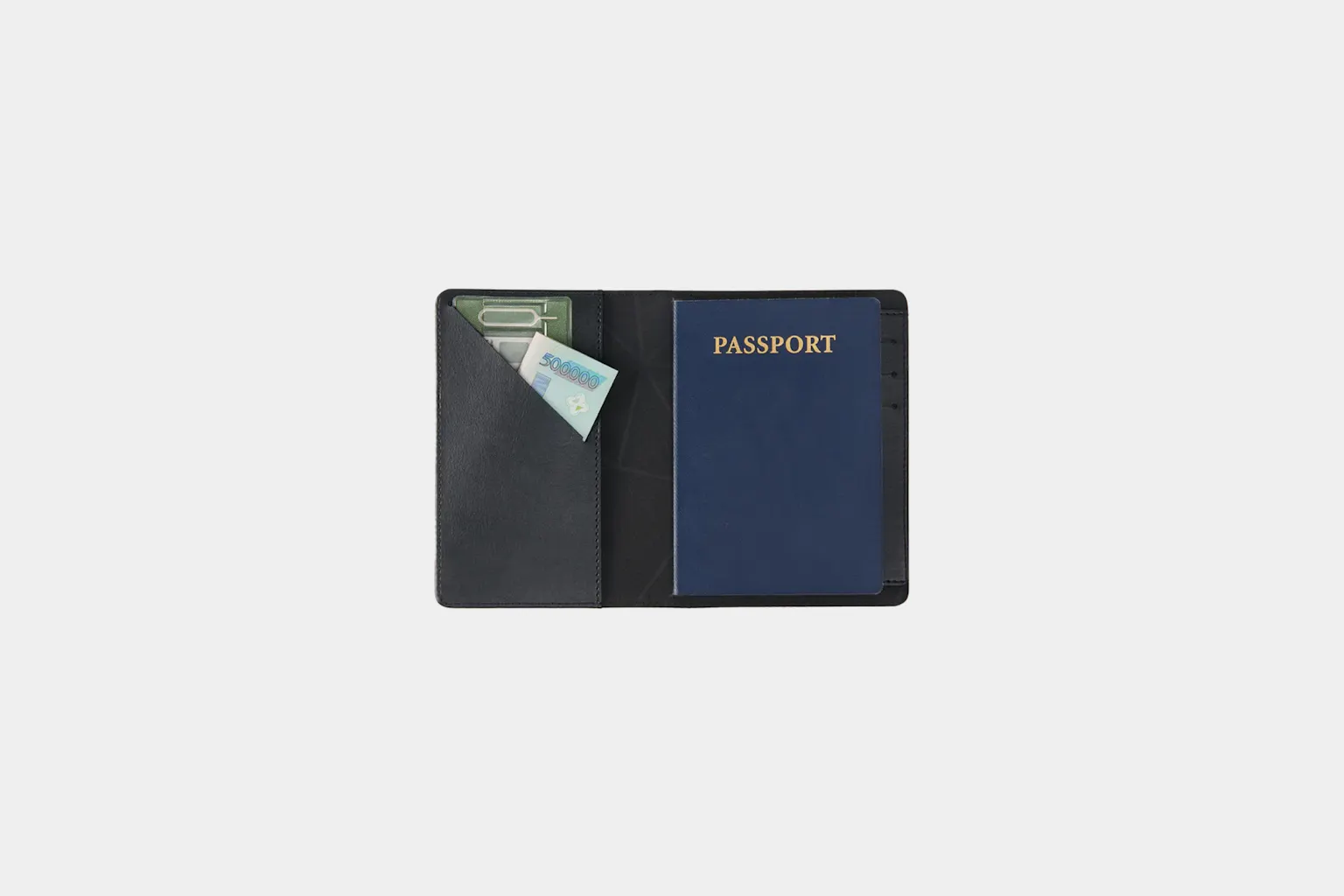
Nomatic RFID Wallet
Fastest turnstile access via exterior slot. Rigid construction, full RFID. Less flexible for receipts and boarding passes.
Nomatic's RFID Wallet has a dedicated exterior quick-access slot that holds one card without opening the wallet — the fastest turnstile and convenience store access of anything in this comparison. The accordion card structure inside holds 10 cards with RFID blocking throughout. The material is a rigid poly composite that keeps its shape over time rather than the leather slump that some Bellroy wallets develop under heavy use. The honest weakness: the rigid construction doesn't expand well for boarding passes or receipts — it's optimized for cards and cash, not documents.
Pros
- ✓Exterior card slot — fastest turnstile access
- ✓Rigid poly keeps shape under heavy use
- ✓RFID blocking on all slots
Cons
- ✗Rigid — doesn't accommodate boarding passes or folded receipts well
Score breakdown
| RFID blocking | All card slots, full-wallet treatment |
| Card slots | 10 (+ 1 exterior quick-access) |
| Slim profile | 10 mm (8 cards) |
| Closure | Magnetic snap |
| Materials | Poly composite rigid shell |
| Price | $69.99 |

Zero Grid Neck Wallet
Under-shirt carry, full RFID. Use as secure backup for passport + emergency card, not primary daily wallet.
Zero Grid's neck wallet is not a wallet in the conventional sense — it's a flat security pouch worn under clothing on a breakaway neck lanyard. It holds a passport, 6 cards, and folded cash in a flat RFID-blocking lining that sits against your chest and is invisible under a shirt or light jacket. This is the highest-security configuration available for passport + card carrying in high-pickpocket-risk environments. The honest weakness: accessing your cards requires lifting your shirt and opening a zipper, which is conspicuous and slow. It's not suitable as an everyday-access wallet — it's the backup that stays under your shirt while a secondary wallet handles small daily transactions.
Pros
- ✓Highest physical security — worn under clothing
- ✓Full RFID blocking throughout
- ✓Passport + cash + 6 cards in one pouch
Cons
- ✗Slow and conspicuous to access
- ✗Not suitable as primary daily transaction wallet
Score breakdown
| RFID blocking | Full-pouch metallic lining |
| Card slots | 6 |
| Slim profile | 6 mm (flat under shirt) |
| Closure | Zipper (internal) |
| Materials | Ripstop nylon + metallic RFID liner |
| Price | $19.99 |
Which one is right for you?
For document-heavy international travelers
Bellroy Travel Wallet
Holds passport, boarding pass, and 12 cards — the most complete travel document organization with full RFID blocking.
For Southeast Asia and high-pickpocket-risk destinations
Travelon Anti-Theft RFID Blocking Wallet
Slash-resistant panels and hidden zipper pull provide the highest physical anti-theft construction.
For Japan rail-heavy travel with Suica/PASMO
Nomatic RFID Wallet
Exterior quick-access slot keeps the transit card accessible at every turnstile without opening the wallet.
For high-security document carrying at border crossings
Zero Grid Neck Wallet
Under-shirt carry is the highest physical security level — invisible and inaccessible to anyone but you.
For minimalist leather wallet travelers
travel-wallet-andar-the-voyager
Slimmest profile at 8 mm, full-grain leather quality, at a lower price than Bellroy.
RFID blocking: what works and what's marketing
RFID skimming requires a criminal to get an RFID reader within a few centimeters of your card while it's in your wallet. In practice, this means a crowded train or elevator where someone can get close without obvious contact. The risk is real but statistically low in most travel contexts — on a packed commuter train, in Bangkok's BTS during rush hour, in Shanghai's Metro. A properly constructed RFID-blocking wallet uses a Faraday cage layer — typically aluminum or a metallic fabric — that reflects and absorbs the 13.56 MHz frequency used by contactless payment cards and RFID passport chips.
The problem with most RFID-blocking wallets is the claim without verification. Adding a metallic layer to fabric is cheap; independently testing that the layer actually attenuates the relevant frequency bands to the required -30 dB threshold is not required for marketing claims. Of the five wallets in this comparison, Bellroy and Nomatic have the most credible RFID blocking implementations — both use a full-length metallic liner rather than a single-card-slot treatment. Zero Grid's neck wallet uses a metallic lining throughout. Travelon's anti-theft construction is primarily focused on physical security (slash-resistant panels) rather than RFID, and the RFID claim is less thoroughly documented. Andar's Voyager is a bifold with RFID-blocking card sleeves rather than a wallet-wide liner — effective for the specific slots, not others.
Slim profile: the real reason a travel wallet matters
A travel wallet typically adds cards you don't carry daily: travel insurance card, secondary credit card for international fees, local SIM card, maybe a paper emergency itinerary. Most people's everyday wallets are already at the edge of comfortable pocket use; adding 4-6 more cards pushes them into uncomfortable territory. A dedicated travel wallet solves this by compartmentalizing travel-specific items in a slim secondary carry, leaving the everyday wallet at home or in a safe.
The slim profile question is meaningless without specifying the number of cards loaded. Bellroy's Travel Wallet at 8 mm slim profile is 8 mm with 8 cards loaded — not with 16 cards, which is the configuration most honest reviewers use. Andar's Voyager measures 8 mm with 6 cards and expands to approximately 14 mm with 12 cards. The Zero Grid neck wallet is not a slim wallet — it's a security pouch designed to carry a passport, cards, and cash in a flat profile under clothing, where profile thickness matters less than total footprint and how it distributes weight.
For actual pocket carry during Asia travel, 10-12 mm loaded is the practical limit for comfortable front-pocket use. The Bellroy Travel Wallet and Nomatic RFID Wallet both stay within this range at typical travel card loads (6-8 cards). The Travelon is a zipper-around design that sits thicker but distributes the thickness across its full width rather than concentrating it — comfortable in a jacket breast pocket, less comfortable in a jeans front pocket.
Anti-theft construction: slash resistance and zipper security
Physical wallet theft takes two forms: pickpocketing (someone extracts the wallet from your pocket without you noticing) and slashing (a blade cuts through a bag or pocket to access contents). The first is by far more common. Mitigating pickpocketing requires a wallet that is difficult to extract quickly — either a neck wallet under a shirt, a cross-body bag with a zipper on the inside, or a front-pocket wallet that requires deliberate extraction rather than a smooth pull.
Travelon's anti-theft wallet line is built around slash resistance and hidden zipper pulls as its primary security features — the exterior panel uses a woven steel mesh that resists razor cutting, and the zipper pull is tucked inside a flap that makes the zipper hard to find by feel alone. This is overkill for most travel situations but appropriate for markets where bag slashing is a documented risk (certain areas of European cities, some Southeast Asian street markets). For Japan travel, where pickpocketing risk is genuinely very low by global standards, Travelon's physical security construction is more feature than necessity — the RFID blocking and card organization are the relevant features. For Southeast Asia travel, the physical security matters more.
Card slots and boarding pass access in real transit scenarios
The number of card slots matters less than how quickly you can access the card you need at a Japanese convenience store, a Singapore Changi immigration counter, or an airport security checkpoint. A wallet with 12 card slots sounds comprehensive until you realize that slots 9-12 require you to fan out all the cards above them to reach the target card, and the 25 people behind you in the customs queue are impatient. Quick-access design — where the most-used cards (local transit card, hotel key card, primary credit card) sit in dedicated top slots or pull-tab slots — is more useful than maximum slot count.
Bellroy's Travel Wallet uses a pull-tab mechanism where a single tug extracts the top card in the front slot — suitable for a transit card or an Oyster card in London. The Nomatic RFID Wallet has a quick-access slot on the exterior that accommodates one card without opening the wallet. Zero Grid's neck pouch requires opening the zipper to access anything, which is slower but more secure. For frequent transit-card use at rail turnstiles, the pull-tab or exterior slot designs are significantly more practical than a zipper-around wallet.
