Best Travel Pillow 2026: Neck Support & Compact Pack
Most travel pillows fail window-seat sleepers the same way. Density and size matching your body type matter more than brand or feature count.
Each pillow was evaluated on neck support geometry for both lateral and forward-head sleep positions, compressed pack volume, washability, and verified long-haul performance from owner reports on 8+ hour flights.

Cabeau Evolution S3 Travel Pillow
Best Overall: Memory foam with headrest anchor clips that stay put through a 13-hour flight — the most practical all-rounder for aisle and middle seats. Velour cover unzips and machine-washes at 30°C.
Top picks ↓| Product | Price | Link |
|---|---|---|
| $39.99 | View deal → | |
| $54.99 | View deal → | |
| $49.95 | View deal → | |
| $69.00 | View deal → | |
| — | View deal → |
Top picks
Related articles
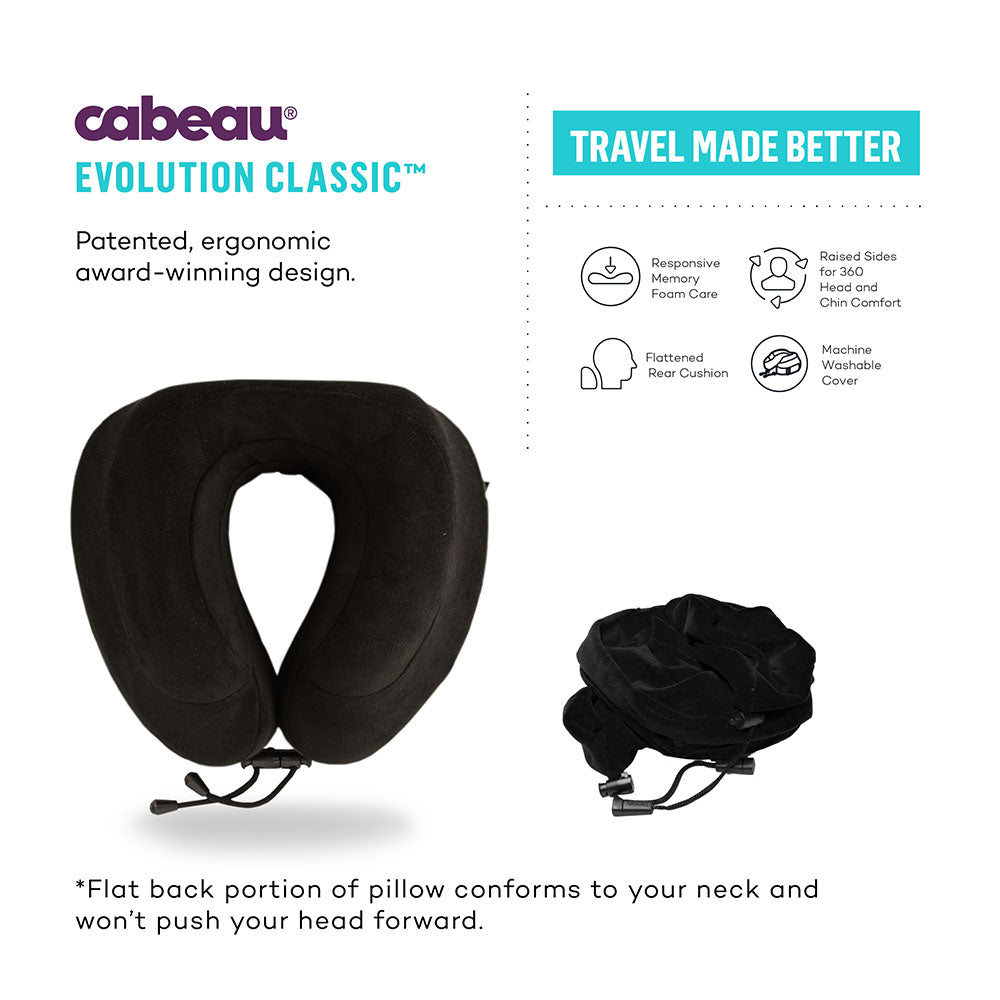
Cabeau Evolution S3 Travel Pillow
Best all-around for aisle and middle seats — memory foam with headrest anchor clips that actually keep the pillow in place through a 13-hour flight. The U-shape fights lateral lean for window-seat sleepers, and the 13 × 13 × 8 cm compressed size is not small.
Memory foam with headrest anchor clips that stay put through a 13-hour flight — the most practical all-rounder for aisle and middle seats. Velour cover unzips and machine-washes at 30°C. The U-shape pushes back against a hard window-seat lean, and the 13×13×8 cm compressed size is not small.
Pros
- ✓Headrest anchor clips prevent shifting
- ✓Velour cover machine-washable
- ✓Works for both upright and forward-head positions
Cons
- ✗Fights lateral lean for window-seat sleepers
Score breakdown
| Fill | Memory foam |
| Shape | U-shape with anchor clips |
| Compressed size | 13 × 13 × 8 cm |
| Cover | Velour, removable, machine-washable |
| Headrest anchor | Yes — magnetic clip straps |
| Best position | Upright-center, aisle/middle seats |
| Price | $39.99 |

Trtl Travel Pillow
Best for window-seat lateral sleepers — rigid internal support gives a true one-sided prop that U-shape pillows cannot replicate. Rolls flat into a jacket pocket. Only works well leaning in one direction; switching sides requires re-wrapping the scarf and waking up.
A fleece scarf with a rigid plastic scaffold — not a U-shape — that props the neck on the lean side for committed window-seat sleepers. Rolls flat to jacket-pocket size, solving the packability problem. Only works well leaning one direction; switching sides requires re-wrapping the scarf mid-flight, which wakes you up.
Pros
- ✓True lateral support for window-seat sleeping
- ✓Jacket-pocket packability
- ✓Machine-washable fleece
Cons
- ✗Only works leaning one direction — switching sides requires re-wrapping
Score breakdown
| Fill | Rigid plastic scaffold + fleece |
| Shape | Scarf wrap (not U-shape) |
| Packed size | Jacket-pocket flat roll |
| Cover | Fleece, hand-wash only |
| Headrest anchor | No |
| Best position | Window-seat lateral lean |
| Price | $54.99 |
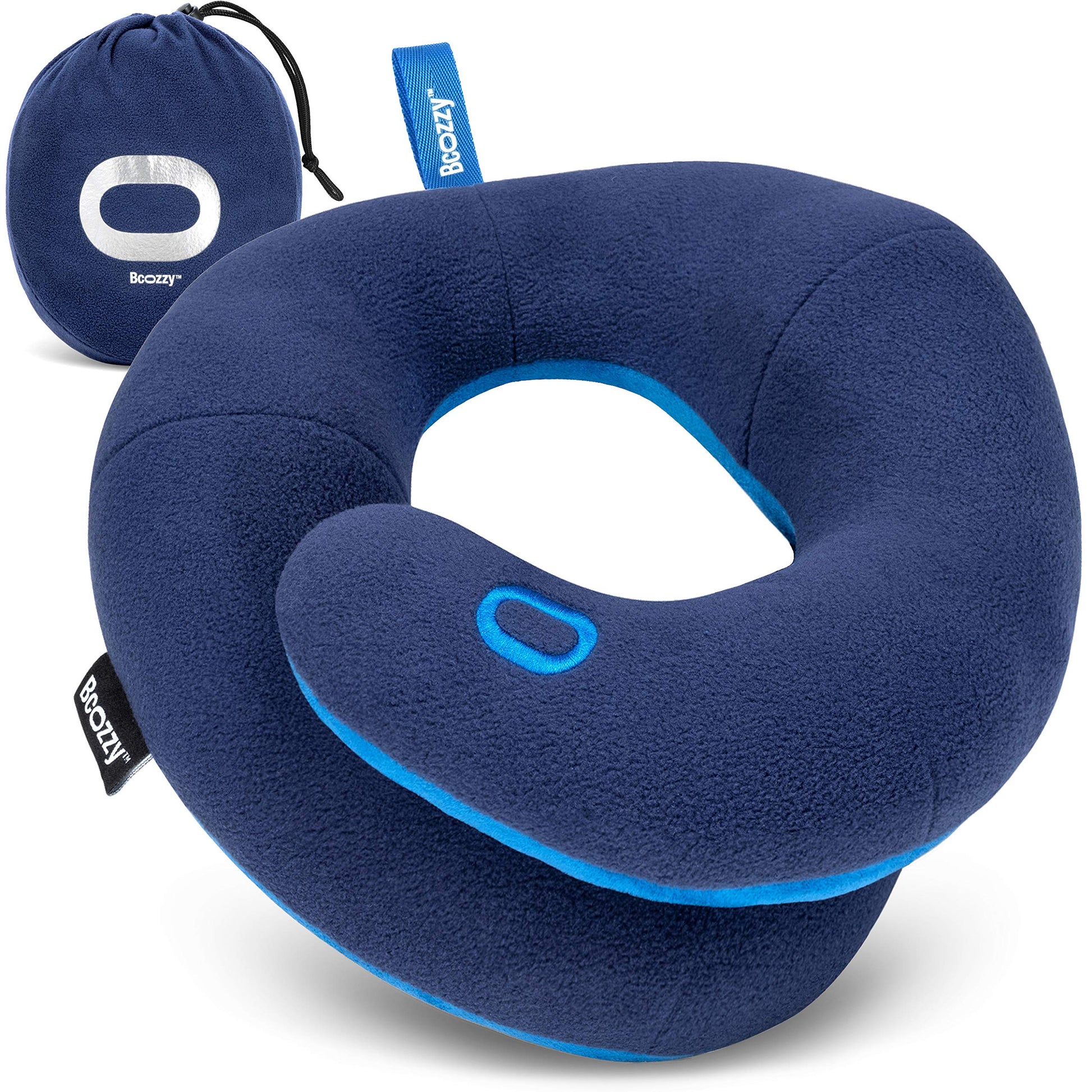
BCozzy Travel Pillow
Best for middle and aisle seats, specifically forward-head sleepers — the chin support channel stops the chin from dropping toward the chest. Lighter and more packable than memory foam options. Chin support becomes awkward if you're leaning laterally rather than forward.
The chin-support channel at the front of the U-shape stops the chin from dropping toward the chest — directly solving the deep-neck-flexor fatigue that builds up on middle and aisle seats. Lighter and more compressible than memory foam. The chin rest becomes awkward if you shift to a lateral lean rather than staying upright.
Pros
- ✓Chin-support channel prevents forward chin drop
- ✓Lighter and more packable than memory foam
- ✓Removable machine-washable cover
Cons
- ✗Chin support becomes awkward in lateral lean positions
Score breakdown
| Fill | Soft fiber (lighter than memory foam) |
| Shape | U-shape with chin support channel |
| Cover | Removable, machine-washable |
| Headrest anchor | No |
| Best position | Upright center, forward-head |
| Weight | Lighter than memory foam options |
| Price | $49.95 |
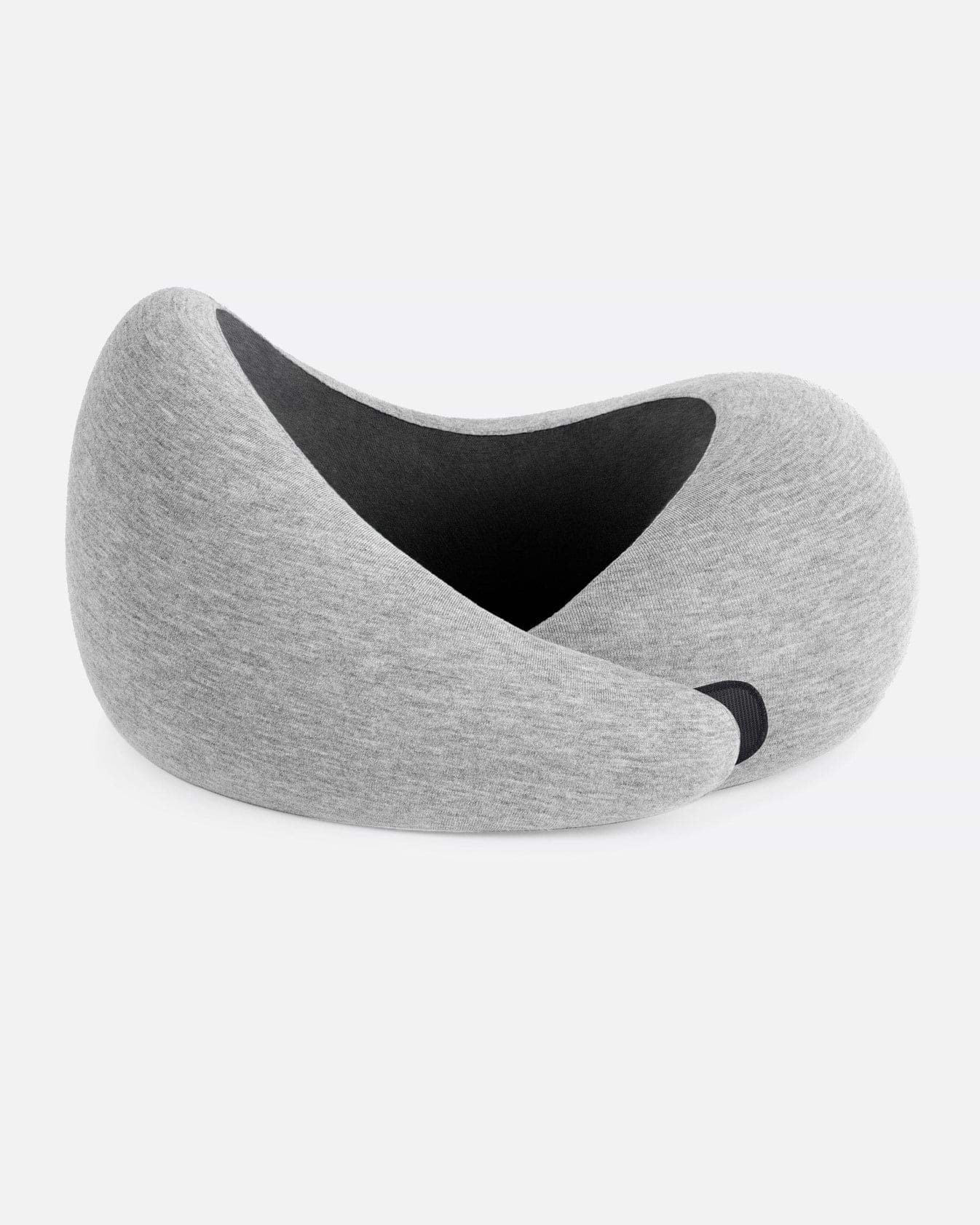
Ostrichpillow Go
Best full-wrap option for forward-and-lateral tilted sleepers — the closed-loop design cradles head from multiple angles. Accommodates position switching without re-setup. Runs warm in the cabin, and the full wrap can feel claustrophobic for some users.
A closed-loop neck and chin wrap that cradles the head from multiple angles — ideal for forward-and-lateral tilt sleepers who shift position mid-flight. The full wrap accommodates position switching without re-setup. It retains heat noticeably in warm cabin conditions, and the full wrap can feel claustrophobic for some users.
Pros
- ✓Closed-loop design supports multiple sleep angles
- ✓No re-setup needed when switching positions
- ✓Removable machine-washable cover
Cons
- ✗Retains heat in warm cabins; full wrap can feel claustrophobic
Score breakdown
| Fill | Micro-bead and fiber composite |
| Shape | Closed-loop neck and chin wrap |
| Cover | Removable, machine-washable |
| Headrest anchor | No |
| Best position | Forward-and-lateral tilt |
| Heat retention | Higher than open designs |
| Price | $69.00 |

Tempur Travel Pillow
Best support quality due to TEMPUR's slow-rebound conforming — adapts to your neck geometry and holds the contour. Does not compress at all, so it occupies fixed bag volume; no headrest anchor; premium price. Only makes sense if you check luggage and prioritize sleep quality above all else.
TEMPUR slow-rebound foam conforms fully to neck geometry and holds position across long sleep stretches — the best pure support quality here. Removable, machine-washable cover. Does not compress at all, which is a real constraint for carry-on-only travellers; no headrest anchor mechanism; premium price.
Pros
- ✓TEMPUR slow-rebound perfectly conforms to neck geometry
- ✓Machine-washable cover
- ✓Holds position during 3–4 hour sleep stretches
Cons
- ✗Does not compress — occupies fixed bag volume
Score breakdown
| Fill | TEMPUR slow-rebound foam |
| Shape | U-shape (wider than average) |
| Packed size | Fixed — does not compress |
| Cover | Removable, machine-washable |
| Headrest anchor | No |
| Best position | Any — conforms to geometry |
| Price | Premium tier |
Which one is right for you?
For window-seat sleepers on overnight long-haul
Trtl Travel Pillow
The rigid scaffold provides true one-sided lateral support that no U-shape can replicate.
For middle and aisle seat sleepers
BCozzy Travel Pillow
The chin support channel is the only design here that directly prevents the forward chin drop.
For travellers who check luggage and prioritise sleep quality
Tempur Travel Pillow
TEMPUR foam delivers the best support quality in this comparison — packability is not a constraint when you check bags.
For carry-on-only travellers who need an all-rounder
Cabeau Evolution S3 Travel Pillow
Headrest anchor clips solve the shifting problem and the compressed size fits inside a 30L backpack.
For position-switchers who run warm
Ostrichpillow Go
The closed-loop wrap accommodates multiple angles without re-setup — best for restless sleepers who move frequently.
Why most travel pillows don't work for window-seat sleepers
The window seat is the best seat for sleep on a long-haul flight precisely because the fuselage wall gives you a lateral support surface. You lean your head to one side, find a comfortable angle, and stop fighting gravity. The problem is that a standard U-shaped travel pillow is designed for upright sleeping — head centered, neck supported from both sides equally — and the moment you tilt 30-40 degrees toward the window, one side of the pillow pushes your head back toward center, fighting the lean instead of allowing it.
This is not a minor ergonomic quibble. Cabin pressure, dry air, and zero-recline economy seating already stress your neck. A pillow that actively resists your natural lean adds sustained muscle tension on the side that's bracing against the push-back, which is why the typical result of a U-shaped foam pillow on a 13-hour flight is a sore neck on the side you were trying to rest, not a rested neck. The products in this comparison take different approaches to this problem, and some solve it much better than others.
Neck support angle: forward-head vs lateral support
There are two fundamentally different sleeping positions in an airplane seat. The first is lateral — leaning to the side (usually toward the window or a companion's shoulder), with the neck bent 30-50 degrees laterally. The second is forward-head — chin dropping toward the chest, neck flexed forward, which happens when you're trying to sleep upright in a middle or aisle seat without anything to lean against. These two positions require completely different pillow designs.
For lateral sleepers, you need something that blocks the head from rolling further toward the shoulder on the lean side, and lets the other side stay neutral. The Trtl and Ostrichpillow Go are built around this — rigid or semi-rigid support on the lean side, open on the other. For forward-head sleepers, you need chin support that stops the chin from falling toward the chest, relieving the deep neck flexors that fatigue quickly under load. The BCozzy's chin-support channel is designed for exactly this. The Cabeau Evolution S3's strap-and-clip system attempts to solve both positions by anchoring the pillow to the headrest so it can't shift, but it's still fundamentally a U-shaped pillow and remains better for upright-center sleeping than for lateral sleeping.
TEMPUR material is denser and slower to rebound than standard memory foam, which means it conforms more completely to the specific angle of your neck rather than pushing back to a preset shape. This is meaningful on long flights where your head position changes as you drift in and out of sleep — slower rebound means smaller disruptions when you shift position.
Inflatable vs memory foam: packability vs support
Inflatable travel pillows compress to roughly the size of a tennis ball and weigh under 150 g, which solves the carry-on space problem completely. The tradeoff is support quality: an inflated air bladder has no structural rigidity, so it shifts and deforms under head weight in ways that foam doesn't. The specific failure mode is lateral shifting — when you lean your head, an inflatable pillow compresses on the lean side and bulges on the opposite side, which actually tilts your neck further in the direction you're leaning rather than supporting it at a stable angle.
Memory foam (Cabeau, Tempur) gives you better positional stability at the cost of pack size. The Cabeau Evolution S3 compresses to about the size of a large apple and fits inside its own carry pouch to a volume of roughly 13 × 13 × 8 cm — it is not small, but it packs into a backpack side pocket and most people accept the trade. The Tempur Travel Pillow does not compress at all; it is a solid foam piece that takes up a fixed volume in your bag regardless of packing technique. The Trtl solves the packability problem differently — it's not a pillow in the traditional sense but a scarf with a rigid plastic insert, and it rolls flat to a thin cylinder that fits in a jacket pocket.
For anyone flying with only a personal item, the Trtl or an inflatable is the honest answer on packability. For anyone with a full carry-on, the Cabeau or Tempur trade is usually acceptable. The Tempur is the worst-case packability option and should only be considered if support quality is the primary criterion.
Washability and long-flight hygiene
A travel pillow goes in contact with your face and neck for hours in a recycled-air environment where the previous occupant of your seat used the same headrest. This is not a theoretical concern — influenza, rhinovirus, and SARS-CoV-2 all survive on fabric surfaces for measurable durations, and airplane headrests are not laundered between flights. A pillow with a removable, machine-washable cover is materially different from one that requires hand-washing or spot-cleaning.
The Cabeau Evolution S3's velour cover unzips and machine-washes at 30°C — this is the most convenient washability in this comparison. The Trtl's fleece wraps the rigid insert and hand-washes only; the insert itself is not removable. The BCozzy cover is removable and machine-washable. The Ostrichpillow Go cover is removable and machine-washable. The Tempur Travel Pillow's cover zips off and is machine-washable, but the TEMPUR core should not get wet, which means the cover wash cycle matters. Budget at least one wash per 3-4 long-haul trips.
Long-haul vs short-haul use cases
The calculus changes with flight duration. On a 2-hour domestic flight, any pillow that's moderately comfortable is fine because the total sleep window is short and neck fatigue hasn't accumulated enough to matter much. The products in this comparison are all overkill for domestic routes — a rolled-up hoodie in a window seat does an equivalent job. The meaningful differences between these five products only compound over 8+ hours.
On a 13-hour or 14-hour long-haul flight, the accumulated neck muscle fatigue from a poorly-fitting pillow is not a minor annoyance — it's a two-day recovery problem. The specific scenario where support quality most matters: sleeping in the final 4 hours of a long-haul flight when you're maximally fatigued, the seatmate needs the lavatory, and you have to sleep sitting more or less upright without a wall to lean on. That's the scenario the Trtl and BCozzy were built for. The Cabeau is a better all-rounder but specifically weaker in that upright-no-wall scenario because the U-shape gives you nothing to press against laterally.
Business class reduces the pillow problem substantially — a lie-flat seat means you're sleeping horizontally with a proper airline pillow, and a travel pillow is mostly redundant. If you're purchasing business class on your primary long-haul route, the ROI on a premium travel pillow is questionable. The case for a quality travel pillow is strongest in premium economy and economy long-haul, specifically window seats on overnight routes.
Product deep-dives
Cabeau Evolution S3 is the most-bought memory foam travel pillow by sales volume across major online retailers, and the reason is legible: it solves the 'pillow slips off to the side while you sleep' problem that U-shaped pillows without securing mechanisms all have. The metal toggles at the front of the neck loop cinch the two ends of the pillow together so they can't splay open, and the two straps with magnetic clips thread through the headrest prongs to anchor the pillow to the seat rather than floating around your neck. In practice on aircraft with exposed headrest prongs (most long-haul economy seats, most business class), this means the pillow stays where you put it for the entire flight. The memory foam gives decent support in the upright-center position and tolerates moderate lateral lean. The honest weakness: it's not a good window-seat lean pillow. The anchoring solves shifting during center-upright sleep, but if you're leaning 45 degrees toward the window wall, the foam still pushes your head toward center and the anchor is mostly working against your lateral position. Cabeau Evolution S3 is the right pick for aisle and middle seats, and for people whose natural sleep style is chin-forward or upright-center rather than a hard lateral lean.
Trtl Travel Pillow is the most radical departure from conventional travel pillow design in this comparison. It is a fleece scarf with a rigid internal plastic scaffold that you wrap around your neck and secure with the attached fastener; the rigid element provides a lateral prop on the side you choose to lean toward, and the fleece wraps around for warmth. There is no U-shape, no foam, and no concern about the pillow slipping — because it's tied to your neck, not floating around it. In practice, the Trtl solves the window-seat lean problem directly: the rigid support braces the side of your neck against lateral forces, your head finds a stable angle, and you sleep at 30-40 degrees without fighting anything. The honest weakness: it only works for lateral sleepers leaning one direction at a time; if you sleep center-upright or want to lean in both directions, you have to re-wrap the scarf mid-flight, which wakes you up. Some users also find the rigid plastic insert uncomfortable at the specific contact point on the neck, particularly on flights longer than 10 hours where pressure marks can develop. Trtl is the right pick for window-seat sleepers on overnight long-haul routes who primarily lean one direction.
BCozzy Travel Pillow is the forward-head sleeper's answer. The design is a U-shape with an extended chin rest in the front — instead of the gap between the two front ends that standard U-pillows leave open (which lets the chin drop toward the chest), the BCozzy's front section wraps around and provides a resting surface for the chin. This directly solves the deep-neck-flexor fatigue that builds up on middle and aisle seats when you're trying to sleep upright without anything to lean sideways against. The filling is a soft fiber that's lighter and more compressible than memory foam, and the whole pillow packs down to about half the volume of the Cabeau. The honest weakness: the chin support only works if you're sitting relatively upright. If you're in a leaned lateral position, the chin rest becomes an awkward protrusion that contacts your cheek at an odd angle rather than supporting the chin. BCozzy is the right pick for middle and aisle seats and for anyone whose primary failure mode is the forward chin drop.
Ostrichpillow Go is the most unusual-looking product in this comparison and arguably the most effective for the specific use case it's designed for. The pillow wraps entirely around the neck and chin in a continuous band — not a U-shape with a gap at the front, but a closed loop that holds the head in whatever position you tuck it into. The 'Go' variant (smaller than the full Ostrichpillow which covers the face) is compact enough to not draw stares on an airplane and rolls into a reasonably small pouch. In practice, the full chin-and-neck wrap means your head is cradled from multiple angles simultaneously, which is genuinely better than either the U-shape gap or the one-sided Trtl support for people who want to lean forward over a tray table or sleep with the head tilted. The honest weakness: the full wrap can feel claustrophobic for some users, and the material retains heat noticeably in warm cabin conditions. Ostrichpillow Go is the right pick for people who sleep with their head tilted forward-and-to-the-side (a common position when leaning over a tray table or seat-back table), and who don't run hot.
Tempur Travel Pillow is the premium option in this comparison by a meaningful margin — TEMPUR material costs more to manufacture than standard memory foam, and the price reflects this. The TEMPUR compound's distinguishing characteristic is its slow rebound under temperature and pressure: it conforms to the specific geometry of your neck and holds that contour for as long as you maintain the position, rather than pushing back to a preset shape the way faster-rebound foams do. On a long-haul flight where you're maintaining one sleep position for 3-4 hour stretches, this means the pillow is genuinely adapted to your neck rather than a generic shape pushing against it. The U-shape is slightly different from the Cabeau — wider and with a slightly more pronounced back-of-neck section. The honest weakness: it does not compress, which means it takes a fixed volume in your bag that cannot be reduced by any packing technique. For a carry-on-only traveler, the Tempur adds a bulk constraint that may require rethinking the rest of your bag. It also doesn't come with any headrest anchor mechanism, so it can shift during sleep like any unanchored pillow. Tempur Travel Pillow is the right pick for business travelers who check a bag, prioritize sleep quality over packability, and are already buying premium products across the board.
