Best Trampolines 2026: Springfree vs Skywalker vs Zupapa
A trampoline is a long-term outdoor commitment — properly maintained, it should last 5-10 years, survive hundreds of sessions, and take abuse from children and adults alike. The decision comes down to one or two factors — the rest is noise.
Each trampoline was evaluated on safety enclosure design and spring-gap injury risk elimination, bounce consistency across the full mat surface, frame material durability against outdoor weather exposure, realistic weight limits for family use, and long-term owner reports on assembly difficulty and component replacement.

Springfree Trampoline Medium Oval
Best Overall: Springfree's flexible composite rods sit 30 cm below the mat surface — there are no exposed spring gaps and no frame within the jump zone, eliminating the two most common contact injury mechanisms. At $1,500–2,500 it is the most expensive option here, but independent safety testing consistently ranks it as the lowest-injury-incidence design in the consumer market.
Top picks ↓| Product | Price | Link |
|---|---|---|
| $1,500 | View deal → | |
| $300 | View deal → | |
| $400 | View deal → | |
| $250 | View deal → | |
| $300 | View deal → |
Top picks
Related articles


Springfree Trampoline Medium Oval
Springless design — composite rods below mat surface eliminate spring-gap contact injuries. 3.4m × 2.5m oval, 200 kg dynamic load rating, UV-resistant rods, below-mat frame removes edge contact risk. Most expensive option at $1,500-2,500 but safest design and longest service life.
Springfree's flexible composite rods sit 30 cm below the mat surface — there are no exposed spring gaps and no frame within the jump zone, eliminating the two most common contact injury mechanisms. At $1,500–2,500 it is the most expensive option here, but independent safety testing consistently ranks it as the lowest-injury-incidence design in the consumer market.
Pros
- ✓Springless rod design eliminates spring-gap contact injuries entirely
- ✓Below-mat frame removes edge contact risk from the jump zone
- ✓UV-resistant rods rated for 200 kg dynamic load over years of outdoor use
Cons
- ✗$1,500–2,500 is 3–5× more expensive than quality spring alternatives
Score breakdown
| Size | 3.4 m × 2.5 m oval |
| Spring system | Springless composite rods (30 cm below mat) |
| Dynamic load | 200 kg |
| Frame position | Outside jump zone |
| Price | ~$1,500–2,500 |
| Enclosure | Net attaches to mat (no gap) |

Skywalker 15ft Round Trampoline with Safety Enclosure
15ft round spring trampoline, 96 springs, enclosure net attached to same poles as padding (reduces net-mat gap), padded spring cover included. The quality mainstream choice at $300-500. Recommended for most families prioritizing space and value.
The Skywalker 15ft is the category standard for quality spring trampolines at an accessible price — 96 springs for consistent bounce across the mat, and an enclosure net attached to the same poles as the padding to eliminate the net-mat gap. At $300–500 it is the right first trampoline for most suburban families who want quality without the Springfree premium.
Pros
- ✓96 springs distribute load evenly for consistent bounce across the full mat
- ✓Enclosure net and padding share the same poles — eliminates net-mat gap
- ✓15 ft accommodates multiple jumpers and adult use comfortably
Cons
- ✗Standard spring system carries spring-gap contact risk compared to Springfree
- ✗Metal frame requires regular inspection for rust in wet or coastal climates
Score breakdown
| Size | 15 ft round |
| Spring count | 96 springs |
| Weight limit | 200 lb per jumper |
| Enclosure | Net attached to same poles as padding |
| Price | ~$300–500 |
| Frame | Steel (powder-coated) |

Zupapa 15ft Trampoline with Safety Enclosure Net
15ft round, 108 springs, galvanized steel frame (rust-resistant even when scratched), thicker spring padding than standard. Best for outdoor longevity in wet or coastal climates where rust resistance matters. $400-600.
The Zupapa 15ft distinguishes itself with a galvanized steel frame — rust-resistant even after surface scratching, which matters for trampolines left outdoors through rain, coastal humidity, or freeze-thaw cycles. The 108-spring count (12 more than the Skywalker) produces more consistent bounce across the edges, a real improvement for experienced jumpers who notice landing position.
Pros
- ✓Galvanized steel frame resists rust even after surface scratches — outlasts powder-coated frames outdoors
- ✓108 springs produce more consistent bounce at the mat edges than lower-count models
- ✓Thicker spring padding than standard competitors
Cons
- ✗$400–600 costs more than the Skywalker without a safety-design advantage over Springfree
Score breakdown
| Size | 15 ft round |
| Spring count | 108 springs |
| Weight limit | ~330 lb total |
| Frame | Galvanized steel (rust-resistant) |
| Price | ~$400–600 |
| Enclosure | Safety enclosure net included |
Jumpking 14ft Round Trampoline with Safety Enclosure
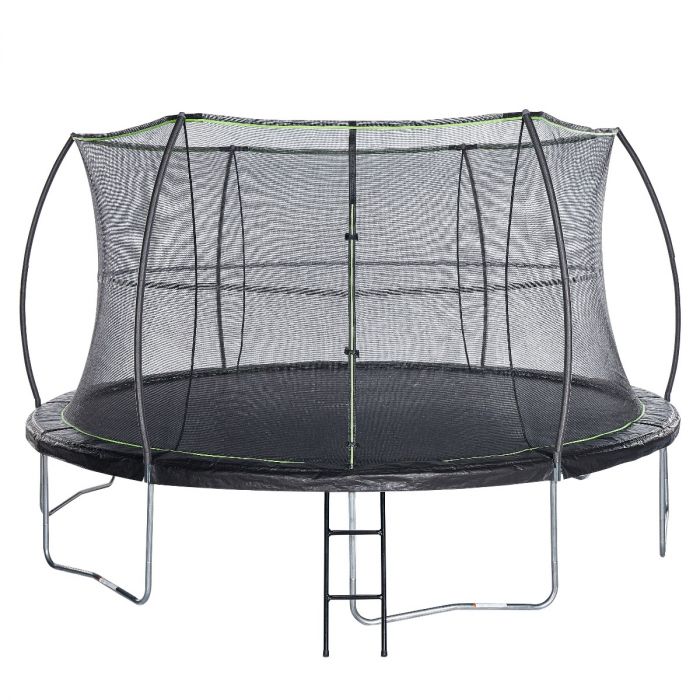
14ft round spring trampoline with safety enclosure. Good value at $250-400 for smaller yards or budget-conscious buyers. Standard spring system and padding quality; adequate for typical family use.
The Jumpking 14ft delivers a complete family trampoline — safety enclosure, spring padding, and a 14 ft jumping area — at $250–400 for yards where a 15 ft round trampoline doesn't fit the available clearance. The spring system and padding quality are standard rather than exceptional, and it does not meaningfully differentiate from the Skywalker at larger sizes.
Pros
- ✓14 ft size fits smaller yards that lack clearance for a 15 ft round
- ✓Safety enclosure net and padded spring cover included at entry price
- ✓Adequate bounce and weight capacity for typical family sessions
Cons
- ✗No meaningful advantage over the 15 ft Skywalker except smaller footprint
- ✗Standard spring padding and frame quality — not optimized for harsh weather
Score breakdown
| Size | 14 ft round |
| Spring system | Standard steel springs |
| Weight limit | ~250 lb total |
| Frame | Steel (powder-coated) |
| Price | ~$250–400 |
| Enclosure | Safety enclosure net included |
JumpSport 550f Fitness Trampoline
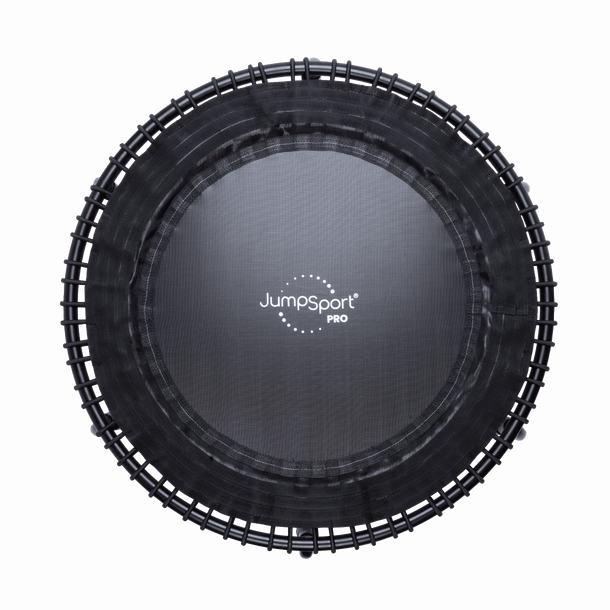
48-inch indoor fitness rebounder, bungee-cord suspension (softer/quieter than springs), fold-flat legs, 250 lb capacity. Designed for adult aerobic fitness — low-impact cardiovascular training at home. Not for outdoor or children's play use.
The JumpSport 550f is a different category: a 48-inch bungee-cord indoor rebounder for adult cardiovascular conditioning, not a backyard family trampoline. The bungee suspension is quieter and more joint-friendly than steel springs, exerting roughly 70% of running's knee and hip ground-reaction force — a legitimate alternative to treadmill training for users with joint issues.
Pros
- ✓Bungee-cord suspension is quieter and more joint-friendly than steel springs
- ✓Fold-flat legs allow compact storage between sessions
- ✓Designed for adult aerobic fitness — reduces knee and hip impact vs running
Cons
- ✗48-inch indoor rebounder — not suitable for outdoor use or children's play
- ✗250 lb adult-only weight limit; not designed for family trampoline sessions
Score breakdown
| Size | 48 inches (122 cm) round |
| Suspension | Bungee-cord bands |
| Weight capacity | 250 lb (113 kg) |
| Legs | Fold-flat for storage |
| Price | ~$300–400 |
| Target use | Adult indoor aerobic fitness |
Which one is right for you?
For families prioritizing safety above all
Springfree Trampoline Medium Oval
No spring gaps and no frame within the jump zone — the lowest-injury-incidence trampoline design available for home use.
For most suburban families
Skywalker 15ft Round Trampoline with Safety Enclosure
96 springs, integrated enclosure, and a quality price point make it the right first trampoline for families who want value without compromising on safety features.
For wet or coastal climates
Zupapa 15ft Trampoline with Safety Enclosure Net
Galvanized steel frame resists rust even after surface scratching — the right long-term investment for trampolines exposed to rain, sea air, or freeze-thaw cycles.
For smaller yards or tight budgets
Jumpking 14ft Round Trampoline with Safety Enclosure
14 ft footprint fits yards where a 15 ft circle can't clear the required 8 ft perimeter buffer, at a price that suits tighter budgets.
For adults doing low-impact cardio indoors
JumpSport 550f Fitness Trampoline
Bungee suspension and fold-flat design make it the only pick here built specifically for adult aerobic conditioning with joint protection.
Spring vs springless: the safety difference that actually matters
Traditional trampolines use steel springs to connect the jump mat to the frame. The springs provide the bounce but also create the primary injury risk: fingers, toes, and limbs that contact the spring gaps while jumping can be pinched or caught. Enclosure nets around the perimeter address the falling-off risk but do not address spring contact, which is the more common injury mechanism for experienced users who don't fall off the edge.
Springfree Trampolines replaced the spring mechanism entirely with flexible composite rods that flex beneath the mat surface rather than at the mat edge. The result is a mat surrounded by no exposed metal spring gaps. The rods are located 30cm below the jump surface — unreachable during normal jumping. The frame is also set outside the jump zone, so there is no hard frame to land on near the edge. This design eliminates the two most common contact injury mechanisms. Independent safety testing consistently ranks Springfree as the lowest-injury-incidence design in the consumer market.
The trade-off for springless design is cost and bounce character. Springfree trampolines cost 2-4 times more than comparable spring trampolines. The bounce is different — flexible rods produce a slightly stiffer, more responsive feel compared to the softer, more forgiving feel of good spring trampolines. Experienced jumpers often prefer the rod feel for controlled bouncing; children often find spring trampolines more immediately fun. Both produce effective jumping surfaces.
The safety-first pick: Springfree Medium Oval
The Springfree Medium Oval (3.4m × 2.5m) is the top recommendation for households where injury prevention is the primary concern — families with young children, households where adults jump alongside children, or anyone who has researched trampoline injury statistics. The springless design removes the spring gap contact risk; the below-mat rod system removes the edge frame contact risk; the enclosure net attaches to the mat rather than outside the frame, eliminating the gap between net and jumping surface.
The build quality is engineered for decades rather than years. The composite rods are UV-resistant and rated for 440 lb (200 kg) dynamic load. The mat is a woven polypropylene that holds tension and elasticity through years of use. The frame is powder-coated galvanized steel with rust-proof hardware. At $1,500-2,500 depending on size, the Springfree is significantly more expensive than any other trampoline in this comparison — but it is also significantly safer and built to last longer.
The oval shape is deliberately narrower than a round trampoline of similar footprint, which encourages linear bouncing and reduces the tendency for jumpers to drift toward the edges — a relevant safety consideration for children. The oval also fits more easily into a rectangular yard than a large round trampoline.
The mainstream choice: Skywalker 15ft with safety enclosure
The Skywalker 15ft Round Trampoline is the category standard for quality spring trampolines at accessible prices. At $300-500, it includes an enclosure net, padded spring cover, and the hardware for assembly. The spring system uses 96 steel springs arranged around the 15-foot frame — the spring count is higher than many competitors, which distributes the load more evenly and produces a more consistent bounce across the mat surface.
The Skywalker enclosure net attaches to the same poles as the padding and mat, rather than independently, which eliminates the gap between the net and the jump surface at the edge. This is a meaningful safety improvement over designs where the net and mat are on separate mounting systems with a gap between them. The spring padding covers the spring system completely when properly installed.
The 15-foot size accommodates multiple jumpers simultaneously and gives enough space for adults to jump comfortably. For most suburban backyards, 15 feet is the practical limit — larger trampolines require significantly more clear space around them (minimum 8 feet clearance from any structure on all sides is the standard recommendation). Weight limit is 200 lb (90 kg) per jumper.
Zupapa 15ft: the budget premium option
The Zupapa 15ft Trampoline positions itself as premium within the traditional spring category — galvanized steel frame (not just powder-coated), 108 springs (more than the Skywalker's 96), and a spring cover that is thicker than the standard foam padding used by most competitors. At $400-600, it costs somewhat more than the Skywalker but less than half the Springfree.
The galvanized steel frame is a meaningful durability difference from powder-coated-only frames. Powder coating protects against rust until it chips — which happens through normal use and weather. Galvanized steel is rust-resistant even after surface scratching, which matters for a piece of equipment that lives outdoors year-round. For trampolines in regions with heavy rain, coastal humidity, or freeze-thaw cycles, galvanized construction extends the useful life significantly.
The 108-spring count at 15 feet produces a notably consistent bounce across the full jump surface. The center and edges have similar bounce characteristics, which is not always true on lower-spring-count models. For experienced jumpers who notice where on the mat they're landing, this consistency is meaningful.
JumpSport 550f: the fitness rebounder for adults
The JumpSport 550f is not a backyard trampoline — it is a 48-inch (122cm) round fitness rebounder designed for indoor adult fitness use. Rebounders used for low-impact aerobic exercise, lymphatic stimulation, and cardiovascular conditioning are a different category from backyard trampolines, and the JumpSport 550f is the most-reviewed premium option in this category.
The 550f uses a bungee-cord suspension system rather than springs — bands arranged around the frame provide a softer, more joint-friendly bounce than steel springs. The design is quieter than spring rebounders (less metal-on-metal noise) and more suitable for apartment use or exercise rooms where noise matters. The fold-flat legs allow compact storage between sessions.
The workout use case for rebounders is cardiovascular fitness with lower joint impact than running. At equivalent heart rate levels, rebounding exerts approximately 70% of the ground reaction force of running on the knees and hips. For users with joint issues who want aerobic conditioning without hard impact, a fitness rebounder is a legitimate alternative to treadmill or elliptical training. The JumpSport 550f is rated for adults up to 250 lb (113 kg).