Best Stationary Bikes 2026: Peloton vs NordicTrack vs Schwinn
Rain cancels your ride. Resistance feel and footprint fit matter more than maximum resistance specs.
Each bike was scored on resistance feel under interval loads, seat and handlebar comfort over 45-minute sessions, build quality and frame rigidity, connectivity and app ecosystem value, and cost including any mandatory subscription — machines that require a subscription were scored on total 12-month ownership cost.
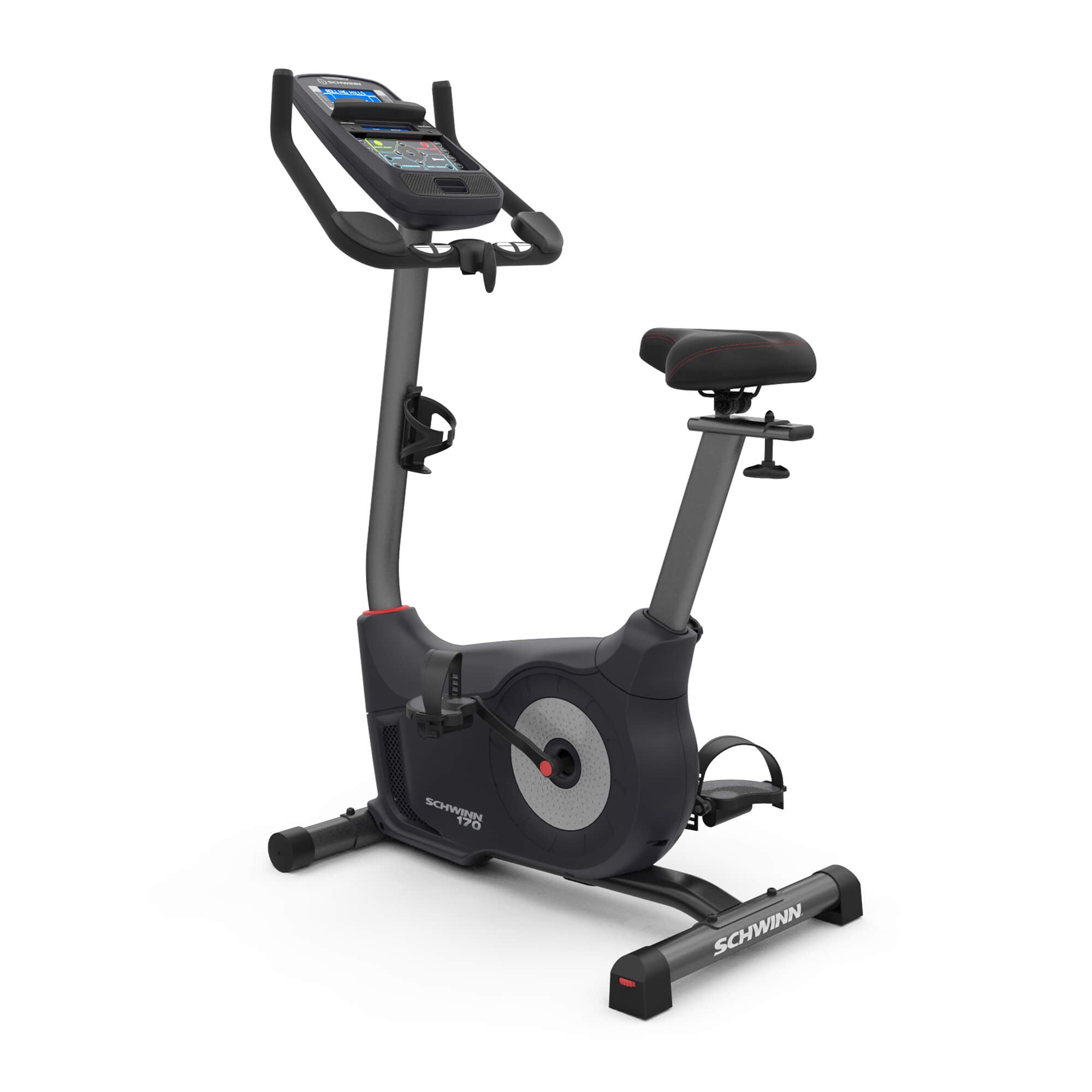
Schwinn 170 Upright Stationary Bike
Best Overall: The Schwinn 170 delivers 25 resistance levels and 29 built-in programs on a magnetic system that never needs maintenance — structured training without a subscription. The 13.3 kg flywheel provides adequate momentum for cardio but won't replicate the road-like feel of heavier spin-bike flywheels.
Top picks ↓| Product | Price | Link |
|---|---|---|
| $449.00 | View deal → | |
| $1,699 | View deal → | |
| $1,445.00 | View deal → | |
| — | View deal → | |
| — | View deal → |
Top picks
Related articles

Schwinn 170 Upright Stationary Bike
Best all-around upright bike for subscription-free structured training — 29 built-in programs cover beginner cardio to interval work, 25 resistance levels, Bluetooth connectivity to Zwift and Peloton app if you want it later. Dual LCD consoles display all metrics simultaneously without requiring a phone. The 13.3 kg flywheel is adequate for cardiovascular training; not the road-feel replacement that a heavy-flywheel spin bike delivers, but correct for session-based fitness goals.
The Schwinn 170 delivers 25 resistance levels and 29 built-in programs on a magnetic system that never needs maintenance — structured training without a subscription. The 13.3 kg flywheel provides adequate momentum for cardio but won't replicate the road-like feel of heavier spin-bike flywheels.
Pros
- ✓29 built-in programs eliminate the need for any external app or subscription
- ✓Quiet magnetic resistance — suitable for early-morning sessions in shared housing
- ✓Bluetooth to Zwift and Peloton app available when you want connectivity later
Cons
- ✗13.3 kg flywheel feels lighter than spin-specific bikes at the same resistance level
Score breakdown
| Flywheel | 13.3 kg |
| Resistance | 25-level magnetic |
| Built-in programs | 29 |
| Connectivity | Bluetooth (Zwift, Peloton app) |
| Display | Dual LCD |
| Max user weight | 113 kg |
| Drive | Belt |
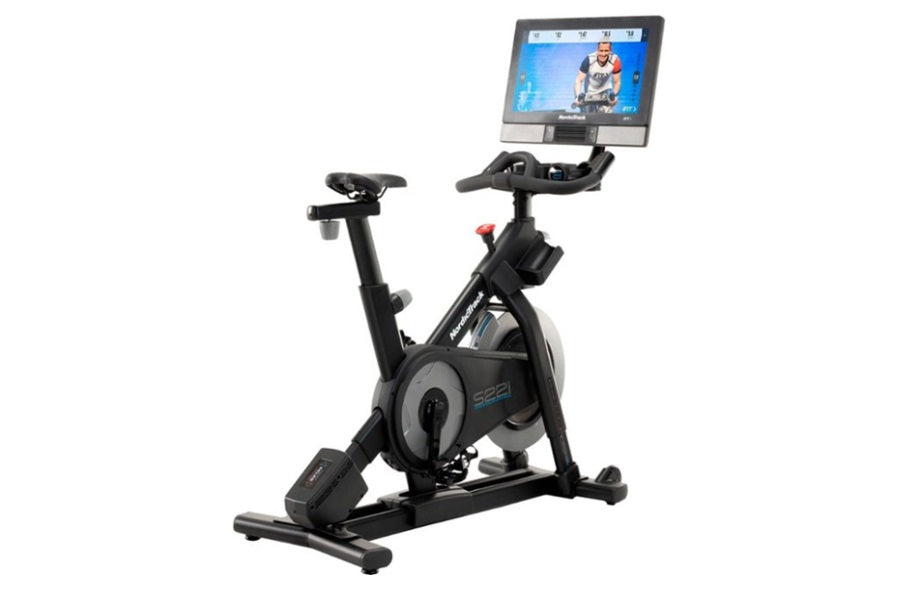
NordicTrack S22i Studio Cycle Bike
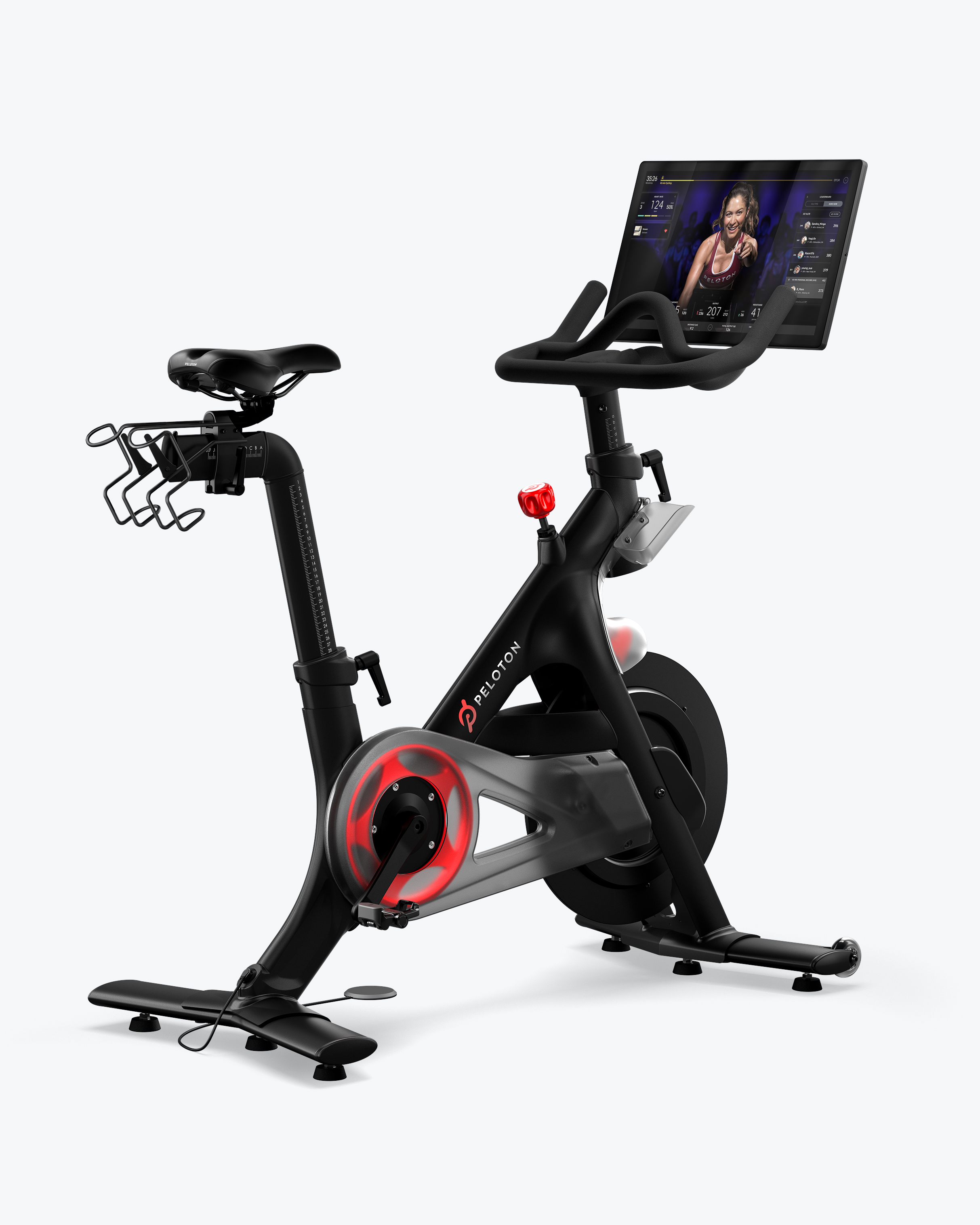
Best connected bike for outdoor cycling simulation — the -10% to +20% incline decline range physically tilts the bike frame, recruiting glutes on climbs and shifting quad load on descents in a way flat cycling cannot replicate. The 24.9 kg flywheel is the heaviest in this comparison. iFit subscription at $39/month unlocks automatic incline and resistance control during trainer-led routes. Most mechanically sophisticated option here; also the largest footprint.
The S22i's physical -10% to +20% incline/decline is a genuine differentiator — no other bike in this comparison tilts the frame to change muscle recruitment. The 22-inch rotating touchscreen and iFit auto-resistance justify the price for dedicated riders, but the mandatory iFit subscription at $39/month adds over $468/year to ownership cost.
Pros
- ✓Physical frame tilting simulates climbs and descents in a way flat bikes cannot
- ✓24.9 kg flywheel — heaviest in the comparison for the most road-like feel
- ✓22-inch rotating touchscreen for off-bike workouts like strength and yoga
Cons
- ✗iFit subscription required for automatic resistance and full class library — $39/month ongoing cost
Score breakdown
| Flywheel | 24.9 kg |
| Resistance | Magnetic (auto-adjust via iFit) |
| Incline range | -10% to +20% |
| Screen | 22-inch rotating touchscreen |
| Connectivity | iFit (subscription required) |
| Max user weight | 136 kg |
| Drive | Belt |

Peloton Original Bike
Best for live-class motivation and community — the leaderboard and real-time class percentile ranking are the features that drive Peloton's engagement numbers above any competitor. Automatic resistance follow during instructor-led classes requires the Peloton Membership at $44/month. Look Delta cleat compatibility means most cyclists need new shoes; factor this cost in. The app ecosystem extends to strength, yoga, and outdoor runs, making the bike a gateway to broader workouts.
Peloton's real-time leaderboard and live instructor resistance cues create a motivational environment no other bike matches. The proprietary Look Delta cleat system and $44/month membership are real costs to factor in before buying — you're choosing an ecosystem, not just a machine.
Pros
- ✓10,000+ live and on-demand classes with a community leaderboard that drives effort
- ✓Automatic instructor resistance follow makes solo training feel coached
- ✓21.5-inch HD touchscreen extends to strength, yoga, and outdoor running content
Cons
- ✗Proprietary Look Delta cleats require new shoes for most cyclists; $44/month membership is non-optional for full feature access
Score breakdown
| Flywheel | Undisclosed (estimated 18 kg) |
| Resistance | 100-level magnetic |
| Screen | 21.5-inch HD touchscreen |
| Connectivity | Peloton Membership ($44/month) |
| Cleat system | Look Delta (proprietary) |
| Max user weight | 136 kg |
| Drive | Belt |
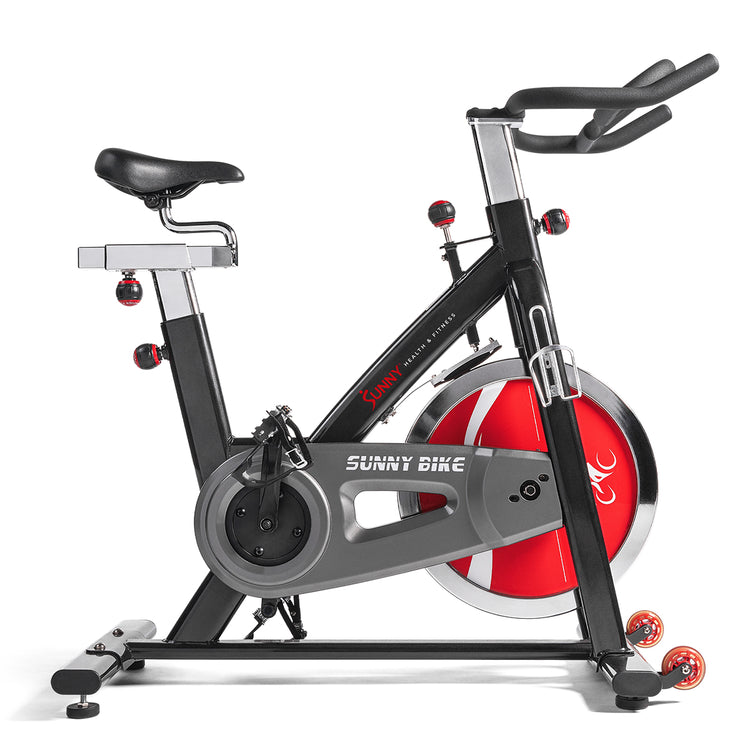
Sunny Health & Fitness SF-B1002 Indoor Cycling Bike
Best budget pick for pure ride feel — the 22 kg flywheel produces heavy, momentum-driven pedal feel that outperforms lighter magnetic-resistance bikes in the same price range for cycling sensation. No screen, no Bluetooth, no programs; pure cardio output and breathing. Friction resistance requires periodic felt-pad replacement. Correct first bike for riders who want to establish a cycling habit before committing to a connected ecosystem.
The SF-B1002's 22 kg flywheel produces a momentum-driven ride feel that magnetic bikes at this price cannot match. Friction resistance means no numbered levels and eventual felt-pad wear, but for riders who want pure cycling sensation without electronics, it's the most honest value here.
Pros
- ✓22 kg flywheel — heavier than the Schwinn 170, produces more authentic cycling momentum
- ✓Four-way handlebar and saddle adjustment fits riders 155–185 cm
- ✓Lowest price in the comparison with no subscription ever required
Cons
- ✗No display, no Bluetooth, no numbered resistance levels — friction pad requires replacement every 12–18 months of daily use
Score breakdown
| Flywheel | 22 kg |
| Resistance | Friction (felt pad) |
| Display | None |
| Connectivity | None |
| Saddle adjustment | 4-way |
| Max user weight | 120 kg |
| Drive | Belt |
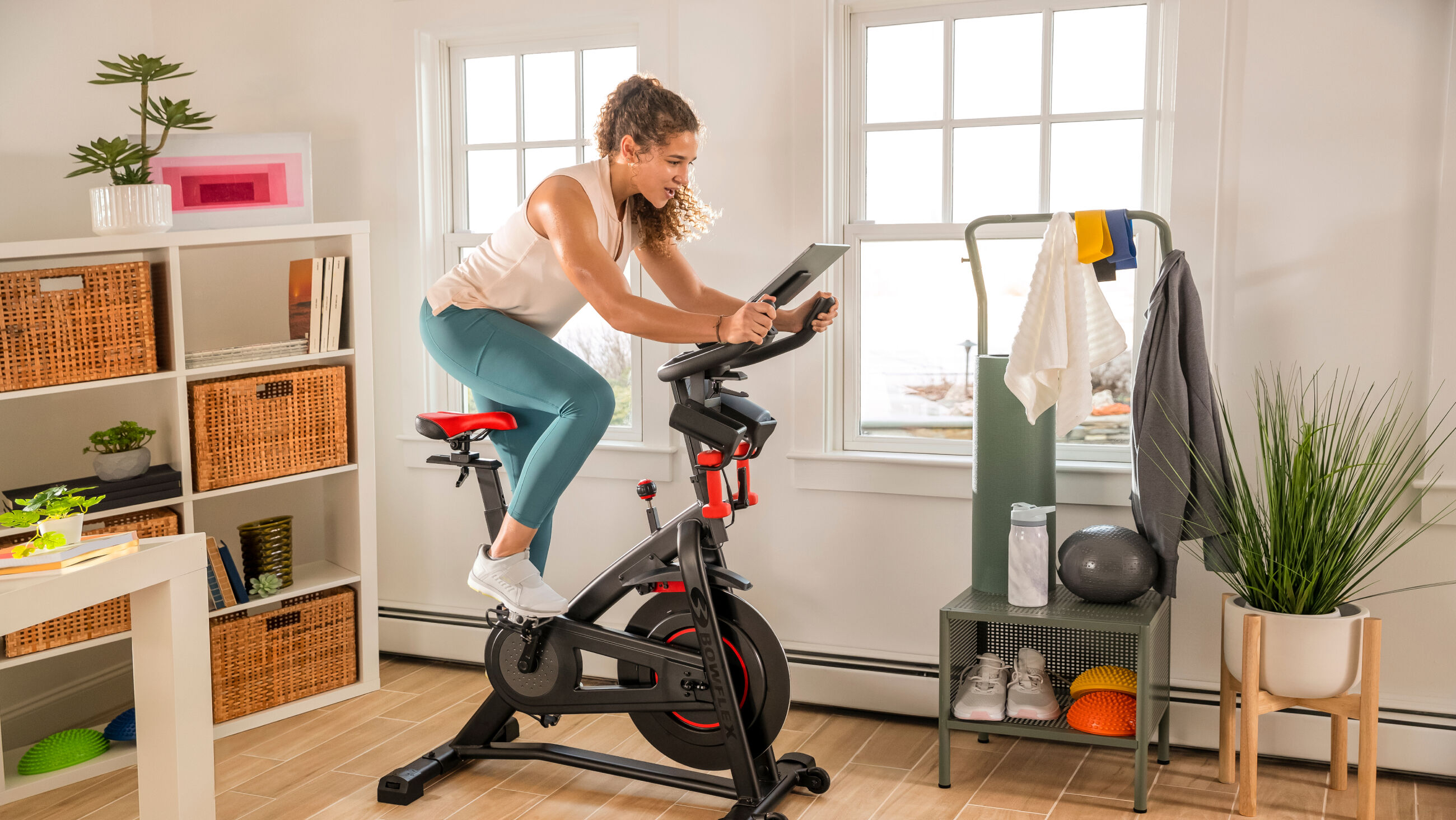
Bowflex C6 Bike
Best mid-range value with maximum app flexibility — 100 micro-adjustable resistance levels provide interval precision that 25-level systems cannot match, Bluetooth connects to Peloton app, Zwift, and JRNY simultaneously, SPD cleat compatibility means road cyclists clip in immediately. Running the Peloton app via Bluetooth on the C6 costs the same $44/month membership as owning a Peloton bike, at a significantly lower hardware price.
The Bowflex C6 offers 100 micro-adjustable magnetic resistance levels and simultaneous Bluetooth to Peloton, Zwift, and JRNY — SPD cleat compatibility means road cyclists clip in immediately. At roughly $100 more than the Schwinn 170, it's the right choice for cyclists who already own SPD shoes and want app flexibility.
Pros
- ✓100 micro-adjustable levels for precise interval watt-matching
- ✓SPD cleat compatible — road cyclists use existing shoes without adapter
- ✓Connects to Peloton, Zwift, and JRNY simultaneously
Cons
- ✗No built-in screen — relies entirely on your own phone or tablet for app content
Score breakdown
| Flywheel | Undisclosed (estimated 16 kg) |
| Resistance | 100-level magnetic |
| Display | Backlit LCD (metrics only) |
| Connectivity | Bluetooth (Peloton, Zwift, JRNY) |
| Cleat system | SPD + toe cage |
| Max user weight | 136 kg |
| Drive | Belt |
Which one is right for you?
For riders who want structured training without subscriptions
Schwinn 170 Upright Stationary Bike
29 built-in programs and 25 resistance levels provide six months of progressive training without connecting to anything — no monthly fee ever.
For outdoor cyclists who want the closest simulation indoors
NordicTrack S22i Studio Cycle Bike
The physical frame tilt and 24.9 kg flywheel are the most accurate indoor approximation of road climbing and descent of any bike here.
For motivation-driven riders who thrive on live classes
Peloton Original Bike
The real-time leaderboard and instructor auto-resistance create a coached experience that drives harder efforts than solo training.
For budget-conscious riders who want pure cycling feel
Sunny Health & Fitness SF-B1002 Indoor Cycling Bike
The 22 kg flywheel delivers the heaviest momentum in this comparison at the lowest price — best for establishing a cycling habit before committing to a connected ecosystem.
For SPD-shoe cyclists who want app flexibility
Bowflex C6 Bike
Clips in with existing road cycling shoes and streams to Peloton, Zwift, or JRNY simultaneously — maximum app flexibility at mid-range hardware cost.
Top pick: Schwinn 170 and Bowflex C6 — structured training without a mandatory subscription
The Schwinn 170 and Bowflex C6 occupy the same market position but solve it differently. The Schwinn 170 is a traditional upright bike with a 13.3 kg flywheel, 25 resistance levels, and 29 built-in workout programs — enough structure for six months of progressive training without connecting the machine to anything. The console shows speed, cadence, heart rate, time, distance, and calories simultaneously on dual LCD displays. Bluetooth connects to Zwift, the Peloton app, and other third-party platforms if you want them, but none are required. For users who want structured sessions programmed into the machine itself, the Schwinn 170 is the correct starting point.
The Bowflex C6 uses magnetic resistance with 100 micro-adjustable levels rather than the Schwinn's 25-level system — the finer granularity matters during interval training where a one-level jump on a 25-level system can disrupt pacing, but a small increment on a 100-level system allows precise watt-matching against a target. The C6's Bluetooth connectivity extends to Peloton, Zwift, JRNY, and the Apple Health ecosystem simultaneously. SPD cleat compatibility means road cyclists can clip in with their existing shoes rather than buying cage-specific footwear. At roughly $100 more than the Schwinn 170, the C6 is the correct choice for cyclists who already own SPD shoes and plan to connect to a third-party app.
Both machines use magnetic resistance, which means no felt-pad wear, no friction dust, and consistent resistance feel across the full life of the machine. The main trade-off versus the Peloton and NordicTrack S22i is the absence of automatic resistance adjustment — no instructor can push the resistance up mid-class through the machine's hardware. You control resistance manually on both. If you prefer full control over your own pacing rather than ceding it to an algorithm or instructor, this is a feature rather than a limitation.
Space matters too. Both the Schwinn 170 and Bowflex C6 have a smaller footprint than the Peloton or NordicTrack S22i — neither has a large attached screen that adds depth to the front of the machine. Apartment riders or shared living situations benefit from this. Noise on magnetic resistance bikes is minimal — belt drive is quieter than chain drive, and no friction pad means no pad-wearing sound at high resistance. Early morning sessions in shared housing are feasible on both machines.
Budget pick: Sunny Health SF-B1002 — heavy flywheel, zero electronics, lowest barrier to entry
The Sunny Health SF-B1002 is an indoor cycling bike, not a traditional upright — the geometry positions the rider more forward over the handlebars, resembling a road bike posture rather than the more upright position of the Schwinn 170 or Bowflex C6. The 22 kg flywheel is heavier than the Schwinn 170's 13.3 kg and gives the SF-B1002 a momentum-driven, road-bike-like feel that magnetic resistance bikes cannot replicate at this price point. Spinning the flywheel to speed and letting cadence carry the momentum is the specific sensation that cycling enthusiasts seek in indoor trainers.
Resistance on the SF-B1002 is friction-based: a felt pad presses against the flywheel when you turn the resistance knob. This is simpler and cheaper than magnetic resistance but introduces wear — the felt pad degrades over time and requires periodic replacement (roughly every 12–18 months of daily use). Friction resistance also lacks precise calibration — there are no numbered resistance levels, only the physical feel of tighter or looser pad contact. For structured interval training that requires hitting specific watt outputs, friction resistance is imprecise. For pure riding feel and cardiovascular effort, the heaviness of the flywheel compensates substantially.
There is no screen, no Bluetooth, no app connectivity, and no built-in programs. A phone or tablet mount is available as an add-on if you want to run a cycling app, but the bike itself provides no data beyond what you read from your own heart rate monitor or cycling computer. For users who prefer distraction-free sessions — eyes forward, no numbers, just breathing and cadence — this is the correct configuration. For users who need data feedback to maintain training consistency, the lack of any display is a genuine limitation.
The four-way handlebar and saddle adjustment — horizontal and vertical for both — accommodates riders from roughly 155 cm to 185 cm on a single machine. The 120 kg maximum user weight is the highest in this comparison. At under $300, the SF-B1002 is the correct first stationary bike for a household that wants to establish a cycling habit before committing to a higher-priced connected ecosystem.
Smart pick: NordicTrack S22i and Peloton — connected ecosystems with automatic resistance
The NordicTrack S22i and Peloton Original Bike are different machines with different philosophies about what a connected bike should do. The S22i's headline feature is its -10% to +20% incline and decline range — the bike physically tilts the frame to simulate climbing and descending, which changes the muscle recruitment pattern in a way that flat cycling cannot replicate. Combined with the 22-inch rotating touchscreen and iFit's automatic incline and resistance adjustment during classes, the S22i produces a closer approximation to outdoor road cycling than any other machine in this comparison. The 24.9 kg flywheel is the heaviest here by a significant margin.
Peloton's approach prioritizes the class library and community over mechanical simulation. The 21.5-inch HD touchscreen delivers live and on-demand classes that update the leaderboard in real time — your output in watts appears alongside your class percentile, which is the specific competitive context that drives Peloton users to push harder than they would alone. The instructor's verbal resistance cues are optionally auto-followed by the machine: when an instructor calls for resistance 45, the bike adjusts automatically if you have enabled the feature. The Peloton app library has over 10,000 classes across cycling, strength, yoga, meditation, and outdoor running — the bike becomes a gateway to a broader fitness ecosystem rather than a cycling-specific tool.
Both machines require a subscription to use their full feature sets. iFit for the NordicTrack S22i runs approximately $39/month (individual) or $49/month (family) after the included trial expires. Peloton Membership runs $44/month for all-access. Both subscriptions unlock the class libraries and automatic resistance features; without a subscription, both machines function as basic bikes with manual resistance control only. Factor the subscription cost into the total cost of ownership — at $44/month, Peloton Membership adds over $500 per year to the cost of the bike.
Cleat compatibility differs: the NordicTrack S22i uses a KnoxVault-compatible pedal system that accepts SPD cleats on one side and a standard cage on the other — road cyclists can clip in immediately. The Peloton Original Bike uses a proprietary Look Delta cleat system; unless you already own Look Delta shoes, you will need either Peloton's branded shoes or aftermarket Look Delta compatible cycling shoes. SPD-compatible pedals are available as a Peloton upgrade but require a separate purchase and installation. This is a meaningful setup cost that is not obvious from the bike's marketing.
How to choose: upright vs cycling geometry, resistance type, and screen necessity
The first decision is geometry. Upright bikes — the Schwinn 170, Bowflex C6, and Peloton — position the rider in a relatively upright posture with the handlebars roughly at chest height and pedals directly below the hips. This geometry is comfortable for longer sessions and accessible to riders without cycling experience. Indoor cycling bikes — the Sunny Health SF-B1002 and NordicTrack S22i — position the rider more aggressively forward, with handlebars lower and pedals slightly in front of the hips. This mimics road bike posture and recruits the core and hip flexors more actively. If you have never ridden a road bike, the cycling geometry can cause lower back discomfort in the first few weeks until the position adapts.
Resistance type determines long-term maintenance cost and training precision. Magnetic resistance (Schwinn 170, Bowflex C6, Peloton, NordicTrack S22i) uses no contact parts, requires no maintenance, and stays consistent across the machine's lifespan. Friction resistance (Sunny Health SF-B1002) uses a felt pad that wears against the flywheel — replacement pads cost roughly $10–15 and are user-installable, but they must be replaced periodically. For training precision, magnetic resistance with numbered levels allows interval programming against specific resistance targets; friction resistance does not.
Screen necessity is the third axis. If you plan to follow instructor-led classes with automatic resistance adjustment, you need a machine with a built-in screen and a connected app — either the Peloton or the NordicTrack S22i. If you prefer to run cycling apps on your own phone or tablet, the Bowflex C6's Bluetooth connectivity covers Peloton app, Zwift, and JRNY without paying for a machine with a built-in screen. If you do not want any app connectivity and prefer pure riding, the Schwinn 170 or Sunny Health SF-B1002 are the correct choices.
Flywheel weight scales the perceived road feel of the bike. A heavier flywheel builds more rotational momentum at speed and produces a smoother, more even pedal stroke — the sensation that experienced cyclists describe as the bike 'pulling' them through the dead spot at the top and bottom of the pedal stroke. The NordicTrack S22i's 24.9 kg flywheel is the heaviest here; the Sunny Health SF-B1002's 22 kg flywheel follows. The Schwinn 170's 13.3 kg flywheel is adequate for cardiovascular training but produces a less road-like feel at low cadence. If the cycling sensation is important to you — not just the cardio output — prioritize flywheel weight.