Best Sous Vide Cooker 2026: Anova vs Joule vs Inkbird
Sous vide solves one specific cooking problem. Weekly usage frequency, not recipe variety, determines which spec actually matters.
Each circulator was evaluated on stated temperature accuracy under loaded-container conditions, wattage performance with large containers, app dependency risk (manual vs app-only operation), motor noise level during long overnight cooks, and owner reports of hardware longevity past the 18-month mark.
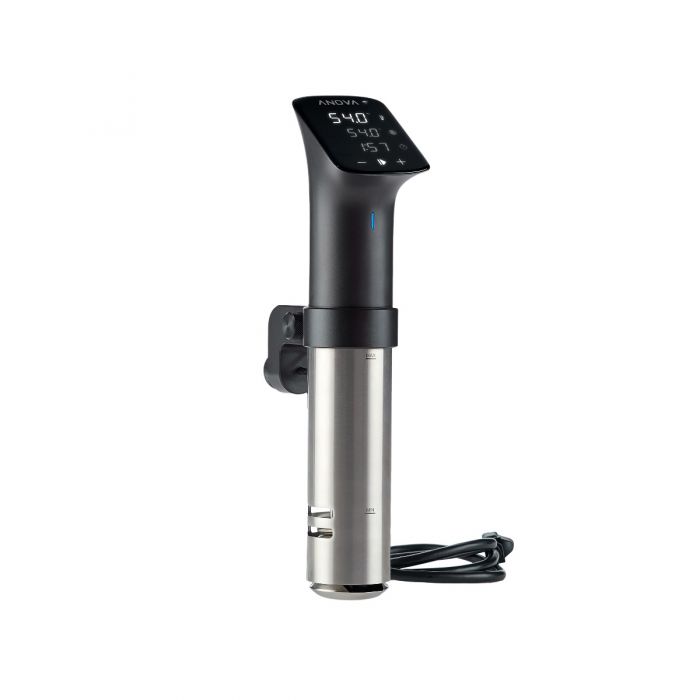
Anova Precision Cooker Pro
Best Overall: The Anova Precision Cooker Pro sets the benchmark for serious home sous vide: 1200W handles large containers without struggling, ±0.1°C precision matters for eggs and fish, and the unit operates fully manually without requiring the app. WiFi adds optional remote monitoring for overnight cooks — a practical advantage when you're asleep and a 24-hour pork shoulder is still running.
Top picks ↓| Product | Price | Link |
|---|---|---|
| $199.00 | View deal → | |
| $199.95 | View deal → | |
| — | View deal → | |
| $49.99 | View deal → | |
| $329.95 | View deal → |
Top picks
Related articles


Anova Precision Cooker Pro
Best choice for serious home cooks who want commercial-grade build quality and reliable WiFi monitoring for overnight cooks. The 1200W motor handles large containers without struggling.
The Anova Precision Cooker Pro sets the benchmark for serious home sous vide: 1200W handles large containers without struggling, ±0.1°C precision matters for eggs and fish, and the unit operates fully manually without requiring the app. WiFi adds optional remote monitoring for overnight cooks — a practical advantage when you're asleep and a 24-hour pork shoulder is still running.
Pros
- ✓1200W motor handles containers up to 100L without stalling
- ✓Full manual controls — works without the app or WiFi
- ✓±0.1°C precision reliable for eggs and temperature-sensitive proteins
Cons
- ✗$199 is the joint-highest price in this comparison
Score breakdown
| Power | 1200W |
| Temp accuracy | ±0.1°C |
| Temp range | 0–92°C |
| Container max | 100L |
| Connectivity | WiFi + Bluetooth |
| Dimensions | 38cm tall, 490g |

Breville Joule Turbo Sous Vide
Best for small kitchens and cooks who want the fastest heat-up time. Turbo mode is genuinely useful for weeknight cooking. Requires the app — not suitable for anyone who dislikes app-dependent appliances.
The Breville Joule Turbo is the smallest full-power unit in this comparison at 28cm and 281g, and its Turbo mode genuinely reduces heat-up time by up to 30% — meaningful for weeknight cooking when you want to start the bath before cutting your vegetables. The app-only operation is a real dependency: if the app loses support for your phone's OS, the unit becomes inoperable.
Pros
- ✓Smallest and lightest full-power unit — 28cm, 281g
- ✓Turbo mode reduces heat-up time by up to 30%
- ✓Well-designed app with guided cook times for common proteins
Cons
- ✗App-only operation — no manual controls on the unit itself
Score breakdown
| Power | 1100W |
| Temp accuracy | ±0.1°C |
| Temp range | 25–99°C |
| Container max | 30L |
| Connectivity | WiFi (required) |
| Dimensions | 28cm tall, 281g |
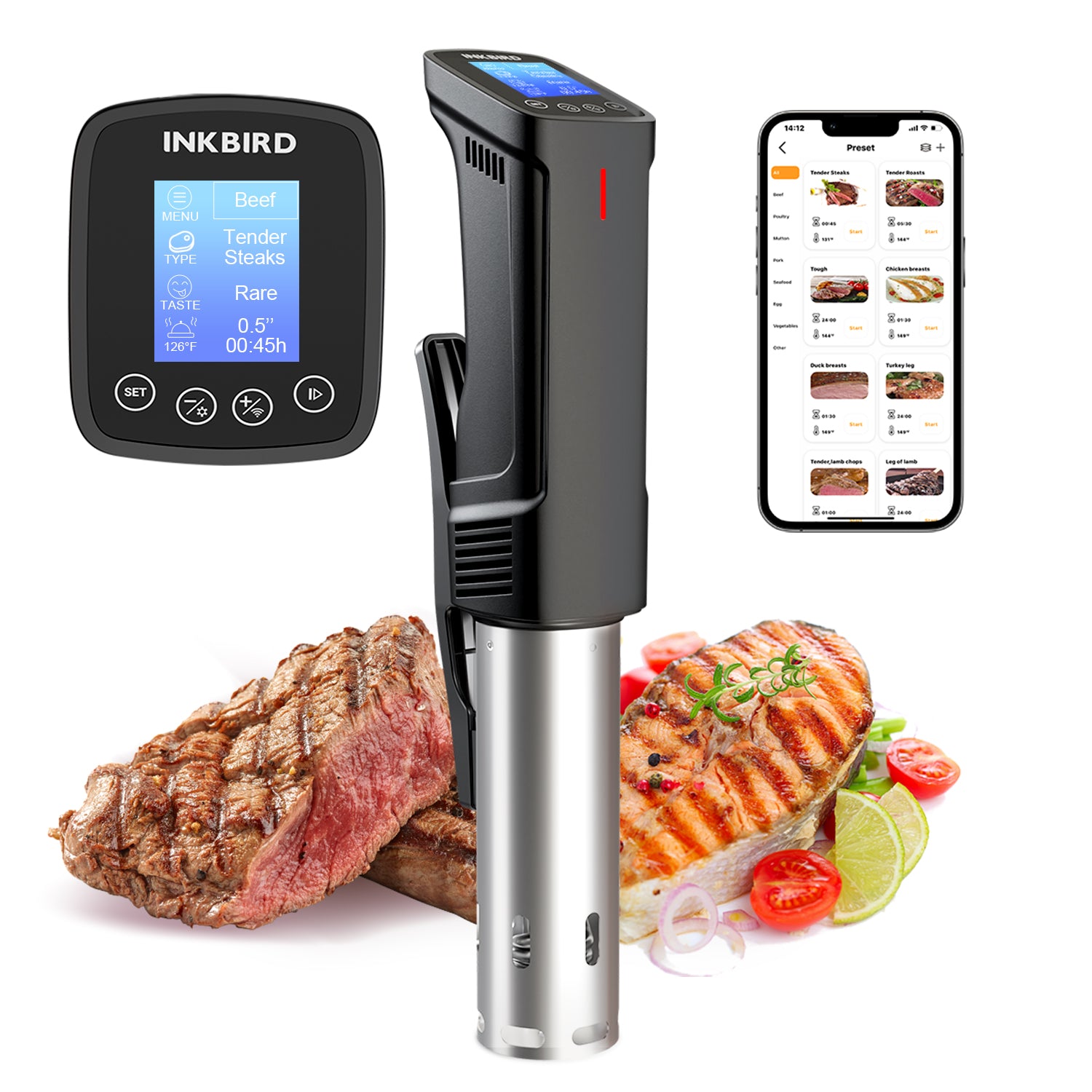
Inkbird ISV-100W Sous Vide Cooker
Best budget pick with WiFi. Physical controls mean it works without a phone, and WiFi adds optional remote monitoring. ±0.5°C accuracy is fine for steak, chicken, and pork.
The Inkbird ISV-100W delivers WiFi connectivity and manual physical controls at a price significantly below the Anova and Breville. The ±0.5°C accuracy is adequate for steak, chicken, and pork — it becomes a limitation only for eggs and fish where narrow temperature windows matter. Set it to the midpoint of your target temperature range and it performs reliably for everyday cooking.
Pros
- ✓Manual dial and display — works without phone or WiFi
- ✓WiFi enables optional scheduling and remote monitoring
- ✓Budget price with adequate accuracy for most proteins
Cons
- ✗±0.5°C accuracy misses the narrow window for eggs and delicate fish
Score breakdown
| Power | 1000W |
| Temp accuracy | ±0.5°C |
| Temp range | 25–99.9°C |
| Container max | 12L |
| Connectivity | WiFi + manual controls |
| Dimensions | 33cm tall, ~900g |
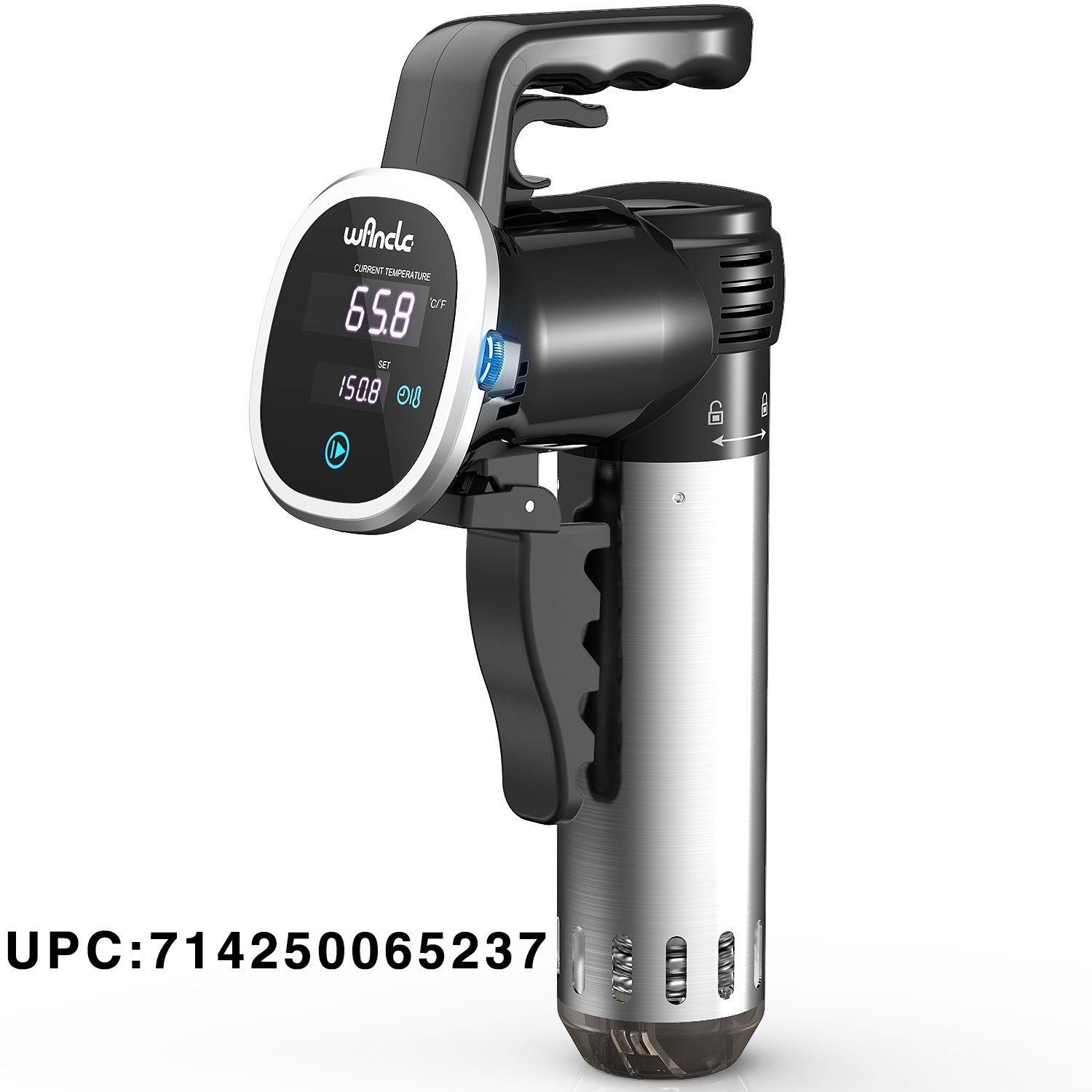
Wancle Sous Vide Cooker
Best for buyers who want zero app dependency and maximum simplicity. No WiFi, no cloud account, no update dependency. Reliable for basic sous vide cooking.
The Wancle Sous Vide Cooker is the simplest unit in this comparison: turn the dial to set temperature and time, clip to any pot, walk away. No WiFi, no cloud account, no app updates that can break functionality. The 850W output is adequate for single-meal cooking in pots up to 15L. If you distrust app-dependent appliances, this is the straightforward alternative.
Pros
- ✓No app, no WiFi, no cloud dependency — completely standalone
- ✓Simple dial operation with LED display
- ✓Reliable for all basic sous vide cooking without complexity
Cons
- ✗850W struggles with large containers — preheat time longer than 1000W+ units
Score breakdown
| Power | 850W |
| Temp accuracy | ±0.5°C |
| Temp range | 25–99.5°C |
| Container max | 15L |
| Connectivity | None |
| Dimensions | 30cm tall, ~800g |

PolyScience Creative Series Sous Vide
Best temperature precision of the group. Designed for professional kitchens; appropriate for home cooks who need repeatable precision for eggs and temperature-sensitive fish.
The PolyScience Creative Series is the only unit in this comparison with a professional kitchen lineage and ±0.07°C temperature stability — the precision that restaurant kitchens require for recipe reproducibility across hundreds of batches. For the home cook who regularly prepares 63°C eggs or 45°C salmon, this precision eliminates the texture variance that ±0.5°C units introduce. The price reflects professional-grade build quality.
Pros
- ✓±0.07°C temperature stability — tightest precision in this comparison
- ✓Professional kitchen lineage with IP-rated splash protection
- ✓Manual controls with no app dependency
Cons
- ✗$329 price is hard to justify unless precision for eggs or fish is a primary requirement
Score breakdown
| Power | 1100W |
| Temp accuracy | ±0.07°C |
| Temp range | 25–99°C |
| Flow rate | 11.5L/min |
| Connectivity | None (manual only) |
| Build | Professional, IP-rated |
Which one is right for you?
For overnight and large-batch cooks
Anova Precision Cooker Pro
1200W handles 30L containers and WiFi monitoring lets you check temperature from bed during a 24-hour pork shoulder cook.
For small kitchen cooks wanting fast heat-up
Breville Joule Turbo Sous Vide
The smallest full-power unit with Turbo mode — heat-up time reduction matters when you're starting the bath during weeknight dinner prep.
For first-time sous vide buyers on a budget
Inkbird ISV-100W Sous Vide Cooker
WiFi monitoring plus manual backup controls at a budget price — ±0.5°C is accurate enough for steak, chicken, and pork shoulder.
For buyers who distrust app-dependent appliances
Wancle Sous Vide Cooker
Dial and LED only — nothing to update, nothing to lose connectivity, nothing to stop working when a company pushes a new OS.
For eggs, fish, and reproducible precision cooking
PolyScience Creative Series Sous Vide
±0.07°C stability means 63°C eggs come out identically every morning — the precision that ±0.5°C units cannot reliably deliver.
What sous vide actually fixes in home cooking
The core problem sous vide solves is the physics of heat transfer. When you cook a 5cm steak in a pan, heat moves inward from the surface. To reach 54°C at the center, the outer 5mm has to pass through 60°C, then 70°C, then higher, because the surface is in contact with a 230°C pan. By the time the center is done, the outside is well done. This is not a skill problem — it is geometry.
A water bath set to 54°C cannot go above 54°C anywhere in the container. The steak sits in that environment for 1-4 hours depending on thickness, and every point in the cut reaches 54°C and holds there. Pull the bag, dry the surface, sear for 30-60 seconds per side in a very hot pan. The crust you are building in the sear does not need to cook the interior — it just needs color and texture, which takes less than two minutes total.
This same principle applies to chicken breast (pasteurized at 60°C for 45 minutes — never rubbery, never dry), pork shoulder (74°C for 24 hours produces pulled-pork texture without a smoker), salmon (45-47°C for 30 minutes produces a translucent, custard-like texture you cannot replicate any other way), and eggs (63°C for 60 minutes for a white that barely sets and a yolk that is creamy rather than chalky). Once you understand the technique, the question is just which circulator gets there reliably.
Wattage and heat-up time
Wattage determines how quickly a circulator brings a cold water bath to target temperature — it does not affect the cook temperature once the bath is stable. For most home cooks using a 10-15 liter container, the difference between 850W and 1200W is roughly 15-25 minutes of preheat time. If you fill the container from the tap and want to start cooking immediately, higher wattage shortens the wait. If you use hot tap water or fill from a kettle, the difference shrinks further.
Where wattage matters more is large containers and cold climates. A 1200W unit like the Anova Pro handles a 30-liter container at a comfortable pace. An 850W unit struggles to maintain temperature in a large cold bath in a cold kitchen — the motor compensates but response time slows. If you regularly cook for a crowd (whole sides of beef, multiple racks of ribs), the extra 350W justifies the price premium. For single-meal cooking in a standard pot, the 1000W budget units are functionally equivalent to the 1200W premium units.
The Breville Joule Turbo's Turbo mode is a different approach — rather than simply increasing wattage, it uses temperature ramp algorithms to overshoot slightly on the way up and recover faster, reducing total heat-up time by up to 30% compared to the standard Joule. This works well for thick cuts in large containers where heat-up time otherwise adds 40+ minutes to the total process.
Temperature accuracy: why ±0.1°C matters (and when it does not)
The difference between ±0.1°C and ±1°C sounds small, but it is meaningful at specific temperatures. Egg white begins to set at around 63°C — if your circulator runs 1°C hot, you get a firmer white than intended. Salmon's custard texture window is narrow: 45-47°C gives the desired result, 48°C starts to push toward flaky. At those temperatures, a ±1°C tolerance means the actual bath temperature could be 46°C or 48°C, which lands in different texture categories.
For beef and pork, the stakes are lower. The difference between 54°C and 55°C in a steak is not detectable by most people. Medium-rare to medium is a range of roughly 54-57°C, and any circulator accurate to ±1°C stays comfortably inside that range when set to 55°C. The practical implication: ±0.1°C precision matters for eggs, fish, and temperature-sensitive proteins; it is irrelevant for steak, chicken (cooked at 60-65°C where ±1°C is not meaningful), and pork shoulder (74°C ± 1°C is the same pulled texture).
The PolyScience Creative Series at ±0.07°C is the only unit here that comes from the professional kitchen world, where recipe reproducibility across batches matters. For home cooking, the Anova Pro at ±0.1°C is more than sufficient. The Inkbird and Wancle at ±0.5°C are fine for steak, chicken, and pork — just use the midpoint of your target temperature as the set point.
App control: useful or gimmick
The Breville Joule Turbo requires the app to operate — there are no controls on the unit. This is a deliberate design choice: the unit is compact because it outsources the interface to your phone. The app is well-designed, with guided cook times for common proteins and the ability to monitor temperature remotely. The limitation is dependency: if the app stops receiving updates for your phone's OS version, or if you lose WiFi connectivity, the unit cannot be operated.
The Anova Pro has both WiFi/Bluetooth app connectivity and full manual controls on the unit. This is the better design for long cooks: you set the temperature and time on the unit itself, then optionally monitor from the app. If your phone dies or you are away from WiFi, the cook continues without interruption. The Anova app works well but is not required — the unit works standalone.
The Inkbird ISV-100W similarly has physical controls as the primary interface, with app as optional monitoring. The Wancle has no app at all — manual only. For anyone who has experienced an app-connected appliance stop working when the manufacturer pushed an update or discontinued the product, the manual-first devices have a meaningful reliability advantage. Connected features are convenient; they are not necessary for the cooking technique itself.
Container and bag setup
Most circulators specify a minimum water depth (8-12cm typically) and a maximum container volume. Container choice affects two things: heat distribution and bag capacity. A narrow pot with high water depth is efficient for single items. A wider, shallower container (a cambro-style polycarbonate food storage box or a stockpot) handles more bags at once and is easier to lid with a cut foam sheet to reduce evaporation.
For long cooks (12+ hours), evaporation is a real concern — a 12-hour cook without a lid can lose 2-3 liters of water, exposing the bags and compromising temperature stability. The simplest solution is a silicone lid with a cutout for the circulator, or a sheet of plastic wrap laid loosely on the surface. Zip-lock freezer bags work for most home cooking — the technique does not require vacuum bags. Air pockets are the actual problem (they cause floating), not whether the bag is vacuum-sealed. The water displacement method (lower the open bag into the water slowly to push air out, then seal the corner) removes enough air to keep bags submerged.
Sous vide containers available from major online retailers range from repurposed stock pots to purpose-built polycarbonate containers with lids designed for the Anova or Joule clip. The purpose-built containers add convenience; they are not required. Any container that holds enough water and can withstand 100°C (most pots qualify) works.
Finishing and searing after sous vide
The sear is where most beginners lose the gains from sous vide. The bag comes out, the surface is wet and soft, and people put it in a pan that is not hot enough. The result is a long cook in the pan trying to build color, which drives the exterior temperature up and starts re-cooking the interior you just spent two hours getting right.
The correct approach: remove from the bag, dry the surface thoroughly with paper towels (moisture inhibits browning — this is the most important step), then sear in a pan preheated until it smokes. Carbon steel or cast iron at maximum heat, a thin layer of high-smoke-point oil (avocado, grapeseed, refined sunflower), 30-60 seconds per side maximum. The Maillard reaction that produces crust happens between 140-180°C on the surface. A hot pan achieves this in under a minute. A warm pan takes several minutes and overcooks the edge.
For steaks, a butter baste with thyme and garlic during the sear adds flavor without meaningfully raising the interior temperature in 30-60 seconds. For chicken breast, skip the butter and focus on extremely dry surface and maximum pan heat — the skin-side benefits from 60-90 seconds on high heat. For fish, pat dry and sear only the skin side if applicable; the flesh side rarely needs more than 15-20 seconds of direct heat.