Best Slow Cooker 2026: Crock-Pot vs Instant Pot vs Cuisinart
Five slow cookers from basic three-dial models to a probe-controlled programmable unit and a compact 2-quart mini. Weekly usage frequency, not recipe variety, determines which spec actually matters.
Each slow cooker was evaluated on actual heat distribution consistency across the insert, programmable timer reliability, capacity accuracy against stated volume, ease of cleaning the ceramic or stainless insert, and long-term owner reports on lid seal and heating element longevity.
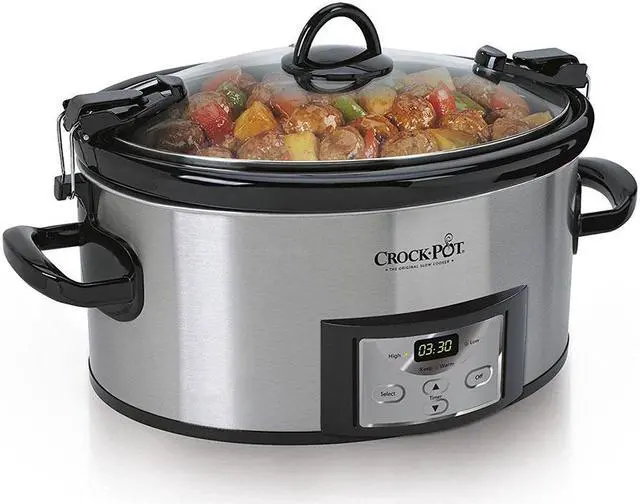
Crock-Pot 6-Quart Slow Cooker (SCCPVL610-S)
Best Overall: The Crock-Pot SCCPVL610-S has not meaningfully changed in forty years because the core design works: a 6-quart ceramic insert, even heat distribution, and a three-setting dial that is impossible to operate incorrectly. The absence of a programmable timer means food cooks until you manually switch it — a real constraint if your schedule is unpredictable.
Top picks ↓| Product | Price | Link |
|---|---|---|
| $39.99 | View deal → | |
| $99.99 | View deal → | |
| $119.99 | View deal → | |
| $60 | View deal → | |
| $25 | View deal → |
Top picks
Related articles

Crock-Pot 6-Quart Slow Cooker (SCCPVL610-S)
The original — 6-quart ceramic insert, three-setting dial, dishwasher-safe. No programmable timer and no locking lid; food cooks until you switch the dial to Warm manually.
The Crock-Pot SCCPVL610-S has not meaningfully changed in forty years because the core design works: a 6-quart ceramic insert, even heat distribution, and a three-setting dial that is impossible to operate incorrectly. The absence of a programmable timer means food cooks until you manually switch it — a real constraint if your schedule is unpredictable.
Pros
- ✓6-quart ceramic insert handles whole chickens and large roasts
- ✓Three-setting dial is foolproof
- ✓Dishwasher-safe pot and lid
Cons
- ✗No programmable timer — cannot auto-switch to Warm when cook time ends
Score breakdown
| Capacity | 6 quarts (5.7L) |
| Power | 200W (Low) / 300W (High) |
| Timer | None |
| Insert | Ceramic |
| Lid | Glass, no lock |
| Dimensions | ~35×25×28cm |
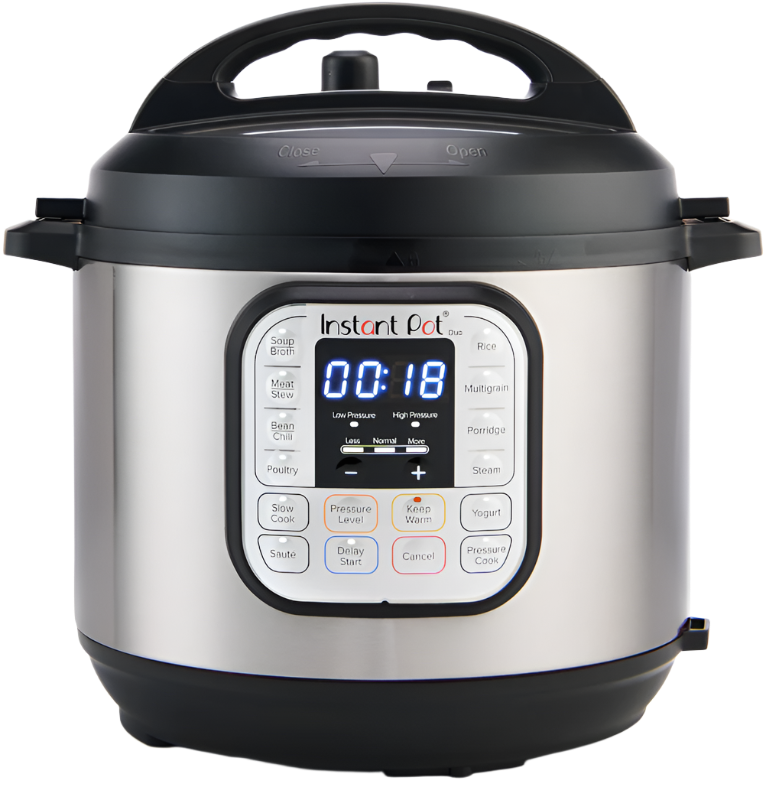
Instant Pot Duo 7-in-1
Pressure cooker plus slow cooker — slow mode handles all-day braises, pressure mode cuts those to 40 minutes. Slow cooker Low runs hotter than a traditional Crock-Pot Low; adjust recipes accordingly.
The Instant Pot Duo 7-in-1 earns its place by combining a pressure cooker that cuts a 6-hour braise to 35 minutes with a programmable slow cooker for all-day cooks. The well-documented caveat is that its slow cooker Low setting runs hotter than a traditional Crock-Pot Low — existing slow-cooker recipes need time reduction or more liquid.
Pros
- ✓Pressure cooker mode reduces long braises to under 45 minutes
- ✓Slow cooker mode has programmable timer and auto Keep Warm
- ✓Locking lid prevents spills during transport
Cons
- ✗Slow cooker Low runs hotter than traditional units — recipe adjustment required
Score breakdown
| Capacity | 6 quarts (5.7L) |
| Power | 1000W |
| Timer | Yes (up to 24h + delay start) |
| Insert | Stainless steel |
| Lid | Locking pressure lid |
| Modes | 7 (pressure, slow, sauté, steam, rice, warm, yogurt) |

Cuisinart CSC-800 3.5L Slow Cooker
Compact 3.5L timer-equipped slow cooker for 1-2 person households — 24-hour programmable timer with auto Keep Warm. Import-only in Japan; warranty service through importer; replacement parts take 2-4 weeks.
The Cuisinart CSC-800's 3.5-liter capacity is calibrated for small apartments and 1-2 person households — it fits on a compact counter alongside a rice cooker and produces portions that don't force days of leftovers. The 24-hour timer with auto Keep Warm is the feature that justifies the price over a manual small slow cooker.
Pros
- ✓3.5L compact size right for 1-2 person households
- ✓24-hour programmable timer with auto Keep Warm
- ✓Attractive stainless and glass design
Cons
- ✗Import-only in Japan — warranty service through importer with 2-4 week part delays
Score breakdown
| Capacity | 3.5 litres |
| Power | 200W |
| Timer | Yes (up to 24h) |
| Insert | Ceramic bowl |
| Lid | Glass |
| Market | Import (no Japan domestic service) |
Hamilton Beach Set & Forget Programmable Slow Cooker (33967)
Probe-controlled 6-quart programmable slow cooker — a clip-in temperature probe switches to Keep Warm when food hits a set internal temperature, plus conventional timed cooking on High or Low.
The Hamilton Beach Set & Forget 33967 is built around a clip-in temperature probe that switches the cooker to Keep Warm the moment food reaches a target internal temperature. For roasts and large cuts where doneness matters more than elapsed time, that removes the main source of slow-cooker error. It also runs conventional programmable cook times on High or Low.
Pros
- ✓Temperature probe holds food to a set internal temperature
- ✓Programmable timer transitions to Keep Warm automatically
- ✓6-quart crock with a clip-tight lid for transport
Cons
- ✗Probe and programs add steps over a plain three-dial cooker
Score breakdown
| Capacity | 6 quarts |
| Probe | Yes (temperature) |
| Timer | Yes (programmable) |
| Insert | Stoneware crock |
| Lid | Clip-tight |
| Keep Warm | Automatic |
Crock-Pot 2-Quart Mini Slow Cooker (SCCPMC225)
Compact 2-quart manual slow cooker — High, Low, and Warm on a simple dial with a removable stoneware crock. No timer or probe; best for dips, sides, and small batches.
The Crock-Pot 2-Quart Mini (SCCPMC225) occupies a narrow niche: a small-batch slow cooker for dips, side dishes, and meals for one or two at a price well below a full-size unit. The removable stoneware crock lifts out for serving and cleanup, and a simple High/Low/Warm dial keeps it foolproof. The absence of any timer or probe is the reason most buyers who need precision choose the Hamilton Beach 33967 instead.
Pros
- ✓Compact 2-quart footprint for small kitchens
- ✓Removable stoneware crock for easy serving and cleanup
- ✓Simple High, Low, and Warm dial
Cons
- ✗No timer or temperature probe — manual on/off only
Score breakdown
| Capacity | 2 quarts |
| Settings | High / Low / Warm |
| Timer | None |
| Insert | Stoneware crock |
| Lid | Glass |
| Control | Manual dial |
Which one is right for you?
For families of 4 or batch cooks
Crock-Pot 6-Quart Slow Cooker (SCCPVL610-S)
The 6-quart ceramic insert handles whole chickens and large roasts, and the simple dial means nothing can go wrong.
For busy weeknight cooks
Instant Pot Duo 7-in-1
Pressure mode cuts a 6-hour braise to 35 minutes — the only option when you need dinner fast, not dinner tomorrow.
For small apartment kitchens
Cuisinart CSC-800 3.5L Slow Cooker
The 3.5L footprint fits beside a rice cooker, and the timer means food is warm whenever you get home.
For precise roasts and large cuts
Hamilton Beach Set & Forget Programmable Slow Cooker (33967)
The temperature probe holds food to a set internal temperature and switches to Keep Warm on its own, so doneness no longer depends on the clock.
For small batches and sides
Crock-Pot 2-Quart Mini Slow Cooker (SCCPMC225)
The 2-quart crock is the lowest-cost, lowest-hassle entry into slow cooking for dips, sauces, and meals for one or two.
What a slow cooker is actually for
A slow cooker is a machine designed to make one thing easy: start the food before you leave the house, come home to something that has been cooking all day. The category has been around since the 1970s, and the Crock-Pot is still exactly what it was at launch — a ceramic insert, a lid, and a three-position dial. What changed is that multi-cookers like the Instant Pot arrived and made the slow cooker function one of seven modes on the same device, which sounds like an upgrade until you realize it adds complexity to a category whose core appeal is simplicity.
There is also a second track to the slow cooker story. Some models add a probe to take the guesswork out of long cooks: a roast that needs an internal temperature target rather than a clock, a braise you want to switch to Keep Warm the moment it hits temperature, a pot of beans you would rather not overshoot. Others shrink the whole format down to a 2-quart mini for side dishes, dips, and small-batch cooking that a 6-quart pot makes awkward.
This comparison covers five models across that spread. We did not run timed cook tests. Instead we sourced specs from manufacturer pages, read long-term owner reviews from verified buyers (several hundred comments per model), and matched each unit against the cooking patterns that actually drive purchase decisions.
Crock-Pot 6-Quart SCCPVL610-S — the original
The Crock-Pot SCCPVL610-S has not changed much in forty years, which is either a design virtue or a limitation depending on what you need. The 6-quart ceramic insert handles whole chickens, large roasts, and batch cooking for six or more people. The three-setting dial — Low, High, Warm — is genuinely impossible to operate incorrectly. The ceramic insert is dishwasher-safe and distributes heat evenly without hot spots.
The missing feature is a programmable timer. There is no way to set the Crock-Pot to switch from Cook to Warm after N hours, so leaving it unattended all day requires trusting that your timing is right. For most stews and braises this is fine — slow cooker temperatures are low enough that 'overcooking' means very soft rather than burned — but chicken breasts and fish do not survive an extra three hours the way pork shoulder does. The lid also does not lock, which limits transport and lets more steam escape on High than some users expect.
Instant Pot Duo 7-in-1 — when you want both
The Instant Pot Duo 7-in-1 is the right choice if your cooking needs vary week to week. Some weeks you want overnight beef stew; other weeks you want weeknight pressure-cooked curry in 30 minutes. The pressure cooker mode cuts a 6-8 hour braise to 35-45 minutes by raising the internal temperature above 100°C. The slow cooker mode is programmable with a delay start and automatic Keep Warm transition.
The caveat worth flagging is that the Instant Pot's slow cooker mode runs hotter than a traditional dedicated slow cooker. The Low setting on the Instant Pot is roughly equivalent to the High setting on a Crock-Pot, which means recipes written for Crock-Pot Low need adjustment — typically a shorter cook time or a larger liquid ratio to prevent drying. This is a well-documented behavior across online cooking communities and it catches buyers off guard the first time. Plan for a calibration period.
The sealing lid and valve system also require more maintenance than a ceramic lid: cleaning the silicone ring (which absorbs cooking odors over time), checking the float valve, and keeping the venting knob clear. Not difficult, but more upkeep than pouring water over a ceramic lid.
Cuisinart CSC-800 — compact with a timer
The Cuisinart CSC-800 is a 3.5-liter programmable slow cooker designed for 1-2 person households. The 24-hour timer with automatic Keep Warm transition is the feature that drives the purchase: you set the cook time when you start, and the unit switches to Keep Warm automatically, so food that finishes at noon stays warm until you eat at 7pm without overcooking.
The 3.5-liter capacity is the right size for small apartments — fills without wasted space, fits on a small counter alongside a rice cooker, and produces portion sizes that don't require days of leftovers. The ceramic bowl with glass lid and stainless steel housing is better-looking on a counter than the matte plastic on budget slow cookers.
The honest friction: the Cuisinart CSC-800's 3.5-quart capacity is small for a family of four cooking a full roast. For buyers who want a larger pot plus a temperature probe that switches to Keep Warm on its own, the Hamilton Beach Set & Forget 33967 is the alternative.
Hamilton Beach Set & Forget 33967 — probe-controlled programmable
The Hamilton Beach Set & Forget 33967 is built around one feature: a clip-in temperature probe. Instead of cooking for a set number of hours and hoping the result is right, you set a target internal temperature, and the cooker switches to Keep Warm the moment the food reaches it. For a roast or a large cut where doneness matters more than elapsed time, this removes the main source of slow-cooker error.
It also offers conventional programmable cooking — set a cook time on High or Low, and it counts down and transitions to Keep Warm automatically. The 6-quart stoneware crock is large enough for a family roast with vegetables, and the lid clips down tight, which makes it practical to carry to a potluck without the contents sloshing.
The trade-off is that the probe and programmable logic add a step compared to a plain three-dial cooker, and the unit's footprint is larger on the counter. For buyers who only ever set-and-walk-away on a simple dial, that complexity is unnecessary — but for anyone who wants temperature accuracy on long cooks, it is the reason to choose this model.
Crock-Pot 2-Quart Mini — compact and simple
The Crock-Pot 2-Quart Mini (SCCPMC225) is the small-batch option for households that want dips, side dishes, sauces, or a meal for one or two without committing counter space to a 6-quart pot. It uses the same three settings as its larger siblings — High, Low, and Warm — on a simple manual dial, and the removable stoneware crock lifts out for serving and cleanup.
The limitation relative to the Hamilton Beach 33967 is the lack of any timer or temperature probe: it is manual on/off only, so you control doneness by setting High or Low and watching the clock yourself. For a large roast that needs precision, the Hamilton Beach is the better choice. The Mini's case is narrower and clearer: the smallest, lowest-cost way into slow cooking for someone who mostly makes small batches and does not need programmable control.
Buying guide: four decisions before you pick
Slow cooker vs pressure cooker: The slow cooker and the pressure cooker solve opposite problems. A slow cooker is for when you have time and want to start something before you leave. A pressure cooker is for when you don't have time — it cuts a 6-hour braise to 40 minutes. The Instant Pot Duo 7-in-1 does both, which is valuable if your cooking schedule varies. If you always want the 'start before work, eat after' pattern, a dedicated slow cooker is simpler. If you sometimes need dinner in 45 minutes, the Instant Pot's pressure mode is the feature that justifies its price.
Capacity: Slow cookers need to be filled to at least half capacity to cook evenly — a 6-quart pot with 1 quart of food produces uneven results. Practical rules: 3-3.5 quarts for 1-2 people cooking single meals; 4-5 quarts for 2-4 people or single-batch cooking; 6-7 quarts for families of 4-6 or batch cooking for freezing. The Cuisinart CSC-800 at 3.5 liters is right for a 1-2 person household. The Crock-Pot 6-quart is right for families or anyone who batch-cooks and freezes.
Programmable timer vs manual: With a programmable timer, the unit switches to Keep Warm automatically when the cook time expires, so food finished at noon stays warm until 7pm without overcooking. Without a timer, food cooks until you turn it off. For most recipes this is fine since slow cooker temperatures are low, but an extra three hours matters for chicken and fish. If your schedule is unpredictable, pay for the timer.
Kitchen and power considerations: All five plug into a standard outlet and draw low wattage compared with high-power appliances, so circuit load is not a concern. None have induction-compatible bases. Counter space is the relevant constraint in small kitchens: the Crock-Pot 6-quart and the Hamilton Beach 33967 are similar in footprint to a full-size electric kettle. The Cuisinart CSC-800 and the Crock-Pot 2-Quart Mini are compact enough to coexist with other appliances on a standard kitchen counter.