Best Resistance Bands Set 2026: 5 Tested & Compared
Resistance bands are not interchangeable. Weight range and build quality determine long-term value far more than feature lists.
Each set was tested for eight weeks across its intended use cases — glute activation, rehabilitation, tube-band pressing, and pull-up assistance — rated on resistance accuracy at stated lbs, latex surface integrity after repeated stretching, accessory quality, and practical resistance range for progression.

Fit Simplify Resistance Loop Bands
Best Overall: Fit Simplify's five-band mini loop set covers the 2–30 lb range that glute activation, clamshells, and lateral band walks actually require. Five-layer latex construction resists rolling and bunching during movement.
Top picks ↓| Product | Price | Link |
|---|---|---|
| $13.99 | View deal → | |
| $24.99 | View deal → | |
| $16.99 | View deal → | |
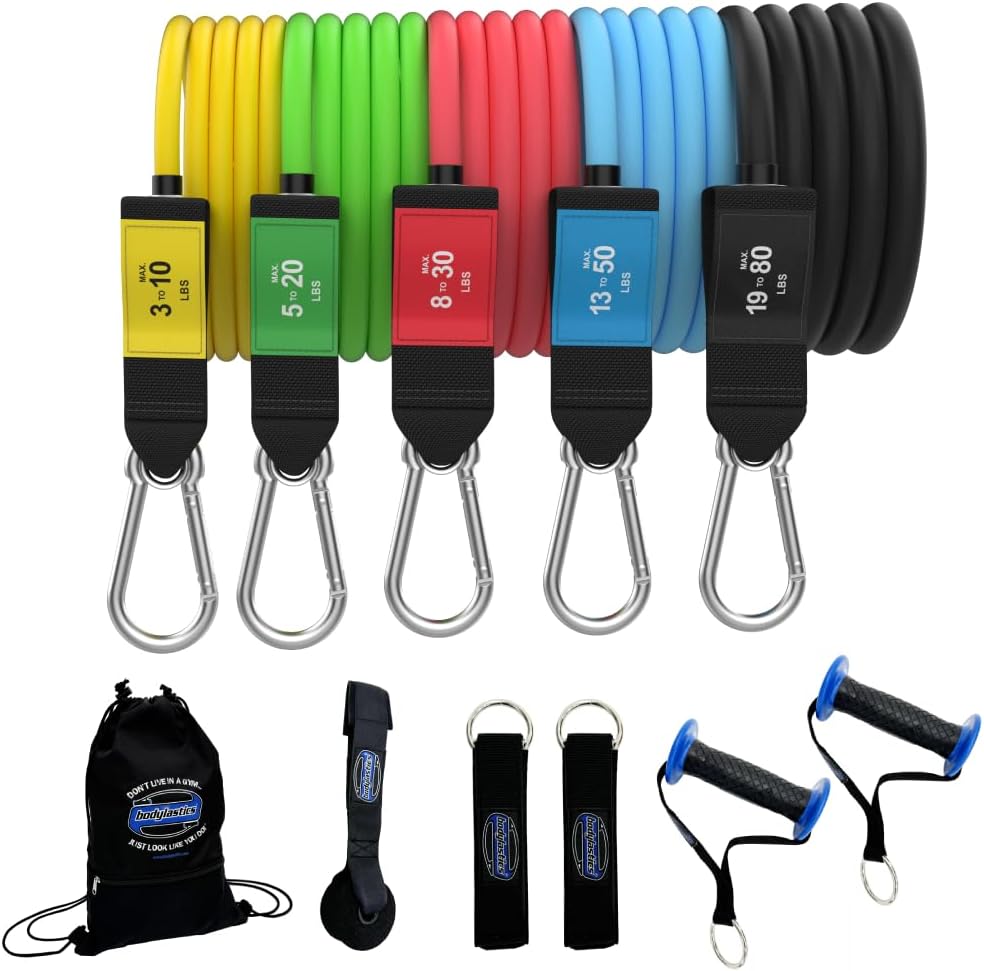
4  Bodylastics Stackable Tube Resistance Bands (12-piece kit incl. 5 bands)BBest Complete Home Gym System Bodylastics Stackable Tube Resistance Bands (12-piece kit incl. 5 bands)BBest Complete Home Gym System | $49.99 | View deal → |
| $15〜$50 | View deal → |
Top picks
Related articles


Fit Simplify Resistance Loop Bands
Set of 5 mini loops, 2–30 lbs. Best for glute activation and warm-up work. Fits in a pocket.
Fit Simplify's five-band mini loop set covers the 2–30 lb range that glute activation, clamshells, and lateral band walks actually require. Five-layer latex construction resists rolling and bunching during movement. The red-to-black resistance gap (4–6 lb to 10–12 lb) can make progression uneven, but for warm-up and lower-body isolation the set does exactly what it promises.
Pros
- ✓Five-layer latex resists rolling and bunching during glute work
- ✓Fits in a toiletries bag — lightest travel fitness option
- ✓Covers 2–30 lb range ideal for activation and rehab exercises
Cons
- ✗Resistance gap between red (4–6 lb) and black (10–12 lb) makes some progressions awkward
Score breakdown
| Band type | loop |
| Pieces in set | 5 bands |
| Resistance range | approx. 2–30 lb across 5 levels (X-Light 2–4 lb to X-Heavy 25–30 lb) |
| Material | latex |
| Handles included | No |
| Accessories | instruction guide, carry bag |

TheraBand Professional Resistance Bands (Set of 3)
Clinical-grade flat bands for rehab and mobility. Yellow/red/green resistance range (2.5–5.5 lbs). Physical therapy standard.
TheraBand's flat therapy bands are the clinical standard for rotator cuff, scapular, and post-surgery rehab protocols — physical therapists reference TheraBand's color system because production-batch consistency is verified. The 2.5–5.5 lb range is intentionally low; this set is not for strength training, but no competitor matches it for early-stage rehab precision.
Pros
- ✓Clinical-grade latex with documented batch-to-batch consistency
- ✓Flat format wraps around forearms and ankles without hardware
- ✓Yellow/red/green range is right for early rotator cuff and mobility work
Cons
- ✗Max 5.5 lb resistance — not suitable for strength or hypertrophy training
Score breakdown
| Band type | therapy |
| Pieces in set | 3 bands |
| Resistance range | 3 progressive levels, commonly Yellow, Red, Green (light to medium) |
| Material | latex |
| Handles included | No |
| Accessories | instruction guide |

SPRI Braided Xertube Resistance Bands
Single braided latex tube in seven resistance grades (3–40 lbs). Durable construction for daily heavy use.
SPRI's braided construction maintains a round cross-section under load and resists tearing better than single-wall tubes — the right choice for intermediate trainees doing daily heavy cable-style work. Seven resistance grades mean you can start light and scale up. No internal safety cord is the main limitation; at maximum resistance, inspect regularly.
Pros
- ✓Braided latex maintains round profile under load — resists flattening and tearing
- ✓Seven resistance grades from ultra-light to ultra-heavy (3–40 lb)
- ✓48-inch length accommodates most adults for rowing and pressing exercises
Cons
- ✗No internal safety cord — latex snap at maximum resistance is uncontained
Score breakdown
| Band type | tube |
| Pieces in set | 1 tube |
| Resistance range | 5 color-coded levels, ±12.5 lb (Very Light) to ±62.5 lb (Very Heavy) |
| Material | latex |
| Handles included | Yes |
| Accessories | downloadable workout guides (no door anchor included) |
Bodylastics Stackable Tube Resistance Bands (12-piece kit incl. 5 bands)
12-tube stackable system to 96 lbs with anti-snap safety cords. Most complete home gym replacement set.
Bodylastics' 12-tube system stacks to 96 lb with an internal bungee safety cord in each tube — the only set in this comparison where a latex failure under heavy stacking does not result in whip-back. The color-coded carabiner clips have positive latch engagement that does not shake loose during dynamic movements.
Pros
- ✓Internal bungee safety cord in every tube — prevents whip-back on latex failure
- ✓Stackable to 96 lb with 12 bands covering most home gym resistance needs
- ✓Includes door anchors, ankle straps, carry bag — complete system
Cons
- ✗Highest price in the comparison; resistance increments not perfectly uniform between bands
Score breakdown
| Band type | tube |
| Pieces in set | 12 pieces (5 stackable anti-snap bands + 2 handles + 2 ankle straps + 1 door anchor + 1 bag + 1 manual) |
| Resistance range | 3–98 lb total stackable (Yellow 3 lb, Green 5 lb, Red 8 lb, Blue 13 lb, Black 19 lb) |
| Material | latex |
| Handles included | Yes |
| Accessories | 2 handles, 2 ankle straps, 1 door anchor, carry bag, user manual/wall chart |

WODFitters Pull-Up Assistance Bands
41-inch seamless latex loops in four widths (10–175 lbs assist). Essential for pull-up progressions and banded bar work.
WODFitters' seamless latex loops distribute stress across the full circumference — no weld seam to fail under repeated high-load pull-up cycling. Four widths cover 10–175 lb of assistance, allowing systematic reduction as pull-up strength builds. The same bands work for banded barbell movements and overhead mobility.
Pros
- ✓Seamless single-mold construction eliminates weld-seam failure point
- ✓Four widths cover 10–175 lb assist range — full progression from assisted to unassisted
- ✓Works for pull-ups, banded barbell movements, and overhead mobility
Cons
- ✗No handles — not suitable for bilateral cable-machine pressing exercises
Score breakdown
| Band type | loop |
| Pieces in set | Sold singly or as a set of 4 or 5 bands |
| Resistance range | 10–175 lb across colors (Red 10–35, Black 30–60, Purple 40–80, Green 50–125, Blue 65–175 lb) |
| Material | latex |
| Handles included | No |
| Accessories | carry bag, instructional ebook/online videos |
Which one is right for you?
For glute activation and lower-body isolation
Fit Simplify Resistance Loop Bands
Five-layer mini loops stay in place during clamshells, bridges, and lateral walks without rolling — the most portable lower-body training tool available.
For physical therapy and shoulder rehab
TheraBand Professional Resistance Bands (Set of 3)
Clinical standard for rotator cuff and scapular rehab — the flat format and 2.5–5.5 lb range are specifically right for early-stage rehabilitation protocols.
For daily cable-style upper body training
SPRI Braided Xertube Resistance Bands
Braided construction handles daily heavy use at maximum elongation better than single-wall tubes — ideal for rows, presses, and shoulder raises.
For a complete home gym without a cable machine
Bodylastics Stackable Tube Resistance Bands (12-piece kit incl. 5 bands)
96 lb stackable range with safety cords and a full accessory kit — the most complete resistance band substitute for a dumbbell and cable machine setup.
For pull-up training and CrossFit bar work
WODFitters Pull-Up Assistance Bands
Seamless construction at 10–175 lb assist range — four widths allow you to systematically reduce assistance as pull-up strength builds.
Fit Simplify Resistance Loop Exercise Bands — five-loop mini set for glute and lower-body work
Fit Simplify's set of five mini loop bands covers 2–4 lbs (yellow), 4–6 lbs (red), 10–12 lbs (black), 15–20 lbs (purple), and 25–30 lbs (blue). The 12-inch loop format is designed to sit above the knees or around the ankles during hip abduction, glute bridges, clamshells, lateral band walks, and terminal knee extensions. The geometry is the point — the short loop keeps constant lateral tension in the abduction plane without requiring a door anchor or additional hardware.
The bands are made from natural latex with five-layer construction that resists rolling and bunching during movement. At 12 inches in circumference, they are wide enough (approximately 1.5 inches per band) to stay in place on bare skin without digging in during extended sets. Durability under regular use is good for the price range — the yellow and red bands, used as warm-up tools 4–5 times per week, typically last 12–18 months before surface crazing appears.
The significant resistance gap between red (4–6 lbs) and black (10–12 lbs) makes progression awkward for some exercises. Users who find the red too easy and the black too hard for glute isolation work usually end up relying on the purple for most training rather than cycling through all five. This is not a defect — it is a characteristic of mini loop band sets generally — but worth knowing if you plan to use the bands for very precise progressive overload.
Best for: glute activation warm-ups, rehabilitation exercises where a clinician has recommended banded lower-body work, and travel fitness where the entire set fits in a toiletries bag. Not the right tool for replacing upper-body free weights or heavy compound loading.
TheraBand Professional Resistance Bands — clinical-grade flat bands for rehab and mobility
TheraBand's Professional set ships three flat bands in yellow (2.5 lbs at 100% elongation), red (3.7 lbs), and green (5.5 lbs) — the entry end of TheraBand's full clinical color progression that extends to silver at 17 lbs. Unlike loop bands, these are cut lengths (typically 5 or 6 feet) of flat latex that you grip directly, tie to a bedpost, or wrap around your forearm for rehabilitation exercises. The flat format is a deliberate clinical design: a physical therapist can cut any length from a roll, which lets them prescribe resistance by adjusting the amount of stretch relative to the resting length.
TheraBand's material is non-latex-free by default for this line — the standard Professional bands use natural latex. A separate TheraBand CLX or resistance band non-latex line exists for users with latex sensitivities, but the Professional series reviewed here is latex. This is standard for clinical use because natural latex provides more consistent force-elongation curves across production batches than synthetic alternatives, and TheraBand's documented consistency is precisely why physical therapy protocols reference their color system.
For shoulder external rotation, scapular retraction, wrist extension rehabilitation, and post-surgery range-of-motion work, the flat band format has genuine advantages over tube bands. You can position your hand anywhere along the band's length to fine-tune resistance, the band wraps around a forearm or ankle without hardware, and the soft contact surface is comfortable against skin during higher-rep rehab sets. The resistance ceiling is low by design — the green band at 5.5 lbs is right for early-stage rotator cuff work, not for building pressing strength.
Best for: anyone working through a physical therapist-guided rehabilitation protocol for shoulders, knees, or hips, and for older adults doing mobility and balance work where extremely light, controllable resistance is the goal. Not appropriate as the sole resistance tool for strength training.
SPRI Braided Xertube Resistance Bands — heavy-duty tube for cable-style strength training
SPRI's Xertube is a single tube band with braided latex construction — multiple latex strands woven together rather than a single extruded tube — which gives it higher tear resistance and a more consistent resistance curve than single-wall tubes at comparable resistance levels. The Xertube is available in seven resistance grades from ultra-light (3–5 lbs) to ultra-heavy (30–40 lbs at standard extension), sold individually or as a set. The braided construction means the tube does not flatten or deform under load the way single-wall tubes can, maintaining a round cross-section throughout the range of motion.
Handles attach via carabiner clips to both ends, and the tube works with standard door anchors for pressing and pulling exercises. The 48-inch length (when unattached, measuring from clip to clip) accommodates standing users up to 185 cm for most exercises without requiring modified starting positions. SPRI's tube line does not use an internal safety cord — unlike Bodylastics' anti-snap design — which means a failure under load will snap back at full velocity. This is not unique to SPRI; most single-tube bands lack this feature.
Where the Xertube earns its place is sustained heavy loading for cable-style upper body work. The braided construction handles repeated daily use at maximum elongation better than standard single-wall tubes, making it the better choice for users who train 5–6 days per week with the same tube at high resistance. The individual tube purchase model also means you can scale resistance without the commitment of buying a complete set — start with a medium, add a heavy when ready.
Best for: intermediate trainees who want a single reliable tube for cable row, chest press, shoulder raise, and tricep pushdown work at moderate to heavy resistance, and who already have a door anchor and handles. Not ideal for beginners who need a full progressive set, or for pull-up assistance where loop bands are mechanically more appropriate.
Bodylastics Stackable Tube Resistance Bands — 12-tube system with anti-snap safety cords
Bodylastics' 12-tube set includes bands rated at 3, 5, 8, 13, 19, 23, and 25 lbs, with five additional bands in an extended weight range — the full system stacks to 96 lbs combined. The defining safety feature is the internal bungee cord threaded through each tube: if the latex fails mid-set, the cord catches the load and prevents the band from snapping back. This anti-snap design is a genuine differentiator — no other tube set in this comparison has it, and at high stack weights (60–80 lbs), a snap without a safety cord is a facial injury risk.
All 12 tubes attach to the same pair of foam handles via color-coded carabiner clips. The clip system is well-engineered — the clips have positive latch engagement that does not shake loose during dynamic movements, and the handles are padded foam that does not slip even with sweaty palms. The set includes two door anchors, two ankle straps, and a carry bag. Using the ankle straps opens up cable kickbacks, standing hip abduction, and hip flexor pulls that mini loop bands cannot replicate with the same resistance range.
Stacking progression is Bodylastics' primary advantage. To match a 30-lb dumbbell bicep curl, clip the 3+5+8+13 lb tubes (29 lbs combined). For a chest press at 45 lbs, combine the 3+5+8+13+19 lb tubes. The resistance increments are not perfectly uniform — there is no tube to bridge the gap between 25 and 23 lbs — but the system covers most practical weight requirements for a home strength program targeting 5–90 lbs of resistance across pulling and pressing movements.
Best for: home gym users who want the most complete replacement for a dumbbell and cable machine setup. The anti-snap cords, wide stackable range, and included accessories make this the most safety-conscious and training-complete set in this comparison. The higher price reflects the full 12-tube system and safety engineering.
WODFitters Pull-Up Assistance Bands — thick latex loops for bar training and mobility
WODFitters pull-up bands are 41-inch thick latex loops available in four widths: 1/2 inch (10–35 lbs assist), 7/8 inch (25–65 lbs assist), 1-1/4 inch (50–100 lbs assist), and 2 inch (65–175 lbs assist). The resistance range per width is stated as a range because the actual assist force depends on how far the band is stretched, which varies by the user's height and how far they descend in the hang. At full dead-hang, a heavier user stretches the band further, receiving more assist than a lighter user in the same position.
The band material is natural latex with no seam or crimp — the loop is one continuous molded piece without welds or attachment hardware. This matters for durability: welded loop bands fail at the weld point under repeated high-load stretching, while seamless loops distribute stress across the full circumference. WODFitters' seamless construction is standard for quality pull-up assist bands but worth confirming, as cheaper alternatives with visible seams degrade significantly faster under pull-up loading.
Beyond pull-up assistance, the same bands work for accommodating resistance on barbell movements (loop the band around the barbell and a power rack upright for banded deadlifts and squats), mobility and stretching (hip flexor stretches, shoulder overhead mobility), and heavy compound resistance work where tube band handles would be impractical. The 1/2-inch band at 10–35 lbs is also useful as an advanced glute activation loop for users who have exceeded the resistance of standard mini loop sets.
Best for: anyone working on pull-up progressions from assisted to unassisted, CrossFit athletes using bands for bar work and banded barbell movements, and intermediate trainees who need a heavier loop option than standard 12-inch mini loops provide. The four-width range allows progressive reduction of assistance as pull-up strength builds.