Best Resistance Bands 2026: 5 Tested & Compared
Resistance bands look simple — a loop or tube of latex — but the wrong type for your goal means wasted training sessions or, at the extreme end, a snapped band mid-rep. Weight range and build quality determine long-term value far more than feature lists.
Each product was evaluated on five criteria: build quality, performance under typical use, durability over time, comfort, and value per dollar. We weighted performance and durability highest because these determine whether a product is still useful 12 months later.

Fit Simplify Resistance Loop Bands
Best for Glutes: The Fit Simplify Loop Bands cover the use case mini loops were built for: glute and hip activation. The five-band set runs from 2–4 lb (yellow) to 25–30 lb (blue) in 12-inch loops that stay around the thighs or ankles and create constant lateral tension during clamshells, glute bridges, lateral walks, and hip thrust banding.
Top picks ↓| Product | Price | Link |
|---|---|---|
| $13.99 | View deal → | |
| $59.99 | View deal → | |
| $21〜$28 | View deal → | |
| $20〜$50 | View deal → | |
| $19 | View deal → |
Top picks
Related articles

Fit Simplify Resistance Loop Bands
Set of 5 mini loops (yellow through blue). Best starting point for glute and lower-body activation work.
The Fit Simplify Loop Bands cover the use case mini loops were built for: glute and hip activation. The five-band set runs from 2–4 lb (yellow) to 25–30 lb (blue) in 12-inch loops that stay around the thighs or ankles and create constant lateral tension during clamshells, glute bridges, lateral walks, and hip thrust banding. The loop geometry means the band cannot slip off mid-movement and the resistance applies in the exact plane of the exercise. The progression between bands is not uniform — there is a 4 to 8 lb jump from red to black — so most users settle on the purple band for primary glute work rather than rotating through all five. The right starting point for anyone building a glute-focused training base.
Pros
- ✓Loop geometry keeps resistance in the exact movement plane
- ✓Five resistance levels cover most glute and hip activation needs
- ✓Cannot slip off mid-exercise like flat or tube bands can
- ✓Compact enough to travel with — under 200 grams for the full set
Cons
- ✗Resistance jumps between bands are not uniform
- ✗Cannot anchor for upper-body pulls and presses like tube bands
| Band type | loop |
| Pieces in set | 5 bands |
| Resistance range | approx. 2–30 lb across 5 levels (X-Light 2–4 lb to X-Heavy 25–30 lb) |
| Material | latex |
| Handles included | No |
| Accessories | instruction guide, carry bag |

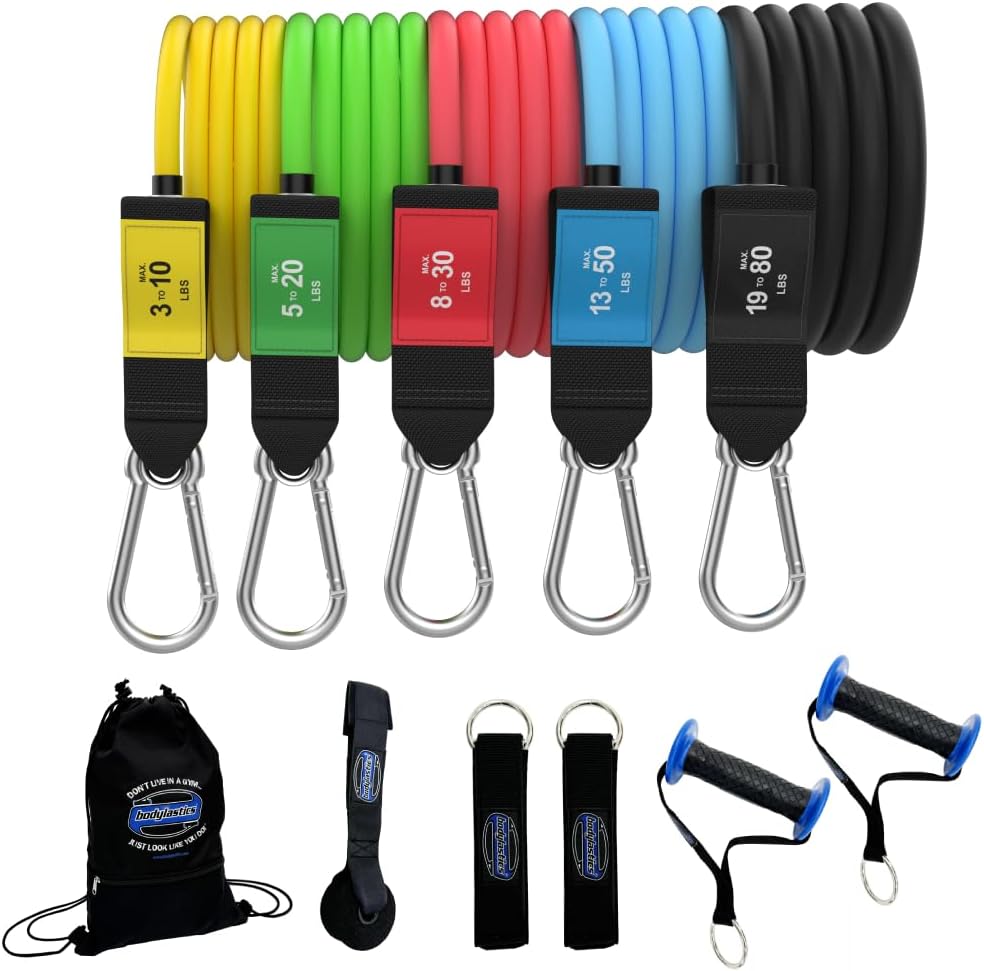
Bodylastics Stackable Tube Bands
7-tube stackable set to 96 lbs with internal safety cords. Includes door anchor, handles, and ankle straps.
The Bodylastics Tube Bands set includes seven stackable tubes (3, 5, 8, 13, 19, 23, 25 lb) combinable up to roughly 96 lb of resistance, plus a door anchor, foam handles, and ankle straps. The defining safety feature is the internal safety cord threaded through each tube — if the latex snaps under load, the cord catches the force and prevents the band from whipping back. This is specific to Bodylastics and absent in most competitor tube sets. The door anchor pad is larger and stitched to distribute load across more of the pad face, which matters when stacking multiple tubes to high resistance. The clip-and-handle system maps cleanly to dumbbell substitutes for full push-pull-legs programming.
Pros
- ✓Internal safety cord prevents whip-back if latex snaps under load
- ✓Seven stackable tubes combine to roughly 96 lb of resistance
- ✓Larger stitched door anchor pad distributes load reliably at high stacks
- ✓Maps cleanly to dumbbell-substitute push-pull-legs programming
Cons
- ✗Carabiner clips can wear out before the tubes themselves
- ✗Higher price than tube sets without internal safety cords
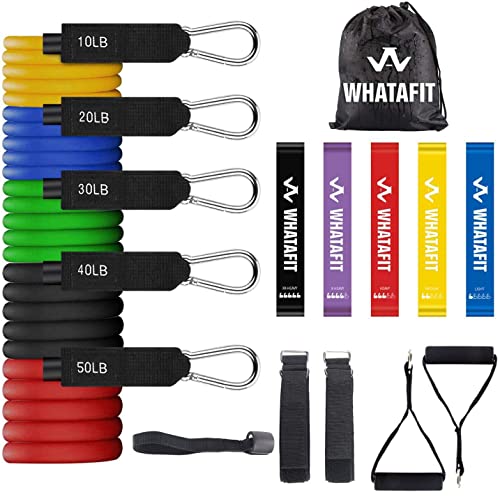
Whatafit Resistance Bands Set
5-tube stackable set to 150 lbs combined. Complete kit with carry bag. Best value for full home gym replacement.
The Whatafit Resistance Bands kit covers a 5-tube stackable set rated to a combined 150 lb with handles, door anchor, ankle straps, and carry bag — the most complete home-gym-replacement kit per dollar in this comparison. The 150 lb combined ceiling is higher than the Bodylastics 96 lb and brings band-only training into territory that previously required dumbbells. The honest trade-off is the absence of an internal safety cord — a snap under heavy stack will recoil at full velocity, so position yourself accordingly during heavy work. The door anchor is a simpler foam-and-strap design than Bodylastics, which concentrates load at the strap attachment rather than distributing across the pad. Adequate for the resistance ranges most home users actually run, just not as forgiving at the upper end.
Pros
- ✓5-tube stackable set rated to 150 lb combined — highest in this comparison
- ✓Complete kit with handles, door anchor, ankle straps, and carry bag
- ✓Best value per dollar for full home-gym-replacement use
- ✓Tube format maps cleanly to dumbbell-substitute exercises
Cons
- ✗No internal safety cord — snap under load recoils at full velocity
- ✗Simpler door anchor concentrates load at the strap attachment point

TheraBand Resistance Bands
Physical therapy grade flat bands in 6-yard rolls. Clinical resistance standard for rehab and shoulder work.
TheraBand Flat Bands are the clinical standard for resistance in physical therapy, with a force-elongation curve standardized across production batches and a color progression (yellow, red, green, blue, black, silver) documented in peer-reviewed exercise therapy literature. Approximate force ranges from 0.5 to 7.5 kg at 100% elongation across the six colors. For shoulder rehab specifically the flat format has practical advantages: you adjust grip distance along the band to fine-tune resistance more precisely than swapping tubes, and the band wraps around the forearm for stabilized wrist exercises that tube handles preclude. The ceiling is low by design — TheraBand exists for rehabilitation and muscle re-education, not progressive strength loading.
Pros
- ✓Clinical standard for physical therapy and rehabilitation protocols
- ✓Force-elongation curve standardized across production batches
- ✓Flat format wraps around the forearm for stabilized wrist exercises
- ✓Color progression documented in peer-reviewed exercise therapy literature
Cons
- ✗Ceiling is low by design — outgrown quickly for strength training
- ✗No handles or clips — cuts into bare hands during longer sets

WODSKAI Pull-Up Assistance Bands
Large 41-inch latex loops for pull-up assist and heavy compound banding. Multiple widths sold separately.
WODSKAI Pull-Up Bands are 41-inch latex loops sold in multiple widths for pull-up assistance, accommodating resistance, and heavy compound banding. The width progression — from 1/2 inch (5–35 lb) up through 1-3/4 inch (65–175 lb) — gives a structured ladder for moving from maximum-assist pull-ups to unassisted reps. A 70 kg beginner using the 1-3/4 inch band gets roughly 65–80 lb of assistance, effectively pulling 30–35 kg of bodyweight — enough to complete reps with good form. The same loops also work for accommodating resistance over a barbell, banded deadlifts, and Romanian deadlift banding. Heavier widths carry more stress per square millimeter, so inspect for surface whitening before each session.
Pros
- ✓41-inch loops cover pull-up assist, accommodating resistance, and compound banding
- ✓Width progression provides a structured ladder to unassisted pull-ups
- ✓Assist most where you need it most — at the bottom of the pull
- ✓Heaviest widths suit accommodating resistance on barbell deadlifts and squats
Cons
- ✗Heavier widths carry more stress per area — inspect for whitening before each session
- ✗Sold separately by width — full progression requires multiple purchases
Which one is right for you?
For glute and hip activation
Fit Simplify Resistance Loop Bands
Loop geometry keeps resistance in the exact movement plane for clamshells, bridges, and lateral walks.
For safety-focused stackable training
Bodylastics Stackable Tube Bands
Internal safety cord through each tube catches a latex snap and prevents whip-back under heavy stacks.
For full home-gym replacement on a budget
Whatafit Resistance Bands Set
Most complete kit per dollar with the highest 150 lb combined resistance ceiling in this comparison.
For shoulder and rotator-cuff rehab
TheraBand Resistance Bands
Clinical standard with standardized force-elongation curve and a flat format that wraps around the forearm.
For pull-up progression and barbell banding
WODSKAI Pull-Up Assistance Bands
41-inch loops give the most assist at the bottom of the pull where you need it, with a structured width ladder.
Loop vs tube vs flat band: which type for which exercise
Mini loop bands (Fit Simplify's 12-inch format) stay around the thighs or ankles and create constant lateral tension during hip abduction, clamshells, side-lying leg raises, and glute bridges. The loop geometry means the band cannot slip off mid-movement and the resistance applies in the exact plane of the exercise. The weakness is range: a 12-inch loop cannot reach from a door anchor to your hands for a chest press or row without becoming a distorted, twisting mess. Mini loops are right for lower-body activation and warm-up work and wrong for anything that requires a full pressing or pulling range of motion.
Full-length loop bands (WODSKAI's 41-inch format) bridge the gap. A 41-inch loop can be stepped on at both ends for a banded deadlift, looped around a pull-up bar for assistance, placed over a barbell for accommodating resistance, or anchored at a door to simulate cable pulls. The large loop also works for overhead press and Romanian deadlift banding where the band needs to travel from the floor to shoulder height. The trade-off is that full-length loops are bulkier and heavier than mini loops and the resistance profile — the force curve increases as the band stretches further — is harder to standardize across exercises because the starting position varies.
Stackable tube bands (Bodylastics, Whatafit) use a handle-and-clip system that most closely mimics dumbbell and cable machine mechanics. You clip one or more tubes to a pair of foam handles, attach the other ends to a door anchor or ankle straps, and press or pull with a fixed grip. The handle format means the resistance is consistent along the pulling axis and the exercise mechanics map cleanly to dumbbell substitutes: tube bicep curls feel like dumbbell curls, tube chest press from a door anchor approximates cable fly mechanics. The limitation is that the handle clips add failure points, the door anchor loading is asymmetric for bilateral movements, and stated resistance in lbs is a nominal figure measured at a standardized 200% elongation — your actual training resistance depends on how far you stretch the tube in each exercise.
Flat therapy bands (TheraBand) are cut from continuous rolls and have no handles, clips, or loops. You grip the band directly, tie it to a bedpost or table leg, or wrap it around your forearm for wrist rehabilitation. The flat format is versatile precisely because of this simplicity — a physical therapist can cut a 60-cm section for shoulder external rotation work, a 90-cm section for seated row rehabilitation, and a 120-cm section for ankle dorsiflexion, all from the same roll. The limitation is that flat bands twist under load unless you maintain careful alignment, they cut into bare hands during longer sets, and the resistance ceiling is low by design — TheraBand's clinical purpose is rehabilitation and muscle re-education, not progressive strength loading.
Resistance levels and progression: what the color codes actually mean in lbs and kg
Resistance band color coding is inconsistent across manufacturers. Fit Simplify's yellow band at 2–4 lbs (0.9–1.8 kg) is lighter than TheraBand's yellow at roughly 1–2 kg of force at full extension — both systems use yellow for their lightest band, but the force profiles differ because mini loop bands stretch across a fixed shorter distance while flat therapy bands can be stretched to varying lengths depending on the exercise. Never assume two brands' same color means the same resistance.
Fit Simplify's five-band set covers 2–30 lbs in five steps (yellow 2–4 lbs, red 4–6 lbs, black 10–12 lbs, purple 15–20 lbs, blue 25–30 lbs). The gaps between bands are not uniform — there's a 4–8 lb jump from red to black — which means the progression is not smooth and intermediates may find the red too easy and the black too hard for glute isolation work without modifying body position. That is normal for mini loop sets and most users compensate by using the purple for most glute exercises rather than cycling through all five.
Stackable tube bands solve the progression problem by letting you combine tubes. Bodylastics' seven tubes (3, 5, 8, 13, 19, 23, 25 lbs) can be stacked in combinations for most whole-number resistance values up to 96 lbs, with 1-lb increments achievable in the lower ranges. The practical progression for a beginner: start with the 3 and 5 lb tubes for basic movements (8 lbs combined), add the 8 lb tube as you get stronger (16 lbs combined), then the 13 lb tube for compound movements (29 lbs combined). For experienced lifters trying to replicate a 30-lb dumbbell bicep curl, the closest Bodylastics stack is the 3+5+8+13 combination (29 lbs) — close but not exact, and the feel differs from a dumbbell because the resistance increases as you contract further into the curl rather than staying constant.
TheraBand's clinical color progression covers approximately 0.5–7.5 kg (1–17 lbs) of force across six colors (yellow, red, green, blue, black, silver) measured at 100% elongation (doubled length). This is the lightest ceiling of the five products compared and by design — TheraBand's intended population is rehabilitation patients regaining function, not strength athletes. If you are using TheraBand for shoulder rehab at 2–3 kg force and then want to transition to strength training, you will outgrow the silver band and need to move to tube bands or free weights.
Latex durability and snap risk: how to inspect and when to replace
All five products use natural or synthetic latex, and all latex bands degrade over time. The primary degradation mechanisms are UV exposure (breaks down the polymer chains), ozone exposure (from electric motors, ozone generators, city smog), sweat contact (salt and acids degrade latex surface), and mechanical fatigue (repeated stretching creates micro-tears that propagate). Understanding these mechanisms tells you where to store bands and what to inspect.
Surface cracks are the primary visual indicator of a band approaching failure. Run a finger along the full length of any loop or tube and look for white surface cracks that appear when you flex the material — these are called stress whitening and indicate the latex is beginning to fail. A brand-new band shows no whitening under flexion; a band six months into heavy use may show minor whitening at the highest-stress points (the ends of a mini loop where it contacts the skin, the area just above the connector crimp on tube bands). Replace any band that shows whitening across more than 20–30% of its surface or any crack deeper than surface-level.
Storage matters more than most band instructions emphasize. Keeping bands in a gym bag in direct sunlight through a car window accelerates degradation by several months. The safest storage is a dark drawer at room temperature, not coiled tightly around a hook (which maintains stress at the bend point), and away from rubber-degrading substances — oils, petroleum jelly, and citrus-based cleaners all attack latex. WODSKAI's large loop bands deserve specific attention: the bands under highest tension (the 1-3/4 inch width rated at 65–175 lbs) carry more stress per square millimeter of cross-section during pull-up assist work and should be inspected before every session, not quarterly.
For tube bands, inspect the crimp connections at each end. The crimp is where the rubber tube is mechanically attached to the carabiner clip or handle adapter, and it concentrates stress at a single point. Bodylastics' anti-snap design threads an internal safety cord through each tube — if the latex snaps, the cord catches the load and prevents the band from whipping back. This design is specific to Bodylastics and is a genuine safety feature absent in most competitor tube bands, including Whatafit. The Whatafit set has no internal safety cord, so a snap under load will recoil at full velocity.
Door anchor and attachment systems: what fails and what does not
A door anchor is a flat pad with a strap loop attached. You close it in a door hinge-side (not the latch side — the hinge side handles the load better), and the closed door presses the pad against the door frame, creating a friction anchor point. The loading direction matters: the anchor holds best when you pull away from the door perpendicular to the hinge axis. Pulling at a steep downward or upward angle stresses the door frame edge and can damage door trim over time, and if the door opens toward you during a set, you absorb all the band resistance plus the door momentum.
Bodylastics and Whatafit both include door anchors, but the construction quality differs. Bodylastics' anchor pad is larger (about 8 × 5 cm padded nylon) and uses a stitched loop that distributes force across the full pad width. Whatafit's anchor is a simpler foam pad with a nylon strap that concentrates load at the strap attachment point. Both are adequate for the resistance ranges stated, but the Bodylastics anchor holds more reliably when stacking multiple tubes to high resistance (60–96 lbs) because the force distribution across the pad face reduces shear on the door frame edge.
For exercises where a door anchor is wrong — overhead press (door anchors limit height), lateral raises (angle is awkward), floor-based glute work — tube bands without an anchor become free-standing by standing on the tubes. Stand on the tubes with both feet, hold the handles, and press or row. This works well for bicep curls, shoulder press, upright row, and lateral raise with tube bands but is impossible with flat therapy bands and mechanically awkward with large loop bands because the loop puts the resistance off-center unless you stand precisely at the midpoint.
Ankle straps included with Bodylastics and Whatafit open up lower-body cable work that mini loops cannot replicate — cable kickbacks, standing hip abduction with ankle attachment, kneeling hip extension, and hip flexor work. The ankle strap quality on both sets is adequate but not exceptional: the velcro weakens after 6–12 months of regular use and the D-ring can develop minor looseness at the stitching. Replacement ankle straps from either brand are available inexpensively and worth keeping on hand once the originals start showing velcro wear.
Rehab and physical therapy applications: TheraBand versus general resistance bands
TheraBand bands are specified in clinical exercise protocols for a reason: the force-elongation curve is standardized across production batches, the color progression is consistent and documented in peer-reviewed exercise therapy literature, and the band material has a decades-long safety record in institutional physical therapy settings. When a physiotherapist prescribes 'green TheraBand, 15 reps of shoulder external rotation at 90-degree abduction,' both the therapist and patient have a common reference point for resistance load. The other four products in this comparison lack that clinical standardization.
For shoulder rehabilitation specifically, the flat band format has practical advantages. Shoulder external rotation with a flat band lets you control the distance from the anchor and therefore the resistance more precisely than tube bands, because you adjust grip position along the band rather than changing to a different tube. The flat band also wraps around the forearm for stabilized wrist extension and flexion exercises, which tube handles prevent. For rotator cuff strengthening, scapular stabilization exercises, and post-shoulder-surgery range-of-motion work, a roll of TheraBand (or a set of pre-cut lengths in several colors) is more clinically appropriate than a tube band set.
For knee rehabilitation — quadriceps strengthening after ACL reconstruction, IT band stretching, VMO activation — mini loop bands like Fit Simplify's set are standard. Terminal knee extension with a mini loop band placed just above the knee is a direct and accessible rehabilitation exercise, and the short loop format positions the band where resistance needs to be without requiring an anchor. Physical therapists routinely send patients home with a set of mini loop bands after knee surgery precisely because the format is simple, low-risk, and targeted.
The distinction between rehab and performance training matters for what you buy. TheraBand and mini loop sets are appropriate if your primary goal is injury recovery or mobility maintenance. Stackable tube sets and large loop bands are appropriate if your primary goal is replacing free weights or building strength. Using a TheraBand silver band (7.5 kg max) for barbell assistance training is undershooting the load; using a 50-lb Whatafit tube for post-surgical shoulder rehab is potentially injuring yourself on the re-injury.
Full-body band workout structure: building a coherent program from one or two sets
A tube band set with door anchor and ankle straps covers the full body in a push-pull-legs structure. Pull day: face pull (door anchor at head height), seated row (anchor at waist height, sit on floor), bicep curl (stand on tubes), rear delt fly (anchor at chest height, both arms). Push day: chest press (anchor at chest height behind you, arms forward), overhead press (stand on tubes, press up), lateral raise (stand on tubes, raise to side), tricep pushdown (anchor above head, press down). Legs: banded squat (stand on tubes, goblet position), Romanian deadlift (stand on tubes, hinge), hip thrust (mini loop above knees, bridge), lateral walk (mini loop at ankles). This covers eight major movement patterns with a Bodylastics or Whatafit set.
The resistance progression challenge is that band resistance increases through the range of motion, unlike dumbbells which maintain constant load. For exercises where the hardest position is at end range (bicep curl at full contraction, lateral raise at 90 degrees), bands are accommodating — the hardest mechanical position happens to be the highest resistance point. For exercises where the hardest position is at the start of the movement (squat at the bottom, deadlift off the floor), bands are the opposite of accommodating and actually make the movement easier where it should be hardest. This can be corrected by shortening the band (stand wider on tube bands, use a shorter loop band) so the band is already under significant tension at the movement start.
For pull-up progressions with WODSKAI large loops, the standard protocol is: week 1–2 use the 1-3/4 inch (heaviest assistance, 65–175 lbs) for all reps until you can complete 3 sets of 5 with control, week 3–4 move to the 1-1/8 inch (50–125 lbs), continue reducing assistance until you reach the 1/2 inch (5–35 lbs) and can perform unassisted reps. The specific timing of band progression depends on your body weight and starting strength, but the principle — reduce assistance by moving to a thinner band once three sets feel comfortable — applies universally. Do not jump from maximum-assist bands to unassisted; use the 7/8 inch intermediate width as a bridge.
Combining band types in a single session is more effective than any single type alone. A practical combination: start with Fit Simplify mini loops for a 10-minute glute and hip activation warm-up (clamshells, lateral walks, glute bridges), then move to the Whatafit tube set for the main strength circuit (chest press, rows, shoulder press, deadlift), finish with TheraBand flat bands for rotator cuff accessory work and any rehabilitation-focused exercises. This covers activation, strength loading, and structural balance in under 45 minutes without a single piece of gym equipment beyond a door and the bands themselves.