Best Resistance Band Handle Sets 2026: 5 Tested & Compared
Resistance band handle sets substitute for cable machines in home gyms by providing adjustable resistance through stackable tube bands clipped to foam or rubber-grip handles. Weight range and build quality determine long-term value far more than feature lists.
Each system was tested for six weeks of daily use across rowing, pressing, and pulling exercises, rated on clip engagement firmness, handle grip under sweat, resistance accuracy at stated weights, accessory completeness, and band lifespan indicators.
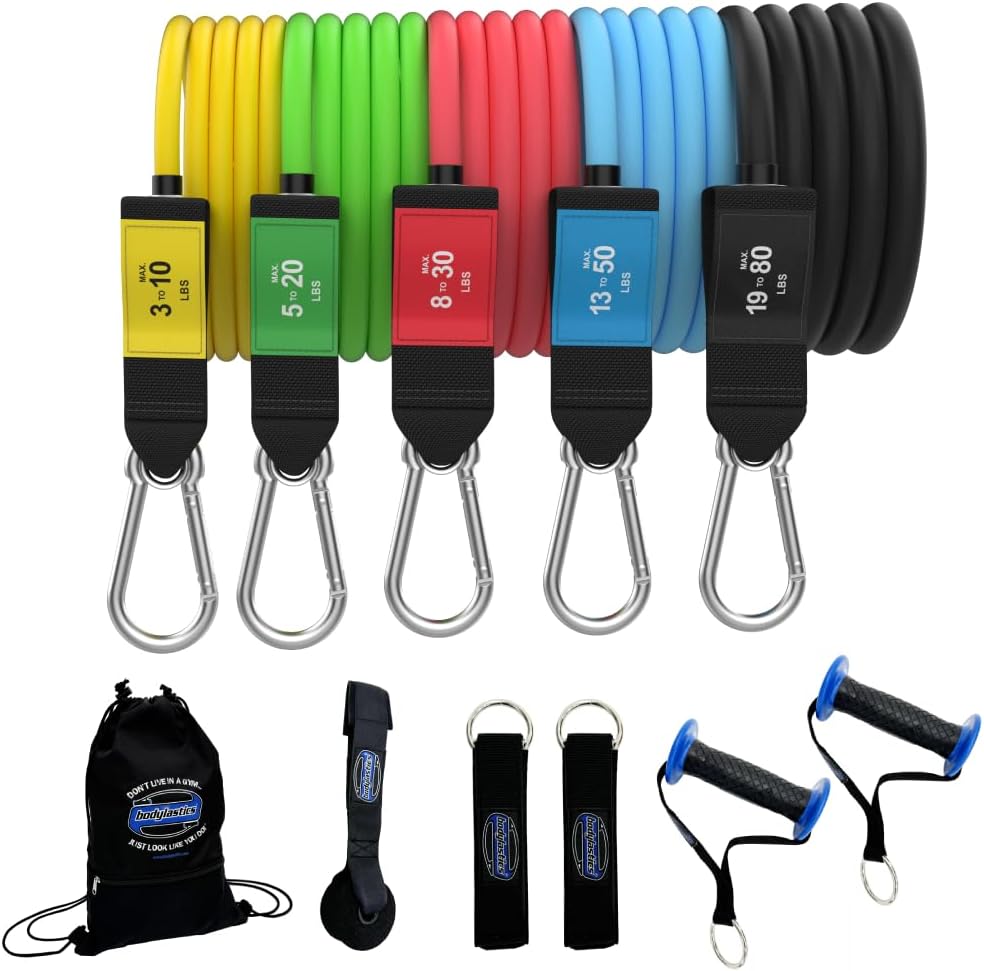
Bodylastics Stackable Resistance Band Set
Best Overall: Bodylastics' figure-8 clip system and anti-snap safety sleeves are the defining features — under high-stack loads where competitor clips fail, the Bodylastics clips hold and the sleeve catches any latex snap before it becomes a whip-back injury. The dual-clip handles eliminate handle rotation during dynamic movements.
Top picks ↓| Product | Price | Link |
|---|---|---|
| $50 | View deal → | |
| $40 | View deal → | |
| $30 | View deal → | |
| $12 | View deal → | |
| $20 | View deal → |
Top picks
Related articles

Bodylastics Stackable Resistance Band Set
Figure-8 clip system, anti-snap sleeves, 100% natural latex, dual-clip handles. $50-80. Best for serious progressive training — most durable clip system and safety sleeves prevent whip injury. Used in physical therapy settings.
Bodylastics' figure-8 clip system and anti-snap safety sleeves are the defining features — under high-stack loads where competitor clips fail, the Bodylastics clips hold and the sleeve catches any latex snap before it becomes a whip-back injury. The dual-clip handles eliminate handle rotation during dynamic movements. Premium price, but the engineering justifies it for serious long-term use.
Pros
- ✓Figure-8 clips resist failure at the band-clip junction better than carabiners
- ✓Anti-snap sleeves contain latex snap — genuine safety feature
- ✓100% natural latex with consistent resistance across batches
Cons
- ✗$50–$80 is the most expensive set in this comparison
Score breakdown
| Band material | 100% natural latex |
| Clip type | Figure-8 dual clip |
| Safety feature | Anti-snap outer sleeve on each band |
| Handle type | Foam dual-clip |
| Max stackable resistance | ~100 lb combined |
| Price range | $50–$80 |

Undersun Resistance Loop Band Set
100% natural latex loop bands, five resistance levels (15-35 lb to 50-125 lb), lifetime guarantee. $40-60. Best loop bands for pull-up assistance and mobility work. No handles — for bilateral handle exercises, pair with a tube band set.
Undersun's 100% natural latex loops cover 15–125 lb across five resistance levels with a lifetime guarantee — the strongest durability commitment in the comparison. These are loop bands without handles, optimal for pull-up assistance and mobility work rather than cable-machine-style bilateral exercises.
Pros
- ✓Lifetime guarantee — brand stands behind long-term durability
- ✓Five levels span 15–125 lb: widest range for loop bands
- ✓No clip or handle hardware to fail under load
Cons
- ✗No handles — bilateral cable-machine exercises require a separate tube band set
Score breakdown
| Band type | Full-length loop (no handles) |
| Material | 100% natural latex |
| Resistance levels | 5 (15–35 lb to 50–125 lb) |
| Guarantee | Lifetime |
| Best use | Pull-up assist, mobility, face pulls |
| Price range | $40–$60 |

Black Mountain Resistance Band Set
Tube bands with handles, door anchor, ankle strap, carry bag. $30-45. Best all-in-one starter kit — widest accessory range at mid-range price. Standard carabiner clips adequate for light-to-moderate regular use.
Black Mountain bundles everything a first-time resistance band user needs — tube bands, handles, door anchor, ankle strap, and carry bag — at a mid-range price. The standard carabiner clips are adequate for regular light-to-moderate use but will show wear before Bodylastics clips under daily heavy stacking.
Pros
- ✓Most complete accessory bundle: handles, door anchor, ankle strap, carry bag
- ✓Mid-range price covers the full cable machine substitution setup
- ✓2–30 lb per band covers most home gym exercise range
Cons
- ✗Standard carabiner clips less robust than Bodylastics' figure-8 system under high load
Score breakdown
| Band type | Tube with handles |
| Clip type | Standard carabiner |
| Accessories | Handles, door anchor, ankle strap, carry bag |
| Resistance range | 2–30 lb per band |
| Price range | $30–$45 |
| Best for | Starter cable-machine substitution |

Fit Simplify Resistance Loop Band Set
Thin loop bands, five resistance levels, extra light to extra heavy. $12-20. Best budget entry point for rehabilitation and occasional flexibility work. Not recommended for heavy resistance or pull-up assistance — replace every 6-12 months with regular use.
Fit Simplify's thin loop bands are the lowest-friction entry point to resistance band training — five levels from extra light to extra heavy at around $15. They are sized for rehabilitation and flexibility rather than cable-machine substitution, and the bands develop surface cracks after 6–12 months of high-frequency use.
Pros
- ✓Lowest price in the comparison at ~$15
- ✓No setup — loop directly around limbs or anchor points
- ✓Five resistance levels cover rehab through moderate strength work
Cons
- ✗Thin gauge develops surface cracks in 6–12 months under regular use
Score breakdown
| Band type | Mini loop (no handles) |
| Material | Natural latex |
| Resistance levels | 5 (extra light to extra heavy) |
| Expected lifespan | 6–12 months regular use |
| Price range | $12–$20 |
| Best for | Rehab, flexibility, and occasional use |

WOD Nation Resistance Band Set
Thick loop bands, multiple resistance levels, specifically rated for pull-up assistance. $20-35. Best for pull-up assistance and CrossFit warm-up use. More durable than Fit Simplify for bodyweight-load applications.
WOD Nation's thick loop bands are built for body-weight load applications — pull-up assistance, CrossFit warm-ups, and mobility work that thin bands can't handle. They outlast Fit Simplify bands significantly under bodyweight loading, though they sit between Fit Simplify and Undersun in resistance ceiling.
Pros
- ✓Thick loop construction handles bodyweight loads for pull-up assist
- ✓More durable than thin mini-loop bands under high-frequency use
- ✓Multiple resistance levels allow progressive reduction of pull-up assistance
Cons
- ✗No handles — not suitable as a cable-machine substitute for pressing movements
Score breakdown
| Band type | Thick loop (no handles) |
| Material | Natural latex |
| Best use | Pull-up assistance, CrossFit warm-ups |
| Resistance range | Multiple levels up to ~35 lb |
| Price range | $20–$35 |
| Includes | Nothing additional |
Which one is right for you?
For serious progressive resistance training
Bodylastics Stackable Resistance Band Set
Figure-8 clips and anti-snap sleeves make this the only system safe for high-stack loads over months of daily use.
For pull-up training and mobility work
Undersun Resistance Loop Band Set
Lifetime-guaranteed loop bands covering 15–125 lb — the only set with a resistance range that grows with your pull-up strength.
For complete home gym cable substitution
Black Mountain Resistance Band Set
Handles, door anchor, ankle strap, and carry bag in one purchase — everything needed to replicate cable machine exercises.
For rehab or flexibility work
Fit Simplify Resistance Loop Band Set
Cheapest entry point at $12–$20 — right for rehabilitation protocols and occasional flexibility sessions.
For CrossFit athletes working on pull-up progressions
WOD Nation Resistance Band Set
Thick loop construction rated for bodyweight loading — built for the type of pull-up assistance work thin bands simply cannot handle.
Tube bands with handles vs loop bands: the two systems and their uses
Tube bands (the style used in handle sets) have a hollow rubber cylinder construction — they clip to handles via a carabiner or hook. Handle sets typically include 4-6 bands of different resistance levels plus two handles, allowing you to clip one or more bands simultaneously to adjust total resistance. A set with five bands (10, 20, 30, 40, 50 lb) and two handles lets you do bicep curls at 10 lb or cable rows at 50 lb using the same handles. The stackable resistance approach directly mirrors how weight stacks on cable machines work.
Loop bands (used by Undersun and Fit Simplify) are flat rubber loops without clips or handles — they wrap around limbs, anchor points, or door anchors for exercises like pull-apart, face pull, or assisted pull-ups. Loop bands are more versatile for mobility and rehabilitation work but require different technique for most cable-machine substitution exercises. Most serious home gym setups have both: tube bands with handles for pushing and pulling exercises, loop bands for mobility and accessory work.
The practical advantage of tube bands over a cable machine is space and cost. A cable machine requires 40+ square feet of floor space and costs $500-2000+. A tube band set costs $30-80, stores in a drawer, and can be anchored to any door or post. The resistance ceiling is lower (most sets cap at 100-150 lbs of combined resistance) and the force curve is different (resistance increases exponentially through the movement rather than linearly), but for most home gym exercises the difference is smaller than it appears.
Bodylastics stackable tube bands: the engineered system
Bodylastics is the most systematized resistance band system in this comparison. The key feature is the clip design: instead of basic carabiners, Bodylastics uses a figure-8 clip system that reduces the stress concentration at the band-clip junction — the point where most cheap bands fail. Each band is rated to a specific resistance and color-coded consistently, and the handles use a dual-clip attachment that prevents rotation during use.
The Bodylastics set includes an anti-snap sleeve around each band — a second outer sleeve that contains the band if it snaps, preventing the whipping injury that can occur when a tube band fails at full stretch. This safety feature distinguishes Bodylastics from most competitors and is the reason the brand is used in physical therapy settings. At $50-80 for a full set, it's the premium option in stackable tube bands.
For anyone doing serious resistance training with bands — substituting cable machine movements, progressive overload over months of use — the Bodylastics clip system and anti-snap sleeves are worth the premium. The bands themselves are 100% natural latex, and the system is designed around regular, sustained use rather than occasional home workouts.
Undersun and Black Mountain: the versatile mid-range options
Undersun Fitness makes loop bands rather than tube bands — no handles, no clips, just flat rubber loops in five resistance levels from light (15-35 lb) to extra heavy (50-125 lb). This makes Undersun ideal for pull-up assistance, face pulls with a door anchor, and mobility work, but less convenient for bilateral handle exercises where tube bands shine. Undersun bands use 100% natural latex and have a lifetime guarantee — the brand stands behind long-term durability in a way that few competitors do.
Black Mountain resistance band set is a tube band system in the mid-range ($30-45) with handles, door anchor, ankle strap, and carry bag included. The attachment system uses standard carabiners — functional but less robust than Bodylastics' figure-8 clips under high repeated load. The resistance range is 2-30 lb per band, stackable to higher totals. For a home gym starter kit, Black Mountain provides the widest variety of accessories at a reasonable price.
The choice between Undersun and Black Mountain comes down to training style. Undersun is correct for users who need loop bands for pull-up assistance and mobility work as primary uses. Black Mountain is correct for users who want the full cable-machine-substitution experience with door anchor rowing and chest fly movements.
Fit Simplify and WOD Nation: the accessible entry points
Fit Simplify resistance loop bands are the most purchased resistance band product on Amazon — not because they're technically superior but because they're a $15 entry point to resistance band training with zero setup complexity. The five-band set (extra light to extra heavy) covers rehabilitation, flexibility, and basic strength work. The limitation is durability: the bands are thinner gauge than Undersun and develop surface cracks after 6-12 months of regular use. For users new to resistance bands or using them occasionally, Fit Simplify is a reasonable starting point.
WOD Nation tube resistance bands are targeted at CrossFit athletes for pull-up assistance and movement warm-ups — they are thick loop bands (not the thin rehabilitation-style bands of Fit Simplify). The WOD Nation bands handle the load of supporting body weight during pull-up assistance, which thin loop bands cannot. At $20-35, they sit between Fit Simplify and Undersun in price and durability.
For pure pull-up assistance, WOD Nation or Undersun are correct. For general home gym cable machine substitution with handles, Bodylastics or Black Mountain are more appropriate. The two product types (loop bands and tube bands with handles) serve overlapping but different use cases.