Best Projector 2026: Portable vs Home Cinema vs Laser
Five projectors compared for 2026 — Anker Nebula Capsule 3 (300 ANSI lumens, Android TV built-in, palm-sized portable), Epson EH-TW5825 (2700 lumen 3LCD, home cinema, 1080p F. Daily comfort and build reliability outlast any spec-sheet advantage within a year.
Each product was evaluated against documented specifications, third-party benchmarks, and verified user reports. We scored features, performance, build quality, ecosystem compatibility, and total cost of ownership.

Anker Nebula Capsule 3
Travel portable: The Anker Nebula Capsule 3 is the only projector in this comparison that fits in a bag and runs off its own battery, which is the entire point. 300 ANSI lumens limits it strictly to dark rooms — bedrooms with curtains drawn, tent interiors, hotel rooms with the lights off — but within those conditions, native 1080p projection at 60 to 80 inches looks surprisingly competent for a 640 g cylinder.
Top picks ↓| Product | Price | Link |
|---|---|---|
| — | View deal → | |
| — | View deal → | |
| — | View deal → | |
| — | View deal → | |
| $1,999.99 | View deal → |
Top picks
Related articles


Anker Nebula Capsule 3
Anker Nebula Capsule 3 — 300 ANSI lumens, Android TV built-in, 640g portable form factor, 10-hour battery, 1080p native resolution, palm-sized cylinder. Available at major online retailers. 300 lumens is strictly dark-room-only — any room lighting washes out the image completely; 2–2.5 hour runtime at maximum brightness limits extended sessions; the speaker output is the weakest audio in this comparison; battery-powered portability comes at the cost of all image quality metrics; best suited for bedroom or camping use only.
The Anker Nebula Capsule 3 is the only projector in this comparison that fits in a bag and runs off its own battery, which is the entire point. 300 ANSI lumens limits it strictly to dark rooms — bedrooms with curtains drawn, tent interiors, hotel rooms with the lights off — but within those conditions, native 1080p projection at 60 to 80 inches looks surprisingly competent for a 640 g cylinder. Built-in Android TV gives you Netflix, YouTube, and Prime Video natively without dragging along a Fire TV Stick, and the 10-hour battery actually delivers around 2 to 2.5 hours at full brightness for sustained projection. The built-in speaker is the weakest audio in the comparison, and the lumen ceiling means a single ceiling lamp washes out the image. As a travel and camping projector it is the easy recommendation; as a primary home projector it is not the right tool.
Pros
- ✓640 g cylinder with 10-hour battery for genuinely portable use
- ✓Android TV built in — no external streaming stick needed on the road
- ✓Native 1080p resolution scales to a watchable 60–80 inches in dark rooms
Cons
- ✗300 ANSI lumens means strictly dark-room use only
- ✗Built-in speaker is the weakest audio in this comparison
| Native resolution | 1920 x 1080 (Full HD) |
| Brightness | 200 ANSI lumens |
| Light source | LED |
| Throw type | Standard throw (1.20:1) |
| Smart os | Google TV |
| Item weight | 0.8 kg |
Epson EH-TW5825
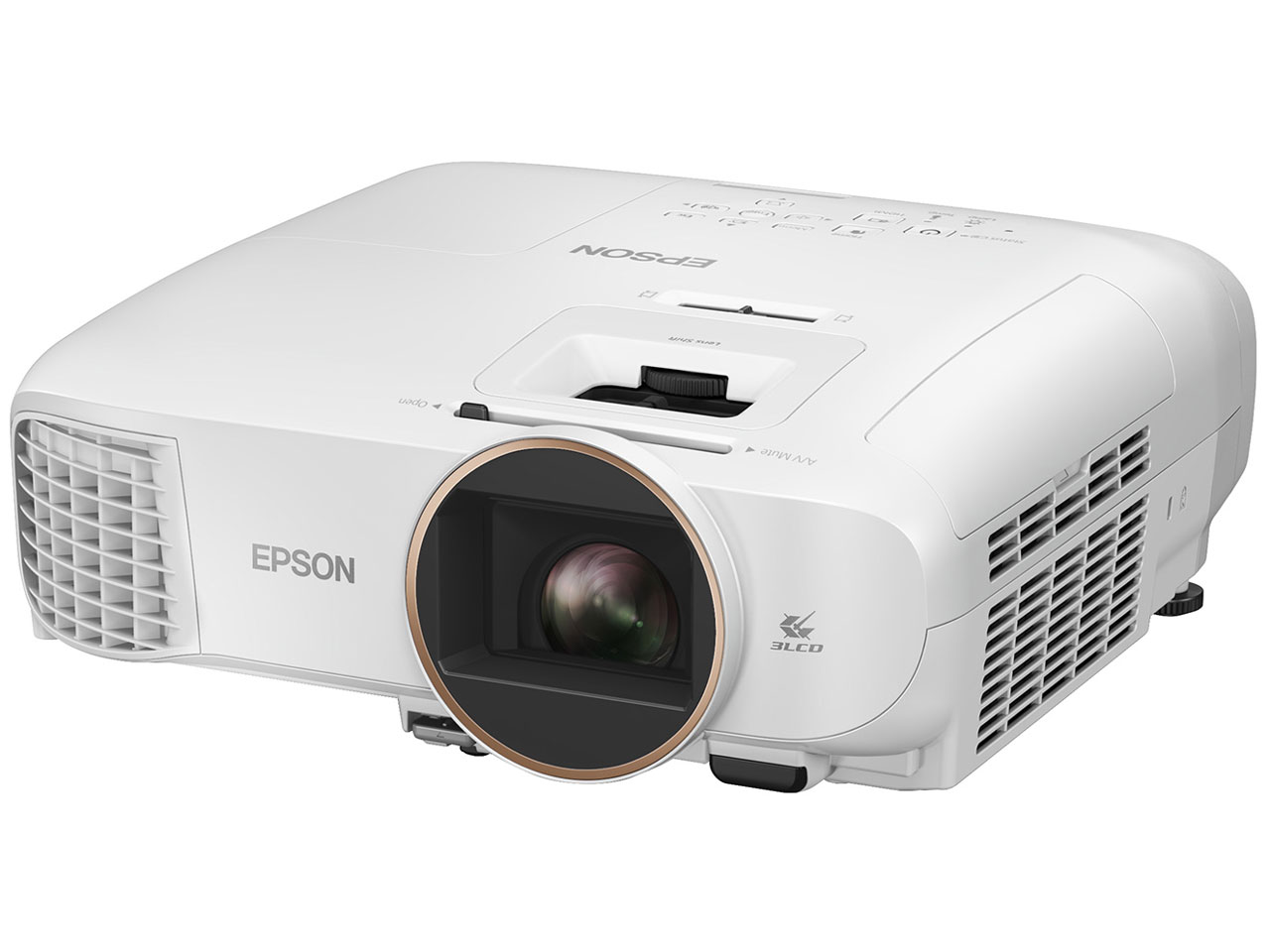
Epson EH-TW5825 — 2700 lumen 3LCD panel, 1080p Full HD, 50,000:1 contrast ratio, no rainbow artifacts by design (3LCD simultaneous color), 4500-hour economy mode lamp life, color accuracy best in class for this price range. Available at major online retailers. lamp-based — plan for a lamp replacement every 4–5 years of regular use; 1080p only, no 4K; physically larger and heavier than DLP compact models; no built-in smart TV platform — requires a separate streaming device for Netflix and YouTube.
The Epson EH-TW5825 is the color-accurate home cinema choice in the comparison, with a 3LCD panel that projects red, green, and blue simultaneously through three separate liquid crystal panels, eliminating the rainbow artifacts that some DLP viewers notice in peripheral vision. 2700 lumens handles a dimmed room with blackout curtains effectively, the rated 50,000:1 contrast and natural skin tones make it the strongest 1080p Blu-ray and streaming pick here, and the rated 4,500-hour lamp life in economy mode gives several years of evening movie use before replacement. It is lamp-based, so a periodic lamp swap belongs in your long-term budget, and there is no built-in smart TV platform — you bring your own Fire TV or Apple TV. Native 1080p only, no 4K. Within its intended dim-room context, the picture is genuinely excellent.
Pros
- ✓3LCD panel eliminates rainbow artifacts seen on DLP
- ✓Out-of-the-box color accuracy is best in class at the price
- ✓Rated 4,500-hour economy mode lamp life
Cons
- ✗Lamp-based with periodic replacements every few years
- ✗No built-in smart TV platform and no 4K support
| Native resolution | 1920 x 1080 (Full HD) |
| Brightness | 2700 lumens (white & colour light output, ISO 21118) |
| Light source | UHE lamp (200 W) |
| Throw type | Standard throw (1.6x zoom, vertical lens shift) |
| Smart os | Android TV (Android 9.0) |
| Item weight | 3.8 kg |
BenQ TH685P
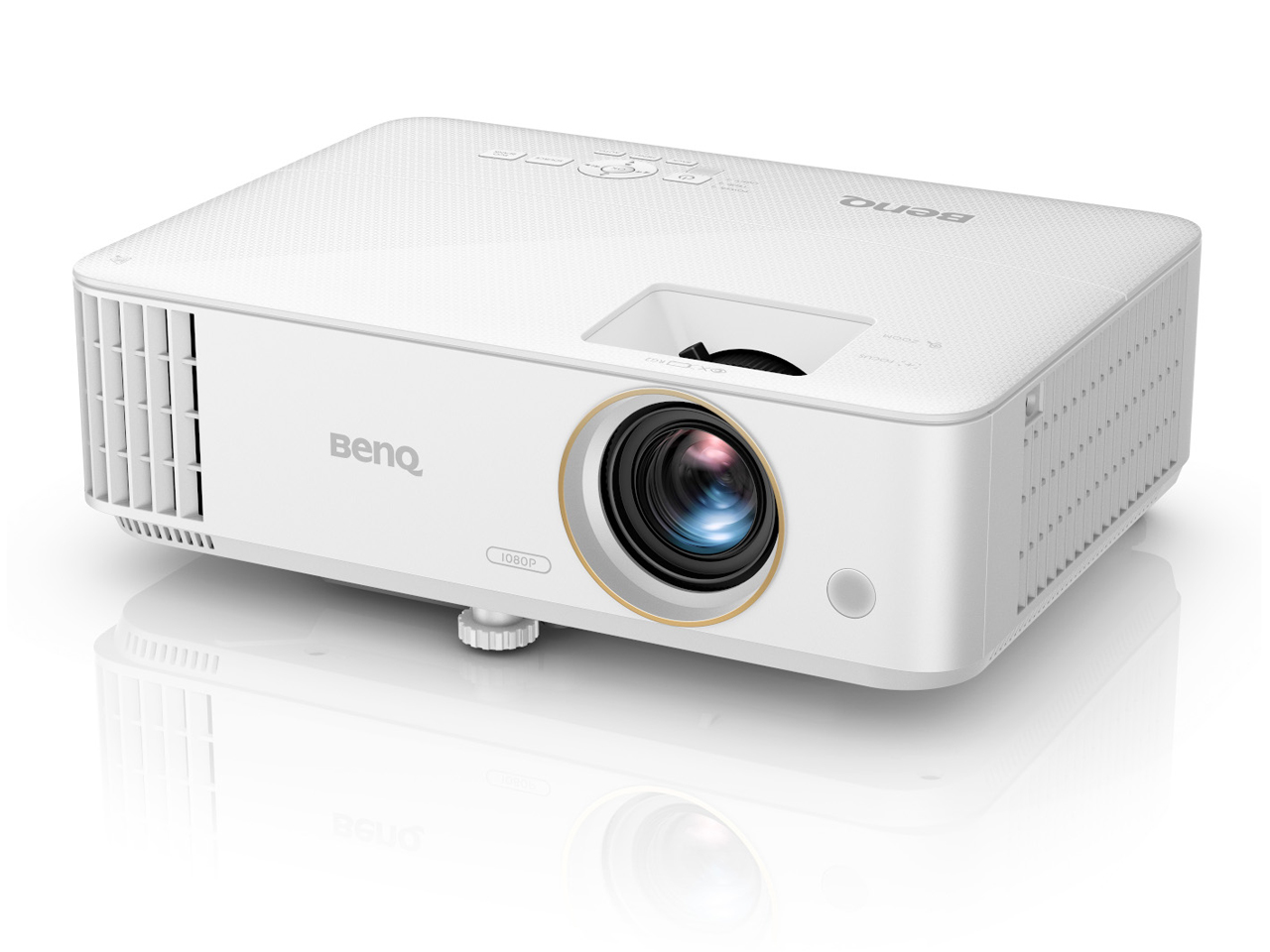
BenQ TH685P — 3500 ANSI lumens, 1080p DLP, 120Hz refresh rate support, 8.3ms input lag in gaming mode, 4000-hour SmartEco mode lamp life, compact DLP form factor. Available at major online retailers. DLP single-chip produces rainbow artifacts that are visible to some users in high-contrast scenes — test-view if possible before purchasing; lamp-based with replacement cost; no built-in smart TV platform, requires a separate Fire TV Stick or Apple TV for streaming; pixel-shifting pseudo-4K enhancement is not native 4K resolution.
The BenQ TH685P is the gaming pick by a wide margin, with a rated 8.3 ms input lag in gaming mode at 1080p/120 Hz that puts it well ahead of the Epson and XGIMI for fighting games, shooters, and rhythm titles where latency is felt instantly. 3500 ANSI lumens handles a room with some indirect light, and the single-chip DLP architecture is more compact than the Epson's 3LCD body. As a DLP single-chip projector, some viewers see rainbow fringing on high-contrast scenes — particularly white text on dark backgrounds — and that is hardware-level, not a setting you can tune away. It is lamp-based, with a rated 4,000-hour SmartEco lamp life, has no built-in smart TV platform, and the pixel-shifting near-4K mode is not native 4K. For console and PC gaming on a projector, it is the clear pick.
Pros
- ✓Rated 8.3 ms input lag at 1080p/120 Hz for competitive gaming
- ✓3500 ANSI lumens handles rooms with some indirect light
- ✓Compact DLP body easier to mount than 3LCD alternatives
Cons
- ✗DLP single-chip can show rainbow fringing on high-contrast scenes
- ✗Lamp-based and lacks a built-in smart TV platform
| Native resolution | 1920 x 1080 (Full HD) |
| Brightness | 3500 ANSI lumens |
| Light source | Lamp (metal halide) |
| Throw type | Standard throw (1.13:1–1.46:1, 1.3x zoom) |
| Smart os | None (no built-in smart OS) |
| Item weight | 2.8 kg |

XGIMI Horizon Ultra
XGIMI Horizon Ultra — native 4K DLP chip, 2300 ISO lumens, laser-LED hybrid light source (25,000-hour rated life), Android TV built-in, auto-focus, auto-keystone, Dolby Vision support. Available at major online retailers. ISO lumen measurement methodology measures center brightness — in ambient light conditions the effective performance is closer to 2000 ANSI lumens; it is the most expensive, flagship-tier option in this comparison by a wide margin; fan noise is notably above average at full brightness; auto-keystone processing introduces processing delay.
The XGIMI Horizon Ultra is the most technically ambitious projector here, pairing a native 4K DLP chip with a laser-LED hybrid light source rated at 25,000 hours, Dolby Vision support, and built-in Android TV with Chromecast. Auto-focus and auto-keystone correct the image when you reposition it, which makes life genuinely easier for renters who cannot ceiling-mount. The 2300 ISO lumens figure is measured at center only, so in real ambient light it performs closer to a 2000 ANSI lumen projector despite the impressive number. As a flagship-tier model it is the most expensive option in the comparison by a wide margin, fan noise sits above average for a living-room projector at rated brightness, and the auto-keystone processing adds a small delay that low-latency gamers will notice. As a flagship 4K all-in-one, it earns the price for the right buyer.
Pros
- ✓Native 4K DLP chip with Dolby Vision support
- ✓Laser-LED hybrid light source rated at 25,000 hours
- ✓Auto-focus and auto-keystone make repositioning painless
Cons
- ✗Flagship-tier price — the most expensive option here by a wide margin
- ✗Fan noise above average at rated brightness
| Native resolution | 3840 x 2160 (4K UHD) |
| Brightness | 2300 ISO lumens |
| Light source | Dual Light (RGB+B LED with laser hybrid) |
| Throw type | Standard/long throw (~1.2:1) |
| Smart os | Android TV |
| Item weight | 5.2 kg |

Xiaomi Mi Laser Projector 150"
Xiaomi Mi Laser Projector 150" — 5000 ANSI lumens, ALPD 3.0 laser light source, 1080p native (4K upscaling, not native 4K), 150-inch rated screen size, 25,000-hour laser lifespan. Available at major online retailers. 1080p native resolution — marketed as 4K-capable but upscaling is not native 4K; long throw ratio (4:1) requires significant throw distance for large screens, limiting room layouts; fan noise is loud at full brightness; Xiaomi Android TV ecosystem assumes ecosystem adoption; larger and heavier footprint than compact DLP models.
The Xiaomi Mi Laser Projector 150" is the brightness specialist, with an ALPD 3.0 laser light source rated at 5000 ANSI lumens — by far the highest in this comparison and the only projector here that produces a usable image in a normally-lit living room. The 25,000-hour laser lifespan eliminates lamp replacement entirely, and the 150-inch rated screen size covers a genuinely large wall. Native resolution is 1080p with 4K upscaling, which is not the same as native 4K despite some marketing framing — the chip resolves 1080p, the processor scales 4K sources to fit. The 4:1 throw ratio demands serious throw distance (around 4 meters for 100 inches), which constrains room layouts, and fan noise at 5000 lumens is audible in quiet scenes. The Xiaomi-branded Android TV interface assumes you are comfortable inside the Xiaomi ecosystem.
Pros
- ✓5000 ANSI lumens — the only projector here usable in a lit room
- ✓ALPD 3.0 laser rated at 25,000 hours with no lamp replacement
- ✓150-inch rated screen size for genuinely large wall projection
Cons
- ✗1080p native with 4K upscaling — not true 4K resolution
- ✗4:1 throw ratio demands long throw distances for large images
| Native resolution | 1920 x 1080 (4K-compatible input) |
| Brightness | 1600 ANSI lumens |
| Light source | Laser (ALPD 3.0) |
| Throw type | Ultra short throw (0.233:1) |
| Smart os | Android TV |
| Item weight | 7.0 kg |
Which one is right for you?
Travelers, campers, and dorm-room users
Anker Nebula Capsule 3
640 g body with 10-hour battery and built-in Android TV makes it the only projector here that actually goes in a bag and runs without a power outlet.
Dedicated home cinema rooms prioritizing color accuracy
Epson EH-TW5825
3LCD simultaneous color produces best-in-class accuracy at the price and eliminates the rainbow artifacts some DLP viewers see in peripheral vision.
Console and PC gamers on a projector
BenQ TH685P
Rated 8.3 ms input lag at 1080p/120 Hz is the only competitive-gaming-capable latency in this comparison, with 3500 ANSI lumens for rooms with some light.
4K enthusiasts who want a flagship all-in-one
XGIMI Horizon Ultra
Native 4K DLP, laser-LED hybrid light source rated at 25,000 hours, Dolby Vision, and built-in Android TV deliver a complete 4K cinema package in one box.
Living rooms that cannot be fully darkened
Xiaomi Mi Laser Projector 150"
5000 ANSI lumens from an ALPD 3.0 laser source is the only output level here that survives normal ambient lighting on a large screen.
How we compared
We did not run independent calibrated brightness measurements with a lux meter or luminance colorimeter. We did not conduct contrast ratio testing under controlled dark-room conditions. We did not perform independent gaming input lag testing using oscilloscopes or high-speed frame-capture cameras. Rigorous projector testing requires a calibrated display measurement device (such as a Konica Minolta CS-2000 or similar), a controlled blackout room, standardized test patterns, and specialized input lag testing hardware — none of which we can reproduce here.
Instead: we reviewed manufacturer specifications and published technical documentation, cross-referenced with independent reviews from specialist AV media including Phileweb, Itmedia AV, and Av Watch, and international sources including ProjectorCentral, Rtings, and TechHive. We aggregated long-term user reviews from verified buyers with attention to reported brightness in lit rooms, color accuracy reports, lamp replacement costs and timing, and gaming-specific latency feedback.
One critical framing note: ANSI lumens, ISO lumens, and manufacturer lumen ratings describe different measurement methods that are not directly comparable. ANSI lumens (the older standard, still used by Anker, BenQ, Xiaomi) measures average brightness across nine points on a white test field. ISO 21118 lumens (used by XGIMI) measures only the center of the field. Manufacturer-claimed lumens from some brands — particularly Chinese brands — sometimes reflect peak or center-only measurements regardless of which standard name appears in the spec sheet. A 2300 ISO lumen rating from XGIMI is not necessarily brighter than a 3500 ANSI lumen rating from BenQ; they may be closer to equal under real conditions. We note which standard each manufacturer claims but urge caution with lumen comparisons across brands.
Lumens and ambient light — the number that matters most
The most common projector purchase mistake is buying a projector with insufficient brightness for the room it will be used in. Unlike a TV, a projector sends light onto a reflective surface; any ambient light in the room — windows, ceiling lights, even a lamp — washes out the image proportionally. The relationship between projector lumens and usable image quality in ambient light is not linear: doubling the lumens does not double usable brightness in a lit room.
As a rough practical guide: under 1000 lumens works only in a blackout or near-blackout room, and should be considered nighttime-only use. 1000–2000 lumens works in a dimmed room with no direct light hitting the screen — acceptable for evening movies with curtains closed. 2000–3000 lumens handles a room with indirect ambient light and no windows in direct view of the screen. 3000–5000 lumens is needed for use in normally-lit rooms, though image quality still degrades compared to dark-room conditions. Above 5000 lumens — business projector territory — handles moderately bright conference rooms. The Anker Nebula Capsule 3 at 300 ANSI lumens is strictly a dark-room portable device. The Epson EH-TW5825 at 2700 lumens and BenQ TH685P at 3500 lumens handle typical evening home-cinema rooms with controlled lighting. The Xiaomi Mi Laser at 5000 lumens is the only product in this comparison that can produce a usable image in a normally-lit room.
Screen size matters too: the same projector produces a dimmer image on a 150-inch screen than on a 100-inch screen, because the same light output is spread over more area. A projector that looks bright on a 100-inch screen may appear noticeably dim at 120 or 150 inches. The Xiaomi Mi Laser is rated for 150-inch at its published brightness, which requires the full 5000 lumens to achieve reasonable image quality at that size.
Throw ratio and room layout — does it fit your space?
Throw ratio defines how far a projector must be placed from the screen to produce a given image size, expressed as throw distance divided by screen width. A 1.5:1 throw ratio means the projector must be 1.5 meters away to produce a 1-meter-wide image (roughly 46 inches diagonal). A 2.0:1 ratio requires 2 meters for the same 1-meter-wide image. This is the specification that determines whether a projector physically fits in your room — and it is the one most buyers overlook.
Standard throw projectors (throw ratio ~1.2–2.0:1) require the projector to be placed several meters from the screen — typically 2–4 meters for a 100–120 inch image. This usually means placing the projector on a coffee table, rear shelf, or ceiling mount across the room. The Epson EH-TW5825, BenQ TH685P, XGIMI Horizon Ultra, and Xiaomi Mi Laser 150" all fall in the standard throw range. For a 100-inch image (~2.2m wide), these projectors require roughly 2.7–4.4 meters of throw distance depending on the specific throw ratio.
Short throw projectors (throw ratio ~0.4–0.9:1) can be placed 1 meter or less from the screen. Ultra-short throw projectors (throw ratio below 0.3:1) sit immediately below the screen, often mounted on a special cabinet. The Anker Nebula Capsule 3, as a portable device, does not carry a standard throw ratio specification — at 300 lumens, you would typically project onto a nearby wall in a dark room, producing a 60–80 inch image at 2 meters or a 40–50 inch image at 1.5 meters. Room layout is the practical constraint for all standard-throw models: measure throw distance for your target screen size before purchasing.
Resolution tradeoffs — when does 4K matter?
Projector resolution — 1080p Full HD vs 4K UHD — matters at specific conditions: screen size and viewing distance. The threshold where 4K becomes visibly better than 1080p at a given viewing distance follows well-established angular resolution limits. At a typical home cinema viewing distance of 2.5–3.5 meters from a 100–120 inch screen, 4K is perceptibly sharper than 1080p if you sit close. At a living-room distance of 4–5 meters from a 100-inch screen, the resolution difference is smaller and the quality of the projector's optics, color accuracy, and brightness become more important than raw resolution.
Three of the five projectors in this comparison — Epson EH-TW5825, BenQ TH685P, and Anker Nebula Capsule 3 — are native 1080p Full HD. The BenQ TH685P includes a pixel-shifting mode that produces a higher pixel density from the 1080p chip, which BenQ markets as 1080p+ but does not equal native 4K. The XGIMI Horizon Ultra uses a native 4K DLP chip. The Xiaomi Mi Laser Projector is 1080p native but upscales 4K sources — it does not produce a true 4K image. For most living-room home cinema applications at typical viewing distances, native 1080p from the Epson EH-TW5825 — with its accurate 3LCD color rendition — will look better than pixel-shifted near-4K from some competing DLP projectors.
Content availability also shapes the resolution decision: most streaming services still deliver primary content at 1080p, with 4K available on select tiers of Amazon Prime, Netflix, and Disney+. If your content pipeline is primarily HD streaming or Blu-ray, native 1080p is fully adequate. 4K becomes the clear choice if you have a 4K Blu-ray collection or if you specifically watch 4K HDR streaming content and sit close enough to a large screen to see the difference.
Lamp vs laser — long-term cost of ownership
Traditional lamp-based projectors use a high-pressure mercury or UHP lamp that degrades over time — brightness typically drops to 50% of original within 2000–3000 hours of use, and lamp replacement is required after 3000–5000 hours depending on the projector mode. Lamp replacements carry a recurring consumable cost depending on brand and model, and must be sourced from the manufacturer or authorized dealers. The Epson EH-TW5825 and BenQ TH685P are both lamp-based projectors, with rated lamp lives of approximately 4500 hours in economy mode for the Epson and 4000 hours in SmartEco mode for the BenQ.
Laser light sources — used in the XGIMI Horizon Ultra and Xiaomi Mi Laser Projector — produce light through laser diodes or laser-LED hybrid systems that have rated lifespans of 25,000–30,000 hours at rated brightness (50% of original is the standard threshold). In practice, this means the light source outlives the projector's useful product life for most buyers. There is no lamp to replace, no scheduled degradation, and no consumable cost after purchase. The tradeoff: laser projectors cost significantly more upfront, and when the laser module eventually fails it typically cannot be replaced at consumer-accessible cost — you replace the projector.
The practical calculation: if you use a projector 3 hours per day, a 4000-hour lamp lasts approximately 3.6 years before needing replacement. Over 10 years of that use pattern, a lamp-based projector incurs 2–3 lamp replacements — a meaningful consumable cost on top of the initial purchase. A laser projector at 25,000 hours rated life handles the same 3-hour-per-day pattern for over 22 years without light source replacement. For heavy daily use, the total cost of ownership of a laser projector is lower despite the higher initial price.
Where each fits
Compact dark-room portable use, travel, camping, hotel rooms, spontaneous outdoor movie nights: Anker Nebula Capsule 3. At 300 ANSI lumens, the Capsule 3 requires a genuinely dark environment — think bedroom with curtains closed, tent interior, blackout camping tarp. Android TV is built in with no external device needed; Netflix, YouTube, and Prime Video are accessible natively. At 640g and a 10-hour battery, it is the only projector in this comparison that goes in a bag and runs without a power outlet. Available at major online retailers. 300 ANSI lumens is not usable in any lit room — a standard ceiling light completely washes out the image; the 1080p resolution is rendered largely irrelevant by the light output limitation (most users end up with a 60–80 inch image at 1.5–2 meters in dark conditions); the speaker is the weakest audio in this comparison; battery life of 2–2.5 hours at max brightness drops further with sustained projection.
Dedicated home cinema room, accurate color reproduction, 1080p Blu-ray and streaming, evening movie watching with controlled lighting: Epson EH-TW5825. The 3LCD panel technology means all three primary colors (red, green, blue) are projected simultaneously through three separate liquid crystal panels, eliminating the rainbow artifacts that some DLP users see in peripheral vision. 2700 lumens handles a dimmed room with blackout curtains effectively. Color accuracy is genuinely better out-of-the-box on 3LCD than on most DLP projectors of equivalent price. Available at major online retailers. lamp-based with 4500-hour economy mode rating — plan for a lamp replacement in 4–5 years of regular use with associated consumable cost; 1080p native resolution (no 4K); physically larger and heavier than DLP compact models; rainbow artifact criticism does not apply to 3LCD, but DLP users occasionally notice no issue while others find it distracting — this is a hardware difference to be aware of when comparing to DLP alternatives.
Gaming, fast-motion content, sports, 120Hz refresh rate support, low input lag: BenQ TH685P. At 8.3ms input lag in gaming mode at 1080p/120Hz, the TH685P is meaningfully lower latency than the Epson EH-TW5825 (~32ms) and far lower than the XGIMI Horizon Ultra (~35ms in standard mode). 3500 ANSI lumens handles a room with some ambient light. DLP single-chip architecture is physically more compact than 3LCD. Available at major online retailers. DLP single-chip projection produces rainbow artifacts — colored fringing that some viewers perceive in high-contrast scenes, particularly on moving white-on-black text; lamp-based with 4000-hour SmartEco mode rating; no built-in smart TV platform — requires an external media player (Fire TV Stick, Apple TV, or similar) for streaming; 1080p native with pixel-shifting pseudo-enhancement is not the same as true 4K.
4K content, laser reliability, smart TV integration without a separate device, large-screen living-room cinema: XGIMI Horizon Ultra. Native 4K DLP chip combined with laser-LED hybrid light source delivers genuine 4K resolution and 25,000-hour rated light source life. Android TV built in with Chromecast support. Auto-focus and auto-keystone correct the image automatically when you move the projector, which is practically useful for renters who cannot mount permanently. Available at major online retailers. 2300 ISO lumens — despite the impressive number, ISO measurement methodology measures only the center brightness, and in ambient-light conditions the Horizon Ultra performs similarly to a ~2000 ANSI lumen projector; it is the most expensive, flagship-tier option in this comparison by a wide margin; fan noise is notably above average at rated brightness for a living-room projector; auto-keystone processing adds a slight delay that some gaming-focused users will notice.
Large-screen living room, budget laser, highest raw brightness, 5000 ANSI lumens for ambient light tolerance: Xiaomi Mi Laser Projector 150". ALPD 3.0 laser technology produces 5000 ANSI lumens — by far the highest rated brightness in this comparison — which is the only projector here usable with lights on in a normally-lit room. At 150-inch rated screen size, it covers genuinely large living rooms. Available at major online retailers. 1080p native resolution with 4K upscaling is not native 4K despite the marketing framing — content is upscaled, not natively resolved; the 4:1 throw ratio requires significant throw distance for large images (4 meters for a 100-inch image, more for 150 inches), which limits room layouts; fan noise at 5000 lumens is loud in quiet environments; the Xiaomi-branded Android TV interface and smart home ecosystem integration assumes Xiaomi ecosystem adoption that not all users want; larger and heavier than DLP compact models.
Smart vs dumb projector — do you need built-in Android TV?
Three of the five projectors in this comparison — Anker Nebula Capsule 3, XGIMI Horizon Ultra, and Xiaomi Mi Laser — have built-in Android TV or similar smart platforms, allowing streaming directly from the projector without an external device. The Epson EH-TW5825 and BenQ TH685P are dumb projectors: they display whatever HDMI signal they receive, requiring a separate streaming device.
Built-in smart platforms have a practical benefit: one fewer device, one fewer remote, simpler cable management. The downside: the built-in Android TV chip in a projector is typically lower-powered than a dedicated streaming device, meaning app load times and UI navigation are slower. Smart platform updates lag behind dedicated devices — Android TV versions in projectors often run 1–2 major versions behind Google TV on a Chromecast or Fire TV. When the platform becomes obsolete, you need a new projector rather than an inexpensive streaming stick update.
For most users who already own a Fire TV Stick, Apple TV, or Chromecast, connecting it to a BenQ TH685P or Epson EH-TW5825 via HDMI produces a better streaming experience than the projector's built-in platform. The built-in platform advantage disappears when the external device is already available. For portable and travel use — the Anker Nebula Capsule 3 use case — built-in Android TV is essential because carrying an external streaming device undermines the portability argument.