Best Packing Cubes 2026: Organized, Compressed, Ready
Packing cubes don't compress clothes the way a compression bag does — but they do make repacking in a cramped hotel room at 6 a.m. something you can actually do without dumping everything on the floor.
Each set was evaluated on compression ratio (stuffed vs. unstuffed cube volume), material weight and durability, set size range (whether a small + medium + large covers a real 4-day trip), and YKK vs. generic zipper quality. Asia travel scenarios — ryokan stays, guesthouse stops, multiple-city carry-on trips — were the primary use case.

Eagle Creek Pack-It Specter Cube Set
Best Overall: Eagle Creek's Pack-It Specter line sets the weight standard for packing cubes at roughly 24 g per medium cube — the lightest construction you'll find that still uses quality YKK zippers and reinforced mesh panels. The ultralight ripstop nylon doesn't fray at corners after 30+ trips, and the two-tone design (cube body vs.
Top picks ↓| Product | Price | Link |
|---|---|---|
| 45〜75 | View deal → | |
| 45〜55 | View deal → | |
| 25〜35 | View deal → |
Top picks
Related articles


Eagle Creek Pack-It Specter Cube Set
Lightest non-compression cube at ~24 g medium. YKK zippers. Best for frequent travelers who care about cumulative bag weight.
Eagle Creek's Pack-It Specter line sets the weight standard for packing cubes at roughly 24 g per medium cube — the lightest construction you'll find that still uses quality YKK zippers and reinforced mesh panels. The ultralight ripstop nylon doesn't fray at corners after 30+ trips, and the two-tone design (cube body vs. mesh top) makes visual identification fast at security. The honest weakness: no compression mechanism, so you're organizing without gaining any compression ratio. If your carry-on is already tight, this doesn't help with volume — it helps with sanity.
Pros
- ✓Ultralight at ~24 g per medium cube
- ✓YKK zippers on all cubes
- ✓Mesh top for instant visual ID
Cons
- ✗No compression — doesn't reduce bag volume
Score breakdown
| Materials | Silnylon ripstop + mesh panel |
| Compression ratio | None (non-compression) |
| Set count | Available in 2, 3, or 6-piece sets |
| Zipper quality | YKK |
| Weight (medium cube) | ~24 g |
| Price | $44.95 (3-piece) |

Osprey Ultralight Packing Cube Set
Lifetime guarantee, snag-resistant ripstop. 3-piece set works for 4-7 day trips; add extra cubes for longer Asia itineraries.
Osprey's Ultralight cubes split the difference between Eagle Creek's ultra-minimal construction and the heftier Away cubes — slightly heavier than Eagle Creek (about 38 g per medium) but using a ripstop nylon that resists snags and abrasion more reliably across 50+ trip cycles. The mesh top panel is identical in function to Eagle Creek's. The set configuration is 3-piece, which works for 4-7 day trips but requires supplemental cubes for longer Asia itineraries. Osprey's lifetime guarantee covers manufacturing defects, which adds genuine long-term value.
Pros
- ✓Snag-resistant ripstop nylon
- ✓Osprey lifetime guarantee
- ✓Mesh top for visual identification
Cons
- ✗3-piece set undersized for 10+ day trips
- ✗Slightly heavier than Eagle Creek
Score breakdown
| Materials | Ripstop nylon + mesh panel |
| Compression ratio | None |
| Set count | 3-piece (S/M/L) |
| Zipper quality | YKK |
| Weight (medium cube) | ~38 g |
| Price | $49.95 (3-piece) |
Gonex Compression Packing Cube Set
Best compression ratio (40-60%). 4-piece set. Heavier per cube — buy for compression, not for weight savings.
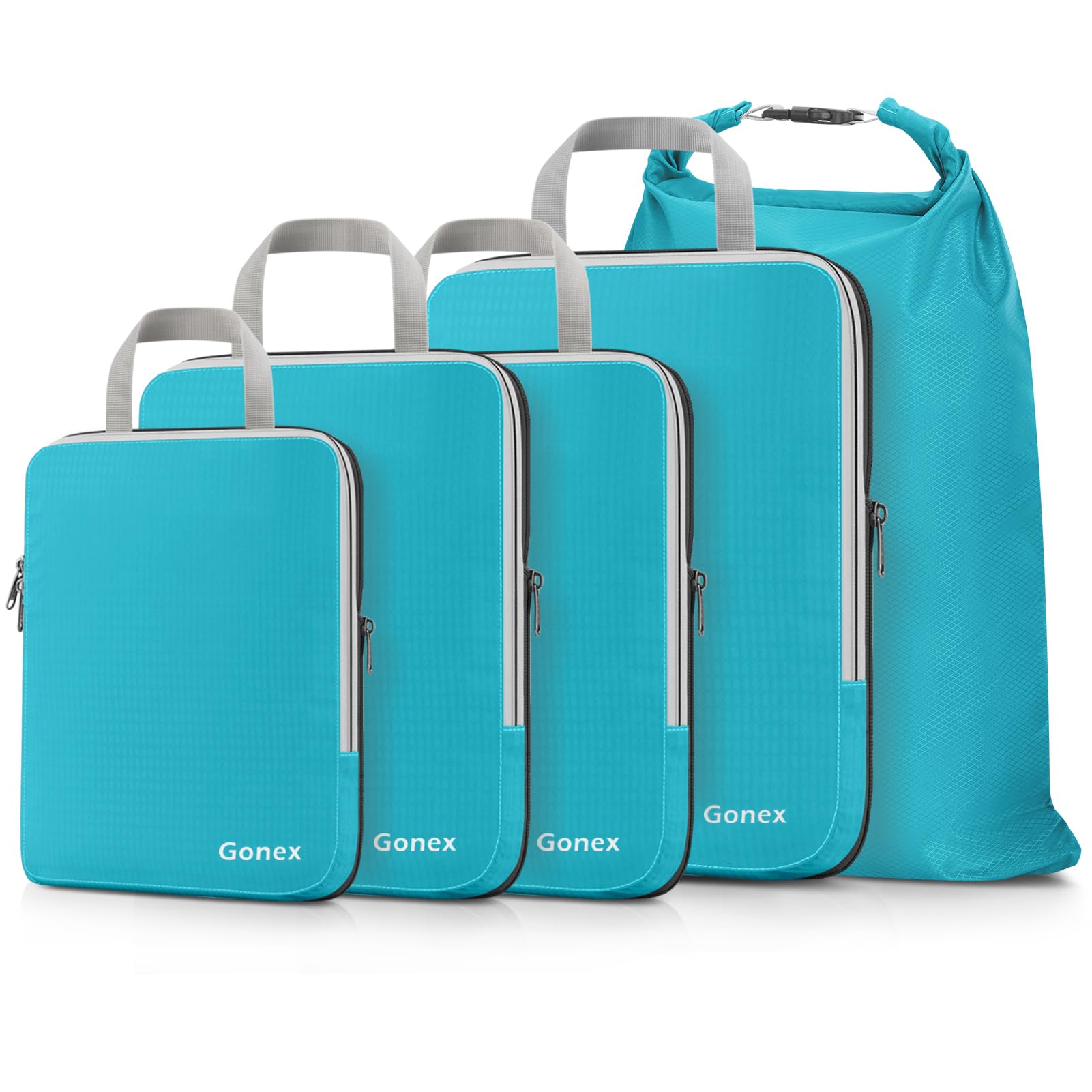
Gonex's compression cubes are the only product in this comparison with a meaningful compression mechanism: a fill zipper loads the cube, then a compression zipper (with a mesh panel that confirms it's fully closed) presses the contents together and reduces the cube's height by 40-60% depending on contents. This is genuinely useful for bulky synthetic travel clothes — compression-cube a set of merino T-shirts and you recover roughly half the cube's volume. The honest weakness: heavier per cube than non-compression alternatives (about 75 g per medium), the two-zipper system adds a step to every pack and unpack, and the compression doesn't work well for already-flat items like underwear that don't hold air.
Pros
- ✓40–60% compression ratio with second zipper
- ✓Mesh window confirms compression zipper closed
- ✓4-piece set covers 10-day trips
Cons
- ✗Heavier per cube (~75 g medium)
- ✗Two-zipper system adds steps
- ✗Minimal benefit for flat items
Score breakdown
| Materials | Nylon + compression mesh panel |
| Compression ratio | 40–60% |
| Set count | 4-piece (S/M/L/XL) |
| Zipper quality | Quality branded (non-YKK) |
| Weight (medium cube) | ~75 g |
| Price | $29.99 (4-piece) |
Which one is right for you?
For frequent Asia multi-city travelers
Eagle Creek Pack-It Specter Cube Set
Ultralight YKK-zipper construction that doesn't add weight penalty across 5+ cube sets.
For Away luggage owners
packing-cubes-away-starter-set
Matched aesthetic and equivalent quality to the Away bag system.
For travelers who want a premium build
packing-cubes-hideo-wakamatsu-jp
Available through major online retailers, built for traditional-inn-style travel, superior corner construction.
For travelers who need maximum compression
Gonex Compression Packing Cube Set
The only product here with a real compression mechanism — 40-60% volume reduction on synthetic clothes.
For long-haul durability with light weight
Osprey Ultralight Packing Cube Set
Osprey's lifetime guarantee and snag-resistant ripstop nylon for 50+ trip cycles.
What packing cubes actually do (and don't do)
Packing cubes do not give you more space in a suitcase — the total volume of your belongings does not change because you put them in fabric boxes. What they do is impose a structure on your bag that makes retrieval faster, keeps categories separated, and prevents the soft-collapse problem where unpacking one thing on day two turns the rest of your bag into a pile you'll never fully reassemble. The real benefit is behavioral: with cubes, you repack each cube individually rather than trying to reconstruct a whole-bag puzzle at 11 p.m. before an early checkout.
Compression cubes add a second function: by zipping a second panel over a stuffed cube, you press the contents together and reduce the cube's total height by roughly 40-60% depending on what's inside. This matters most for bulky items — a compression cube full of rolled T-shirts compresses noticeably; a cube full of already-flat items like underwear doesn't change much. The compression mechanism is not magic — you are pressing air out of fabric, not changing the volume of the fabric itself — but it is genuinely useful for synthetic travel clothes that compress well and bounce back fully when released.
Compression ratio: what the numbers mean in practice
A compression cube with a stated 60% compression ratio means the cube's exterior footprint reduces to 60% of its stuffed-and-uncompressed size. In practice this means a cube that bulges to 12 cm tall when stuffed with a week's worth of T-shirts will compress to approximately 7 cm — a difference that adds up when you're stacking three cubes in a 40L carry-on alongside a laptop bag and a jacket. The Gonex compression cubes in this comparison are specifically designed around this mechanic, with a two-zipper system (fill zipper, compression zipper) and a mesh top that makes it easy to see that the second zipper is fully closed.
Eagle Creek's Pack-It Specter line uses a different approach — extremely lightweight materials (about 24 g per cube) that don't add meaningful weight penalty, with a single zipper and no compression mechanism. The philosophy is that extremely light cubes add essentially nothing to your bag weight, so you can carry more of them without penalty. Osprey's Ultralight cubes take a similar approach but with slightly heavier yet more durable ripstop nylon. Away's Starter Set prioritizes visual simplicity and matching aesthetics over compression or weight optimization.
For Asia travel specifically — where you might transit through 4 cities in 10 days and repack daily — the light single-zipper cubes (Eagle Creek, Osprey) reduce friction at every repack. Compression cubes (Gonex) are most valuable if you're doing a single-destination trip and need to maximize carry-on capacity for the return journey when you've acquired things.
Materials: ripstop nylon vs mesh panels vs polycarbonate shells
The material choice affects three things: weight, durability, and visibility into the cube without opening it. Mesh panels on one face are the dominant design in travel cubes for good reason — you can see what's inside and identify the cube without opening it, which saves 30 seconds at every airport security checkpoint when you're trying to reassemble your bag at the x-ray machine exit. Eagle Creek's Specter line uses a mesh top panel on nylon body — lightest construction here, at about 24 g for a medium cube. Osprey's Ultralight uses the same mesh-top-nylon-body approach but slightly heavier ripstop nylon that resists snags better.
Gonex's compression cubes use a more complex construction: two fabric panels (the compression mesh on one side, heavier nylon on the other), plus the fill zipper and compression zipper system. This makes them noticeably heavier per cube — roughly 75 g for a medium — but the compression mechanism is the reason you're buying them. Away's cubes use a simple nylon construction without mesh, which means you're identifying by color tag only, not by visible contents.
Hideo Wakamatsu's cubes are notable for their quality stitching and reinforced corner construction — more important than it sounds, because the corners of packing cubes take the most stress during compression and during being crammed into overhead bins. The construction standard is visibly higher than budget-category alternatives, and the set configurations match traditional-inn travel patterns (paired cubes for a standard ryokan format where you separate bathing items from clothing).
Set configurations for 4-day vs 10-day Asia trips
A 4-day single-destination city trip works well with a 3-piece set: large cube for clothing, medium for layers, small for underwear/socks. A 10-day multi-city trip where you need to pack for multiple climates (Japan in spring is cold; Thailand is hot; Vietnam varies by region) requires either a 4-5 piece set or compression cubes that can change configuration depending on which city you're in. The Eagle Creek Pack-It Specter 6-piece set covers the full range — two smalls, two mediums, one large, one xl — and the extremely light weight means the extra cubes don't add meaningful bag weight.
Away's Starter Set (3 cubes: small, medium, large) is the right configuration for a single-destination 4-day trip but undersized for a serious 10-day multi-city trip. Osprey's Ultralight 3-piece set has the same coverage gap. If you're doing a single-country three-city loop (5 days, single bag, multiple hotel check-ins), a 3-piece set works. If you're adding Bangkok or Bali to the itinerary, you'll want 4-5 cubes minimum. The Gonex set ships in a 4-cube configuration that covers the 10-day case without needing additional purchases.