Best Olive Oil 2026: 5 Tested & Compared
Five extra virgin olive oils — from a $9 grocery-store bottle to a $38 single-origin finishing oil — covering everyday cooking, high-heat applications, premium finishing, and bulk value. Taste consistency between batches matters more than health claims on the label.
Each oil was assessed on harvest-date transparency, cost per ounce, flavor profile and polyphenol character, suitability for cooking vs finishing use, and how well the freshness claims hold up given typical retail supply chain timelines.

California Olive Ranch Extra Virgin Olive Oil
Best Everyday: California Olive Ranch is the most practical default everyday EVOO for US households — harvest-date printed on the front label, domestic California production with efficient retail distribution, and a mid-range polyphenol profile that handles both cooking and light finishing at ~$0.45/oz. The blend sometimes incorporates international sources; check the label for domestic-only SKUs if origin matters.
Top picks ↓| Product | Price | Link |
|---|---|---|
| — | View deal → | |
| $20.99 | View deal → | |
| $40.00 | View deal → | |
| $25.50 | View deal → | |
| — | View deal → |
Top picks
Related articles

California Olive Ranch Extra Virgin Olive Oil
Best everyday US-made EVOO — harvest-date labeled, domestic production from California and partner farms, reliable freshness at mainstream retail pricing (~$0.45/oz). Mid-range polyphenol profile covers both cooking and light finishing use. Best for households who want freshness transparency without a premium spend. Limitation: blended with international sources in some SKUs; check the label for domestic vs. blended.
California Olive Ranch is the most practical default everyday EVOO for US households — harvest-date printed on the front label, domestic California production with efficient retail distribution, and a mid-range polyphenol profile that handles both cooking and light finishing at ~$0.45/oz. The blend sometimes incorporates international sources; check the label for domestic-only SKUs if origin matters.
Pros
- ✓Harvest-date labeled — freshness verifiable at purchase
- ✓~$0.45/oz — accessible price for a quality domestic EVOO
- ✓Covers both cooking and light finishing use cases
Cons
- ✗Some SKUs blended with international sources — check label for domestic-only
Score breakdown
| Grade | Extra virgin |
| Origin | California, USA |
| Harvest dated | yes |
| Certifications | Non-GMO Project Verified; Kosher; Keto/Paleo Certified; OOCC (Olive Oil Commission of California) certified extra virgin |
Kirkland Signature Organic Extra Virgin Olive Oil
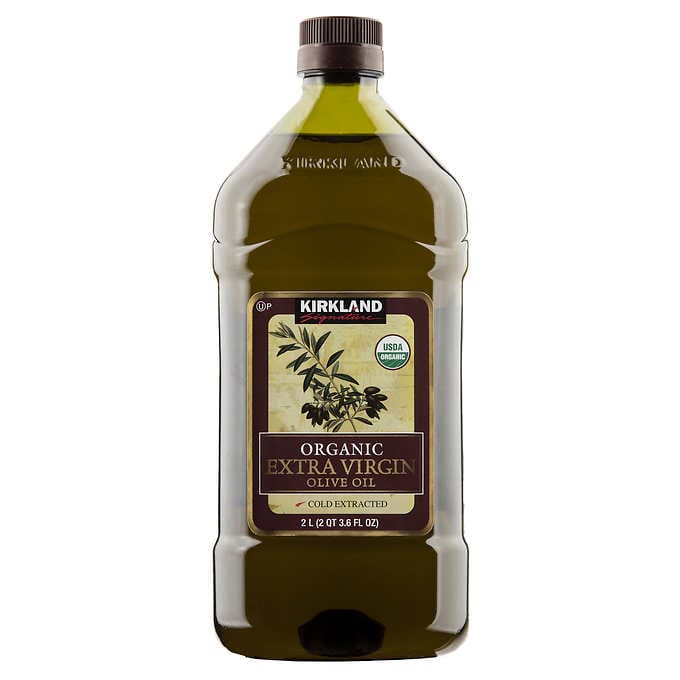
Best bulk value — lowest cost per ounce in this comparison at ~$0.31/oz for the 2-liter Costco size, USDA Organic certified, Mediterranean-sourced. Best for households cooking with olive oil daily where freshness is managed through rapid consumption. Limitation: no harvest date printed; freshness depends on how recently the warehouse stock turned over.
Kirkland's 2-liter organic EVOO from Costco is the lowest cost per ounce in this comparison at ~$0.31/oz — meaningful savings for households cooking with olive oil daily. USDA Organic certified and Mediterranean-sourced. The honest limitation is no harvest date, making freshness harder to verify; rapid consumption mitigates this for high-volume kitchens.
Pros
- ✓~$0.31/oz — lowest cost per ounce in this comparison
- ✓USDA Organic certified
- ✓2-liter format efficient for daily cooking households
Cons
- ✗No harvest date — freshness depends on warehouse stock turnover
Score breakdown
| Grade | Extra virgin (organic) |
| Origin | Imported Mediterranean blend (varies by batch: Italy, Spain, Portugal, Greece, Tunisia); bottled in Italy |
| Harvest dated | no |
| Certifications | USDA Organic; Bureau Veritas traceability/authenticity seal |
Brightland Alive Extra Virgin Olive Oil
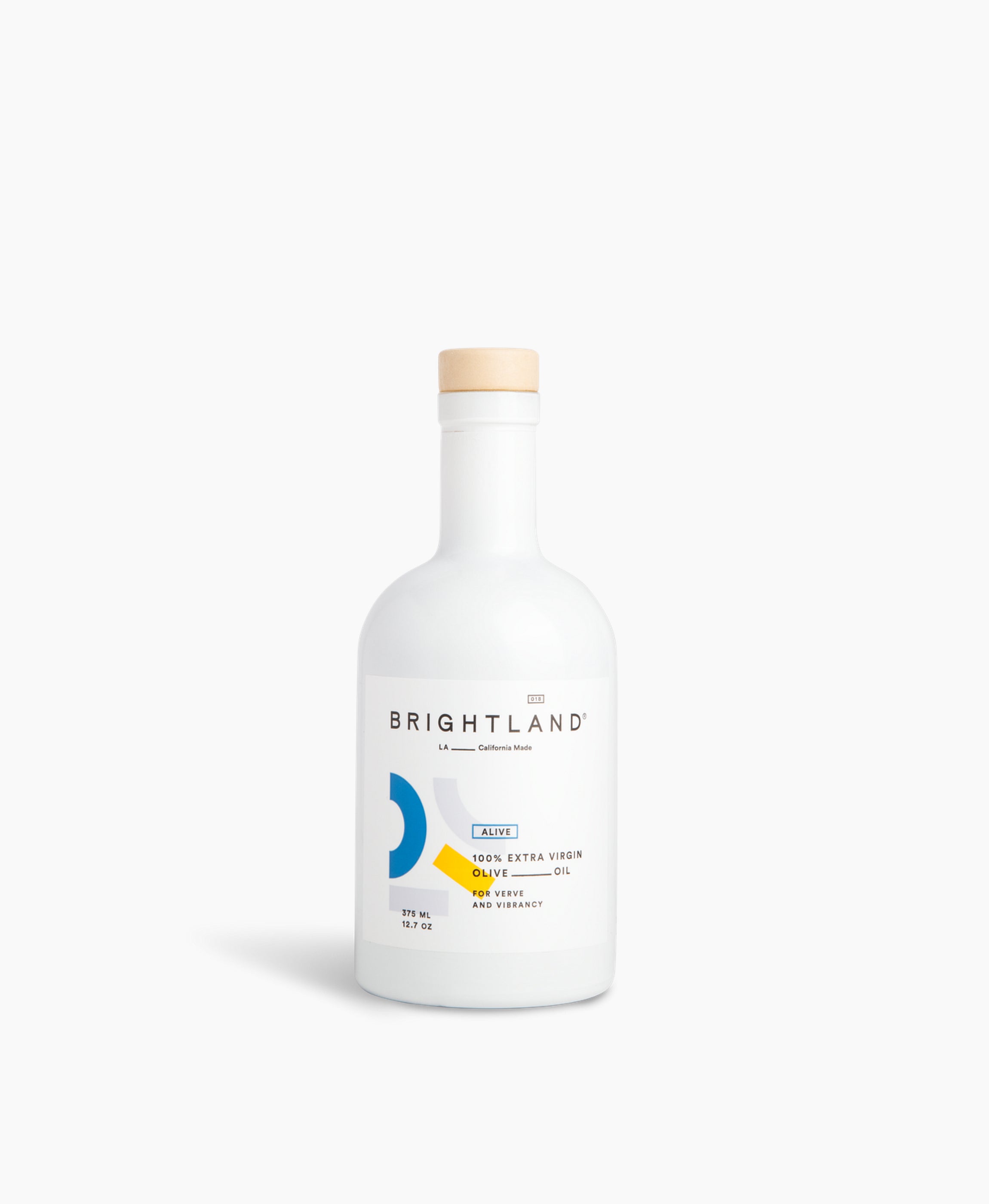
Best premium single-origin finishing oil — harvest date and pressing date both labeled, direct-to-consumer supply chain eliminates retail aging lag, high-polyphenol California Arbequina/Arbosana blend with assertive grassy flavor. Best for finishing use on salads, pasta, and vegetables where the oil flavor is the point. Limitation: $38/375ml makes it economically wrong for cooking use; designed specifically for unheated application.
Brightland is the most freshness-transparent oil in this comparison — both harvest date and pressing date are printed, and the direct-to-consumer supply chain eliminates the retail aging lag. The assertive, grassy high-polyphenol California Arbequina/Arbosana flavor is best experienced unheated. Using it to sauté onions at $3.25/oz is economically wrong; for finishing salads, pasta, and grilled vegetables, the flavor justifies the price.
Pros
- ✓Harvest date and pressing date both labeled — maximum freshness transparency
- ✓High-polyphenol California blend with assertive grassy flavor
- ✓Direct-to-consumer supply chain minimizes aging lag
Cons
- ✗$3.25/oz — economically suited for finishing use only, not cooking
Score breakdown
| Grade | Extra virgin |
| Origin | California, USA (Central Coast & Valley; early-harvest Arbosana & Koroneiki) |
| Harvest dated | yes |
| Polyphenols | 280–330 mg/kg |
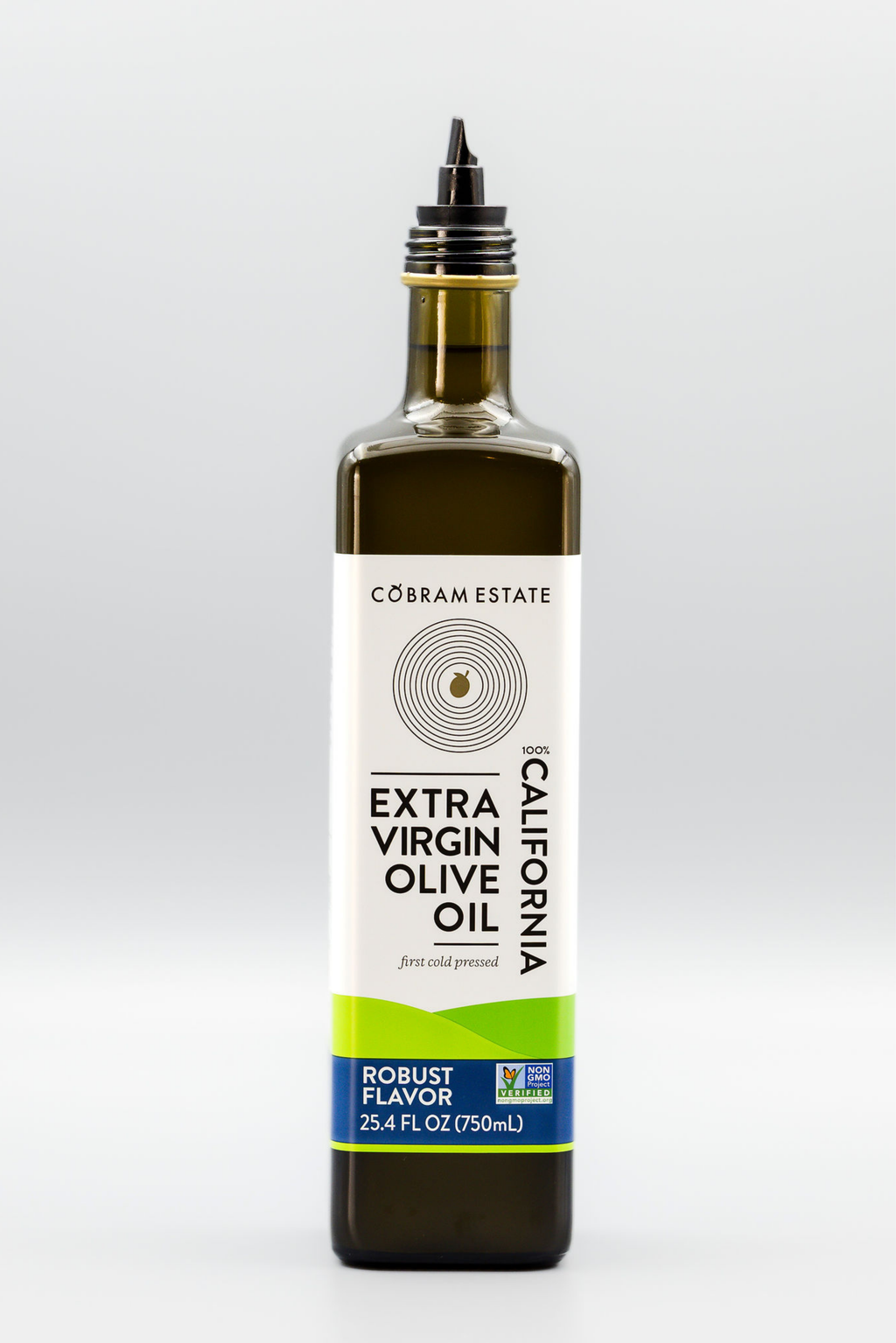
Cobram Estate Robust Extra Virgin Olive Oil
Best for high-heat cooking — higher-polyphenol Robust designation from Coratina and Koroneiki varieties provides oxidative stability at cooking temperatures, harvest-date labeled on US-market bottles. Peppery, assertive flavor profile. Best for sautéing, roasting, and households who prefer a more robust EVOO character. Limitation: assertive flavor is not universally preferred; the Mild or Classic lines are better for households who want a neutral cooking oil.
Cobram Estate Robust uses Coratina and Koroneiki varieties specifically for higher polyphenol content and oxidative stability at cooking temperatures. Harvest-date labeled on US bottles. The peppery, assertive flavor profile is not universally liked, but it holds up better under heat than mild EVOOs — the right choice when sautéing or roasting is the primary application.
Pros
- ✓High-polyphenol Coratina/Koroneiki blend for oxidative stability at heat
- ✓Harvest-date labeled on US-market bottles
- ✓Peppery flavor holds character better than mild oils at cooking temperatures
Cons
- ✗Assertive peppery flavor not suited for mild-flavor applications
Score breakdown
| Grade | Extra virgin |
| Origin | California, USA (Sacramento Valley) |
| Harvest dated | yes |
| Acidity | < 0.5% |
| Certifications | Non-GMO; COOC (California Olive Oil Council) certified |
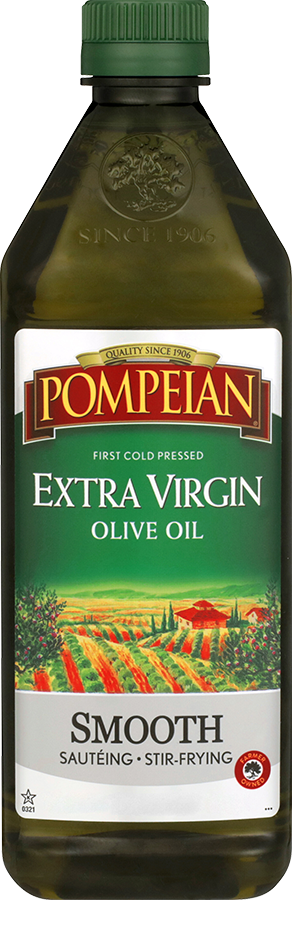
Pompeian Smooth Extra Virgin Olive Oil
Best budget grocery-store option — widely available, lowest price point at ~$0.25/oz in large format, mild flavor designed for consumers who dislike bitterness. Best when budget is the binding constraint and cooking volume is high. Limitation: no harvest date, lower polyphenol content by design, limited finishing-oil utility — not the choice if freshness or health value is a priority.
Pompeian Smooth is filtered to remove the bitterness that polyphenols create — a deliberate consumer choice that also reduces polyphenol content and finishing-oil utility. At ~$0.25/oz it is the cheapest option here, widely available at grocery stores, and adequate for high-volume cooking where oil flavor is not the point. Not the choice if freshness, polyphenol health value, or finishing character matter.
Pros
- ✓~$0.25/oz — lowest price in this comparison
- ✓Widely available at mainstream grocery stores
- ✓Mild filtered flavor for consumers who dislike bitterness
Cons
- ✗No harvest date; lowest polyphenol content by design; limited finishing utility
Score breakdown
| Grade | Extra virgin |
| Origin | Imported Mediterranean blend (e.g., Spain, Italy, Greece, Tunisia; sourced largely via DCOOP Spain); bottled in Baltimore, USA |
| Harvest dated | no |
| Certifications | NAOOA Certified; Non-GMO Project Verified; Kosher; Gluten-Free |
Which one is right for you?
For everyday household cooking
California Olive Ranch Extra Virgin Olive Oil
Harvest-date transparency, domestic production, and a price that doesn't require rationing — the one bottle that covers most kitchen uses without compromise.
For daily high-volume cooks
Kirkland Signature Organic Extra Virgin Olive Oil
The 2-liter Costco format at ~$0.31/oz makes daily olive-oil cooking genuinely economical; rapid consumption manages the freshness trade-off.
For finishing-oil enthusiasts
Brightland Alive Extra Virgin Olive Oil
Harvest and pressing date printed, direct-from-producer freshness, and a high-polyphenol flavor that's best experienced drizzled unheated over salad or pasta.
For high-heat sautéing and roasting
Cobram Estate Robust Extra Virgin Olive Oil
The Robust designation signals higher-polyphenol Coratina/Koroneiki varieties specifically selected for oxidative stability at cooking temperatures.
EVOO vs refined: what the label actually tells you
Extra virgin olive oil is defined by two criteria: free acidity below 0.8% and no sensory defects detectable by trained tasters. That definition is tighter than it sounds — an oil that was once EVOO but stored poorly, shipped in warm containers, or bottled months after milling can degrade past the threshold before it reaches the shelf. The EVOO label is a quality snapshot at the time of testing, not a guarantee of what arrives in your kitchen. 'Pure olive oil' and 'light olive oil' are refined products — chemically processed to remove defects and neutralize flavor — and carry no polyphenol content, negligible antioxidant value, and a higher smoke point because there is nothing left to burn off.
The practical implication: an EVOO with a printed harvest date and a 12–18 month best-by window is meaningfully different from an EVOO with no harvest date and a 24-month best-by stamped at bottling. California Olive Ranch and Brightland both print harvest dates; Kirkland's Costco EVOO carries a best-by date (typically 24 months from bottling) but no harvest date, which makes freshness harder to verify. Cobram Estate prints a harvest date on US-market bottles. Pompeian does not print a harvest date, which is consistent with its market position as a standard grocery-store EVOO where freshness communication is not a selling point.
One category not represented here: filtered versus unfiltered EVOO. Unfiltered oils contain suspended olive particles that accelerate rancidity — they look cloudy and taste fruitier initially but have a shorter window. All five oils reviewed here are filtered, which is the practical choice for household pantry use where a bottle may sit for two to three months after opening.
Harvest date and freshness window: how to read the bottle
Olive oil begins oxidizing from the moment of milling. A freshly milled oil — typically October through December in the Northern Hemisphere, March through May in the Southern — has 12 to 18 months of peak quality if stored away from heat and light. After that window, the flavor goes flat and the polyphenol content that gives EVOO its health value and characteristic bitterness degrades. The harvest date, not the best-by date, is the number that matters.
California Olive Ranch (COR) prints a harvest season on the front label and mills within hours of picking at their California and partner farms. A bottle labeled 'Harvest 2024/2025' purchased in mid-2026 is outside the ideal freshness window — their oils are best within 12 months of the harvest date. In practice, finding COR on shelf near or within a recent harvest season is common because their US distribution is efficient. This makes them one of the most reliably fresh domestic EVOOs at a mainstream price point.
Brightland prints both harvest date and pressing date on every bottle — the most transparent freshness communication of the five. Their Alive blend uses California Arbequina and Arbosana olives, milled within four hours of harvest. Bottles from the current season are available directly from their website, which eliminates the distribution lag that ages oils sitting in warehouse and retail inventory. The premium price reflects this supply chain control as much as the oil quality itself.
Cobram Estate, an Australian producer with a California operation, prints harvest dates and has a controlled supply chain for US-market bottles. Their Robust variety uses higher-polyphenol olive varieties with a more assertive flavor profile — the green, peppery finish that indicates fresh polyphenol content. Kirkland Signature Organic EVOO from Costco carries a 24-month best-by window but no harvest date; the oil is sourced primarily from Mediterranean producers and may have been in the supply chain for many months before bottling. For bulk buyers where cost per ounce matters more than peak freshness, this trade-off is defensible.
Smoke point and high-heat cooking: which EVOO handles the heat
The smoke point of extra virgin olive oil is commonly cited as 375–405°F (190–207°C), which places it safely above the temperatures reached in typical sautéing and pan frying (300–375°F). The claim that EVOO should not be used for cooking above low-medium heat is not supported by the evidence — laboratory studies show that EVOO's high monounsaturated fat content and natural antioxidants make it more stable at heat than most refined seed oils, which have higher smoke points but fewer protective compounds. The smoke point matters less than oxidative stability.
Cobram Estate Robust is specifically positioned for high-heat cooking. The higher polyphenol content in Robust-designated oils (from Coratina, Koroneiki, and similar varieties) contributes to oxidative stability at temperature. Cobram also produces their Classic and Reserve lines; the Robust designation is a reliable signal that the oil handles heat better than mild-profile EVOOs. At roughly $15–$18 for a 500ml bottle, it sits at the midrange of this comparison for high-heat use cases.
California Olive Ranch's Everyday Fresh is a blended oil from California and international sources — the blend composition varies by season, which affects both flavor and heat stability slightly. It is a competent all-purpose EVOO for cooking at medium heat, less optimized for high-heat than Cobram's Robust but more than adequate for most household cooking uses. Pompeian Smooth is the lowest-polyphenol oil of the five by design — it is filtered to a milder profile specifically to reduce the peppery finish some consumers dislike, which also reduces heat stability somewhat. It is adequate for low-to-medium cooking but the lack of flavor at higher heat makes it less useful as a finishing oil.
Polyphenol content and health claims: what the research actually supports
Polyphenols — specifically oleocanthal and oleacein — are the compounds in EVOO responsible for the peppery, sometimes throat-catching finish of fresh high-quality oil. They also carry the most evidence-backed health benefits associated with olive oil consumption: anti-inflammatory activity (oleocanthal shares a mechanism with ibuprofen), antioxidant effects, and association with reduced cardiovascular disease risk in Mediterranean diet studies. Polyphenol content is measured in mg/kg of oil; a 'high polyphenol' EVOO is typically above 250 mg/kg. EU regulations allow health claims on polyphenol content only above 250 mg/kg and only for specific wording.
Brightland's Alive blend is described by the company as high-polyphenol, though they do not publish specific mg/kg values on the bottle. The flavor profile — distinctly grassy, peppery, with a long finish — is consistent with high polyphenol content in fresh-milled Arbequina/Arbosana oils. Cobram Robust similarly has a peppery, high-polyphenol profile by variety selection design. California Olive Ranch's Everyday Fresh is milder by blend design — polyphenol content is lower than single-variety, freshly-milled premium oils but higher than refined or heavily processed EVOO.
The health claims sometimes attached to EVOO marketing outrun the evidence. Eating high-polyphenol EVOO as part of a Mediterranean diet pattern is well-supported for cardiovascular benefit. Consuming a tablespoon daily as a supplement is a different claim with less precise evidence. Pompeian Smooth's mild profile specifically targets consumers who dislike the bitterness that polyphenols create — which is a legitimate consumer preference, but means the health rationale for choosing Pompeian over a milder refined oil is weaker than for higher-polyphenol options. Kirkland Organic EVOO has an organic certification, which addresses pesticide use but says nothing about freshness, polyphenol content, or quality beyond the EVOO standard.
Bulk vs small-bottle economics: cost per ounce in context
The cost-per-ounce comparison between these five oils spans a wide range, and the right calculation depends on how quickly a household uses oil. A 1-liter bottle of California Olive Ranch costs roughly $14–$16 at major retailers — around $0.42–$0.48 per ounce. A Costco Kirkland Organic EVOO 2-liter costs roughly $20–$22, landing at $0.30–$0.33 per ounce — the lowest cost per ounce in this comparison by a meaningful margin. Pompeian Smooth in a 68oz bottle at mainstream grocery prices runs about $0.22–$0.28 per ounce, making it the cheapest option but also the lowest-quality.
The Kirkland bulk economics only make sense if a household uses oil quickly enough to consume a 2-liter bottle within four to six months of opening. Olive oil oxidizes after opening — a half-used bottle sitting in a warm kitchen for eight months will be noticeably degraded regardless of its original quality. For households cooking with olive oil daily, the Kirkland bulk option delivers real savings without meaningful quality compromise. For households who cook with olive oil two to three times a week, a 500ml to 750ml bottle of California Olive Ranch or Cobram is likely the better purchase: lower cost per use over the bottle's actual consumption window.
Brightland Alive at $38 for 375ml ($3.25 per ounce) is priced for use as a finishing oil — drizzled over salads, hummus, pasta, or grilled vegetables where the flavor is the point. Using it to sauté onions is technically possible but economically wasteful given that a $16 bottle of COR performs equivalently at cooking heat. The positioning is deliberate: Brightland sells the freshness, the artisan sourcing, and the flavor, all of which are most apparent when the oil is used unheated. At that use case, the $38 price is defensible for households who care about flavor. For cooking-primary households, it is not the right bottle.
Where each fits
California Olive Ranch is the right default everyday EVOO for households who want a US-produced, harvest-date-labeled oil at a mainstream price. The freshness transparency, reliable domestic distribution, and mid-range polyphenol content cover most household cooking and finishing use cases without requiring a premium spend. Buy the 500ml to 1-liter size and rotate through it within three months of opening.
Kirkland Signature Organic EVOO is the right choice for households cooking with olive oil daily who want organic certification and the lowest cost per ounce. The freshness trade-off versus California Olive Ranch is real but manageable if the household uses oil quickly. Buy a single 2-liter rather than stacking multiple units unless storage conditions are ideal.
Brightland Alive is the right choice for households who use a dedicated finishing oil and want the flavor of fresh-milled California EVOO in a small bottle bought close to harvest. The transparency and supply chain control justify the price if finishing-oil flavor is a genuine priority — not as an everyday cooking oil.
Cobram Estate Robust is the right choice when high-heat cooking is the primary use case and polyphenol content and heat stability matter. It is also a solid all-purpose EVOO for households who prefer a peppery, assertive flavor profile over mild oils.
Pompeian Smooth is the right choice when budget is the hard constraint and the primary use is high-volume cooking where olive oil flavor is not the point. It is not the right choice if polyphenol content, freshness, or finishing flavor matter.
Verdict
California Olive Ranch is the most practical everyday EVOO for most US households: harvest-date transparency, domestic production, mid-range polyphenol content, and a price that does not require rationing. It is the one bottle that covers cooking and light finishing use without compromise.
Add Cobram Estate Robust if high-heat cooking is regular in your kitchen, or Brightland Alive if you use a dedicated finishing oil. Use Kirkland if you cook with oil every day and want to cut cost per ounce without dropping to refined. Pompeian earns its place only when budget is the binding constraint and flavor is not the point.
