Best Meat Thermometers 2026: Thermapen vs MEATER vs Lavatools
Pull a steak at the wrong moment and you've turned a $40 ribeye into a hockey puck — no amount of resting time undoes an overcooked center. A good meat thermometer eliminates that guesswork entirely. Seal integrity and stackability outlast any smart feature after six months of daily use.
Each thermometer was assessed on probe response speed, stated accuracy tolerance, waterproofing and durability claims, and practical workflow — how quickly a reading can be taken and acted upon during active grilling, roasting, or frying.
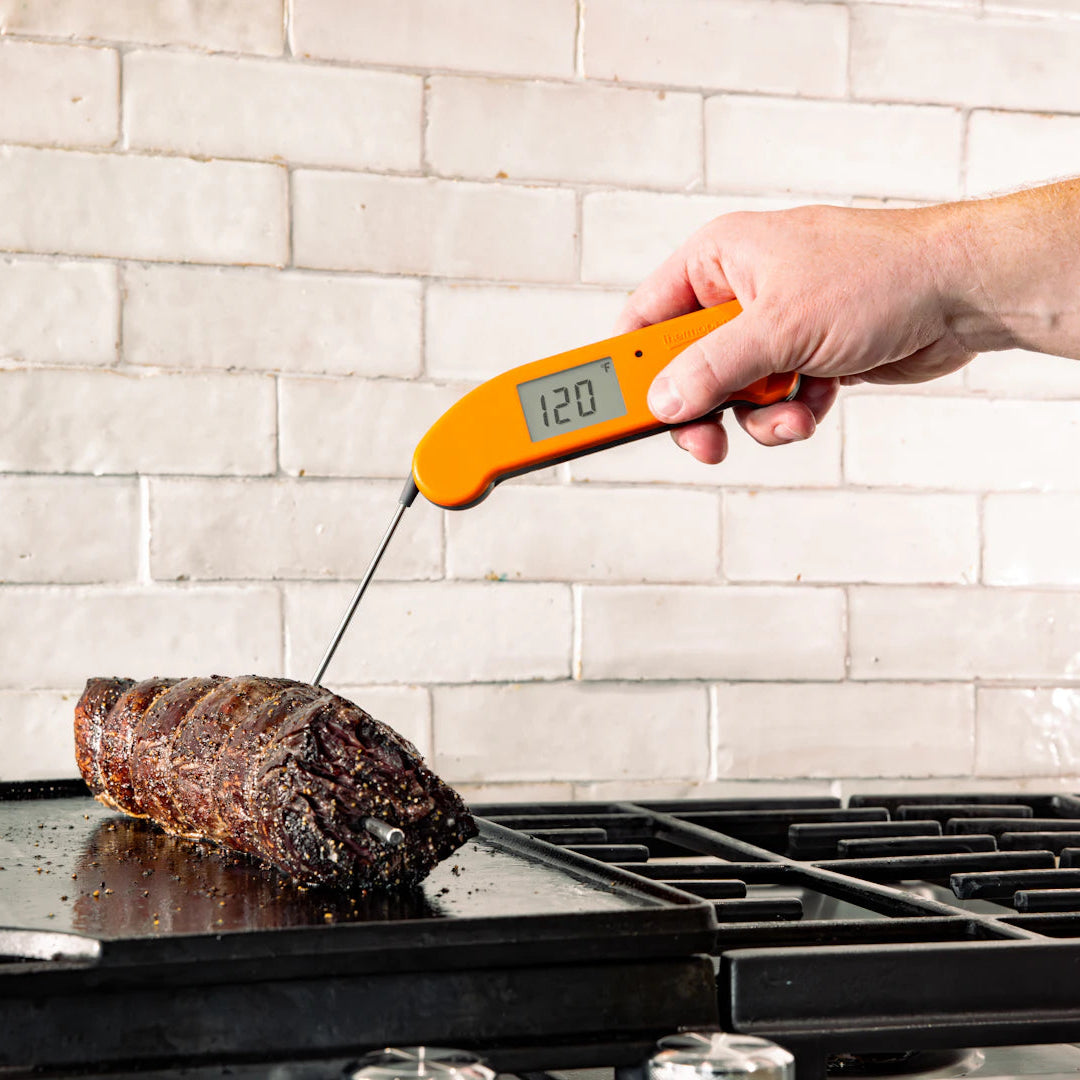
ThermoWorks Thermapen ONE
Best Overall: The Thermapen ONE is the fastest and most accurate instant-read thermometer available for home use — one-second readings accurate to ±0.5°F, IP67 waterproof, auto-rotating display that orients for any grip angle. The only real trade-off is the $109 price, which is two to five times more than any other option here.
Top picks ↓| Product | Price | Link |
|---|---|---|
| $109.00 | View deal → | |
| — | View deal → | |
| $99.95 | View deal → | |
| — | View deal → | |
| $14.99 | View deal → |
Top picks
Related articles


ThermoWorks Thermapen ONE
One-second read time accurate to ±0.5°F from -58°F to 572°F, auto-rotating display, IP67 waterproof rating, and 2,000-hour battery life. The fastest and most accurate instant-read thermometer available at any price — the right choice for anyone who cooks proteins frequently and wants zero compromise on speed.
The Thermapen ONE is the fastest and most accurate instant-read thermometer available for home use — one-second readings accurate to ±0.5°F, IP67 waterproof, auto-rotating display that orients for any grip angle. The only real trade-off is the $109 price, which is two to five times more than any other option here.
Pros
- ✓1-second read time — fastest in class
- ✓±0.5°F accuracy, IP67 washable under tap
- ✓Auto-rotating display works at any angle
Cons
- ✗$109 — significantly more expensive than alternatives
Score breakdown
| Read time | 1 second |
| Accuracy | ±0.5°F |
| Range | -58°F to 572°F |
| Waterproofing | IP67 |
| Battery life | 2,000 hours |
| Display | Auto-rotating |
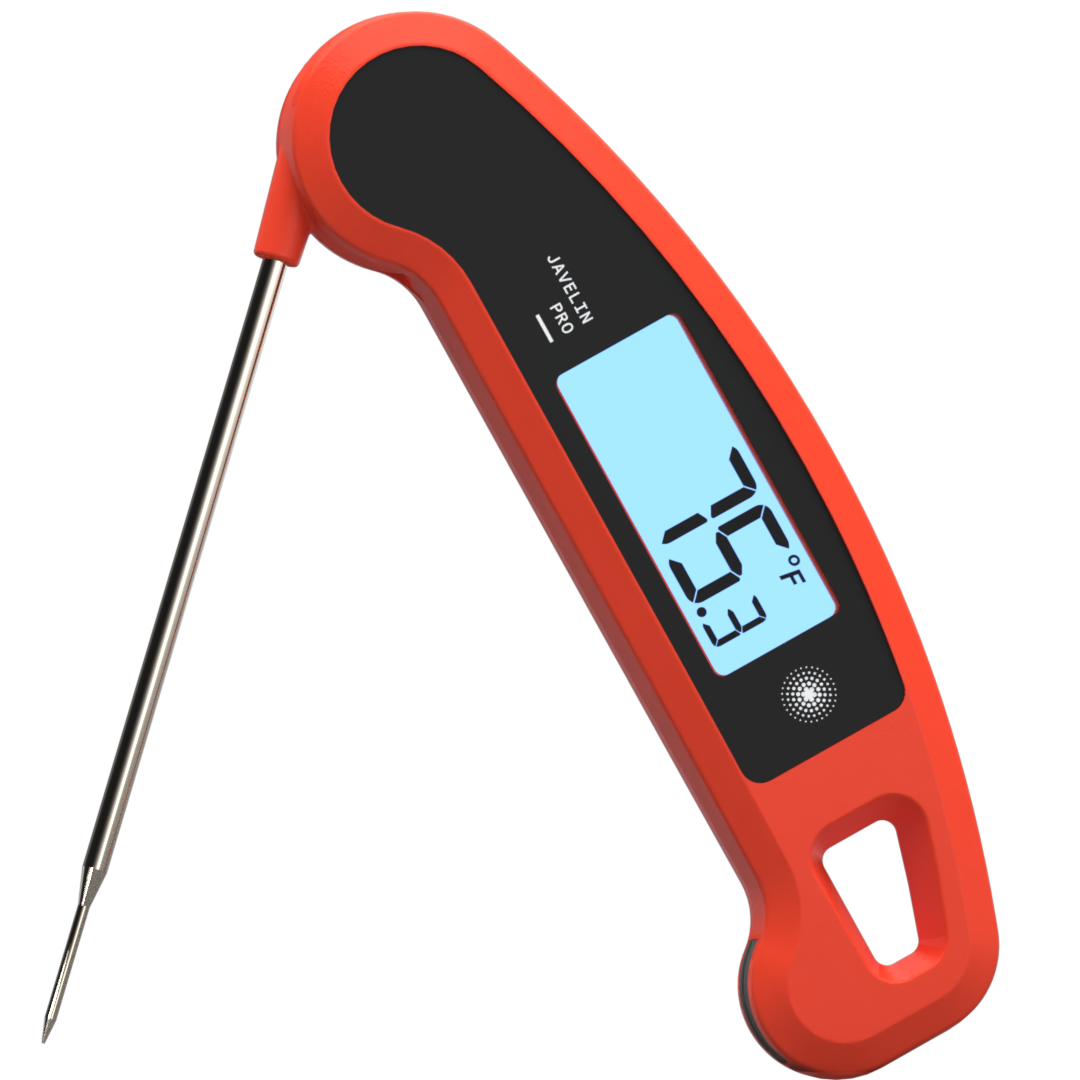
Lavatools Javelin PRO Duo Digital Instant Read Thermometer
Three-to-four second read time with ±0.9°F accuracy, magnetic back for fridge mounting, and a large auto-rotating display. The best value in instant-read thermometers at roughly 40% of the Thermapen ONE's price — the choice for households that want excellent accuracy without the premium.
The Javelin PRO Duo delivers ±0.9°F accuracy and a 3–4 second read time at roughly 40% of the Thermapen ONE's price. A magnetic back for fridge or grill attachment and an ambidextrous folding probe make it the most practical budget upgrade. The slower speed is noticeable at a hot grill but not a dealbreaker for most cooks.
Pros
- ✓±0.9°F accuracy at ~40% of Thermapen's price
- ✓Magnetic back for grill or fridge mounting
- ✓Large auto-rotating display
Cons
- ✗3–4 second read is slower than Thermapen at an open grill
Score breakdown
| Read time | 3–4 seconds |
| Accuracy | ±0.9°F |
| Range | -40°F to 482°F |
| Waterproofing | Splash resistant |
| Mounting | Magnetic back |
| Display | Auto-rotating |
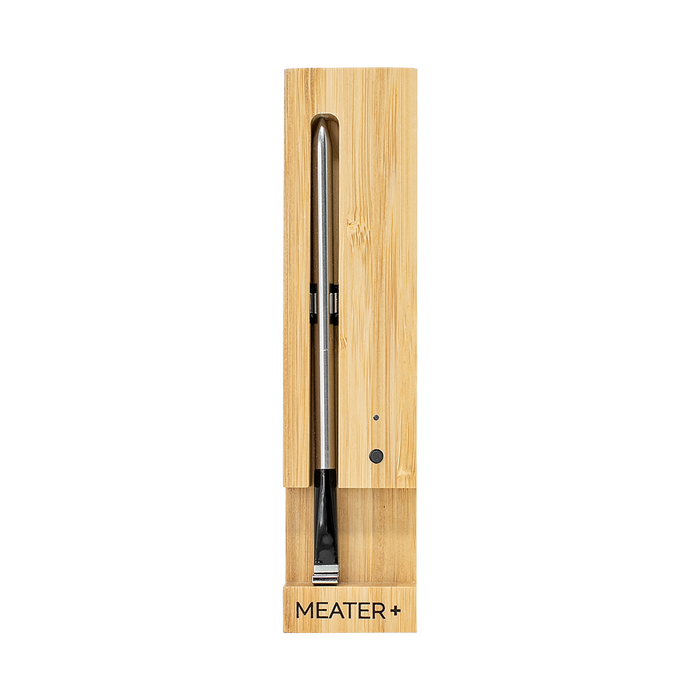
MEATER Plus Wireless Smart Meat Thermometer
Wireless probe with dual sensors reads internal meat temperature and ambient cook temperature simultaneously, transmitting to a companion app over Bluetooth with estimated time-to-target predictions. The right tool for long oven or smoker cooks where monitoring without opening the door matters.
The MEATER Plus solves a completely different problem: it stays in the meat throughout the entire cook, sending real-time temperatures and time-to-target estimates to a smartphone app over Bluetooth. Essential for long smokes or oven roasts where opening the door matters. It measures only one location, so a spot-check with an instant-read at the finish is still worthwhile for large cuts.
Pros
- ✓Completely wireless — no cord to manage or burn on grill grates
- ✓Dual sensors track both internal and ambient temperature
- ✓App estimates remaining cook time in real time
Cons
- ✗Measures only one point — need a second probe check for very large cuts
Score breakdown
| Read type | Wireless continuous |
| Internal range | Up to 212°F |
| Ambient range | Up to 527°F |
| Bluetooth range | 165 ft |
| Connectivity | Bluetooth + Wi-Fi via dock |
| App | iOS and Android |
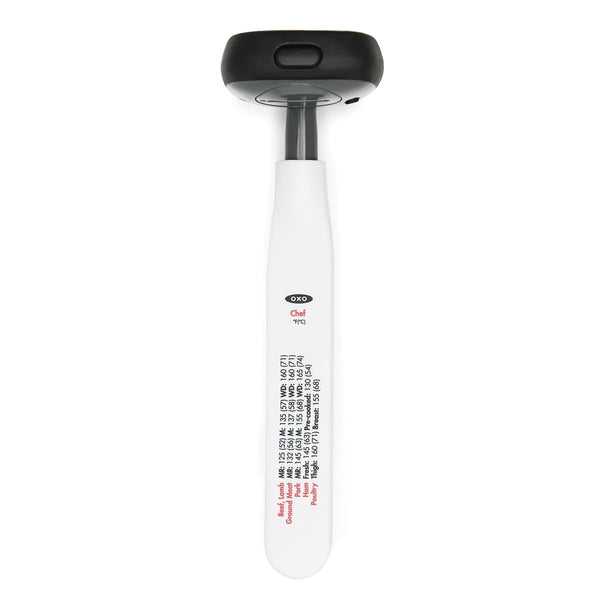
OXO Good Grips Chef's Precision Instant Read Thermometer
Three-to-four second read time, ±1°F accuracy, large easy-read display, and a comfortable non-slip grip. OXO's two-year warranty is unusual at this price point — a solid mid-range choice if the Taylor is too slow but the Lavatools is more than you want to spend.
The OXO gives 3–4 second reads at ±1°F with a non-slip grip and a 2-year warranty that is unusual at this price. It sits clearly above the Taylor in speed and accuracy and below the Lavatools. The 2-year warranty is genuine value if you're hard on kitchen tools.
Pros
- ✓±1°F accuracy with 2-year warranty
- ✓Non-slip grip handles wet hands and heat
- ✓Large easy-read display
Cons
- ✗Range tops out at 392°F — may not cover deep-frying temperatures
Score breakdown
| Read time | 3–4 seconds |
| Accuracy | ±1°F |
| Range | 32°F to 392°F |
| Waterproofing | None stated |
| Warranty | 2 years |
| Storage | Foldable probe |

Taylor Precision Products 9842 Digital Thermometer
Straightforward digital instant-read with four-to-five second response and ±2°F accuracy. Covers the essential use cases — checking chicken, roasts, and frying oil — at a price under $20. The entry point for anyone who wants a thermometer but doesn't cook protein often enough to justify spending more.
The Taylor 9842 covers the essential use cases — chicken, roasts, frying oil — at under $20. The 4–5 second response and ±2°F tolerance are slower and less precise than anything else here, but adequate for cooks who check temperatures a few times a week and want a functional thermometer without spending more.
Pros
- ✓Under $20 — lowest price in this comparison
- ✓Covers all essential food-safety temperature checks
- ✓Simple, no-learning-curve operation
Cons
- ✗4–5 second read is twice as slow as OXO; ±2°F is the widest tolerance here
Score breakdown
| Read time | 4–5 seconds |
| Accuracy | ±2°F |
| Range | 32°F to 392°F |
| Waterproofing | None |
| Display | Digital LCD |
| Storage | Foldable probe |
Which one is right for you?
For serious grill cooks
ThermoWorks Thermapen ONE
The 1-second read means you can check a steak and close the grill lid in the same motion — no heat loss, no hovering.
For budget-conscious home cooks
Lavatools Javelin PRO Duo Digital Instant Read Thermometer
Near-Thermapen accuracy at 40% of the price; the magnetic back keeps it on the fridge door and ready to grab.
For low-and-slow smokers and roasters
MEATER Plus Wireless Smart Meat Thermometer
Set it and check the app — no lifting the lid, no cord tangling, and an estimated finish time so you can plan sides.
For occasional home cooks on a budget
Taylor Precision Products 9842 Digital Thermometer
Handles the food-safety checks that matter most (poultry, ground meat) at a price that makes owning one a no-brainer.
Top pick: ThermoWorks Thermapen ONE
The Thermapen ONE is the reference standard for instant-read thermometers — the tool used by food scientists, BBQ competition judges, and professional kitchens that need accurate readings without waiting. The headline specification is a one-second read time across the full range of -58°F to 572°F, accurate to ±0.5°F. In practice that means you stab the probe into a chicken thigh, read 158°F, and pull it immediately rather than standing over the grill waiting for a number to stabilize.
The auto-rotating display activates the moment you open the probe and orients its digits based on the thermometer's angle — right-handed or left-handed grip, probe pointing any direction, the readout faces you. A motion-sensing sleep function turns it off when the probe is closed and wakes it when opened. The backlight triggers automatically when the sensor detects low ambient light. Battery life is rated at 2,000 hours. The probe folds for storage and the body is IP67 rated — fully submersible, washable under a running tap.
The honest limitation is price: the Thermapen ONE costs $99, which is two to five times more than the other instant-read thermometers in this comparison. For a household that cooks proteins several times a week and wants the fastest possible confirmation — grilling steaks, smoking brisket, frying chicken, checking bread — the price is justified by the daily time savings and the confidence that the reading is accurate. For someone who cooks protein once or twice a week and is willing to wait three to four seconds for a reading, the Lavatools Javelin PRO Duo at $42 returns excellent accuracy for less than half the price.
Budget picks: OXO Chef's Precision and Taylor 9842
The OXO Good Grips Chef's Precision Instant Read Thermometer returns a reading in three to four seconds, accurate to ±1°F across 32°F to 392°F. The large display is easy to read without bending close to the food, and the probe folds flush with the body for pocket or drawer storage. The rubber grip handles hot pans and wet hands without slipping. OXO backs it with a two-year warranty, which is unusual in this price range. At around $25-30, it sits between the Taylor and the Lavatools — a reasonable middle ground if the Taylor's slower response time frustrates you but the Lavatools price is more than you want to spend.
The Taylor Precision 9842 is the entry point: a reliable digital thermometer with a four-to-five second read time, ±2°F accuracy from 32°F to 392°F, and a straightforward digital display. It handles the most common use cases — checking whether chicken is at 165°F, whether a roast has reached 135°F for medium-rare, whether frying oil is at the right temperature. The step-down from the OXO and Lavatools is measurable: the Taylor takes roughly twice as long to stabilize and its accuracy tolerance is twice as wide. For occasional home cooking at a price under $20, the Taylor covers the basics adequately. For frequent use — multiple cooking sessions per week — the extra seconds per reading add up to a real friction point.
Where both budget picks fall short relative to the Lavatools and Thermapen: a slower response time means you hold the probe in hot food longer, which gets uncomfortable near a grill or hot oven, and you risk moving the probe before it stabilizes if you're impatient. The OXO is the better buy of the two if the budget allows it — the speed and accuracy improvement over the Taylor at a $5-10 premium is worth it.
Wireless pick: MEATER Plus
The MEATER Plus solves a different problem than the other thermometers in this comparison. Where instant-read thermometers tell you the temperature when you check, the MEATER Plus tells you the temperature continuously — it stays in the meat throughout the entire cook, transmits internal and ambient temperatures every two seconds over Bluetooth, and estimates the remaining cook time based on the heat curve it observes.
The probe is completely wireless — no cord to deal with when rotating a roast or basting a turkey, no cord to melt against a hot grill grate. The internal sensor reads the meat temperature up to 212°F; the ambient sensor at the probe's handle end reads the surrounding air or oven temperature up to 527°F. A companion app displays both in real time and sends a notification when the meat is 15 minutes from the target temperature. Bluetooth range is rated at 165 feet; in practice through a wall or door, 80-100 feet is realistic. The charging dock doubles as an extended wireless range repeater when connected to Wi-Fi.
The limitation of the MEATER Plus compared to instant-read thermometers is that it measures one location in the meat — wherever you placed the probe. For a large roast or brisket where temperature varies by two to three inches of travel, you may still want to probe a second spot with an instant-read thermometer at the end to confirm the coldest part of the cut. The MEATER Plus is the right tool for long cooks where monitoring without opening the oven matters: smoked brisket, roasted turkey, slow-roasted pork shoulder. It is not the right tool for grilling steaks, pan-searing fish, or any technique where the cook is short and you're checking multiple items in sequence.
How to choose: read speed, probe length, and wireless vs instant-read
Read speed: for grilling, pan-searing, and frying — short, high-heat cooks where you're actively monitoring and adjusting — read speed is the most important specification. A one-second thermometer like the Thermapen ONE lets you check a steak and close the grill lid in the same motion. A four-to-five second thermometer requires you to hold the grill open while the number stabilizes, losing heat each time you check. If you're doing this ten times during a cook, the slower thermometer becomes a real friction point.
Probe length: the probes on the instant-read thermometers in this comparison range from 3.5 inches (OXO) to 4.5 inches (Thermapen ONE and Lavatools). For most cuts of meat, 3.5 inches is adequate. For whole turkeys, large pork shoulders, and thick briskets, a longer probe reaches the thermal center of the cut without your hand getting close to the heat source. The MEATER Plus probe is 5.1 inches, long enough to stay in a large roast with the handle end exposed above the surface.
Wireless vs instant-read: these serve different use cases rather than competing directly. Instant-read thermometers are faster for checks, but you have to open the oven or grill lid each time. Wireless probes stay in the meat and eliminate repeated lid opens — each lid open on a smoker or oven drops the chamber temperature and extends cook time. If you cook proteins on a grill or in an oven more than twice a week, owning both types is the practical answer: a wireless probe for the long cook and an instant-read to confirm at the finish.
