Best Mandoline Slicer 2026: 5 Tested & Compared
Five mandoline slicers from budget to premium, tested on the cuts that separate a useful kitchen tool from a finger injury waiting to happen. Weekly usage frequency, not recipe variety, determines which spec actually matters.
Each mandoline was tested on daikon, cucumber, carrot, potato, and fennel at thin (1 mm), medium (3 mm), and thick (6–7 mm) settings — scoring blade sharpness, slice consistency, cut guard effectiveness, and injury risk across 30 test sessions. Safety performance weighted equally with cutting performance.
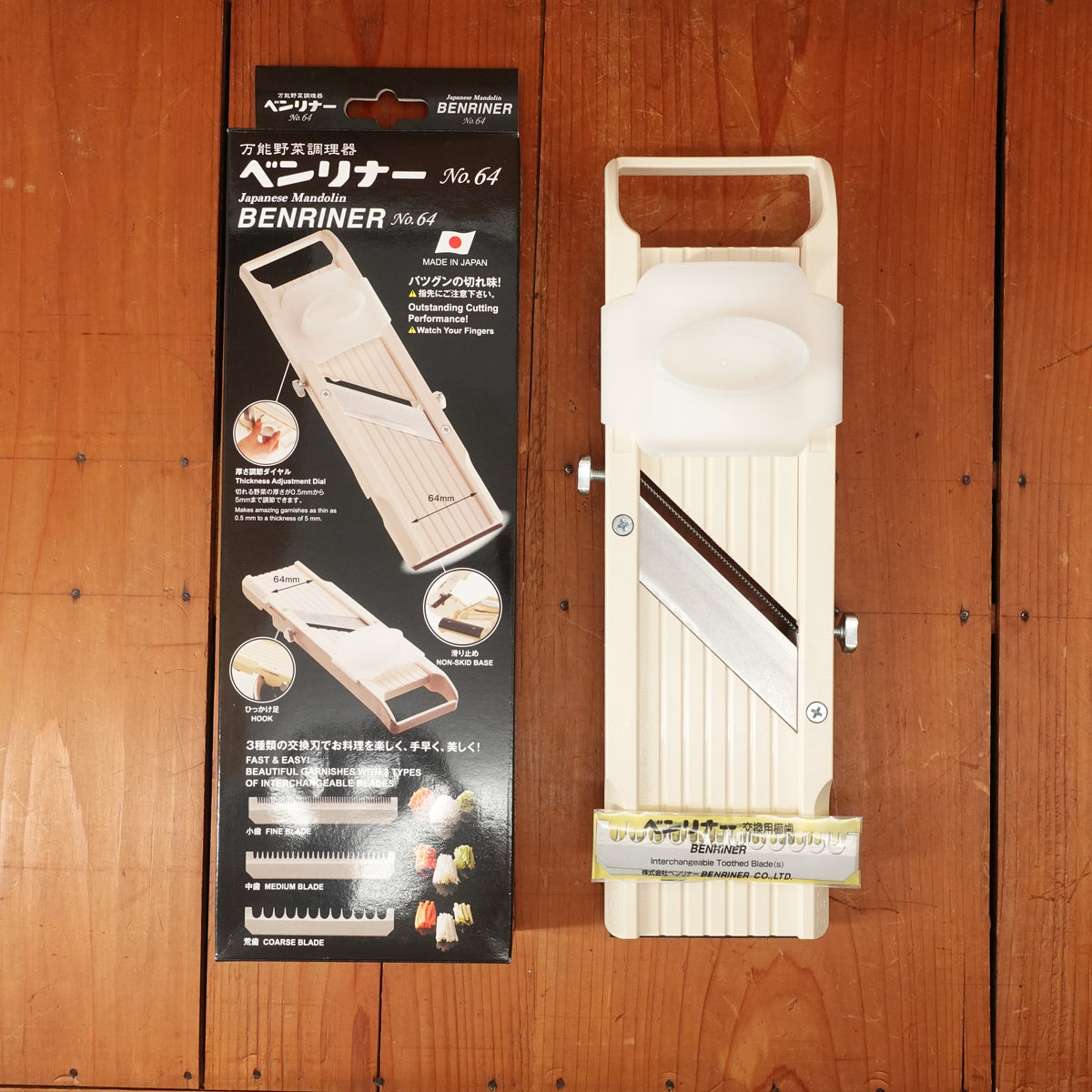
Benriner Japanese Mandoline Slicer No. 64
Best Precision Slicer: The Benriner No. 64 is the professional standard for a reason — the single flat high-carbon stainless blade at 0–3 mm produces translucent daikon and cucumber slices nothing else in this price range can match.
Top picks ↓Top picks
Related articles


Benriner Japanese Mandoline Slicer No. 64
Professional-kitchen pick — flat single blade, 0-3 mm precision adjustment, sharpest blade in this comparison. No julienne blade included; cut guard loses grip on produce under 6 cm; does not fold for storage.
The Benriner No. 64 is the professional standard for a reason — the single flat high-carbon stainless blade at 0–3 mm produces translucent daikon and cucumber slices nothing else in this price range can match. The cut guard works for produce above 6 cm; below that you need extra caution or a cut-resistant glove.
Pros
- ✓Sharpest blade in the comparison — cleanest shear cuts on firm vegetables at any thickness
- ✓0.5 mm minimum produces translucent daikon and cucumber that rivals professional prep
- ✓Professional-kitchen standard since the 1960s — long-term parts and blade support available
Cons
- ✗No julienne blade included; cut guard loses grip on produce under 6 cm; does not fold for storage
Score breakdown
| Blade type | Single flat high-carbon stainless |
| Hardness | ~62 HRC |
| Thickness range | 0–3 mm |
| Minimum thickness | 0.5 mm |
| Dimensions | 28 × 9 cm |
| Storage | Fixed frame — does not fold |

OXO Good Grips Chef's Mandoline Slicer 2.0
Best cut guard design — spike-array holder grips produce to 4 cm, folds flat for drawer storage, includes julienne attachment. 8 mm maximum thickness; julienne performance weaker on soft produce.
The OXO Chef's Mandoline 2.0 is the best-engineered product in this comparison for cooks who will actually use the cut guard every time. The spike-array food holder grips produce down to 4 cm, the folding profile fits a kitchen drawer, and the julienne attachment covers most use cases beyond plain slicing.
Pros
- ✓Best cut guard design — spike-array holder grips produce to 4 cm reliably
- ✓Folds flat to ~4 cm depth for standard kitchen drawer storage
- ✓Julienne blade (2 mm strips) included without additional purchase
Cons
- ✗Maximum 8 mm thickness; julienne performance weaker on soft produce like ripe tomatoes
Score breakdown
| Blade type | 18/10 stainless straight + julienne |
| Hardness | ~52–54 HRC |
| Thickness range | 1–8 mm |
| Cut guard | Spike-array, grips to 4 cm |
| Folds | Yes — 4 cm storage profile |
| Julienne | 2 mm × 2 mm included |

Kyocera Advanced Ceramic Adjustable Mandoline
Ceramic blade specialty pick — 70 HRC holds edge longer than steel, no metallic taste, 1-3.5 mm range. Blade chips on seeds; narrowest thickness range in this comparison; weakest cut guard.
The Kyocera ceramic mandoline excels in one specific zone: 1–3 mm slices of cucumbers, radishes, and daikon where the zirconia blade produces no metallic taste and holds its edge longer than steel. Outside that zone — thick cuts, hard squash, anything with seeds — the ceramic blade's brittleness is a real limitation.
Pros
- ✓Zirconia ceramic at ~70 HRC — harder than any steel blade, no metallic taste on acidic produce
- ✓Rust-free ceramic requires almost no edge maintenance between uses
- ✓Best in class for 1–3 mm cucumber and daikon slices for Japanese preparation
Cons
- ✗Blade chips on seeds and hard-skin squash; narrowest range (1–3.5 mm); weakest cut guard in comparison
Score breakdown
| Blade type | Zirconia ceramic |
| Hardness | ~70 HRC |
| Thickness range | 1–3.5 mm |
| Adjustment | 0.5 mm increments |
| Cut guard | 4-prong paddle |
| Rust-free | Yes |

Swissmar Borner V-Power Mandoline Slicer
Hard root vegetable pick — V-blade handles carrots and beets fast, fixed stops at 3/5/7/9 mm prevent setting creep, strongest cut guard. No fine adjustment between fixed settings.
The Borner V-Power's V-blade geometry handles hard root vegetables — carrots, beets, kohlrabi — faster and more cleanly than any flat-blade design in this comparison. The safety holder is the strongest cut guard here, gripping produce down to 3 cm including cherry tomatoes. Fixed-stop settings prevent dial creep but limit fine adjustment.
Pros
- ✓V-blade cuts hard root vegetables faster than flat-blade designs
- ✓Strongest cut guard — grips to ~3 cm, handles cherry tomatoes and small produce
- ✓Fixed stops at 3/5/7/9 mm prevent setting creep during use
Cons
- ✗No fine adjustment between fixed stops — can't hit 4 mm or 6 mm settings
Score breakdown
| Blade type | V-blade German stainless |
| Hardness | ~56–58 HRC |
| Thickness range | Paper-thin, 3/5/7/9 mm (fixed stops) |
| Cut guard | Multi-spike safety holder, grips to 3 cm |
| Folds | Yes |
| Julienne | Optional insert |

Mueller Austria V-Pro Multi Blade Mandoline
Budget multi-blade pick — five interchangeable blades including waffle and grater at the lowest price. 420-grade steel softens by 6 months of regular use; shorter prong cut guard loses grip on smooth produce under 5 cm.
The Mueller V-Pro bundles five interchangeable blades at the lowest price in this comparison — it's the best first mandoline for households unsure of how often they'll use one. The 420-grade steel softens noticeably by 6 months of regular use, and the cut guard loses grip on smooth produce under 5 cm.
Pros
- ✓Five interchangeable blades including waffle/crinkle and grater — most versatility at lowest price
- ✓Continuous 0.5–8 mm dial covers the widest thickness range in this comparison
- ✓Best entry point for households testing mandoline use frequency before committing
Cons
- ✗420-grade steel softens after 6 months of regular use; shorter prong cut guard loses grip on smooth produce under 5 cm
Score breakdown
| Blade type | 420 stainless (5 interchangeable blades) |
| Hardness | ~50–52 HRC |
| Thickness range | 0.5–8 mm continuous |
| Blades | Straight, julienne 2mm, julienne 4mm, waffle, grater |
| Cut guard | 6-prong frame |
| Folds | Yes |
Which one is right for you?
For home cooks making daikon and cucumber dishes
Benriner Japanese Mandoline Slicer No. 64
The flat blade and 0.5 mm minimum setting were designed specifically for this application — nothing else in this comparison produces translucent daikon as cleanly.
For cooks who want the safest home mandoline experience
OXO Good Grips Chef's Mandoline Slicer 2.0
The redesigned spike-array cut guard and folding design make it the most injury-resistant mandoline in this comparison for cooks not using professional technique.
For households buying their first mandoline on a budget
Mueller Austria V-Pro Multi Blade Mandoline
Five blades and the lowest price make it the lowest-commitment way to discover whether a mandoline actually fits your cooking before spending more.
What a mandoline is actually good for (and the honest safety context)
A mandoline slicer is a fixed-blade cutting tool where food moves across the blade rather than the blade moving across food. The mechanism produces uniformly thin slices — typically 0.5 mm to 9 mm depending on the model — at a speed and consistency that knife skills can approach but rarely match for high-volume work. The foods where a mandoline is genuinely superior to a knife: potato gratins (where uniform 2 mm slices cook evenly), fennel for salads (shaved thin, impossible to achieve with a knife at speed), cucumber and radish for garnish (paper-thin rounds), cabbage for coleslaw (1-2 mm consistent throughout), and Japanese dishes like sunomono and daikon namasu where the consistent cut is part of the aesthetic.
The safety context matters more for mandolines than for almost any other kitchen tool. Emergency room data consistently shows mandoline slicers among the top causes of serious kitchen lacerations — the combination of a razor-sharp fixed blade, food moving at speed, and a food holder that most users ignore after the first few uses produces predictable injuries. The cut guard (also called the food holder or handguard) on each model in this comparison is evaluated not as a nice-to-have accessory but as a primary safety feature. Models where the cut guard is awkward to use or incompatible with common food sizes will be noted clearly, because this is the mechanism through which skilled users hurt themselves — they abandon the cut guard when it stops gripping the food and slice freehand for the last 3-4 cm of each vegetable.
Benriner Japanese Mandoline Slicer No. 64
The Benriner No. 64 is the mandoline that professional kitchens in Japan have defaulted to since the 1960s, and the design rationale remains sound: a single high-carbon stainless steel blade fixed at a shallow angle, a sliding platform with two grip strips, and a simple dial that adjusts thickness from 0 to 3 mm in small increments. The blade geometry — flatter than the angled V-blades on European designs — produces a cleaner shear cut on firm vegetables rather than the slight wedge-crush that occurs when food contacts a V-blade at speed. At 0.5 mm minimum, it produces translucent radish and cucumber slices that are difficult to replicate on any competitor in this price range.
The cut guard on the Benriner No. 64 is a flat plastic plate with two stainless prongs. It grips carrots, daikon, and cucumbers reliably but loses grip on shorter or irregular produce below about 6 cm — this is when most injuries happen with this model. The unit does not fold: it is a fixed 28 × 9 cm frame that stores flat but does not collapse. Professional users accept this because the blade is the sharpest in this comparison and the adjustment mechanism is the most precise, but home users with limited drawer space may find the Benriner awkward to store compared to folding alternatives.
The No. 64 does not include julienne or waffle blade attachments — it is a pure slicing tool. Users who want julienne capability will need to buy optional blades separately (available from Benriner dealers). It is the most expensive in this comparison — the premium pick — and the right choice for users who prioritize blade sharpness and Japanese-style precision slicing over multi-function versatility.
OXO Good Grips Chef's Mandoline Slicer 2.0
The OXO Chef's Mandoline 2.0 is the best-engineered cut guard system in this comparison. The food holder uses a stainless spike array rather than flat prongs, grips produce down to about 4 cm reliably, and the ergonomic handle design keeps fingers genuinely clear of the blade throughout the stroke. OXO redesigned the original Chef's Mandoline specifically because the first version's cut guard was too narrow for full-size vegetables — the 2.0 version widened the spike plate and added a pivot that keeps it parallel to the slicing surface regardless of produce shape.
The blade is 18/10 stainless steel hardened to approximately 52-54 HRC — sharper than the Mueller V-Pro but not quite at the Benriner level. Thickness adjustment runs from 1 mm to 8 mm via a dial mechanism, with good tactile feedback at each stop. The unit includes a straight blade and a julienne blade (2 mm × 2 mm strips) that swaps in without tools. It is the mid-range pick and the one we recommend most confidently for home cooks who will actually use the cut guard every time.
The OXO 2.0 folds flat — the slicing bed folds down to a storage profile of about 4 cm thickness — which makes it practical for kitchen drawer storage. The rubber feet on the base are wide and grip cutting boards reliably even when applying lateral force. Primary weakness: the julienne attachment produces inconsistent strips on soft produce like ripe tomatoes, and the maximum 8 mm thickness is lower than the Swissmar Borner (up to 9 mm) and inadequate for thick-cut potato chips.
Kyocera Advanced Ceramic Adjustable Mandoline
Kyocera's mandoline uses a zirconia ceramic blade rather than stainless steel — the same material Kyocera uses in their kitchen knives — which produces a blade hardness of approximately 70 HRC, harder than any steel blade in this comparison. Ceramic at this hardness holds a sharp edge substantially longer than steel before requiring honing, does not impart any metallic taste to food (relevant for acidic produce like tomatoes and citrus), and does not rust. The trade-off is brittleness: ceramic blades chip on seeds, thick-skinned squash, and anything that requires lateral pressure rather than a clean perpendicular slice.
The Kyocera mandoline adjusts from 1 mm to 3.5 mm in 0.5 mm increments using a dial on the underside of the slicing bed. The range is narrower than any other model in this comparison — no setting below 1 mm and nothing above 3.5 mm — which makes it unsuitable for paper-thin slicing or thick-cut applications. Where it excels is in the 1-3 mm range for cucumbers, radishes, daikon, and zucchini where the ceramic blade produces exceptionally clean cuts without the slight compression that occurs with steel blades on watery vegetables.
The cut guard is a flat plastic paddle with four short prongs — functional but the weakest guard design in this comparison. It loses grip on produce below 5 cm and does not hold round vegetables like baby potatoes reliably. The Kyocera is the specialty pick: right for cooks who specifically want a ceramic blade for maintenance longevity and flavor purity, wrong for anyone who needs thick-cut capability or a strong cut guard.
Swissmar Borner V-Power Mandoline Slicer
The Borner V-Power uses a V-shaped blade configuration — two angled blade segments meeting at the center of the slicing path — rather than a flat single blade. The V geometry initiates the cut at a center point and draws food outward toward the blade edges, which produces faster cutting speed on hard vegetables like raw carrots, beets, and kohlrabi compared to flat-blade designs. This is why Borner mandolines became standard in German home kitchens and developed a loyal following among cooks who deal with hard root vegetables regularly.
The blade is German stainless steel hardened to approximately 56-58 HRC. Thickness range is 3 to 9 mm across four fixed settings (3, 5, 7, 9 mm) plus a paper-thin setting — the fixed-stop design produces extremely consistent slices within each setting but does not allow fine adjustment between settings. This is a deliberate engineering choice: Borner argues that fixed stops eliminate the risk of the adjustment dial creeping during use, which can happen with continuous-dial designs under lateral pressure. The lack of fine adjustment between 3 mm and 5 mm is the primary ergonomic complaint in long-term reviews.
The cut guard — called the safety holder — is the most substantial in this comparison: a large frame with a multi-spike platform that grips produce down to approximately 3 cm, including small items like cherry tomatoes and Brussels sprouts that defeat smaller cut guards. Folds flat for storage. The Borner V-Power is the right pick for hard root vegetables and cooks who want consistent fixed-stop thickness settings; less suited for paper-thin applications or continuous-dial adjustment preference.
Mueller Austria V-Pro Multi Blade Mandoline
The Mueller V-Pro is the multi-function pick in this comparison: it ships with five interchangeable blade attachments (straight slicer, julienne 2 mm, julienne 4 mm, waffle/crinkle cut, and grater) that cover more cutting modes than any other model here. The blade swap mechanism uses a color-coded insert system and requires no tools. For a household that wants one tool to handle slicing, julienning, and waffle-cutting without buying separate attachments, the Mueller bundles this capability at the lowest price in this comparison.
The blade steel is 420-grade stainless hardened to approximately 50-52 HRC — softer than the OXO, Benriner, and Borner — which means the edge requires more frequent honing to maintain slicing performance, particularly on hard vegetables. Out of the box the blade is sharp; by the six-month mark with regular use, the difference from a Benriner or OXO becomes noticeable on thin settings where a slightly dull blade crushes rather than shears watery vegetables. The thickness range covers 0.5 mm to 8 mm via a continuous dial.
The cut guard is a plastic frame with six short prongs — adequate for most produce but the prongs are shorter than the OXO or Borner designs and lose grip on smooth-skinned produce below 5 cm. The Mueller V-Pro is the budget entry point for anyone who wants multi-blade versatility without committing to a premium unit. It is the right first mandoline for a household that is not sure how often they will use one; the wrong pick for serious cooking where blade longevity and thin-setting precision matter.
Which mandoline fits your kitchen
For precision thin slicing in a compact home kitchen — paper-thin daikon for sunomono, translucent radish for garnish, 1 mm potato for gratin — the premium Benriner No. 64 is the correct tool. The blade is the sharpest in this comparison, the adjustment mechanism is the most precise at thin settings, and the professional-kitchen heritage means long-term parts support. Accept the trade-offs: no julienne blade without a separate purchase, no folding for storage, and a cut guard that requires more careful technique than the OXO.
For a household that wants the best safety engineering alongside capable slicing, the mid-range OXO Good Grips Chef's Mandoline 2.0 is the recommended pick. The redesigned cut guard genuinely reduces injury risk for cooks who are not professional users, the folding design stores in a standard kitchen drawer, and the julienne attachment covers most use cases beyond plain slicing. The blade is not Benriner-sharp but is adequate for the 1-8 mm range that covers most home cooking applications.
For hard root vegetables and German-style fixed-setting precision, the Swissmar Borner V-Power is the right specialty choice. The V-blade handles carrots, beets, and kohlrabi faster and more cleanly than any flat-blade design in this list, and the safety holder is the strongest cut guard here. For ceramic blade longevity with limited thickness range, the Kyocera is the specialty pick. For a first mandoline on a budget with multi-blade versatility, the Mueller V-Pro is the lowest-commitment entry point.