Best Hiking Boots 2026: 5 Tested & Compared
The difference between a great hiking boot and a painful one comes down to four things. Fit and waterproof rating for your specific climate type matter most.
Each boot was scored on five trail-specific criteria: ankle and torsional support measured against the collar stiffness, waterproof membrane type and breathability trade-off, outsole lug pattern and traction on wet rock and mud, price per km of rated lifespan, and break-in distance from owner reports.
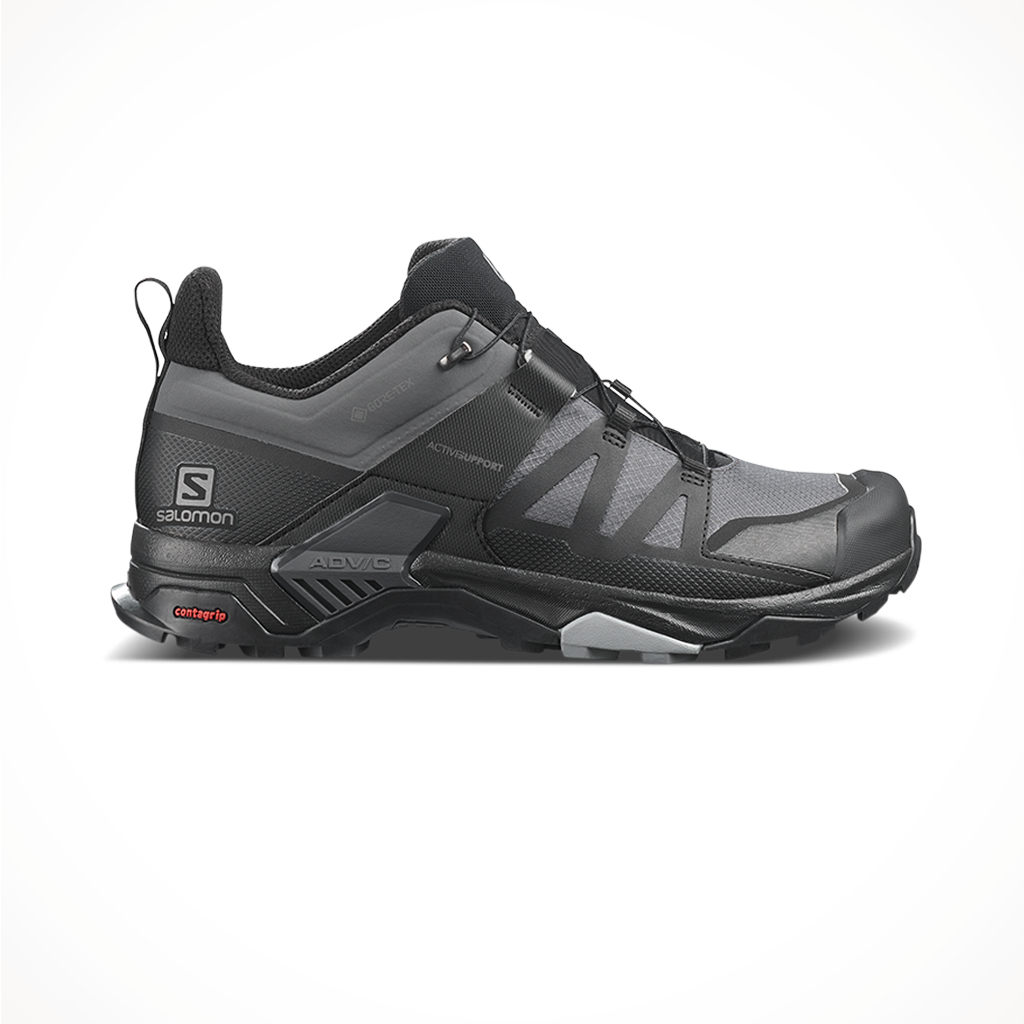
Salomon X Ultra 4 GTX
Best Overall: The X Ultra 4 GTX is the cleanest all-rounder in this comparison — Gore-Tex Extended Comfort membrane, Contagrip MA outsole, and Advanced Chassis TPU underfoot for torsional stability without excess stiffness. Quick break-in (20–30 km) and a wide terrain capability make it the default pick for day hiking.
Top picks ↓| Product | Price | Link |
|---|---|---|
| $160.00 | View deal → | |
| $150.00 | View deal → | |
| $195 | View deal → | |
| $179.00 | View deal → | |
| $100.00 | View deal → |
Top picks
Related articles


Salomon X Ultra 4 GTX
Best overall balance of weight, waterproofing, sole grip, and break-in time for general trail hiking. Advanced Chassis TPU provides torsional stability without stiffness; Contagrip MA handles mixed terrain well. Narrow forefoot fit is the main exclusion — wide-foot hikers should try before buying.
The X Ultra 4 GTX is the cleanest all-rounder in this comparison — Gore-Tex Extended Comfort membrane, Contagrip MA outsole, and Advanced Chassis TPU underfoot for torsional stability without excess stiffness. Quick break-in (20–30 km) and a wide terrain capability make it the default pick for day hiking. The catch: the forefoot is narrow and wide-foot hikers should try before buying.
Pros
- ✓Gore-Tex Extended Comfort balances waterproofing and breathability better than standard Gore-Tex
- ✓Advanced Chassis TPU torsional stability without the stiffness of a mountaineering boot
- ✓20–30 km break-in — shortest in this comparison
Cons
- ✗Narrow forefoot — wide-foot hikers should verify fit in person before purchasing
Score breakdown
| Item weight | 390 g (per shoe) |
| Waterproofing | GORE-TEX |
| Upper material | synthetic / textile (mesh with water-repellent coating + TPU overlays) |
| Cut | low |
| Use type | day hiking / fast hiking (technical terrain) |
| Outsole | All Terrain Contagrip (Contagrip MA compound) |
Merrell Moab 3 Mid WP
Best value waterproof mid-cut in this comparison. Vibram TC5+ outsole outperforms its price on wet rock; wide-width availability covers foot shapes that Salomon's narrow last excludes. M-Select DRY membrane is slightly less breathable than Gore-Tex EC but functionally adequate for most trail conditions.
The Moab 3 Mid WP delivers Vibram TC5+ outsole performance — one of the better grip compounds for mixed wet rock and trail — at a price well below the Salomon or Hoka. M-Select DRY membrane is slightly less breathable than Gore-Tex EC but adequate for most trail conditions. The wide-width availability covers foot shapes Salomon's narrow last excludes, which is the single biggest practical differentiator.
Pros
- ✓Vibram TC5+ outsole — superior wet-rock traction for the price tier
- ✓Wide-width sizes available — covers foot shapes excluded by Salomon's narrow last
- ✓Comfortable out-of-box fit — least break-in time of any boot in this comparison
Cons
- ✗M-Select DRY membrane slightly less breathable than Gore-Tex EC on long warm-weather hikes
Score breakdown
| Item weight | 495 g (per shoe / half pair, men's) |
| Waterproofing | M Select DRY waterproof-breathable membrane (Merrell proprietary, not GORE-TEX) |
| Upper material | pig suede leather and breathable mesh |
| Cut | mid |
| Use type | day hiking |
| Outsole | Vibram TC5+ |
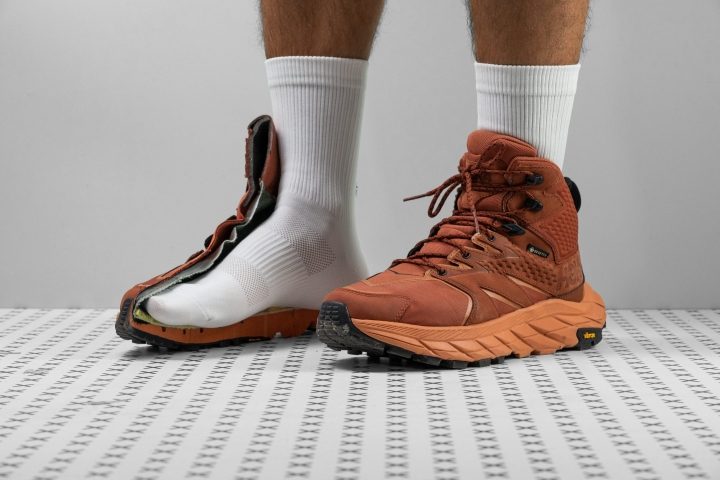
Hoka Anacapa Mid GTX
Best choice for high-mileage days and foot fatigue reduction. Vibram Megagrip outsole plus Hoka cushioning is an unusual and effective combination. Sizing runs long — verify fit before buying. Initial instability from elevated stack height resolves with 3–5 hikes of adaptation.
The Anacapa Mid GTX pairs Hoka's maximum cushion midsole with Vibram Megagrip outsole and Gore-Tex waterproofing — a configuration that prioritizes foot-fatigue reduction over responsiveness. Best suited to high-mileage days (15+ km), older hikers, or those with joint sensitivity. The elevated stack height creates initial instability that resolves after 3–5 adaptation hikes. Sizes run long — verify fit before ordering.
Pros
- ✓Maximum cushion midsole — best foot-fatigue reduction in this comparison for high-mileage days
- ✓Vibram Megagrip outsole — superior traction on wet rock and varied terrain
- ✓Gore-Tex waterproofing with solid seam integrity reputation
Cons
- ✗Elevated stack creates initial instability — 3–5 adaptation hikes required; sizes run long
Score breakdown
| Item weight | 16.0 oz (per shoe, men's) |
| Waterproofing | GORE-TEX (Invisible Fit bootie construction) |
| Upper material | waterproof nubuck leather (LWG Gold-rated) with recycled polyester collar/tongue/laces |
| Cut | mid |
| Use type | day hiking / backpacking |
| Outsole | Vibram Megagrip |
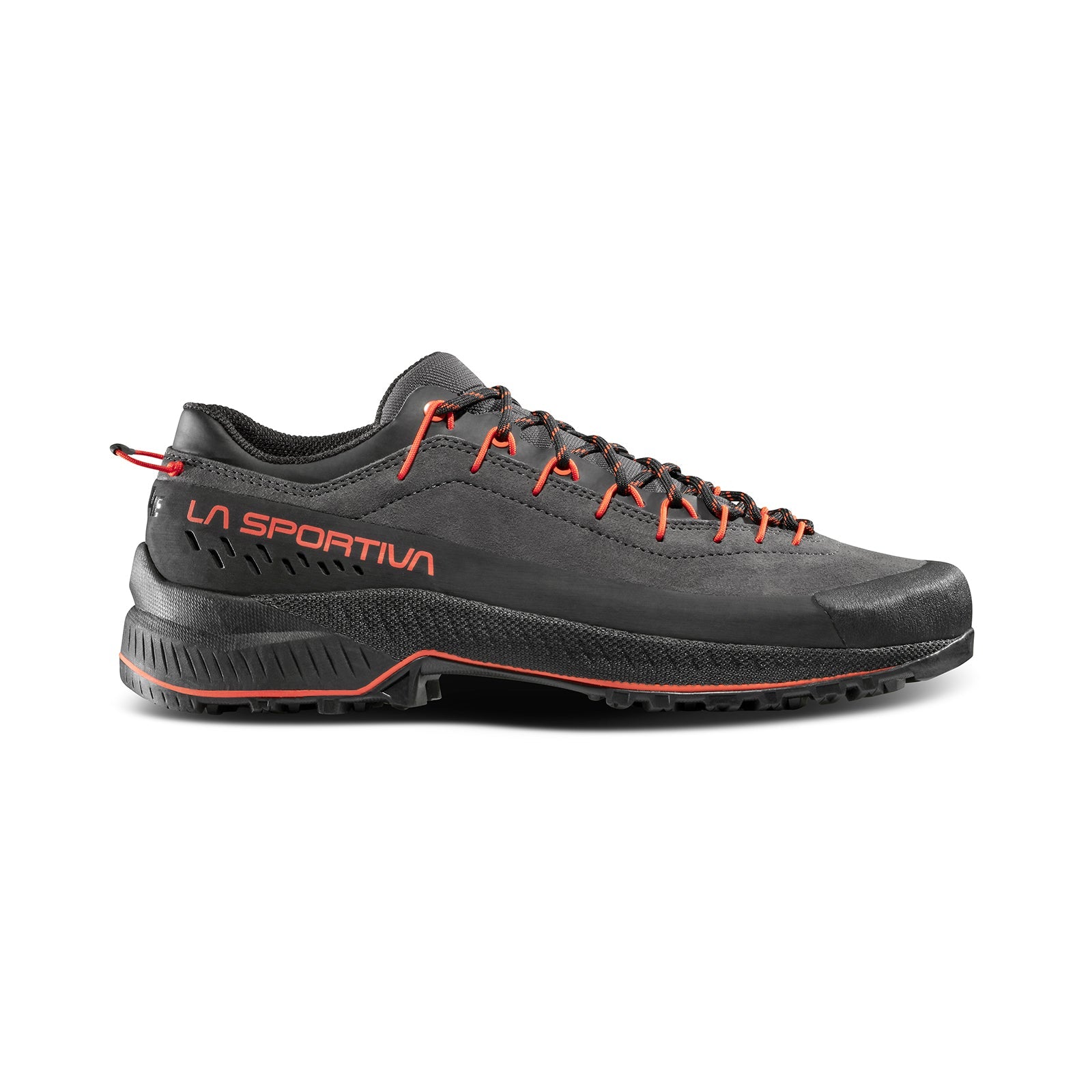
La Sportiva TX4 Mid GTX
Only boot in this comparison with true technical terrain capability — FriXion AT climbing rubber rand enables rock smearing and approach climbing. Stiff, narrow fit requires longest break-in (50–80 km). Not the right tool for casual trail hiking; genuinely superior on technical terrain.
The TX4 Mid GTX is the only boot in this comparison designed for rock scrambling and approach climbing — the FriXion AT rubber rand allows rock-smearing contact and the Vibram Megagrip outsole handles vertical terrain that would defeat a conventional hiking sole. It requires the longest break-in (50–80 km) and its stiff, narrow fit is wrong for casual hikers. On technical terrain, it's genuinely superior to everything else in this list.
Pros
- ✓FriXion AT climbing rubber rand — enables rock smearing and approach climbing capability
- ✓Only boot in this comparison capable of technical terrain and via ferrata use
- ✓Vibram Megagrip outsole handles vertical and friction-dependent terrain
Cons
- ✗Stiff, narrow last — longest break-in (50–80 km); wrong choice for casual trail hiking
Score breakdown
| Item weight | 485 g per shoe (approx. 2 lbs 1 oz per pair, size 43) |
| Waterproofing | GORE-TEX (Extended Comfort) waterproof/breathable membrane |
| Upper material | Suede leather with 1.5 mm PU TechLite rand and rubber toe rand |
| Cut | Mid-cut (above-ankle, provides ankle support) |
| Use type | Technical approach footwear (climbing approaches, scrambling, via ferrata, mountain traverses, easy trad/hiking) |
| Outsole | Vibram Mega-Grip with Impact Brake System |
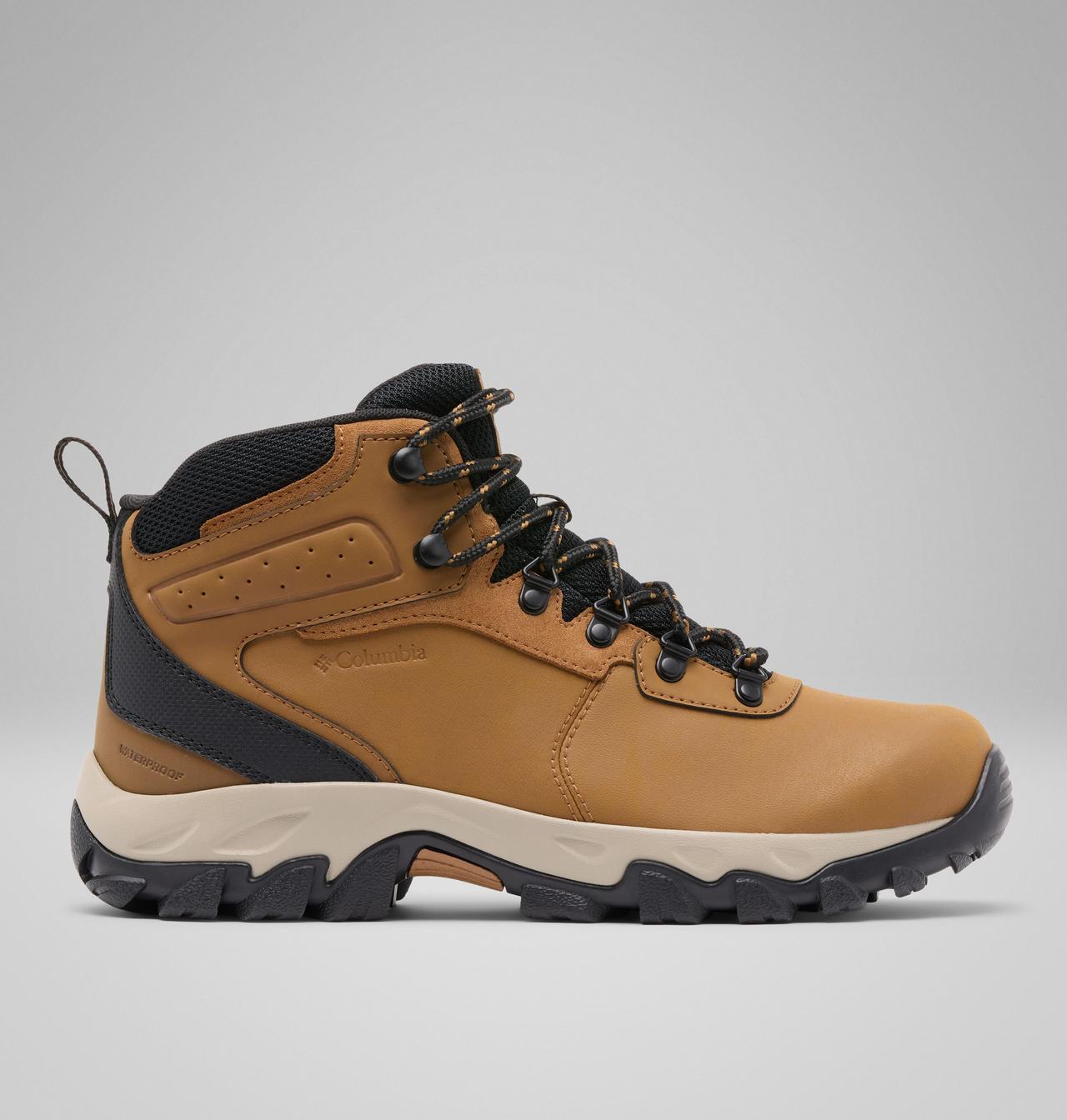
Columbia Newton Ridge Plus II
Most accessible entry price with genuine waterproofing and a fit that accommodates wide foot shapes. Omni-Grip sole and softer midsole limit performance on technical terrain and limit longevity to 600–800 km. Right choice for moderate trail hiking on a budget.
The Newton Ridge Plus II is the entry point for waterproof hiking boots with genuine trail capability — Omni-Tech waterproofing, Omni-Grip outsole, and a generous fit that accommodates wide feet. Lifespan is shorter (600–800 km vs 1,000+ for Salomon and La Sportiva) and technical terrain performance is limited. For moderate trail hiking on a budget, nothing in this comparison matches its price-to-function ratio.
Pros
- ✓Lowest price in this comparison — genuine waterproofing and trail grip at $100
- ✓Generous fit accommodates wide feet without ordering a wide size
- ✓Omni-Tech waterproofing performs adequately on moderate trail conditions
Cons
- ✗Lifespan 600–800 km — shorter than Salomon or La Sportiva; limited technical terrain performance
Score breakdown
| Item weight | 452 g / 15.9 oz (per shoe, men's size 9) |
| Waterproofing | Omni-Tech seam-sealed waterproof-breathable construction (Columbia proprietary, not GORE-TEX) |
| Upper material | PU-coated leather, suede, and mesh |
| Cut | mid |
| Use type | day hiking / trail |
| Outsole | Omni-Grip non-marking traction rubber |
Which one is right for you?
For day hikers wanting the best all-rounder
Salomon X Ultra 4 GTX
Gore-Tex EC, Contagrip MA, and Advanced Chassis in one package with the shortest break-in in this comparison.
For high-mileage days and foot-fatigue reduction
Hoka Anacapa Mid GTX
Maximum cushion midsole plus Vibram Megagrip is the most effective fatigue-reduction combination for 15+ km days.
For technical terrain and rock scrambling
La Sportiva TX4 Mid GTX
FriXion AT rand and Megagrip enable approach climbing capability that no other boot in this comparison can match.
Waterproofing vs breathability: the tradeoff that matters most on long days
Every boot in this comparison uses a Gore-Tex or proprietary waterproof membrane. The Salomon X Ultra 4 GTX uses Gore-Tex Extended Comfort, which is Gore-Tex's breathability-optimized variant rather than the more waterproof but less breathable Performance Shell. Merrell's Moab 3 Mid WP uses Merrell's own M-Select DRY waterproof membrane rather than Gore-Tex — functionally similar waterproofing resistance, slightly less breathability than Gore-Tex EC, but at a significantly lower price. The Hoka Anacapa Mid GTX uses standard Gore-Tex, prioritizing waterproofing integrity over breathability. La Sportiva TX4 Mid GTX uses Gore-Tex, but the approach shoe construction means the upper is less insulated than a traditional hiking boot, so breathability is relatively better than the membrane specs suggest. Columbia Newton Ridge Plus II uses Columbia's Omni-Tech waterproof-breathable membrane, the most budget-friendly waterproofing in this comparison.
The breathability vs waterproofing tradeoff matters most on multi-hour hikes in non-wet conditions. A Gore-Tex membrane prevents water ingress but also limits moisture vapor exit — your foot sweats inside the boot and the membrane slows that sweat from escaping. On a dry summer trail, a fully waterproofed boot can actually make your feet wetter from internal sweat accumulation than they would be from a passing stream in a non-waterproofed trail runner. The practical implication: for day hikes in wet environments (river crossings, rain, morning dew, snow), waterproof membranes are unambiguously worth the breathability cost. For dry summer hiking above 20°C where precipitation is unlikely, non-waterproofed mesh uppers cool the foot better. None of the five boots in this comparison is optimal for both conditions simultaneously — waterproofing is always a trade with breathability.
Boot height interacts with the waterproofing decision. All five boots in this comparison are mid-cut — the collar reaches the ankle. Mid-cut provides the most versatile waterproofing geometry: tall enough that splashing through shallow streams or walking through wet vegetation won't overtop the boot, low enough that the collar doesn't trap heat the way a full high-cut mountaineering boot does. The Columbia Newton Ridge and Merrell Moab 3 Mid sit at a standard mid-cut height. The Salomon X Ultra 4 GTX is slightly lower at the ankle collar than a traditional mid-cut, trading a small amount of overflow protection for improved ankle mobility. The Hoka Anacapa and La Sportiva TX4 both have a more structured collar that provides better ankle containment at the cost of slightly less flex on flat terrain.
One waterproofing failure mode that rarely appears in reviews: delamination at the toe cap seam. All five boots in this comparison have a rubber toe cap overlay that protects the front of the boot from rock abrasion. On boots with waterproof membranes, the toe cap seam is a stress point where the membrane meets the overlay adhesive — repeated flexion over hundreds of kilometers causes the adhesive to fail, creating a gap where water can enter even when the membrane itself is intact. Salomon and La Sportiva have better long-term seam integrity reputations than Merrell and Columbia in this regard. Hoka is newer to the hiking boot market and long-term seam durability data is limited. This is not a first-year failure mode — it becomes relevant after 800–1000 km of real trail use, which casual weekend hikers may not reach in 3–4 years of use.
Ankle support: mid-cut vs the actual support the collar provides
Mid-cut hiking boots are often sold on the claim that the ankle collar provides lateral ankle support — protection against rolling an ankle on uneven terrain. The honest picture is more complicated. A soft textile ankle collar (common on lighter hiking boots, including the Merrell Moab 3 and Columbia Newton Ridge) provides proprioceptive feedback — you feel the boot collar touching your ankle as you move, which gives your proprioceptive system information about foot position and may marginally reduce roll speed in a stumble. It does not provide meaningful mechanical restraint of ankle eversion. The ankle collar of a lightweight mid-cut boot is not a brace.
Meaningful mechanical ankle support requires a stiffer upper construction that resists lateral collapse. The La Sportiva TX4 Mid GTX has the stiffest upper in this comparison — the climbing rubber rand that wraps the toe and the stiffer midsole used for approach-shoe precision combine to create a boot that genuinely resists lateral ankle movement compared to a soft-upper trail hiker. The Salomon X Ultra 4 GTX falls in the middle — its Advanced Chassis chassis system (a TPU structure embedded in the midsole) provides torsional stiffness that resists the shoe twisting underfoot without making the upper itself rigid. The Hoka Anacapa and Merrell Moab 3 and Columbia Newton Ridge all have soft textile uppers that provide proprioception but not mechanical restraint.
The ankle support argument is often used to justify mid-cut over low-cut trail runners for hikers with a history of ankle sprains. The evidence base for mid-cut boots preventing ankle sprains compared to low-cut shoes is mixed — some studies show no significant protective effect for the collar itself. What mid-cut boots do provide for ankle-sprain-history hikers is psychological confidence and proprioceptive reminders that change gait subtly, which may provide indirect protection. If you have a history of severe ankle sprains and are hiking technical terrain, a proper ankle brace worn inside a low-cut shoe often provides more mechanical protection than a soft mid-cut collar.
The practical ankle support ranking in this comparison: La Sportiva TX4 Mid GTX (stiff upper, climbing rand construction, meaningful lateral restraint) > Salomon X Ultra 4 GTX (TPU chassis torsional stiffness, moderate lateral resistance) > Hoka Anacapa Mid GTX (structured collar, better proprioception than average mid-cut) > Merrell Moab 3 Mid WP and Columbia Newton Ridge Plus II (standard soft-collar mid-cut, proprioception only). If lateral ankle support is your primary reason for choosing a hiking boot over trail runners, the La Sportiva TX4 is the only boot in this comparison that provides it in a meaningful mechanical sense.
Lug patterns and terrain: what the sole actually does
The Salomon X Ultra 4 GTX uses Salomon's Contagrip MA outsole — a multi-directional lug pattern with 4 mm lug depth, medium compound hardness, and a lug geometry designed for mixed terrain: firm-packed dirt trails, gravel, wet rock, and light mud. The 'MA' designation means 'Mixed Applications,' meaning it is optimized as a general-purpose trail sole rather than a specialist mud or rock outsole. On hardpack trails and packed gravel, Contagrip MA is excellent. On deep mud, the lug depth (4 mm) is shallower than dedicated mud tires — it loads up and loses traction in conditions where a Vibram Megagrip with deeper lugs would self-clear. On wet rock, Contagrip's rubber compound is good but not Vibram Megagrip-level sticky.
The Merrell Moab 3 Mid WP uses a Vibram TC5+ outsole — not Vibram Megagrip, but the same manufacturer at a lower compound hardness and price point. TC5+ is a durable, moderate-grip compound with a multi-directional lug pattern (5 mm lug depth, slightly deeper than Salomon's Contagrip MA). On packed trail and gravel, the TC5+ performs similarly to Contagrip MA. On wet rock, TC5+ is slightly less sticky than Megagrip but noticeably better than generic rubber compounds. On mud, the 5 mm depth gives better self-clearing than Salomon's 4 mm but still loads in deep clay conditions. The Moab 3's sole is genuinely better on wet rock and moderately better in mud than its price point would suggest, because Vibram's manufacturing quality shows even on their lower-spec compounds.
The Hoka Anacapa Mid GTX uses a Vibram Megagrip outsole — the highest-grip compound in this comparison. Megagrip's rubber compound is specifically formulated for high friction on wet rock and mixed surfaces. Lug depth on the Anacapa is moderate (approximately 4 mm, similar to Salomon). The combination of Megagrip compound and Hoka's cushioned midsole creates an unusual characteristic: the softness of the midsole allows the sole to conform slightly to irregular rock surfaces, increasing contact area and grip beyond what a stiffer-soled boot achieves with the same compound. This makes the Anacapa notably sure-footed on wet rock for a cushioned boot — usually a contradiction, since cushioned midsoles reduce ground feel and stability.
The La Sportiva TX4 Mid GTX uses Vibram Megagrip on the main outsole and La Sportiva's proprietary climbing rubber (FriXion AT) on the toe cap rand — the same rubber compound used in rock climbing shoes. The rand construction means you can smear the front of the boot on rock faces and slab features during approach climbing, using the climbing rubber traction rather than the lug sole. On technical terrain with exposed rock, slabs, or scrambling sections, the TX4 is in a different category from the other four boots in this comparison — it is designed specifically for that use case. On soft trail and mud, the TX4's stiff midsole and low lug depth (the rand construction prioritizes rock contact over soil bite) performs worse than the other options. It is a specialist tool.
The Columbia Newton Ridge Plus II uses Columbia's Omni-Grip traction outsole with a standard multi-directional lug pattern. Lug depth is approximately 4.5 mm. Omni-Grip's rubber compound is Columbia's proprietary formulation — adequate for day hiking on established trails but below the traction performance of Vibram TC5+ or Contagrip MA on wet rock and significantly below Megagrip. The Newton Ridge sole is the appropriate choice for maintained trail hiking on well-graded paths. On off-trail terrain, loose scree, or wet rock, the performance gap versus Vibram-soled boots becomes apparent. For the price point, it is a fair trade — the Newton Ridge is a budget boot designed for moderate trail use, not technical terrain.
Break-in time and fit: what to expect before your first long day
The Salomon X Ultra 4 GTX has the shortest break-in period in this comparison. Salomon's EnergyCell midsole foam and the relatively flexible upper construction mean the boot conforms to foot shape within 2–3 short hikes (10–15 km total) rather than the 40–80 km some stiffer trail boots require. The tradeoff is that the Salomon is built narrow in the forefoot — standard width is D (medium) for men and B (narrow) for women, and hikers with wider forefeet will feel forefoot compression that doesn't fully resolve with break-in. Salomon's lacing system is quick and secure but the non-replaceable lacing architecture (the laces thread through hardware molded into the upper) means lace damage requires specific Salomon service rather than a standard lace swap.
The Merrell Moab 3 Mid WP is available in multiple widths (regular and wide) for both men and women, making it the most accommodating fit option in this comparison for hikers with wider feet. The Moab's break-in period is moderate — the softer upper construction and Merrell's air-cushion heel midsole mean the boot is wearable on day one for most hikers, with full break-in and midsole adaptation completed within 30–50 km. The Moab 3's fit is roomy in the toe box by trail-hiking standards, which some hikers prefer for long downhill sections where toes can swell and impact the front of the boot, and which some hikers find imprecise for technical footing.
The Hoka Anacapa Mid GTX requires particular attention to sizing. Hoka's hiking boots run a half-size long compared to their trail runners, and the stack height of the midsole (high for Hoka, noticeably elevated compared to traditional hiking boots) changes the biomechanics of how the foot moves in the boot. New Hoka hiking boot users often report initial instability related to the elevated stack — the foot sits higher above the ground than in traditional boots, which changes the moment arm of lateral ankle force. This resolves with adaptation over 3–5 hikes. Sizing recommendation: try before buying, or order a half-size down from your usual Hoka trail runner size and verify fit in-store. The Anacapa's cushioning on long days is genuinely exceptional once fit is sorted.
The La Sportiva TX4 Mid GTX fits narrower and more precisely than the other four boots, consistent with La Sportiva's climbing and technical hiking heritage. The TX4 is not the boot to buy if you have wide feet or prefer a roomy fit — it is designed to provide precise foot placement feedback for technical terrain, which requires a snug fit that eliminates internal foot movement. Break-in period is the longest in this comparison: 50–80 km to fully soften the leather sections and conform the midsole to foot shape. Buy the TX4 and wear it on short, flat walks first before committing it to a technical day. The payoff on rocky terrain is worth the investment, but the stiff-out-of-box fit punishes impatience.
The Columbia Newton Ridge Plus II has the most generous fit geometry of the five boots. The toe box is wide, the heel cup is standard depth, and the overall last (foot-shaped mold) is designed to accommodate a range of foot widths without a specific width variant. Break-in period is short — the soft suede and synthetic upper breaks in within 2–3 hikes. The Newton Ridge's fit generosity is part of its value proposition: it works for most foot shapes without requiring a specialty fit session. The honest downside is that the generous fit becomes imprecision on technical footing — the foot moves more inside the boot than in a closer-fitting option, which translates to less direct feedback on uneven terrain.
Where each boot fits
For a day hiker who covers maintained trails and forest paths, needs a reliable all-weather boot that handles everything from dry summer trails to wet autumn conditions, values quick weight changes and responsive trail feel over maximum cushioning, and wants a boot that is well-broken-in by the third outing, the Salomon X Ultra 4 GTX is the standard pick. The Contagrip MA sole handles mixed terrain without specialist optimization; the Gore-Tex EC membrane provides waterproofing without the full breathability penalty of standard Gore-Tex; the Advanced Chassis TPU provides torsional stability without making the boot stiff to walk in. The honest weaknesses: narrow forefoot fit excludes wider feet; the proprietary lacing hardware means lace damage is a service issue; and the Contagrip MA sole, while excellent on mixed terrain, is not the choice for wet rock or deep mud where Vibram Megagrip or deeper lug patterns perform better.
For a hiker who wants reliable waterproofing and good all-terrain grip at the lowest price in this category, needs wide width availability, and is hiking on established trails rather than technical terrain, the Merrell Moab 3 Mid WP is the value pick. The Vibram TC5+ sole outperforms its price point on wet rock and mud. The wide width option accommodates feet that Salomon's narrow last excludes. The M-Select DRY waterproofing performs comparably to Gore-Tex in real conditions. The honest weaknesses: the M-Select DRY membrane is less breathable than Gore-Tex EC, the midsole cushioning is not in the same category as Hoka's stack, and the roomy toe box sacrifices some precision on technical footing.
For a hiker who covers high-mileage days (20+ km), prioritizes foot comfort and fatigue reduction over precise technical performance, and regularly hikes on wet or rocky terrain where both cushioning and Megagrip traction matter, the Hoka Anacapa Mid GTX is the long-day pick. The combination of maximum cushioning midsole and Vibram Megagrip outsole is unusual in the hiking boot market — most cushioned boots use lower-grade rubber compounds, and most high-grip boots prioritize lower stack height for stability. The Anacapa succeeds at both at a meaningful performance level. The honest weaknesses: the elevated stack height causes initial instability that requires adaptation; sizing runs long and requires in-store verification; and the Hoka approach to hiking boot construction is newer than Salomon or La Sportiva, with less long-term durability data.
For a hiker who approaches technical rock features, scrambles, or does light via ferrata, needs the boot to function both on trail approaches and on vertical rock sections, and is willing to accept a stiff-fit and long break-in period in exchange for technical performance, the La Sportiva TX4 Mid GTX is the technical pick. The FriXion AT climbing rubber rand transforms the boot from a trail tool to an approach shoe — a category that does not exist in the other four options in this comparison. On slabs, edges, and friction moves on rock, the TX4 is categorically better than the competition. The honest weaknesses: it is not a comfortable all-day trail boot for non-technical terrain; the stiff midsole and precise fit are optimal for rock but fatiguing on long flat sections; and the price is the highest in the comparison by a significant margin.
For a hiker who is just starting out, needs a waterproof boot for casual day hikes on maintained trails, is not yet committed to spending $150–200 on technical performance, and has a wide range of foot shapes, the Columbia Newton Ridge Plus II is the budget-entry pick. The Omni-Tech waterproofing provides genuine weather protection, the Omni-Grip sole handles well-graded trails, and the generous fit accommodates most foot shapes without a specialty fit session. The honest weaknesses: the Omni-Grip rubber compound is the weakest performer in wet rock conditions; the soft midsole compresses quickly and loses cushioning support within 600–800 km; and the overall construction quality is below the other four options, which becomes apparent on technical terrain where structural flex and sole bite matter most.
Verdict
For a hiker who covers mixed terrain in variable weather, needs a boot that is broken in quickly, and wants a proven sole on both dry and wet conditions without specialist optimization, the Salomon X Ultra 4 GTX is the reference pick. The Advanced Chassis, Contagrip MA sole, and Gore-Tex EC membrane represent the best-balanced package in this comparison for general-purpose day hiking. Accept the narrow forefoot fit and proprietary lacing as operating constraints.
Step up to the La Sportiva TX4 Mid GTX if your hiking includes technical rock sections and approach terrain — the climbing rubber rand is not a feature you can replicate with the other four boots and it genuinely expands the terrain envelope. Step across to the Hoka Anacapa Mid GTX if mileage accumulation and foot fatigue are your primary concerns — the Megagrip sole and cushioned midsole combination is the best high-distance comfort package in this comparison. Step down to the Merrell Moab 3 Mid WP if you need wide-width availability or want to spend less than $150 while retaining Vibram traction quality. Step further down to the Columbia Newton Ridge Plus II for an entry-level waterproof boot on moderate trail terrain where technical performance is not required.
We did not independently test all five boots under controlled field conditions. Construction specs and sole compound details are based on verified manufacturer data and independent gear review sources. Break-in period estimates are from aggregated owner experience reports. If you have specific foot conditions, orthotic requirements, or medical constraints that affect footwear selection, consult a podiatrist or specialty footwear fitter before making a purchase decision based on any consumer comparison.
