Best Food Dehydrators 2026: Excalibur vs Cosori vs Nesco
A food dehydrator removes moisture from food slowly at low temperature, preserving it for months without refrigeration and concentrating flavor in ways that no other cooking method replicates. Weekly usage frequency, not recipe variety, determines which spec actually matters.
Each dehydrator was evaluated on airflow design and drying evenness, temperature range and accuracy, tray capacity, noise level at operating distance, ease of cleaning, and long-term reliability based on documented user feedback.
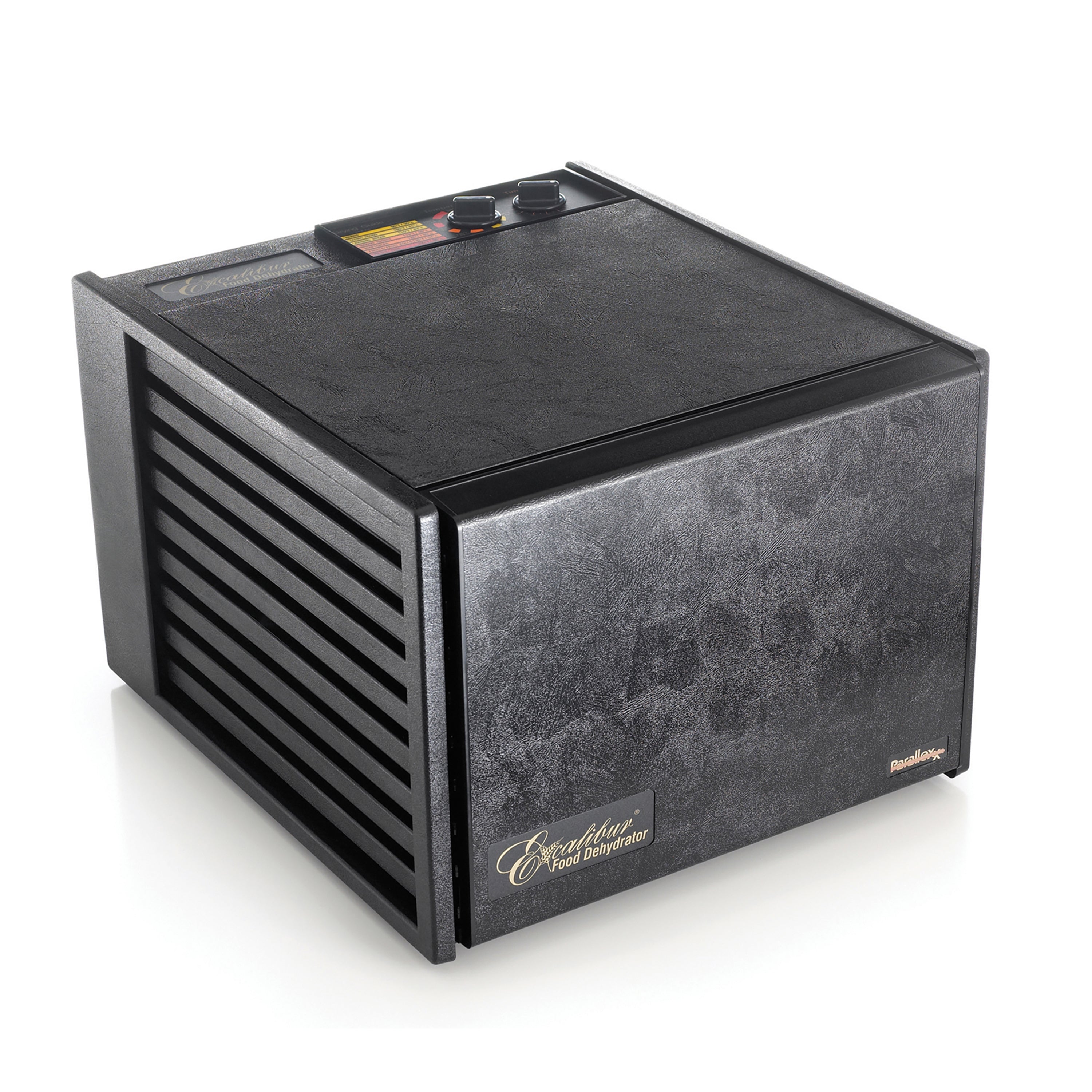
Excalibur 9-Tray Food Dehydrator
Best Overall: The Excalibur 9-Tray is the benchmark against which every other food dehydrator is measured. Rear-mounted horizontal airflow dries all 9 trays evenly without rotation, and 15 sq ft of drying space handles a full batch of jerky in one session.
Top picks ↓| Product | Price | Link |
|---|---|---|
| $200 | View deal → | |
| $100 | View deal → | |
| $60 | View deal → | |
| $60 | View deal → | |
| $250 | View deal → |
Top picks
Related articles
Excalibur 9-Tray Food Dehydrator
9 trays (15 sq ft total), rear-mounted fan, horizontal airflow, 95-165°F, digital thermostat, below 60 dB, dishwasher-safe trays, 10-year warranty. The category reference standard. Best for serious home dehydrators processing large batches of jerky, fruit, and herbs without tray rotation.
The Excalibur 9-Tray is the benchmark against which every other food dehydrator is measured. Rear-mounted horizontal airflow dries all 9 trays evenly without rotation, and 15 sq ft of drying space handles a full batch of jerky in one session. The trade-off is price ($200–$300) and counter footprint.
Pros
- ✓Rear-mounted fan with horizontal airflow — no tray rotation needed
- ✓15 sq ft capacity across 9 trays
- ✓Below 60 dB and 10-year warranty
Cons
- ✗$200–$300 price tag and large counter footprint
Score breakdown
| Price | ~$200–$300 |
| Trays | 9 (15 sq ft) |
| Airflow | Horizontal rear-fan |
| Temp range | 95–165°F |
| Noise | <60 dB |
| Warranty | 10 years |
| Tray material | Dishwasher-safe polycarbonate |
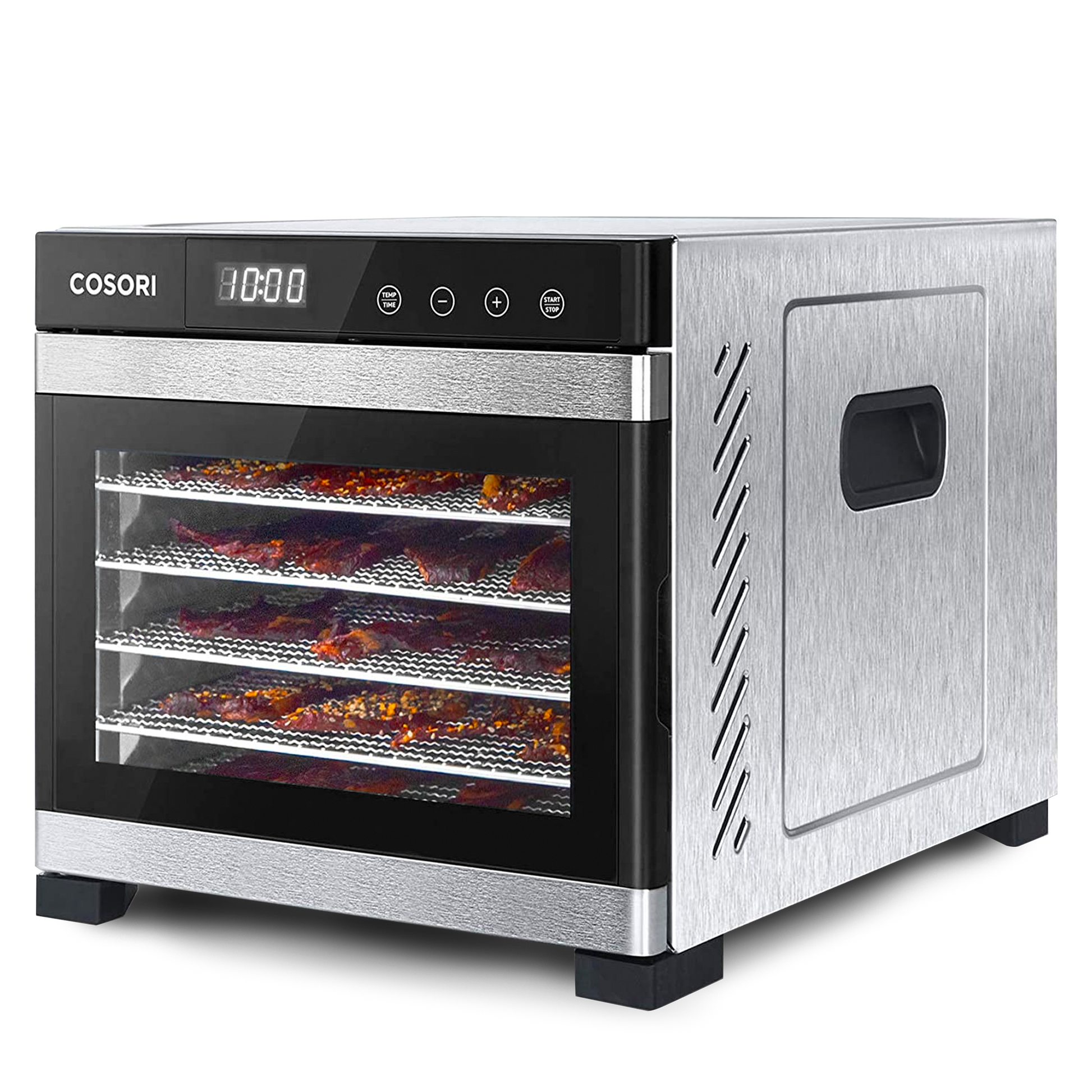
Cosori Premium Food Dehydrator 6-Tray
6 trays (~5.5 sq ft), horizontal airflow, 95-165°F, digital display shows set and actual temperature, 48-hour timer, transparent door. Best value horizontal-airflow dehydrator for households that dehydrate occasionally rather than in bulk.
The Cosori Premium 6-Tray brings horizontal airflow at $100–$150 — half the Excalibur's price with proportionally smaller capacity. The dual-readout digital display (set temp and actual temp simultaneously) is a genuinely useful feature for monitoring cycles. Best for households that dehydrate occasionally rather than in bulk.
Pros
- ✓Horizontal airflow — no tray rotation
- ✓Dual-readout digital display shows set and actual temperature
- ✓48-hour timer with transparent door
Cons
- ✗6 trays vs Excalibur's 9 — smaller batch capacity
Score breakdown
| Price | ~$100–$150 |
| Trays | 6 (~5.5 sq ft) |
| Airflow | Horizontal |
| Temp range | 95–165°F |
| Timer | 48 hours |
| Display | Dual-readout digital |
| Door | Transparent |
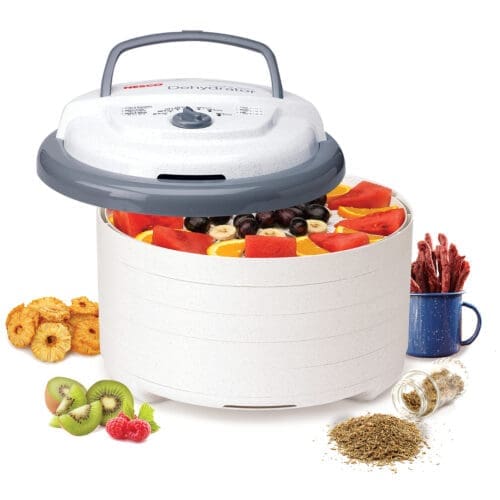
Nesco Snackmaster Pro Food Dehydrator
5 circular trays (expandable to 12), vertical airflow, 95-160°F analog thermostat, expandable capacity. Requires tray rotation for even drying. Best for buyers who want to start small and expand capacity without buying a new machine.
The Nesco Snackmaster Pro is Amazon's most-reviewed dehydrator and has been in production for decades. Its unique advantage is expandability — start with 5 circular trays and add up to 12 without buying a new machine. Vertical airflow means tray rotation is required for even drying, which is the key trade-off versus horizontal-airflow units.
Pros
- ✓Expandable from 5 to 12 trays without buying a new machine
- ✓Most-reviewed dehydrator on Amazon
- ✓Compact circular trays store easily
Cons
- ✗Vertical airflow requires tray rotation for even drying
Score breakdown
| Price | ~$60–$90 |
| Trays | 5 (expandable to 12) |
| Airflow | Vertical top-mounted |
| Temp range | 95–160°F |
| Controls | Analog dial |
| Rotation required | Yes |
| Shape | Circular trays |
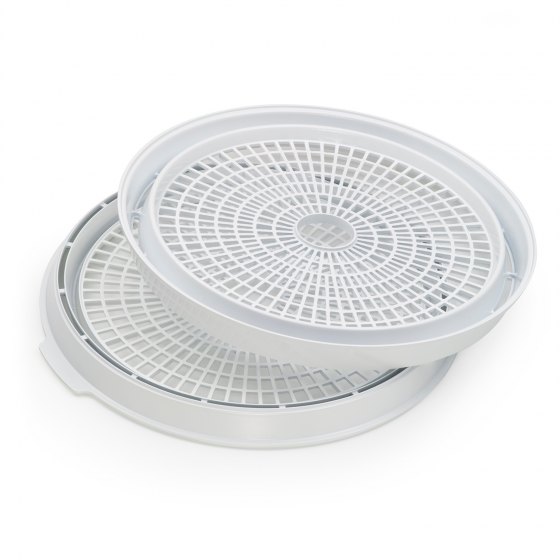
Presto Dehydro Digital Food Dehydrator
6 circular trays, vertical airflow, digital thermostat and timer, entry-level price. Requires tray rotation. Best as a trial purchase for first-time dehydrators before committing to a horizontal-airflow model.
The Presto Dehydro Digital is the entry point for first-time dehydrators at $60–$80. Digital thermostat and timer are an upgrade over the Nesco's analog dial. Six circular trays with vertical airflow deliver adequate but uneven results — plan on tray rotation. Best used as a trial purchase before committing to a horizontal-airflow machine.
Pros
- ✓Digital thermostat and timer at entry-level price
- ✓Good first dehydrator for testing the hobby
- ✓Compact footprint
Cons
- ✗Vertical airflow produces uneven drying without tray rotation
- ✗Circular trays narrower than rectangular
Score breakdown
| Price | ~$60–$80 |
| Trays | 6 circular |
| Airflow | Vertical |
| Temp range | Digital thermostat |
| Timer | Digital |
| Rotation required | Yes |
| Shape | Circular trays |
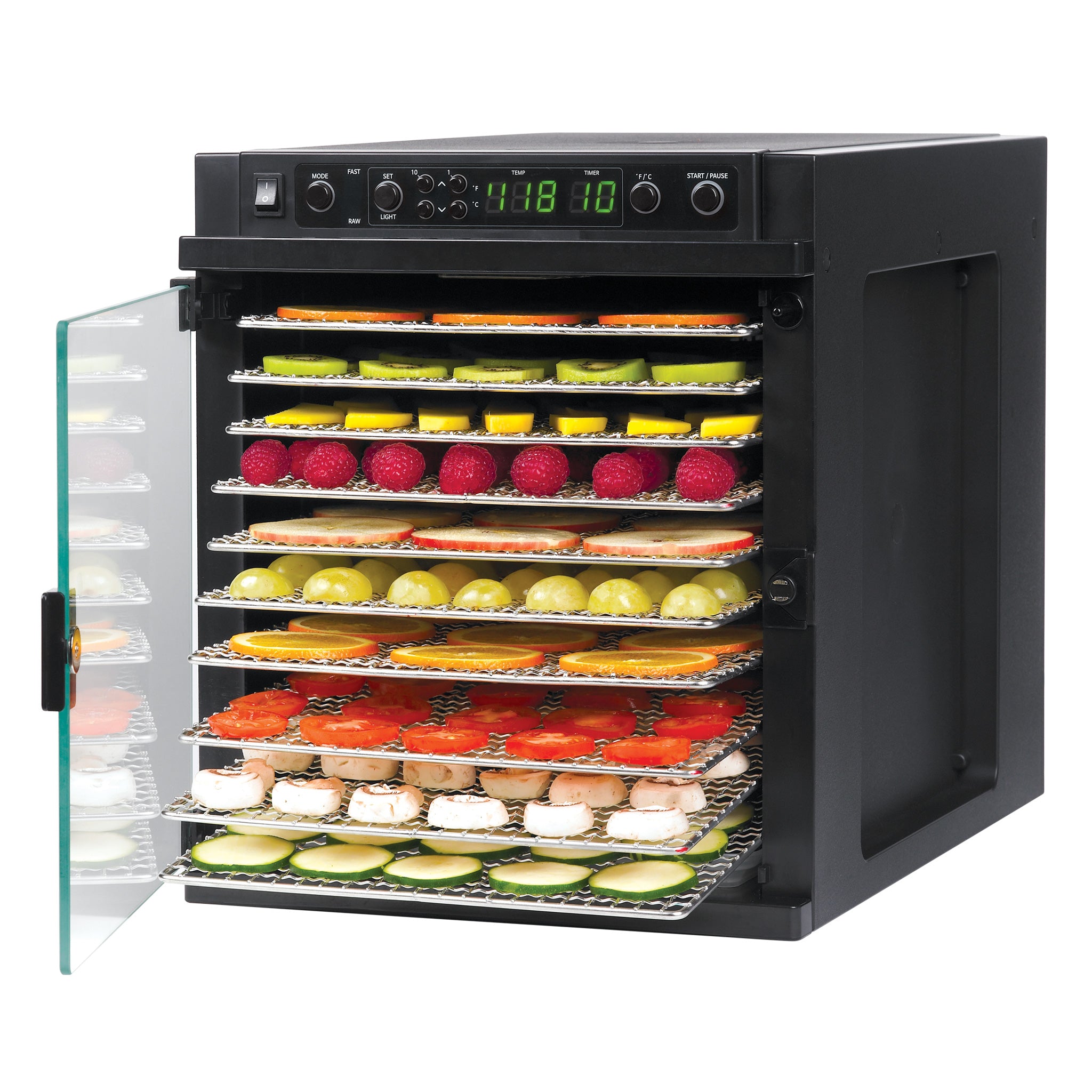
Tribest Sedona Express Food Dehydrator
11 trays, dual heating zones (front/rear can be set to different temperatures), below 55 dB. Best for mixed-temperature loads — simultaneously dehydrating herbs at low temperature and jerky at high temperature in the same machine.
The Tribest Sedona Express solves the one problem the Excalibur can't: simultaneously drying foods that require different temperatures. Its dual heating zones (front and rear independently controllable) let you run herbs at 95–115°F and jerky at 155–165°F in the same machine at the same time. Below 55 dB makes it the quietest in class. Costs more than the Excalibur with less total capacity.
Pros
- ✓Dual independent heating zones for simultaneous mixed-temperature loads
- ✓Below 55 dB — quietest food dehydrator in this comparison
- ✓11 trays with stainless steel option
Cons
- ✗More expensive than Excalibur with less tray space
Score breakdown
| Price | ~$250–$350 |
| Trays | 11 |
| Airflow | Horizontal dual-zone |
| Temp zones | 2 independent |
| Noise | <55 dB |
| Temp range | 95–167°F |
| Controls | Digital |
Which one is right for you?
For serious home dehydrators
Excalibur 9-Tray Food Dehydrator
Large horizontal-airflow capacity with no tray rotation and a 10-year warranty
For occasional household use
Cosori Premium Food Dehydrator 6-Tray
Horizontal airflow at half the Excalibur's price with a useful dual-readout display
For buyers who want to scale capacity
Nesco Snackmaster Pro Food Dehydrator
Expand from 5 to 12 trays without replacing the machine
For first-time dehydrators
Presto Dehydro Digital Food Dehydrator
Digital controls at entry-level price to test dehydrating before committing to a larger machine
For mixed-temperature drying
Tribest Sedona Express Food Dehydrator
Dual independent heat zones let you dry herbs and jerky simultaneously in the same machine
Horizontal vs vertical airflow: the design choice that determines evenness
Food dehydrators use one of two airflow designs. Vertical airflow machines (Nesco, Presto) have a fan and heating element at the top or bottom that blows air vertically through stacked circular trays. Horizontal airflow machines (Excalibur, Cosori, Tribest) have a fan at the rear that blows air horizontally across rectangular trays stacked in a box-style cabinet.
The functional difference is how evenly the food dries. In vertical airflow machines, the trays closest to the fan receive more heat and airflow than trays farther away. Most vertical machines require you to rotate trays during drying — moving the top tray to the bottom every few hours — to achieve even drying. If you skip the rotation, the food on the top and bottom trays dries at different rates.
Horizontal airflow machines distribute heat more evenly across all trays without rotation. The Excalibur's rear-mounted fan design is specifically engineered to create a consistent airflow pattern across all 9 trays simultaneously. The practical advantage is that you can load the machine and leave it unattended for the full cycle — 6-12 hours for most foods — without tray rotation. For large batches and overnight drying, horizontal airflow is significantly more convenient.
The reference standard: Excalibur 9-Tray
The Excalibur 9-Tray Dehydrator is the machine against which all others are measured in the food dehydrator category. At $200-300, it is not the cheapest option, but it produces the most consistent results with the least hands-on time. Nine 15×15-inch trays provide 15 square feet of drying space — enough for a full batch of beef jerky (10-15 lb of raw meat), multiple racks of fruit leather, or a season's worth of garden herb drying in a single session.
The rear-mounted fan operates quietly — below 60 dB at typical room distance, which is relevant for machines that run for 6-12 hour cycles. The temperature range is 95°F to 165°F (35°C to 74°C), which covers every dehydration application: herbs at low temperature (95-115°F), fruit at medium (135°F), and jerky at high (155-165°F). The thermostat maintains temperature accurately within ±5°F throughout the cycle.
The trays are dishwasher-safe polycarbonate with mesh inserts. The drip tray at the bottom catches any liquid that drips from food during early stages of drying — particularly relevant for fruit and marinated meats. The 10-year warranty is unusual for kitchen appliances and reflects the quality of construction. At the right price and with correct use, an Excalibur is a decades-long investment.
The value pick: Cosori Premium Food Dehydrator
The Cosori Premium 6-Tray Food Dehydrator offers horizontal airflow and temperature control at $100-150 — significantly less than the Excalibur with somewhat smaller capacity. Six trays of 11.5×11.5 inches provide approximately 5.5 square feet of drying space. For households that dehydrate occasionally rather than regularly, this capacity is adequate for most projects.
The digital control panel shows both set temperature and actual chamber temperature simultaneously — a genuinely useful feature for monitoring whether the machine is maintaining temperature during the cycle. The timer goes to 48 hours, covering the longest dehydration cycles. A transparent door allows monitoring without opening.
The Cosori's main limitation versus the Excalibur is capacity — 6 trays versus 9, and narrower trays. For batch-processing a full deer's worth of jerky or a large garden harvest, the Excalibur's size matters. For regular household use — a pound or two of jerky, a batch of dried mango, dried herbs — the Cosori is right-sized and significantly less expensive.
Vertical airflow options: Nesco and Presto for budget buyers
The Nesco Snackmaster Pro is the most-reviewed food dehydrator on Amazon and has been in production for decades. The top-mounted fan and heating element create vertical airflow through circular trays. The unique advantage is expandability — the Snackmaster Pro comes with 5 trays but can be expanded to 12 trays by adding stackable tray units, which allows the capacity to grow without purchasing a new machine.
The temperature range on the Nesco is 95°F to 160°F, controlled by an analog dial. The dial is less precise than digital controls but adequately accurate for the temperature ranges dehydration requires. The circular tray format stores more compactly than rectangular tray machines when not in use.
The Presto Dehydro Digital Electric Food Dehydrator is the entry-level digital option at $60-80. The digital thermostat and timer improve on the Nesco's analog controls. Six circular trays in a vertical stack produce adequate but uneven airflow — tray rotation is recommended for even results. For someone new to dehydrating who wants to test the process before investing in a horizontal-airflow machine, the Presto is a reasonable starting point.
Tribest Sedona Express: the dual-zone design for mixed loads
The Tribest Sedona Express IFD-2850 addresses a specific limitation of single-zone dehydrators: you can't simultaneously dry foods that require different temperatures. If you want to dry herbs (which need 95-115°F to preserve volatile oils) alongside beef jerky (which needs 155-165°F for food safety), a single-temperature machine forces you to choose one or compromise both.
The Sedona Express uses two separate heating zones — a front zone and rear zone that can be set to different temperatures independently. This allows a mixed load: herbs in the cooler front zone, jerky in the hotter rear zone, simultaneously in the same machine. For dehydrators used to preserve diverse harvests — a garden with both delicate herbs and high-temperature-requiring meats or vegetables — the dual-zone capability is a genuine advantage.
At $250-350, the Sedona Express costs more than the Excalibur and offers less total tray space. The justification is the dual-zone capability and its extremely quiet operation (below 55 dB). If your dehydrating involves mixed-temperature loads and a quiet machine matters, the Sedona Express is the right choice. If you dehydrate one food type at a time and want maximum capacity, the Excalibur is better value.
