Best Elliptical Machines 2026: NordicTrack vs Sole vs Schwinn
Ellipticals fill a gap that treadmills and bikes cannot. Resistance feel and footprint fit matter more than maximum resistance specs.
Each product was evaluated on five criteria: build quality, performance under typical use, durability over time, comfort, and value per dollar. We weighted performance and durability highest because these determine whether a product is still useful 12 months later.

NordicTrack SE7i Elliptical
Best for Multi-User Households: The SE7i's signature feature is its power-adjustable stride that shifts automatically between 46 and 61 cm during a workout — no other elliptical in this comparison fits a 160 cm and a 190 cm user from the same machine without compromise. Combined with the powered 0-10% incline that adjusts in 1% increments, the SE7i lets an iFit trainer change both stride and incline mid-session without the rider touching any control.
Top picks ↓| Product | Price | Link |
|---|---|---|
| $1,099.00 | View deal → | |
| — | View deal → | |
| — | View deal → | |
| $1,999 | View deal → | |
| $1,999 | View deal → | |
| $849.00 | View deal → |
Top picks
Related articles
.png?v=1640040616)
NordicTrack SE7i Elliptical
Power-adjustable stride from 46–61 cm is the standout feature — the only elliptical here that genuinely fits users across the full height range. Powered 0–10% incline adjusts automatically during iFit sessions. The connected ecosystem is the strongest for guided elliptical workouts, with automatic stride and incline control during trainer-led classes. iFit at $39/month unlocks terrain-matched outdoor routes and full workout library.
The SE7i's signature feature is its power-adjustable stride that shifts automatically between 46 and 61 cm during a workout — no other elliptical in this comparison fits a 160 cm and a 190 cm user from the same machine without compromise. Combined with the powered 0-10% incline that adjusts in 1% increments, the SE7i lets an iFit trainer change both stride and incline mid-session without the rider touching any control. The connected experience is the strongest of any elliptical here: iFit's library includes terrain-matched outdoor routes that adjust resistance to the actual elevation profile. The flywheel is lighter than the Sole's, but electronic resistance control compensates well enough at moderate levels.
Pros
- ✓Power-adjustable 46-61 cm stride fits users from 160 cm to 195 cm
- ✓Powered 0-10% incline adjusts automatically during iFit sessions
- ✓iFit terrain-matching for outdoor route simulation
- ✓Front-drive geometry produces a natural inclined walking arc
Cons
- ✗iFit subscription required to unlock most automated features
- ✗Lighter flywheel feels less smooth than the Sole at low resistance
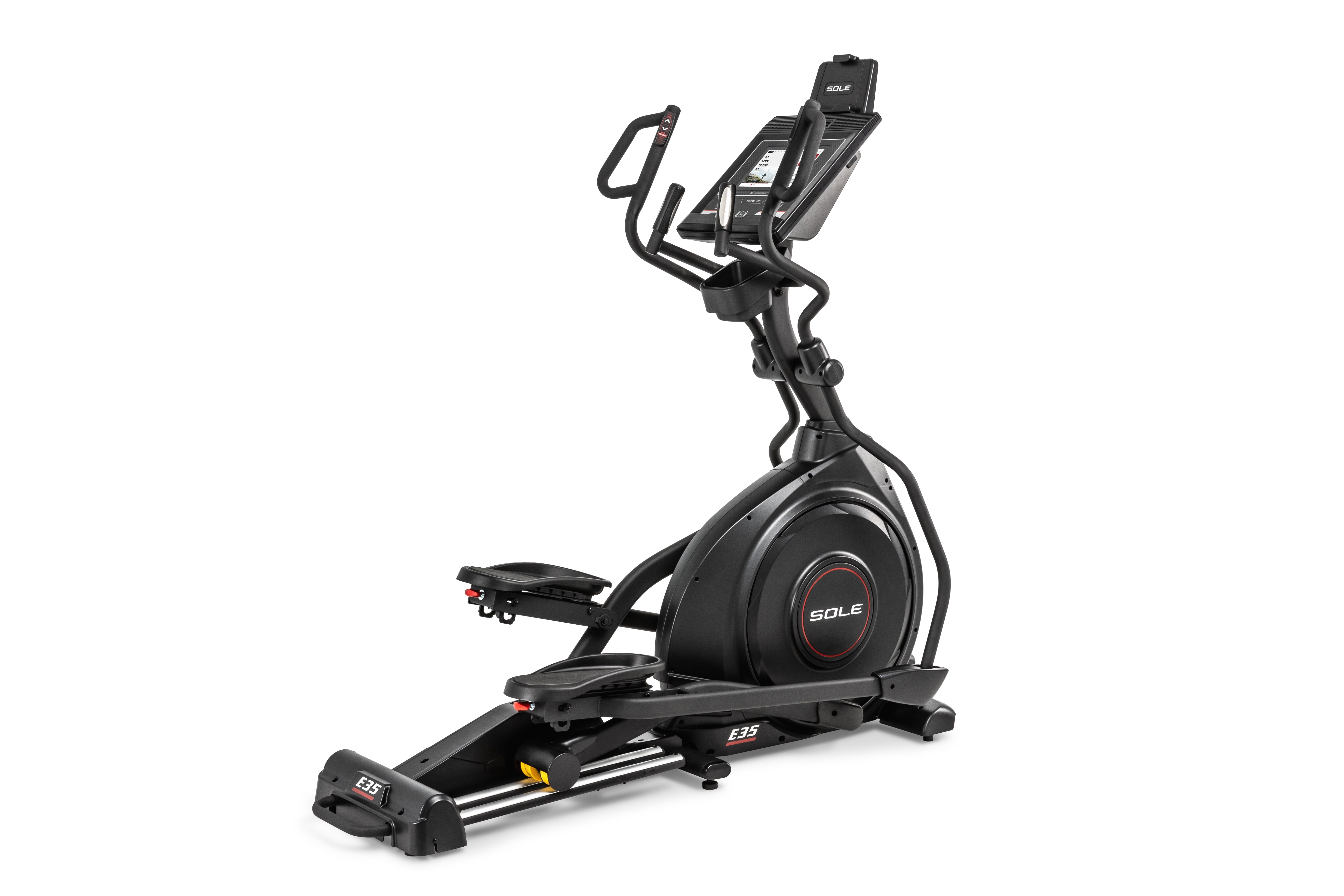
Sole Fitness E35 Elliptical Machine
Best overall elliptical for users 170 cm and taller — the 58 cm stride and 13.6 kg flywheel combine to produce the smoothest, most natural feel of any machine in this comparison. Rear-drive geometry creates a flat, running-like motion that most users find more natural than front-drive alternatives. No subscription required; the 20-position manual incline covers training variety without ongoing cost. Best long-term value for consistent users who do not want connected content.
The E35 earns its reputation as the smoothest mid-range elliptical because the 13.6 kg flywheel is the heaviest in this comparison — heavy enough to carry rotational momentum through the dead spots in the stroke cycle where lighter flywheels feel jerky. The 58 cm stride is the longest fixed stride here, which fits users 175 cm and taller in a way the 51 cm machines don't. Rear-drive geometry produces a flat, running-like motion that many users prefer over front-drive arcs. There's no app subscription requirement — the 20-position manual incline ramp handles training variety, which keeps long-term cost predictable.
Pros
- ✓13.6 kg flywheel — heaviest here for the smoothest motion
- ✓58 cm fixed stride accommodates full leg extension on taller users
- ✓Rear-drive geometry creates a flat running-like motion
- ✓No subscription required for full functionality
Cons
- ✗Manual 20-position incline ramp — no electronic incline control

Schwinn 470 Elliptical Machine
Best budget-friendly elliptical with solid connectivity — 25 resistance levels, power incline to 10%, Bluetooth to Zwift and other third-party apps. The 51 cm stride fits users in the 163–175 cm range well. Bluetooth heart rate monitoring and dual LCD/backlit display cover the essentials without the premium price. Correct entry point for users new to elliptical training who want data visibility and app connectivity.
The Schwinn 470 hits the value sweet spot for entry-level elliptical buyers who still want real features. 25 resistance levels and powered incline to 10% cover the training adjustability most users need, and Bluetooth pairing with Zwift and other third-party apps means you're not locked into a proprietary ecosystem. The 9 kg flywheel is lighter than the Sole's but adequate for the moderate resistance range where most home users actually train. The 51 cm fixed stride fits the 163-175 cm height range well, which covers a large portion of buyers. Dual LCD displays and Bluetooth heart rate monitoring handle the data side without premium pricing.
Pros
- ✓25 resistance levels and powered 0-10% incline at a budget price
- ✓Bluetooth pairing with Zwift and third-party apps
- ✓Dual LCD/backlit display with heart rate monitoring
- ✓51 cm stride fits the 163-175 cm height range well
Cons
- ✗9 kg flywheel less smooth than the Sole at equivalent resistance

Bowflex Max Trainer M9
Best for high-intensity short sessions — the hybrid stair-climber/elliptical motion generates significantly higher caloric burn per minute than conventional ellipticals, making it the correct choice for users with 20–30 minute windows rather than 45-minute sessions. JRNY adaptive coaching adjusts resistance in real time based on heart rate. The compact footprint (smaller than any conventional elliptical here) suits space-limited setups.
The Max Trainer M9 is a genuinely different machine — a hybrid of elliptical arm swing and stair-climber step arc that produces significantly higher caloric burn per minute than any conventional elliptical here. The motion arc is short (around 35 cm), the pedals travel a tight up-down path rather than a wide oval, and the entire machine is built to maximize intensity in 20-30 minute windows. JRNY adaptive coaching adjusts resistance in real time based on heart rate, which matches the machine's HIIT purpose. The compact footprint is meaningfully smaller than any standard elliptical, which makes it the right pick for apartment setups where floor space is the binding constraint.
Pros
- ✓Hybrid elliptical/stair-climber motion maximizes calorie burn rate
- ✓JRNY adaptive coaching adjusts resistance to heart rate
- ✓Compact footprint fits apartments where conventional ellipticals don't
- ✓20 resistance levels with focus on HIIT-style intensity
Cons
- ✗Short stride feels uncomfortable for users with hip flexor issues
- ✗Not designed for long steady-state cardio sessions
Bowflex Max Trainer M9
Best for high-intensity short sessions — the hybrid stair-climber/elliptical motion generates significantly higher caloric burn per minute than conventional ellipticals, making it the correct choice for users with 20–30 minute windows rather than 45-minute sessions. JRNY adaptive coaching adjusts resistance in real time based on heart rate. The compact footprint (smaller than any conventional elliptical here) suits space-limited setups.
The Max Trainer M9 is a genuinely different machine — a hybrid of elliptical arm swing and stair-climber step arc that produces significantly higher caloric burn per minute than any conventional elliptical here. The motion arc is short (around 35 cm), the pedals travel a tight up-down path rather than a wide oval, and the entire machine is built to maximize intensity in 20-30 minute windows. JRNY adaptive coaching adjusts resistance in real time based on heart rate, which matches the machine's HIIT purpose. The compact footprint is meaningfully smaller than any standard elliptical, which makes it the right pick for apartment setups where floor space is the binding constraint.
Pros
- ✓Hybrid elliptical/stair-climber motion maximizes calorie burn rate
- ✓JRNY adaptive coaching adjusts resistance to heart rate
- ✓Compact footprint fits apartments where conventional ellipticals don't
- ✓20 resistance levels with focus on HIIT-style intensity
Cons
- ✗Short stride feels uncomfortable for users with hip flexor issues
- ✗Not designed for long steady-state cardio sessions
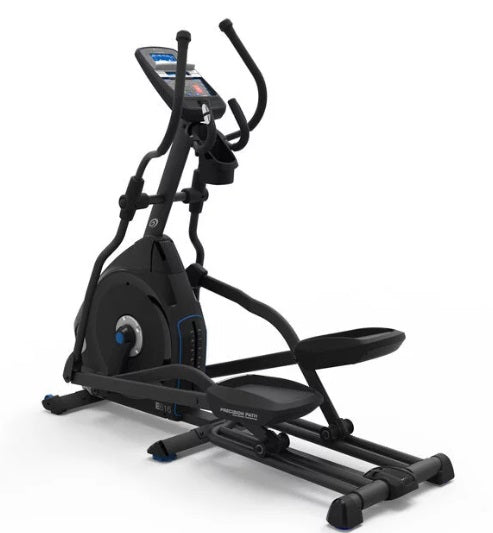
Nautilus E616 Elliptical Trainer
Best for quiet operation in shared living spaces — the Nautilus E616's drive system runs noticeably quieter than the Schwinn 470 or Sole E35 at equivalent resistance levels, which matters in apartments or homes where noise transfers to other rooms. 25 resistance levels, power incline to 10%, Bluetooth connectivity to the Nautilus app. The 51 cm stride fits the 163–175 cm range.
The Nautilus E616 differentiates on noise: its drive system runs noticeably quieter than the Schwinn 470 or even the Sole E35 at equivalent resistance, which is the deciding factor in apartments or houses where the elliptical sits near a sleeping family member. 25 resistance levels and powered incline to 10% match the Schwinn's feature set, and Bluetooth connects the machine to the Nautilus app for workout tracking. The 8 kg flywheel is the lightest here, which is the trade-off for the quieter operation — at high resistance the motion feel is less smooth than the Sole, but at moderate levels the difference is harder to detect.
Pros
- ✓Quietest drive system in this comparison at equivalent resistance
- ✓25 resistance levels with powered 0-10% incline
- ✓Bluetooth connectivity to the Nautilus app
- ✓51 cm stride matches the typical home-user height range
Cons
- ✗8 kg flywheel — lightest here, less smooth at high resistance
Which one is right for you?
For multi-user households with varied heights
NordicTrack SE7i Elliptical
The power-adjustable 46-61 cm stride is the only solution here that fits a 160 cm and a 190 cm user from the same machine without compromise.
For the smoothest possible motion feel
Sole Fitness E35 Elliptical Machine
The 13.6 kg flywheel — heaviest in this comparison — carries rotational momentum through the stroke dead spots that lighter flywheels can't smooth out.
For budget buyers who still want real features
Schwinn 470 Elliptical Machine
25 resistance levels, powered incline to 10%, and Bluetooth pairing with Zwift at the lowest price in this comparison.
For short, high-intensity training sessions
Bowflex Max Trainer M9
The hybrid elliptical/stair-climber motion produces higher caloric output per minute than any conventional elliptical here — built for 20-30 minute HIIT windows.
For apartments where noise matters
Nautilus E616 Elliptical Trainer
The drive system runs noticeably quieter than the Schwinn or Sole at equivalent resistance — the right pick when the machine sits near sleeping family.
Stride length and height: why the number on the spec sheet determines comfort
Elliptical stride length is the maximum distance between foot pedals at the extremes of the motion cycle — the specification that determines whether the machine fits the user's natural gait or forces a truncated, choppy step pattern. A stride length that is too short causes the hips to rock side-to-side to compensate for the restricted leg travel, generating lateral hip flexor fatigue rather than the intended hamstring and quad load. A stride length that is too long forces the front knee to over-extend at the top of the stroke, placing shear stress on the patellar tendon that defeats the low-impact purpose of elliptical training entirely.
The general fit guide: users under 165 cm are comfortable on a 46–48 cm stride; users between 165–175 cm want 50–53 cm; users between 175–185 cm need 53–56 cm; users over 185 cm benefit from 56–58 cm. The Sole E35 offers a 58 cm stride — the longest in this comparison and the correct fit for users above 175 cm. The NordicTrack SE7i uses a power-adjustable stride that shifts between 46 and 61 cm automatically, which is the only machine here that accommodates users across the full height range without compromise. The Schwinn 470 and Nautilus E616 both use a fixed 51 cm stride, appropriate for the 165–175 cm range. The Bowflex Max Trainer M9 uses a compact stepping motion rather than a conventional elliptical stride — the motion arc is approximately 35–38 cm, which fits users of most heights but produces a fundamentally different lower-body feel.
Stride length also affects the muscle recruitment pattern within the same machine. On the Sole E35, extending to the full 58 cm stride at moderate resistance recruits the hamstrings and glutes more aggressively than a shorter stride on the same machine would — the extended reach requires the posterior chain to drive the pedal back through a greater arc. Users targeting glute development specifically should prioritize longer stride lengths and moderate-to-high incline settings over shorter strides at maximum resistance.
The relationship between stride length and step frequency matters for aerobic intensity. A 58 cm stride at 60 revolutions per minute covers the same total pedal distance per minute as a 46 cm stride at 76 RPM — but the longer stride at lower cadence recruits more muscle fiber per stroke and produces higher peak torque, while the shorter stride at higher cadence taxes the cardiovascular system through sustained high-frequency muscle contraction. Neither is superior; they are different training stimuli. The NordicTrack SE7i's adjustable stride makes switching between these two modes possible mid-workout without stopping.
Flywheel weight and motion quality: what heavy flywheels actually do
Flywheel weight is the single specification most correlated with the smoothness of the elliptical motion, particularly at lower resistance levels. A heavy flywheel stores rotational kinetic energy and releases it through the pedal stroke — it smooths out the dead spots in the cycle where the user's legs are changing direction and would otherwise feel resistance drop suddenly. A light flywheel with insufficient rotational inertia creates a mechanical feel: resistance surges on the downstroke and drops on the upstroke, generating a jerky, uneven feel that fatigues the stabilizer muscles rather than the target movers.
The Sole E35 uses a 13.6 kg flywheel — the heaviest in this comparison and the primary reason the E35 is widely cited as the smoothest-feeling mid-range elliptical. At resistance levels 3–8 (the moderate range where most 45-minute sessions are conducted), the E35 flywheel maintains consistent rotational momentum that makes the motion genuinely feel like natural walking or running rather than operating a machine. The Schwinn 470 uses a 9 kg flywheel; the Nautilus E616 uses an 8 kg flywheel; both are adequate for light to moderate training but perceptibly less smooth than the Sole at equivalent resistance. The NordicTrack SE7i uses a magnetic resistance system with a lighter flywheel that compensates partly through electronic resistance control — the smoothness is acceptable but not equivalent to the Sole's mechanical momentum.
Flywheel position — front-drive or rear-drive — changes the body geometry during the elliptical motion. Front-drive ellipticals position the flywheel at the front of the machine; the pedal arc curves upward at the front of the stride, creating a slightly inclined walking motion that many users find more natural. Rear-drive ellipticals position the flywheel behind the user; the pedal arc is more horizontal, creating a motion that more closely resembles running on a flat surface. The Sole E35 is rear-drive; the NordicTrack SE7i is front-drive with an adjustable incline ramp; the Schwinn 470 and Nautilus E616 are front-drive. There is no universal preference — both geometries produce effective cardio training — but users who find front-drive machines uncomfortable typically find rear-drive more natural, and vice versa.
Magnetic versus friction resistance is a practical maintenance consideration. All five machines in this comparison use electromagnetic resistance rather than friction pads — resistance changes are controlled by adjusting the magnetic field rather than pressing a brake pad against the flywheel. Electromagnetic resistance systems require no physical wear parts, produce no dust or degradation, and can be controlled electronically for automated resistance adjustment during connected workouts. The service life advantage of electromagnetic systems over friction systems is significant for machines that will be used daily for 5–10 years.
Incline and Bowflex Max Trainer: two different machines solving the same problem
Incline on an elliptical changes the pedal arc angle, which shifts the primary load from the quadriceps to the glutes and hamstrings. At 0% incline, the motion most closely resembles running — quad-dominant, hip-flexor engaging, with relatively shallow glute recruitment. As incline increases to 10–15%, the pedal pushes down and back rather than forward and up, increasing posterior chain activation and reducing anterior knee load. Users who experience knee discomfort on flat elliptical settings frequently find that 5–8% incline eliminates the problem by shifting load away from the patellofemoral joint.
The NordicTrack SE7i offers a powered incline from 0% to 10%, adjustable in 1% increments and controllable automatically during iFit workouts. This is the machine here where a trainer can dial in incline changes during a session without the user touching any controls — meaningful during interval workouts that alternate flat running motion with hill-climb patterns. The Sole E35 offers a fixed 20-position incline ramp that must be set manually before each workout — there is no electronic incline control. The Schwinn 470 offers power incline to 10%; the Nautilus E616 offers power incline to 10%. The Bowflex Max Trainer M9 does not use incline as a variable — its intensity is controlled entirely through resistance levels (1–20), and the motion geometry is fixed.
The Bowflex Max Trainer M9 deserves separate analysis because it is a genuinely different machine. The M9's motion combines an elliptical-style arm swing with a stair-climbing step arc — the range of motion is shorter than a conventional elliptical (approximately 35 cm), the pedals move in a tighter up-down arc rather than a wide oval, and the machine is designed specifically to maximize caloric burn rate in short sessions. Bowflex's published testing suggests the M9 burns approximately 2.5× more calories per minute than a conventional elliptical at equivalent perceived effort — a figure that has been partially corroborated by independent metabolic testing, though the magnitude varies by user. For users who have 20–30 minutes per session rather than 45–60, the M9's high-intensity design produces a more complete cardiovascular stimulus per minute than any conventional elliptical in this comparison.
The trade-off with the Max Trainer is joint feel. The shorter stride and steeper step arc places more load on the hip flexors and less on the glutes than a long-stride conventional elliptical, and the motion can feel mechanically taxing on the lower back for users with lumbar issues. Users with hip flexor problems specifically find the M9 motion uncomfortable within 10–15 minutes; users with knee issues frequently find it more comfortable than a conventional elliptical because there is minimal knee extension at the top of the step arc. Try the M9 in person before purchasing if you have any existing lower-body joint sensitivity.
How to choose: stride length, flywheel weight, and incline for your use case
The three-question framework for elliptical selection: What is your height? What session length do you plan? Do you have existing joint issues that restrict specific movements? Answering these three questions narrows the field considerably before specifications become relevant. Height below 170 cm with sessions of 30–45 minutes and no joint restrictions: Schwinn 470 or Nautilus E616 — the 51 cm stride fits well, the flywheel is adequate for moderate resistance, and the price is the lowest in this comparison. Height 170–185 cm with sessions of 45–60 minutes and a preference for the smoothest possible motion: Sole E35 — the 58 cm stride accommodates full leg extension, the 13.6 kg flywheel is the smoothest at moderate resistance, and the manual incline system covers training variety without connected-subscription cost.
Height above 185 cm or variable household users with different heights: NordicTrack SE7i — the power-adjustable 46–61 cm stride is the only solution in this price range that genuinely fits users at height extremes without compromise. The iFit integration is also the strongest connected-training ecosystem for ellipticals if you plan to use guided workouts. Budget is tight and session length is 20–30 minutes with high-intensity focus: Bowflex Max Trainer M9 — the hybrid climbing motion generates higher caloric output per minute than any conventional elliptical, justifying the higher machine cost through time efficiency.
Resistance level count is often cited in marketing but less important than it appears. A machine with 20 resistance levels is not twice as adjustable as one with 10 — what matters is the range from minimum to maximum resistance and the usable width of that range for your fitness level. On the Schwinn 470 with 25 resistance levels, most recreational users spend 90% of their training between levels 5–15. On the Sole E35 with 20 resistance levels, the same user range is levels 4–12. The numbers are labeled differently but the physical resistance produced is similar. What actually differentiates these machines is how finely the resistance increments within the working range — smaller increments allow more precise interval programming.
Handlebar design affects upper-body engagement more than most buyers anticipate. Fixed center handlebars for stability versus moving handlebars for arm drive are not equivalent training tools. Moving handlebars on the Sole E35 and NordicTrack SE7i allow the user to deliberately push and pull against arm resistance, engaging the chest, upper back, and shoulders while reducing the total lower-body load per calorie burned — distributing effort across more muscle mass, which is specifically useful for users managing lower-limb fatigue or recovering from lower-body injury. Fixed handlebars provide stability for users who cannot confidently balance on moving handlebars, particularly older users or those early in rehabilitation. All five machines in this comparison include both fixed and moving handlebars.