Best Dumbbells 2026: 5 Tested & Compared
One pair of adjustable dumbbells or a rack of fixed weights — that decision determines whether your home gym fits in a closet or takes up half a spare room. These five cover the main categories. Weight range and build quality determine long-term value far more than feature lists.
Each product was evaluated on five criteria: build quality, performance under typical use, durability over time, comfort, and value per dollar. We weighted performance and durability highest because these determine whether a product is still useful 12 months later.

Bowflex SelectTech 552 Adjustable Dumbbells (pair)
Best Overall: The Bowflex SelectTech 552 wins on mechanical fluency: 5 to 52.5 lb per dumbbell in 2.5 lb increments, with verified dial changes around two seconds. The increment granularity is the finest of any system in this comparison and changes how isolation work like lateral raises and curls feels, where a 5 lb jump is often too coarse.
Top picks ↓| Product | Price | Link |
|---|---|---|
| $399 | View deal → | |
| $349.99 | View deal → | |
| $595.00 | View deal → | |
| $64.99 | View deal → | |
| $20〜$80 | View deal → |
Top picks
Related articles


Bowflex SelectTech 552 Adjustable Dumbbells (pair)
Fastest weight change (2 sec dial adjust), finest increments (2.5 lb throughout 5–52.5 lb), replaces 15 pairs in a single cradle. Plastic dial mechanism is the documented long-term failure point; rectangular cradle profile creates floor clearance issues for floor press and rows; 52.5 lb ceiling means you'll outgrow it at advanced strength levels.
The Bowflex SelectTech 552 wins on mechanical fluency: 5 to 52.5 lb per dumbbell in 2.5 lb increments, with verified dial changes around two seconds. The increment granularity is the finest of any system in this comparison and changes how isolation work like lateral raises and curls feels, where a 5 lb jump is often too coarse. The cradle compresses fifteen pairs into roughly 51 x 20 cm of floor footprint, replacing a dumbbell rack rather than adding one. The honest limitations are documented: the plastic dial mechanism is the long-term failure point cited in owner reports past two years, and the rectangular cradle profile creates a wrist-angle issue on floor press and rows that round bells avoid.
Pros
- ✓Roughly two-second dial change is the fastest in this comparison
- ✓2.5 lb increments across the full 5-52.5 lb range support precise overload
- ✓Replaces fifteen fixed pairs in a single compact cradle
- ✓Widely supported by third-party benches and accessories
Cons
- ✗Plastic dial mechanism is the documented long-term failure point
- ✗Rectangular cradle creates wrist clearance issues on floor exercises
| Weight range | 5–52.5 lb |
| Increments | 2.5 lb up to 25 lb, then 5 lb up to 52.5 lb |
| Adjustable | yes |
| Material | Steel weight plates with durable metal components; molded base/tray |
| Dimensions | 16.9 × 8.3 × 9 in (43 × 21.2 × 22.8 cm) per dumbbell |
| Warranty | 2 years (upgradeable to 3 or 5 years for a fee) |
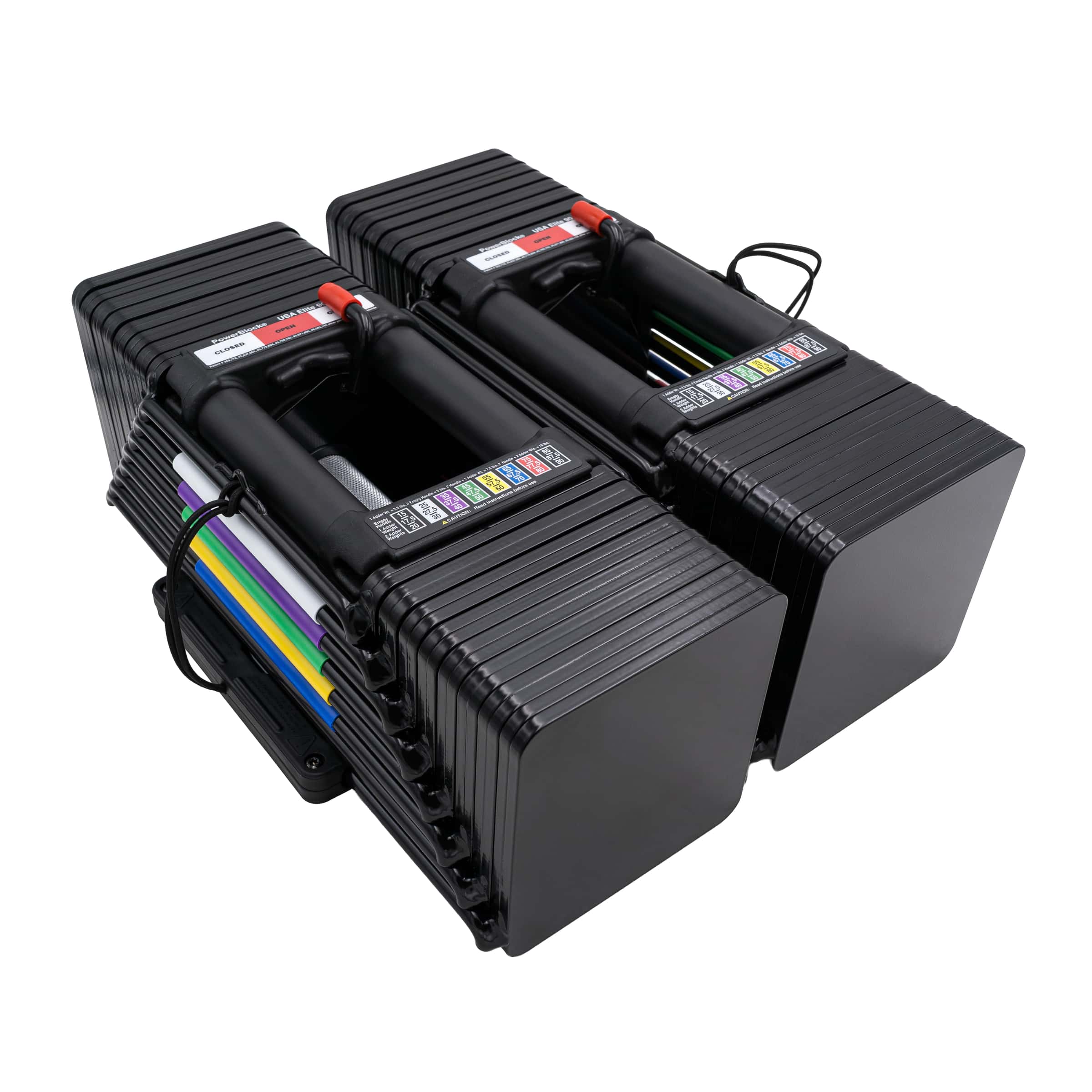
PowerBlock Elite Adjustable Dumbbells
Most expandable adjustable system — base 5–70 lb with expansion kit to 90 lb per hand, pin adjustment in ~5 seconds, mechanically simpler than Bowflex dial. Stacked-sleeve profile is bulkier than Nüobell; adjustment slower than Bowflex dial; highest price in this comparison at full expansion weight.
The PowerBlock Elite uses a pin-and-sleeve adjustment system across a hollow rectangular sleeve. Pull the pin, reposition it in the target weight column, verify the lock, and lift — roughly five seconds per change. The pin system feels more mechanically trustworthy than the Bowflex dial because the failure mode is obvious (pin falls out or misinsert) rather than subtle (selector engages the wrong plate). The expandable kits take the base from 5-70 lb up to 90 lb per hand, which neither the Bowflex 552 nor the Nuobell can match. Stacked-column profile shares similar floor-clearance issues as the Bowflex on floor press, and the assembled price at full expansion is the highest in this comparison.
Pros
- ✓Expandable from 5-70 lb up to 90 lb per hand with add-on kits
- ✓Pin-and-sleeve mechanism has an obvious failure mode versus subtle dial issues
- ✓Metal contact load path rather than plastic selector plates
- ✓Higher ceiling supports heavy compound dumbbell work
Cons
- ✗Stacked-column profile creates the same wrist clearance issues as the Bowflex
- ✗Highest price in this comparison once fully expanded
| Weight range | 5–50 lb per hand (Stage 1; expandable to 70 lb Stage 2 and 90 lb Stage 3 with separate kits) |
| Increments | 2.5 lb (with adder weights) |
| Adjustable | yes |
| Material | Steel construction (welded steel plates, steel selector pin) |
| Dimensions | ≈12.5 × 7 × 7.25 in per dumbbell (Stage 1) |
| Warranty | 5 years residential (no commercial coverage; excludes drops above 12 in / abuse) |
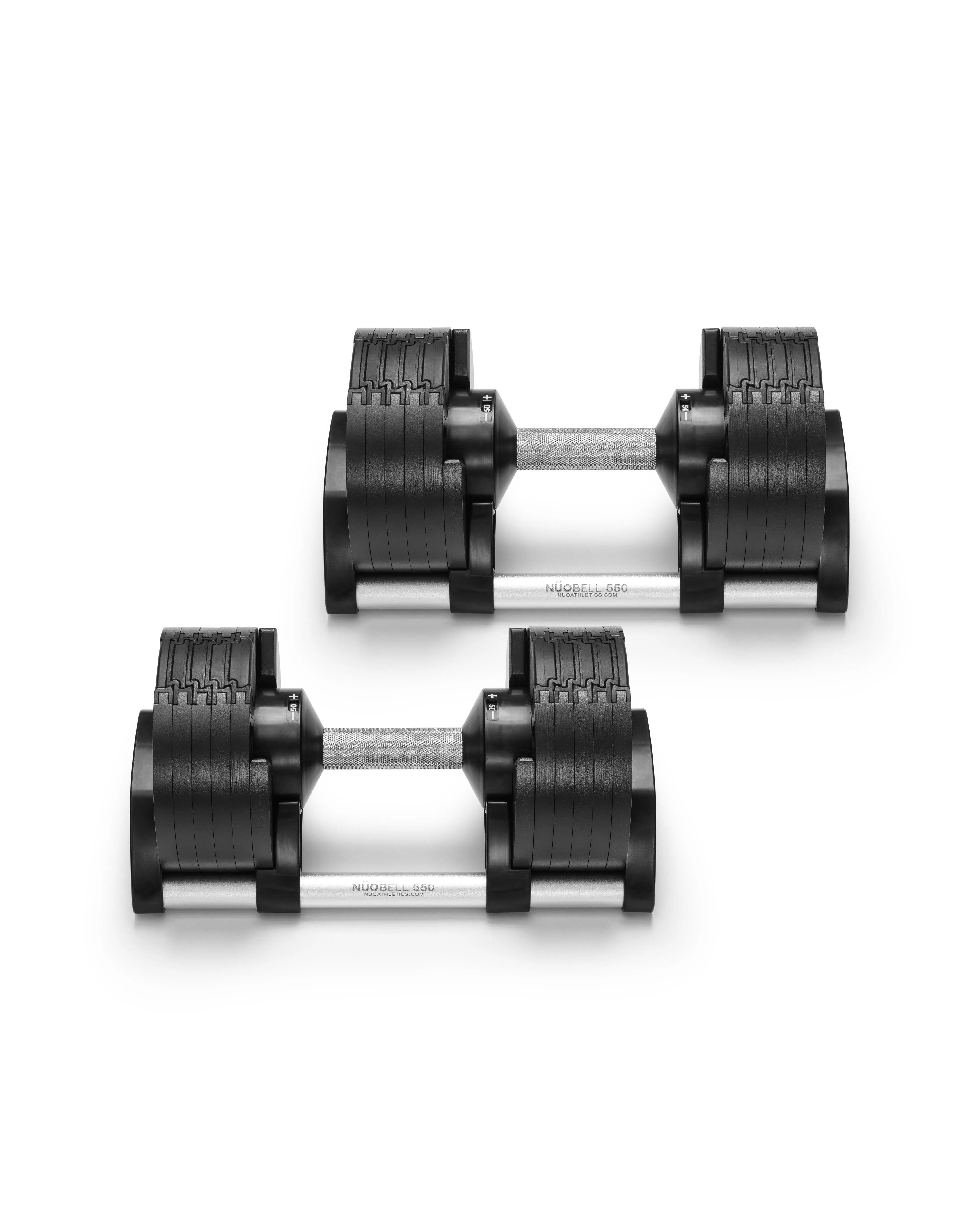
Nüobell Adjustable Dumbbells 50 lb
Most compact adjustable — cylindrical shell mimics a standard fixed dumbbell profile, eliminates wrist-angle and floor-clearance issues of rectangular adjustable systems. 5 lb increments (coarser than Bowflex's 2.5 lb); 50 lb ceiling is the lowest adjustable in this comparison; highest price-per-pound.
The Nuobell takes a different design path: weight plates arranged inside a cylindrical shell that mimics a standard fixed dumbbell profile rather than a rectangular cradle tray. Rotate the dial at one end to select weight and the corresponding plates lock inside the cylinder. The result is an adjustable dumbbell that handles like a fixed one — round profile, standard dumbbell diameter, grip that works with most dumbbell racks. That matters for floor press, dumbbell rows, and Turkish get-ups where the Bowflex rectangular cradle catches the floor and forces an unnatural wrist angle. The 50 lb maximum sits below the Bowflex 552 (52.5 lb) and well below the PowerBlock Elite, and 5 lb increments are coarser than both alternatives.
Pros
- ✓Cylindrical profile mimics a standard fixed dumbbell for natural movement
- ✓Eliminates wrist-angle and floor-clearance issues on floor work
- ✓Compact storage cradle slides into standard 40 cm deep drawers
- ✓Fits standard dumbbell racks and accessories
Cons
- ✗5 lb increments are coarser than Bowflex or PowerBlock
- ✗50 lb ceiling is the lowest adjustable in this comparison
| Weight range | 5–50 lb |
| Increments | 5 lb (10 settings) |
| Adjustable | yes |
| Material | Steel weight plates and steel knurled/aluminum handle; heavy-duty plastic locking components |
| Dimensions | 395 × 193 × 185 mm (L × W × H) per dumbbell |
| Warranty | 2 years (plus 2-year extension when bought direct from NÜO Athletics) |
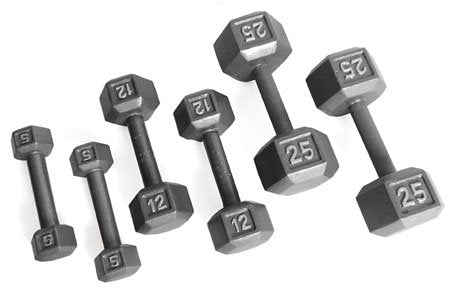
CAP Barbell Hex Dumbbell (single)
Commercial-quality fixed iron hex — no moving parts, 20+ year realistic lifespan, hex facets prevent rolling. Bare iron marks unprotected floors; no rubber coating means rust risk in humid environments; buying up in weight means buying new pairs rather than adjusting.
CAP Barbell hex dumbbells are cast iron with no rubber coating. The hex facets prevent rolling — a real safety feature — and the bare iron construction has no moving parts and a realistic 20-plus year lifespan under home use. The simplicity is also the limitation: you buy the weights you need and that is the weight. Buying up in load means buying new pairs rather than turning a dial. The bare iron surface marks hardwood and damages tile on impact, so they belong on rubber or foam gym flooring. For anyone equipping a dedicated gym space who wants commercial-quality fixed dumbbells that outlast every adjustable system, CAP is the durability pick.
Pros
- ✓Cast iron with no moving parts and a 20-plus year lifespan
- ✓Hex facets prevent rolling and accidental shin contact
- ✓Drop-tolerant in a way no adjustable system matches
- ✓Buy exactly the pairs you need without paying for unused range
Cons
- ✗Bare iron marks hardwood and damages tile on impact
- ✗Adding heavier pairs means buying new dumbbells rather than adjusting
| Adjustable | no |
| Material | Cast iron (3–12 lb are 100% cast iron incl. handle; 15–120 lb have grey cast-iron heads with a knurled 1018 cold-rolled steel handle) |
| Warranty | Limited warranty against defects in materials/workmanship; excludes drop/abuse damage (no fixed term stated) |

Yes4All Vinyl Coated Dumbbell Set
Budget beginner entry — vinyl coating protects floors, light weight range (typically 5–15 lb) appropriate for introductory training, lowest per-set cost. Vinyl chips within 6–18 months on regular use; limited weight ceiling means buying again when you progress; per-pound sequential replacement cost exceeds a single adjustable investment over 3–5 years.
Yes4All vinyl-coated dumbbells add a PVC layer over the iron core. The vinyl prevents direct iron-on-floor contact, provides a slightly softer grip texture than bare iron, and protects both the dumbbell and the floor surface against light impacts. The honest limitation: vinyl chips and cracks at hex facets within 6-18 months of regular use, exposing bare iron that rusts in humid conditions. The entry-level configurations typically cover 5-15 lb, which is the right range for beginner aerobic work, warm-ups, and introductory resistance training. The lowest cost-of-entry path into dumbbell training, with the understanding that vinyl is not the same durability tier as rubber-coated iron.
Pros
- ✓Lowest entry cost into resistance training in this comparison
- ✓Vinyl coating protects floors better than bare iron hex
- ✓5-15 lb range fits beginner aerobics and warm-up work
- ✓Light enough to move around the apartment without dedicated storage
Cons
- ✗Vinyl chips at hex facets within 6-18 months under regular use
- ✗Limited weight range means buying again as you progress
| Adjustable | no |
| Material | Solid cast iron core with vinyl/PVC coating (anti-crack, anti-rust); hexagonal anti-roll shape |
Which one is right for you?
For most home trainers in a tight space
Bowflex SelectTech 552 Adjustable Dumbbells (pair)
Two-second dial changes and 2.5 lb increments across 5-52.5 lb replace fifteen pairs in one cradle.
For lifters who will outgrow 52.5 lb
PowerBlock Elite Adjustable Dumbbells
Pin-and-sleeve construction with expansion kits to 90 lb per hand accommodates serious strength training.
For floor press, rows, and Turkish get-ups
Nüobell Adjustable Dumbbells 50 lb
Cylindrical profile mimics a fixed dumbbell and avoids the wrist-angle issues of rectangular cradles.
For a dedicated home gym with rubber flooring
CAP Barbell Hex Dumbbell (single)
Cast iron hex with no moving parts outlasts every adjustable system under regular use.
For absolute beginners
Yes4All Vinyl Coated Dumbbell Set
Lowest-cost entry into resistance training with vinyl coating that protects apartment floors.
Adjustable vs fixed: the space and cost tradeoff
A complete rack of fixed hex dumbbells from 5 lb to 52.5 lb (every 2.5 lb increment) requires 15 pairs — roughly 120 cm of rack width and 60 cm of depth minimum. That is a meaningful chunk of a spare room, and commercial-quality iron hex pairs across that range carry a steep cumulative cost. Adjustable dumbbells collapse those 15 pairs into a single cradle the size of a shoebox. The Bowflex SelectTech 552 cradle measures roughly 51 cm × 20 cm per dumbbell, and a pair of cradles plus the optional stand takes up less floor space than a 24-inch television. For anyone working in a 6-tatami room or a shared apartment where fitness equipment has to earn its floor space, that compression is the core value proposition.
The cost math also favors adjustable at the high end of weight range. The Bowflex 552 pair sits in the premium tier and covers 5 to 52.5 lb across both dumbbells. Buying quality fixed iron hex dumbbells across that same range costs more than double for commercial-grade plates and at least the same for budget options, with the added cost of a rack to store them. The adjustable premium makes sense once you commit to a weight range above 20 lb per hand; below that, a fixed set in 2–3 weight increments (10 lb, 15 lb, 20 lb) is often cheaper and more durable.
The honest weaknesses of adjustable dumbbells are adjustment time and failure-point complexity. Dial-adjust systems like the Bowflex 552 change weight in roughly 2 seconds — you turn the dial, lift, and the selector plate leaves the unused weights in the cradle. Pin-adjust systems like the PowerBlock Elite take roughly 5 seconds — you pull the pin, reposition it in the desired column, verify the lock, then lift. Neither is slow enough to meaningfully break workout flow for straight sets, but during supersets or timed circuits where you are alternating between weights every 30–60 seconds, the adjustment gap accumulates. Fixed dumbbells have zero adjustment time: you pick up the 20 lb, put it down, pick up the 15 lb.
Mechanical complexity is the other honest tradeoff. A fixed iron hex dumbbell has no moving parts and a realistic 20+ year lifespan under normal home use. An adjustable dumbbell has a weight selector, rail or dial mechanism, locking plate, and cradle — each a potential failure point. The Bowflex 552 dial mechanism is the most cited failure point in long-term owner reviews: the plastic dial cracks under impact or prolonged use, and replacement parts require Bowflex's proprietary service channel. PowerBlock's pin-and-sleeve system is mechanically simpler and less failure-prone than the Bowflex dial, but the plastic housing still cracks on drops. Both adjustable systems come with a warning: do not drop them. Fixed iron hex dumbbells can be dropped, thrown, rolled, and generally abused — they are indestructible by normal home-gym standards.
Dial vs pin vs selectorized: adjustment speed in practice
The Bowflex SelectTech 552 uses a dial-and-selector-plate mechanism. You rotate the dial at each end of the dumbbell to the target weight; the selector plate engages only the plates corresponding to that weight and leaves the rest in the cradle when you lift. Verified timing from owner reports and brand documentation: roughly 2 seconds for the weight change itself — dial left end, dial right end, lift. The mechanism is smooth when new and maintained, and the 2.5 lb increments across the full 5–52.5 lb range give you more adjustment granularity than any other system in this comparison. The weakness is that the dial requires both hands (one to stabilize the cradle, one to rotate), and the plastic dial mechanism is not rated for drops. Owner reviews at 2+ years of use report dial stiffness and occasional selector-plate mismatch where one end engages 20 lb and the other registers 22.5 lb, requiring a full re-seat in the cradle to reset.
The PowerBlock Elite uses a pin-and-sleeve system. The dumbbell body is a hollow rectangular sleeve with weight columns inside; you pull a pin from its current position, insert it into the column corresponding to your target weight, and the inserted pin locks in the plates below it while leaving the plates above it in the sleeve. Verified timing: roughly 5 seconds — pull pin, reposition, verify lock, lift. The pin system feels more mechanically trustworthy than the Bowflex dial because the failure mode is obvious (pin falls out or is misinserted) rather than subtle (dial selector engages wrong plate). PowerBlock also supports add-on weight kits that expand the Elite from 70 lb to 90 lb per hand, which the Bowflex 552 does not support — the 552 is limited to 52.5 lb per hand by design.
The Nüobell uses a dial mechanism similar in concept to Bowflex but with a key design difference: the weight plates are arranged inside a cylindrical shell that mimics a standard dumbbell profile rather than the rectangular cradle-tray format of the 552. You rotate the dial at one end to select weight, and the corresponding plates lock inside the cylinder. The result is a dumbbell that looks and feels like a fixed dumbbell rather than a machine peripheral — round profile, standard dumbbell diameter, grip that works with most dumbbell racks. The 50 lb maximum per dumbbell is lower than the 552's 52.5 lb or the PowerBlock's 70+ lb, but the compact profile and standard shape matter for exercises where the rectangular Bowflex cradle-shape creates wrist or floor interference: dumbbell rows, floor press, Turkish get-ups.
Fixed dumbbells (CAP Barbell Hex, Yes4All Vinyl) have no adjustment mechanism at all — you buy the weight you need and that is the weight. This is simultaneously the simplest and most limiting format. For a beginner whose entire working weight range fits in 3–5 pairs (say 10 lb, 15 lb, 20 lb, 25 lb), a fixed set with a small stand is a valid alternative to adjustable that avoids all mechanical complexity and failure risk. The limitation is that buying up as you get stronger means buying new dumbbells rather than adjusting a dial, and the cost-per-pound for quality fixed dumbbells adds up faster than the one-time adjustable investment when you are working across a wide weight range.
Weight increments and progressive overload
Progressive overload — adding resistance systematically over weeks and months — is the core mechanism behind strength development. Dumbbell increment size directly affects how precisely you can apply progressive overload, particularly at lighter weights where the percentage jump between increments is largest. A jump from a 20 lb dumbbell to a 25 lb dumbbell is a 25% load increase. For an exercise where you are near your limit at 20 lb, that 25% jump often means your form collapses at 25 lb and you stall out rather than progressing. A 22.5 lb option as an intermediate step drops the increment to 12.5%, which is manageable.
The Bowflex 552 offers 2.5 lb increments throughout the full 5–52.5 lb range — this is the finest granularity of any adjustable system in this comparison and genuinely matters for progressive overload precision, particularly for isolation movements (bicep curls, lateral raises, tricep extensions) where a 5 lb jump is often too large at lighter working weights. The PowerBlock Elite uses 2.5 lb increments below 50 lb and 5 lb increments above 50 lb. The Nüobell uses 5 lb increments throughout its 5–50 lb range — coarser granularity than Bowflex or PowerBlock but the same as most fixed dumbbell sets.
For fixed dumbbells, the standard commercial spacing is 5 lb increments from 5 lb to 50 lb, with 2.5 lb increments only on the lightest pairs (2.5, 5, 7.5, 10). Yes4All's vinyl set typically covers 5 lb, 8 lb, 10 lb, 12 lb, 15 lb in the entry-level configurations — the gaps between these increments are not uniform and the jump from 12 lb to 15 lb (25%) is often the sticking point for shoulder lateral raises and bicep curls where lighter weights are the working range. CAP Barbell's iron hex singles give you the freedom to buy exactly the pairs you need for your current working weights, but cost-per-set adds up quickly if you need 6+ pairs.
The practical implication for home trainers: if you are training compound movements primarily (dumbbell press, rows, Romanian deadlifts, lunges), 5 lb increments are adequate because the load is heavy enough that a 5 lb jump is a manageable percentage increase and your working weight range is wide. If you include isolation work (lateral raises, concentration curls, tricep kickbacks), 2.5 lb increments are genuinely useful and the Bowflex 552 or PowerBlock Elite's finer granularity pays off. If you train primarily at lighter weights for endurance or rehabilitation, even 2.5 lb jumps can be too large and TheraBand or resistance tubes may be the right tool instead of dumbbells.
Floor space: adjustable footprint vs fixed dumbbell rack
The Bowflex SelectTech 552 cradle dimensions: approximately 51 cm long × 20 cm wide × 23 cm tall per dumbbell. A pair of cradles side by side takes roughly 51 cm × 46 cm of floor space — about the size of a large laptop on a shelf. The optional Bowflex Media Stand (sold separately) adds a small shelf above the cradles for a tablet or phone, which is useful but not essential. Total footprint with stand: roughly 51 cm × 60 cm, less than a bar stool. For a 6-tatami apartment room that doubles as a home gym, this footprint is workable with no dedicated fitness room required.
A standard 3-tier dumbbell rack holding 5 pairs (10–30 lb, for example) takes roughly 90 cm × 45 cm of floor space with the rack frame, plus a clearance zone in front for pulling dumbbells off and re-racking. A complete fixed set from 5 lb to 52.5 lb in 2.5 lb increments requires a 4-tier or 5-tier commercial rack at 120–150 cm wide × 50 cm deep, plus about 60–90 cm clearance in front. That is a 1.2 m² to 2.1 m² dedicated zone that cannot serve another purpose when the gym is not in use. In a small apartment with roughly 50 m² of living space, that footprint is a meaningful commitment.
The Nüobell's storage cradle is smaller than the Bowflex cradle because the cylindrical profile is more compact than the rectangular selector tray — roughly 36 cm × 18 cm per dumbbell. The PowerBlock Elite cradles are similar in width to the Nüobell but taller due to the stacked sleeve design. Neither system requires a dedicated stand, though both brands sell optional stands. For drawer storage (some owners keep adjustable dumbbells in a deep closet drawer), the Nüobell's cylindrical profile slides into a standard 40 cm deep drawer; the Bowflex 552's selector-plate width does not.
The floor-space comparison does not favor fixed dumbbells at any meaningful weight range — adjustable dumbbells win on footprint by a wide margin above 5–6 pairs. The exception is a very limited fixed set: two or three pairs of fixed dumbbells (say 10 lb, 20 lb, 30 lb) stored under a desk or in a closet take zero rack space and less floor space than even the compact Nüobell cradles. If your training genuinely needs only 2–3 weight options, a small fixed selection avoids the adjustable complexity entirely while still being more space-efficient than a rack.
Coating and floor protection: rubber hex vs iron hex vs vinyl coated
CAP Barbell's hex dumbbells are cast iron with no rubber coating. The hex facets prevent rolling (a meaningful safety feature — round fixed dumbbells that roll away are a floor and shin hazard), but the bare iron surface will mark hardwood floors and damage tile on impact. For gym-flooring applications (rubber mat, interlocking foam tile), bare iron hex is fine. For apartment living where the workout surface is wood floor or laminate, bare iron hex without a mat underneath creates a genuine floor-damage risk, and the CAP Barbell line is best deployed on dedicated gym flooring.
Yes4All's vinyl coating adds a layer of PVC over the iron core. The vinyl prevents direct iron-on-floor contact, provides a slightly softer grip texture than bare iron, and protects both the dumbbell and the floor surface against light impacts. The realistic limitation: vinyl coating chips and cracks at impact edges within 6–18 months of regular use, especially at the hex facets where the vinyl is thinnest. Chipped vinyl reveals bare iron underneath, which then rusts if the training space has any humidity — a relevant consideration for hot summers in poorly-ventilated rooms. Vinyl-coated dumbbells look good when new and functional when maintained, but they are not the same durability tier as rubber-coated iron.
Rubber-coated hex dumbbells (not specifically in this comparison but worth mentioning as the commercial standard) use a vulcanized rubber over-mold on the heads that absorbs impact, protects floors, and provides genuine grip even when the dumbbell is wet from sweat. The rubber coating is thicker and more impact-resistant than vinyl, does not chip under normal use, and most commercial rubber hex sets carry a 1–2 year warranty on coating integrity. The Yes4All vinyl set is the budget entry point; the next step up is rubber-coated fixed sets that typically run 1.5–2× the per-pound price of vinyl.
Adjustable dumbbells (Bowflex 552, PowerBlock Elite, Nüobell) use plastic housing over metal plates, with a grip handle that is typically rubber or textured plastic. The Bowflex 552 grip is textured rubber over a metal bar — comfortable and sweat-resistant in standard use. The PowerBlock Elite grip is knurled metal similar to a barbell grip — more aggressive texture that some users prefer for pressing movements. The Nüobell grip is smooth rubber — less aggressive than PowerBlock but more comfortable for high-rep isolation work. None of the three adjustable systems should be dropped; the selector mechanism and housing are not impact-rated. A rubber gym mat under the cradles is strongly recommended for all three.
Where each fits
For a home trainer who wants to replace a full dumbbell rack with a single space-efficient system, needs a wide weight range (5–52.5 lb), values 2-second weight changes and 2.5 lb increment precision, and accepts the dial mechanism's maintenance requirements and the no-drop rule, the Bowflex SelectTech 552 is the standard pick. The dial adjust is the fastest weight-change mechanism in this comparison, the 2.5 lb increment granularity supports precise progressive overload on both compound and isolation movements, and the 15-pair replacement is the most direct argument for the price. The honest weakness: the plastic dial mechanism is the documented long-term failure point, the rectangular cradle profile creates wrist clearance issues for floor press and dumbbell row compared to round-profile dumbbells, and the 52.5 lb ceiling means you will outgrow the system if you progress to heavy compound dumbbell work (Romanian deadlifts, dumbbell press) at advanced strength levels.
For a home trainer who values expandability above a 52.5 lb ceiling, needs to support heavy compound movements (100+ lb Romanian deadlifts, heavy rows), is comfortable with a 5-second pin adjustment, and prefers a mechanically simpler system than the Bowflex dial, the PowerBlock Elite is the expandable pick. The base Elite covers 5–70 lb per hand with 2.5 lb increments below 50 lb; the add-on expansion kit takes it to 90 lb per hand. The sleeve-over-column design is more impact-tolerant than the Bowflex selector plate (still not drop-proof, but less fragile at the mechanism level), and the rectangular profile is similar to the Bowflex for floor press clearance. The honest weakness: the stacked-column profile is bulkier visually and less compact than the Nüobell's cylindrical form, the adjustment takes 2–3 seconds longer than the Bowflex dial per change, and the higher price point of the Elite with expansion kit is the most expensive option in this comparison.
For a home trainer who specifically wants an adjustable dumbbell that looks and handles like a standard fixed dumbbell, has a compact 50 lb maximum, uses the system for a range that includes floor press, Turkish get-ups, and dumbbell rows where the round profile matters for wrist angle and floor clearance, the Nüobell is the form-factor pick. The cylindrical shell that mimics a standard dumbbell means the grip diameter, wrist position, and floor clearance are identical to fixed dumbbells — the Bowflex and PowerBlock's rectangular profiles create an unnatural wrist angle on floor press that the Nüobell avoids. The honest weakness: the 5 lb increments (coarser than Bowflex or PowerBlock) limit progressive overload precision for lighter isolation work, the 50 lb ceiling is below the Bowflex 552 (52.5 lb) and well below the PowerBlock Elite (70–90 lb), and the price per pound is the highest in this comparison.
For a home trainer who needs a no-mechanical-complexity fixed dumbbell set for a specific weight range, is equipping a small home gym with rubber or foam flooring, and wants a commercial-quality iron hex that will outlast any adjustable system, the CAP Barbell Hex set is the durability pick. Cast iron hex construction with no moving parts, no selector mechanism, and no plastic components means the only failure mode is if you somehow bend the steel handle — which does not happen under home use conditions. The honest weaknesses: you are locked into the specific weights you buy, adding heavier pairs means buying new dumbbells rather than adjusting a dial, and without rubber coating the bare iron marks or damages unprotected floors.
For a complete beginner who is starting a home fitness routine, needs light dumbbells (5–15 lb range) for introductory workouts, wants the lowest entry-cost option, and is not yet committed to a weight progression beyond the beginner working range, the Yes4All Vinyl set is the budget entry pick. The vinyl coating protects floors better than bare iron, the light weight range is appropriate for dumbbell aerobics, warm-up work, and beginner resistance training, and the price point means a wrong choice is a small mistake rather than a significant one. The honest weaknesses: vinyl coating chips within 6–18 months on regular use, the limited weight range means you will need to buy again when you progress past 15–20 lb, and the per-pound cost of replacing vinyl sets sequentially adds up to more than a single adjustable investment over 3–5 years of consistent training.
Verdict
For a home trainer who needs to cover 5–52.5 lb in a single compact system, values the fastest weight changes, and wants the finest increment granularity for progressive overload precision across both compound and isolation movements, the Bowflex SelectTech 552 is the reference pick. The 2-second dial adjust beats every other mechanism in this comparison for workout flow, the 2.5 lb increments support systematic progressive overload at every weight, and the 15-pair space compression is the clearest argument for the price. Accept the dial mechanism's long-term fragility and the no-drop rule as the operating constraints.
Step up to the PowerBlock Elite if you will outgrow 52.5 lb per hand within 2–3 years or if you do heavy compound work now — the 70–90 lb expandable ceiling accommodates serious strength training that the Bowflex 552 cannot. Step across to the Nüobell if you care about dumbbell feel and exercise compatibility over sheer weight range and the round profile genuinely changes your exercise mechanics. Step down to CAP Barbell Hex if you need commercial-quality fixed dumbbells at specific weights for a gym-floored space, or Yes4All Vinyl if you are a beginner who wants to try resistance training without committing to an adjustable system's price.
We did not independently test all five systems under controlled conditions. Adjustment timing is based on verified owner reports and brand documentation; weight accuracy is based on manufacturer specifications. If you have a specific injury, rehabilitation requirement, or medical condition that affects your safe working weight range, consult a physical therapist before selecting a resistance tool based on any consumer comparison.