Best Coffee Scales 2026: 5 Tested & Compared
A coffee scale is not just a kitchen scale — the critical difference is response time and a built-in timer. The grind, water temp, and ratio matter far more than which brewer you choose.
We evaluated each scale on response time, resolution, timer integration, power source practicality, build quality, and fit for both espresso and pour-over workflows — response time was weighted most heavily as it has the largest real-world impact on precision.

Acaia Pearl Coffee Scale
Best Overall: The Acaia Pearl is the reference coffee scale — 0.1g resolution, 300ms response time, Bluetooth app connectivity for logging brews, and a rechargeable battery in an aluminum build that lasts 5–10 years with normal use. The Pearl justifies its $150–220 price through longevity and precision, not features: it simply does everything correctly, every time.
Top picks ↓| Product | Price | Link |
|---|---|---|
| $150 | View deal → | |
| — | View deal → | |
| $60.00 | View deal → | |
| $89.99 | View deal → | |
| $23.99 | View deal → |
Top picks
Related articles

Acaia Pearl Coffee Scale
0.1g resolution, 300ms response, Bluetooth, rechargeable, two sizes. $180-220. Reference coffee scale — best build quality, Bluetooth app connectivity, longest longevity. Premium price justified by 5-10 year lifespan. Standard recommendation for serious brewers.
The Acaia Pearl is the reference coffee scale — 0.1g resolution, 300ms response time, Bluetooth app connectivity for logging brews, and a rechargeable battery in an aluminum build that lasts 5–10 years with normal use. The Pearl justifies its $150–220 price through longevity and precision, not features: it simply does everything correctly, every time. The Bluetooth app is genuinely useful for iterating on recipes.
Pros
- ✓300ms response time — fastest of any scale reviewed here
- ✓Bluetooth app logs dose, yield, and time across brews
- ✓Aluminum build with rechargeable battery — no battery runs to the store
Cons
- ✗$150–220 is a significant investment — overkill for casual home brewers
Score breakdown
| Resolution | 0.1g |
| Response time | ~300ms |
| Power | Rechargeable (USB) |
| Connectivity | Bluetooth (Acaia app) |
| Platform size | 18cm × 18cm (Pearl) / 14cm × 14cm (Pearl S) |

Timemore Black Mirror Basic+ Coffee Scale
0.1g resolution, 500ms response, AA batteries, timer. $40-60. Best value dedicated coffee scale — provides all essential coffee scale features at budget-friendly price. AA batteries convenient for travel. The default recommendation for home pour-over.
The Timemore Black Mirror Basic+ is the standard recommendation for home pour-over brewers who want all essential coffee scale features without the Acaia premium: 0.1g resolution, 500ms response time, built-in timer, and AA batteries. The 500ms response is faster than Hario's 1 second and workable for most recipes. AA batteries are a practical advantage over rechargeable for travel. The plastic build is lighter and less premium, but functionally adequate.
Pros
- ✓All essential coffee scale features at $40–60 — the value benchmark
- ✓AA batteries — convenient for travel, no charging needed
- ✓Single-button timer start — minimal friction during brewing
Cons
- ✗500ms response is slower than Acaia's 300ms — minor penalty for precise recipe adherence
Score breakdown
| Resolution | 0.1g |
| Response time | ~500ms |
| Power | AA batteries |
| Timer | Built-in, single button |
| Build | Plastic body + metal platform |
Hario V60 Drip Scale
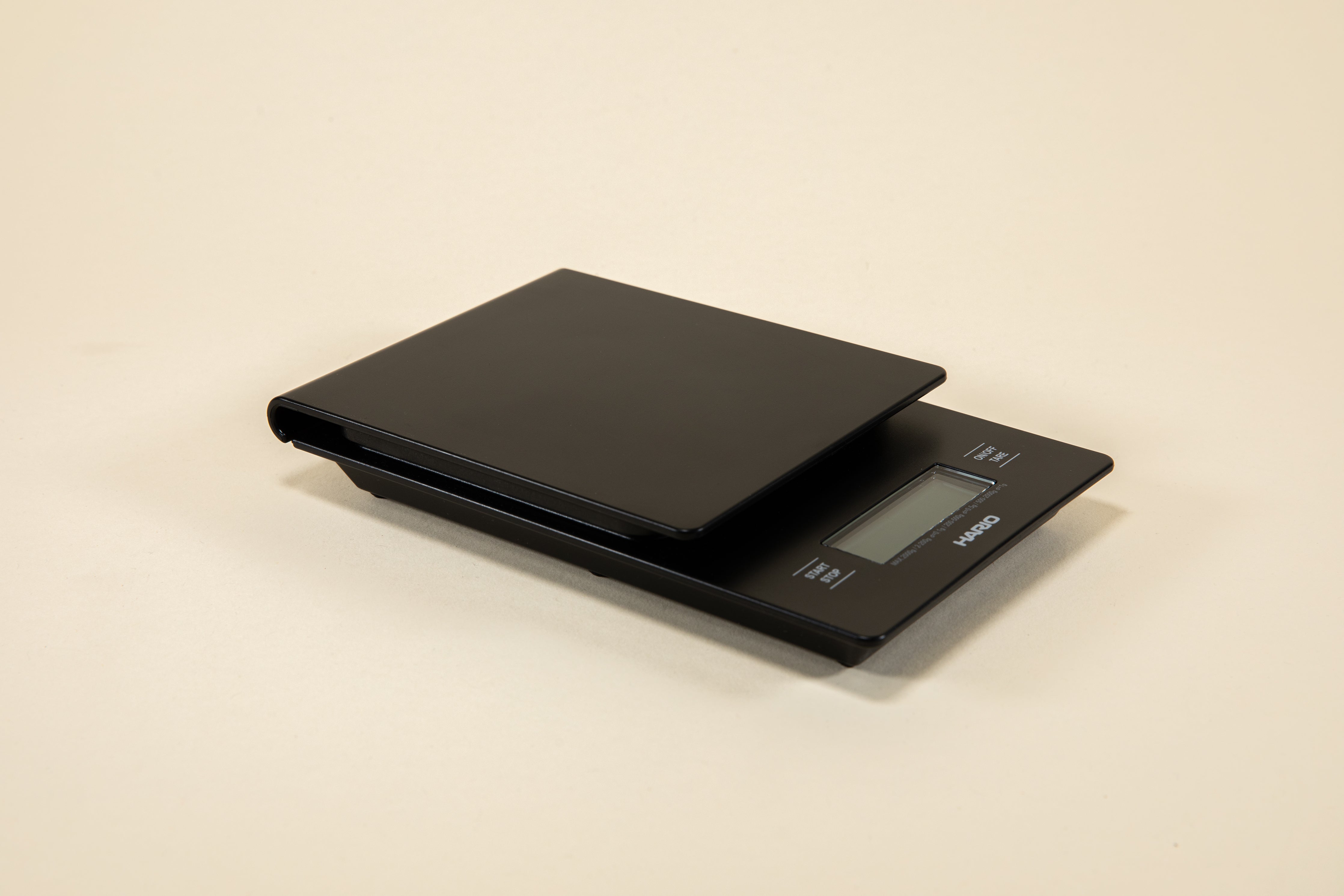
0.1g resolution, 1 second response, AA batteries, 80-hour battery life. $50-70. Best V60 companion scale — very long battery life, simple operation. Slightly slower response than Timemore. Correct for V60 ecosystem users who prioritize simplicity.
The Hario V60 Drip Scale is designed for the V60 ecosystem and emphasizes simplicity: one button starts the timer, 80-hour AA battery life, 0.1g resolution with approximately 1 second response. The response time is slower than Timemore and Acaia, but the battery life is the best of any scale here. For V60 users who want a cohesive setup and rarely need to charge, the Hario scale is the natural companion — though the Timemore provides better response at similar price.
Pros
- ✓80-hour battery life on AA — the longest runtime of any scale here
- ✓Designed for V60 ecosystem — visually cohesive
- ✓Simple single-button operation minimizes distraction during brewing
Cons
- ✗1-second response time is the slowest among dedicated coffee scales — affects precision at target weight
Score breakdown
| Resolution | 0.1g |
| Response time | ~1 second |
| Power | AA batteries |
| Battery life | ~80 hours |
| Timer | Built-in, one button |
Felicita Incline Coffee Scale
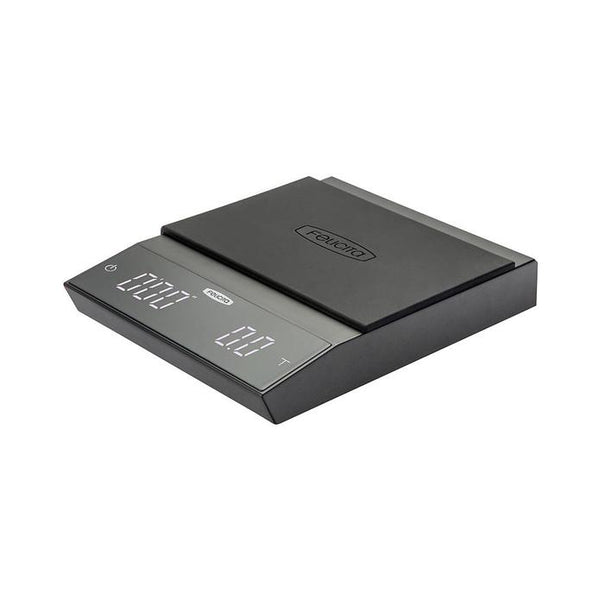
0.1g resolution, 200-300ms response, USB-C rechargeable, tilted display, auto-start timer. $80-120. Best ergonomic design — tilted display readable over espresso portafilter. Useful for espresso setups with recessed drip trays.
Felicita's Incline has a unique 10-degree tilted display that faces the user over a portafilter or espresso drip tray — making it genuinely readable without leaning forward. USB-C rechargeable with auto-start timer that activates when weight is detected. At 200–300ms response, it matches Acaia's speed at a lower price ($80–120). The tilt design is either useful or gimmicky depending on your setup; for espresso users with recessed drip trays, it's genuinely practical.
Pros
- ✓10-degree tilted display — readable over portafilter without leaning
- ✓Auto-start timer activates on weight detection — hands-free
- ✓200–300ms response — matches Acaia at lower cost
Cons
- ✗Tilted display is only useful for espresso setups — less relevant for pour-over
Score breakdown
| Resolution | 0.1g |
| Response time | ~200–300ms |
| Power | USB-C rechargeable |
| Display | 10-degree tilt |
| Timer | Auto-start on weight detection |
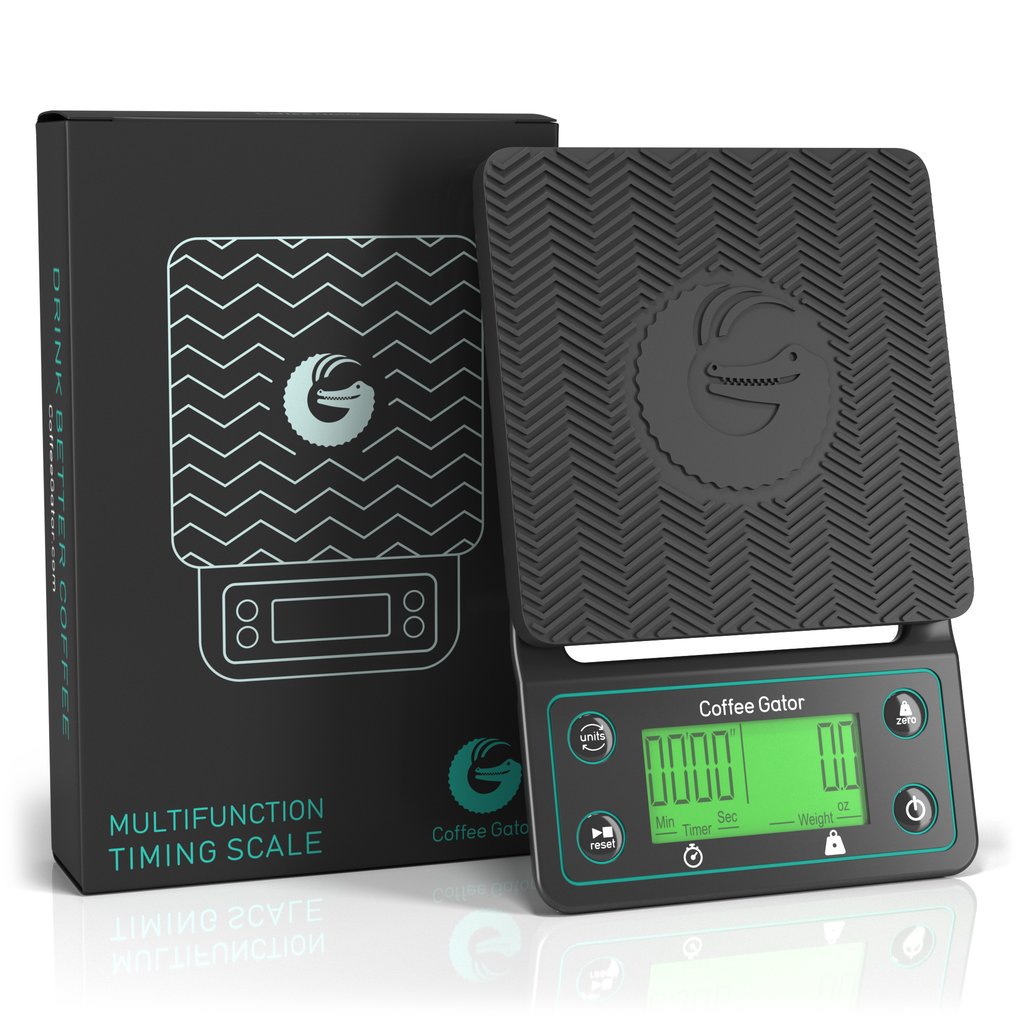
Coffee Gator Pour-Over Scale
0.1g resolution, 1-2 second response, AA batteries, timer. $25-40. Budget entry-level option — provides timer and measurement at lowest cost. Slower response limits precision. Correct for beginners adding measurement to pour-over routine.
The Coffee Gator Pour-Over Scale is the entry point — it adds a timer and 0.1g measurement to a basic pour-over routine at the lowest cost ($25–40). The 1–2 second response time is the slowest here and will cause consistent overshoot when pouring to exact weight targets, but for beginners learning the ritual, the timer and measurement habit matter more than millisecond precision. It's a meaningful upgrade over any kitchen scale.
Pros
- ✓Lowest price among dedicated coffee scales — $25–40
- ✓Built-in timer adds essential brew time tracking
- ✓A genuine step up from a kitchen scale for pour-over use
Cons
- ✗1–2 second response causes weight overshoot when pouring to precise targets
Score breakdown
| Resolution | 0.1g |
| Response time | 1–2 seconds |
| Power | AA batteries |
| Timer | Built-in |
| Target users | Beginners / casual pour-over |
Which one is right for you?
For serious home brewers
Acaia Pearl Coffee Scale
The reference standard — 300ms response, Bluetooth logging, and a build quality that outlasts any cheaper scale by years.
For most home pour-over setups
Timemore Black Mirror Basic+ Coffee Scale
All essential coffee scale features at $40–60 — the default recommendation that covers 80% of users.
For espresso setups
Felicita Incline Coffee Scale
The tilted display is genuinely readable over a portafilter — the one ergonomic advantage that matters specifically for espresso.
For V60 ecosystem users
Hario V60 Drip Scale
80-hour battery and one-button simplicity complement V60 brewing — and the visual cohesion is a bonus.
For pour-over beginners
Coffee Gator Pour-Over Scale
At $25–40 it introduces timer and measurement habits without requiring a committed investment before you know if you'll stick with it.
Why response time matters for pour-over brewing
Response time and pour control: when pouring into a V60 or Chemex, water weight is increasing continuously. With a 2-second lag, you read 60g, the scale shows 60g 2 seconds later, and you've already poured 70g. A 0.1-0.5 second response time means what you see on the display reflects near-real-time weight — you can pour to a target weight by watching the number approach and stopping in time. This precision matters most for bloom weight (typically 2× coffee weight, ±2g) and subsequent pour targets in recipes that specify exact intervals.
Timer integration: most coffee scale recipes specify total brew time and pour intervals — for example: bloom at 0:00, first pour at 0:45, second pour at 1:30, target finish by 3:30. Running a phone stopwatch while simultaneously watching a scale display and controlling a pour is awkward. An integrated timer starts with a single button press and displays both weight and time on the same screen. Some scales (Acaia, Felicita) have auto-start timers that begin when weight is detected, removing the need to manually start the timer with wet hands.
0.1g resolution: most coffee scales display to 0.1g resolution. Kitchen scales typically display to 1g or at best 0.5g. The 0.1g resolution matters most for espresso — 0.2g difference in espresso dose can affect extraction visibly. For pour-over, 0.5g precision is usually sufficient for practical brewing. Scales that read to 0.1g but have slow response time are less useful than scales with faster response at 0.5g resolution — response time is the more important spec for pour-over.
Acaia Pearl and Felicita: the premium options
Acaia Pearl ($180-220) is the reference coffee scale — the standard against which other coffee scales are measured. It combines 0.1g resolution, 300ms response time, and an integrated timer with Bluetooth connectivity to the Acaia app (which logs brews and provides guided recipes). The Pearl is available in two sizes: Pearl (18cm × 18cm platform, 2kg max) and Pearl S (14cm × 14cm, for espresso machines with limited drip tray space). Build quality is aluminum with no moving parts except the power/timer buttons. Water resistance is adequate for coffee splashes but not submersion. The Pearl justifies its premium price through longevity — well-maintained Acaias last 5-10 years.
Felicita Incline ($80-120) is the most distinctive design in the category — the display is tilted at a 10-degree angle toward the user, making it readable over a portafilter or dripper without having to lean forward. The Incline uses a rechargeable battery (USB-C), has auto-start timer, and 0.1g resolution at approximately 200-300ms response time. The Incline is positioned as a premium feature alternative to the Acaia at significantly lower cost. Some users find the tilted display gimmicky; others find it genuinely useful for espresso setups where the scale is recessed under an espresso machine's drip tray.
Both Acaia and Felicita use rechargeable batteries, which is a meaningful advantage over AA-battery scales for daily use. Battery life on both is approximately 5-8 hours of continuous use per charge. The Acaia's Bluetooth app connectivity is useful for documenting brew parameters — if you're iterating on a recipe, logging dose, yield, and time across multiple attempts simplifies improvement.
Timemore Black Mirror and Hario V60: the mid-range options
Timemore Black Mirror Basic+ ($40-60) is the best-value dedicated coffee scale — it provides 0.1g resolution, a built-in timer, and approximately 500ms response time at a fraction of the Acaia price. The Basic+ display is easy to read, the timer starts with a single button, and the scale uses AA batteries (widely available, easy to replace while traveling). Build quality is plastic with a metal platform surface — it's lighter and less premium feeling than the Acaia but functionally adequate for pour-over brewing. For home brewers who want accurate coffee measurement without the Acaia premium, the Timemore Black Mirror is the standard recommendation.
Hario V60 Drip Scale ($50-70) is designed specifically for the Hario V60 ecosystem but works with any pour-over. The Hario scale emphasizes simplicity: one button starts the timer, it reads to 0.1g, and has a response time of approximately 1 second — slightly slower than Timemore but still faster than a kitchen scale. The display is clear with a simple white readout on black background. Battery life is approximately 80 hours on AA batteries — significantly longer than rechargeable scales. For brewers who already use V60 equipment and want a cohesive setup, the Hario scale is the natural complement, though the Timemore provides better response time at similar price.
Coffee Gator Pour-Over Scale ($25-40) is the budget option — it includes a timer, reads to 0.1g, and runs on AA batteries. Response time is approximately 1-2 seconds, which is adequate for casual pour-over brewing but less precise than the Timemore for recipe adherence. The Coffee Gator is a significant step up from a kitchen scale for coffee use at a modest price. For beginners who want to add measurement to their pour-over routine without spending $40+, the Coffee Gator provides the essential functionality. Experienced brewers will notice the slower response time when pouring to exact weights.
Scale selection for espresso vs pour-over
Espresso-specific requirements: espresso scales need to fit on an espresso machine's drip tray, which often has limited space — some machines have trays that are only 150mm × 150mm or smaller. The Acaia Pearl S, Felicita Incline, and Timemore Black Mirror Basic+ are all compact enough for most home espresso machines. Espresso also benefits more from 0.1g resolution than pour-over does — a 0.2g dose difference at 18g is 1.1%, which is detectable. For espresso, the scale sits underneath the portafilter during dosing and under the cup during extraction — it needs to be active for longer continuous use than pour-over.
Pour-over-specific requirements: for pour-over, scale size is less critical because you have more platform space. Response time is the key spec — the faster the scale, the more accurately you can hit pour targets in a recipe. For a V60 or Chemex recipe, a 0.5-1 second response time is workable; for strict recipe adherence, 300ms or faster is preferable. Platform weight capacity matters: most pour-over vessels + water can weigh 400-600g, which is within every scale's capacity. The max capacity spec only matters if you're using very large vessels.
Kitchen scale vs coffee scale: if you already own a kitchen scale and are starting with pour-over, try your kitchen scale first. If the lag makes it difficult to hit targets, upgrade to a dedicated coffee scale. The clearest signal that you need a dedicated scale: you're consistently overshooting your target weights because you can't stop pouring before the number catches up.