Best Balance Boards 2026: 5 Tested & Compared
Balance boards train proprioception — the body's internal sense of joint position and movement — which is the underlying mechanism behind ankle sprain prevention, improved athletic agility, and core s. Weight range and build quality determine long-term value far more than feature lists.
Each product was evaluated on five criteria: build quality, performance under typical use, durability over time, comfort, and value per dollar. We weighted performance and durability highest because these determine whether a product is still useful 12 months later.

Indo Board Original Balance Trainer
Best for Athletes: The Indo Board Original pairs a 30x11-inch fiberglass deck with a 6.5-inch foam roller, and the resulting front-to-back instability is the closest dryland analog to the feel of a surfboard or skateboard. The skill ceiling is high — most users need wall support for the first several sessions and the board continues to challenge for years rather than weeks.
Top picks ↓| Product | Price | Link |
|---|---|---|
| $100 | View deal → | |
| $150 | View deal → | |
| $60 | View deal → | |
| $20 | View deal → | |
| $40 | View deal → |
Top picks
Related articles


Indo Board Original Balance Trainer
30x11-inch deck + 6.5-inch foam roller. High skill ceiling — appropriate for surfers, skateboarders, snowboarders, and anyone who wants a long-term balance challenge. Fiberglass deck + grip tape. Compatible with larger rollers and disc cushion accessories. Best for advanced users and board sport athletes.
The Indo Board Original pairs a 30x11-inch fiberglass deck with a 6.5-inch foam roller, and the resulting front-to-back instability is the closest dryland analog to the feel of a surfboard or skateboard. The skill ceiling is high — most users need wall support for the first several sessions and the board continues to challenge for years rather than weeks. The deck is essentially indestructible, and the system accepts swap-in accessories: a wider Gigante roller for more stability or a disc cushion that converts the unit to multi-directional wobble mode. At $100-130 it costs more than wobble boards, but for board sport athletes it is a long-term investment with no near-term ceiling.
Pros
- ✓Roller-deck system mimics surfboard / skateboard balance
- ✓High skill ceiling stays challenging for years
- ✓Accepts Gigante roller and disc cushion accessories
- ✓Fiberglass deck is essentially indestructible
Cons
- ✗Steep learning curve requires wall support early on
- ✗Most expensive option in the lineup
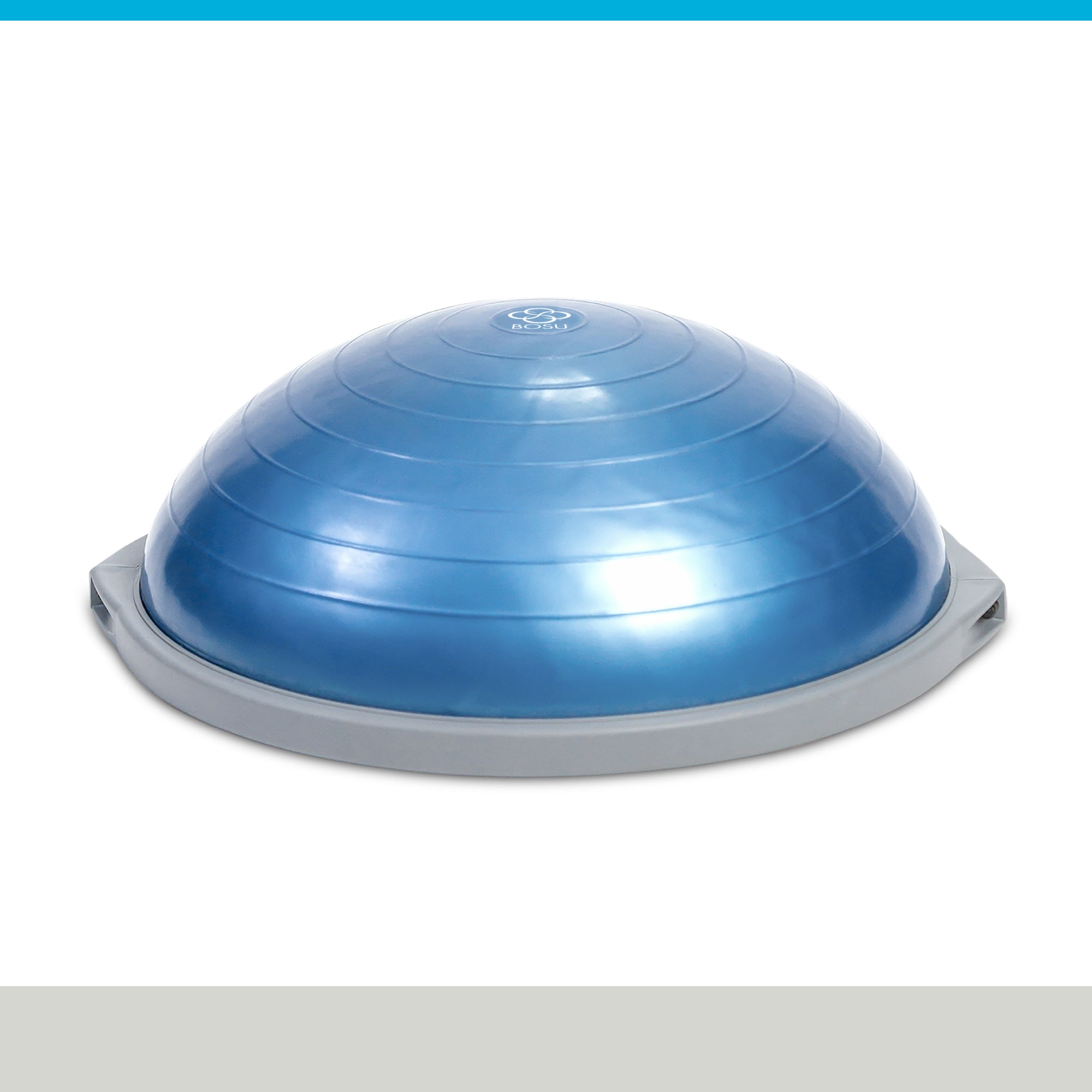
BOSU Balance Trainer Pro
65 cm inflatable dome + rigid platform. Dome up: standing balance exercises, squats, lunges. Platform up: planks, push-ups, mountain climbers. 350 lb rating for commercial use. Best versatility for full-body workout integration. Best for rehabilitation, group fitness, and users who want one tool for many exercises.
The BOSU Pro pairs a 65 cm inflatable dome with a rigid platform and is rated to 350 lbs for commercial gym and physical therapy use. Dome up, it provides a softer, more forgiving unstable surface for standing exercises, squats, lunges, and overhead presses — accessible enough for rehab and group fitness contexts where excessive challenge is contraindicated. Platform up, it functions as a dynamic surface for planks, push-ups, and pike-ups. Because the platform stays stable on a hard floor, it integrates into existing workout programming better than any single-purpose balance board. The Pro version's commercial rating is worth it where multiple people use it daily.
Pros
- ✓Dome up: standing exercises, squats, lunges, overhead presses
- ✓Platform up: planks, push-ups, pike-ups, mountain climbers
- ✓350 lb rating built for commercial and PT use
- ✓Integrates into existing programming without dedicated sessions
Cons
- ✗65 cm footprint is too large for most desk setups
- ✗Pro pricing is overkill for individual home users

RevBalance 101 Balance Board
Maple deck + interchangeable fulcrum (3 difficulty levels). 350 lb rated. Adjustable difficulty makes it uniquely appropriate for rehabilitation and multi-user households. Best for PT settings and users who want the ability to progress within one board.
RevBalance 101 addresses the one limitation most wobble boards share: fixed difficulty. The interchangeable fulcrum system ships with three base attachments that change the effective dome radius, giving you beginner, intermediate, and advanced settings on the same maple deck. That progression makes it the right pick for rehab settings where a patient works through stages, or households where multiple users at different skill levels share one board. Build quality is solid — machined base components rather than molded plastic, 350 lb rating — though swapping fulcrums takes about 30 seconds, which is fine for deliberate sessions but not for quick transitions mid-workout.
Pros
- ✓Three interchangeable fulcrums for beginner-to-advanced progression
- ✓Maple deck with machined base components
- ✓350 lb load rating
- ✓Best fit for multi-user households and rehab settings
Cons
- ✗Fulcrum swap takes ~30 seconds — not for mid-workout transitions
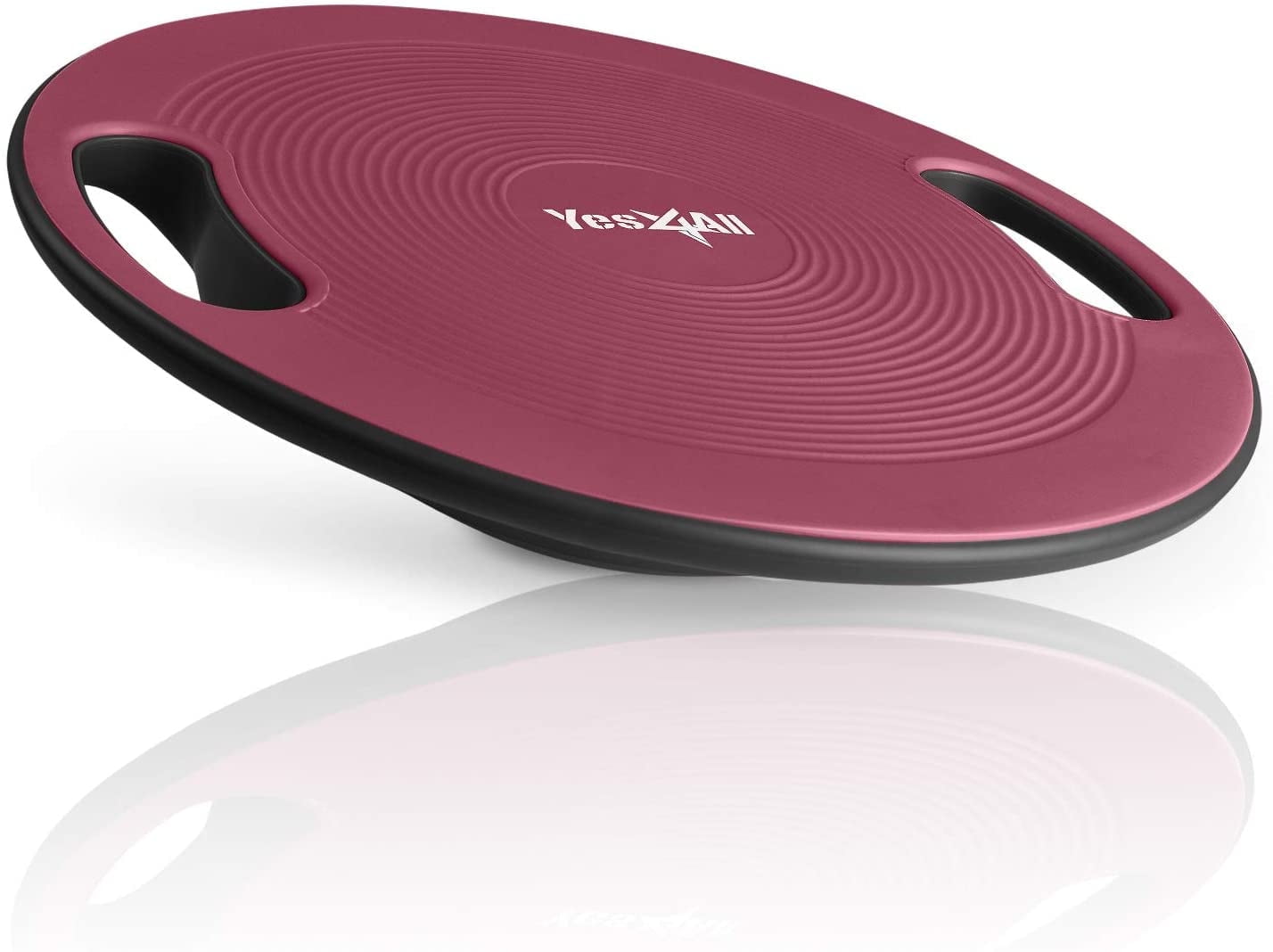
Yes4All Wobble Balance Board
15.7-inch wood deck + hemispherical plastic base. $20-30. Best entry-level wobble board for beginners and ankle rehabilitation. Appropriate first purchase before committing to premium balance training equipment.
Yes4All's 15.7-inch hemispherical wobble board is the most accessible entry point to balance training. The wood deck with textured rubber grip and durable plastic dome base is adequately built, and the moderate tipping range lets most users find some control inside the first session. The honest limitation is the same as all single-difficulty budget boards: once you can hold balance for 2-3 minutes without the board touching the floor, you have largely exhausted the challenge. For anyone testing whether balance training fits their routine before investing in premium equipment, or for supervised ankle rehab, it is the correct starting point.
Pros
- ✓Most accessible price point in the category
- ✓Textured rubber deck grips bare feet and shoes
- ✓Moderate tipping range works for first-time users
- ✓Appropriate for supervised ankle rehab
Cons
- ✗Fixed difficulty — advanced users outgrow it within weeks

FitterFirst Professional Balance Board
18-inch diameter, higher dome than Yes4All. $40-60. Better for adults with larger feet or users who plateau on standard wobble boards. Mid-range entry option with more instability range than budget alternatives.
The FitterFirst Professional Balance Board sits one tier above the Yes4All with an 18-inch diameter and a taller dome that widens the tipping angle range. The extra dome height gives adults with larger feet a more proportional platform and pushes back the plateau point that beginners hit on smaller wobble boards. At $40-60 it is more expensive than the Yes4All but still significantly cheaper than the Indo Board or BOSU Pro, which makes it the natural step up for users who outgrew their first wobble board and are not ready to commit to a high-ceiling tool.
Pros
- ✓18-inch diameter fits adult feet better than 15.7-inch boards
- ✓Taller dome widens the tipping angle range
- ✓More challenge than budget boards at a moderate price
- ✓Comfortable progression from Yes4All to here
Cons
- ✗Still a fixed-difficulty board — no adjustable fulcrum
Which one is right for you?
For surfers, skaters, and snowboarders
Indo Board Original Balance Trainer
The roller-deck system is the closest dryland analog to the front-to-back instability of riding a moving board.
For physical therapy and group fitness
BOSU Balance Trainer Pro
The soft dome forgives missed reps and the platform side adds dynamic surface options for planks and push-ups.
For multi-user households and progressive rehab
RevBalance 101 Balance Board
The interchangeable fulcrum delivers beginner, intermediate, and advanced settings on the same board.
For first-time buyers and ankle rehab
Yes4All Wobble Balance Board
The lowest entry price in the category lets you test whether balance training fits your routine before committing to premium gear.
For adults outgrowing a basic wobble board
FitterFirst Professional Balance Board
The 18-inch diameter and taller dome push back the plateau point that beginners hit on smaller budget boards.
Roller boards vs wobble boards vs inflatable platforms: what each type trains
A roller board (like the Indo Board) places a rigid deck on a cylindrical roller. The challenge is primarily front-to-back balance — tipping forward or backward is the failure mode. The skill ceiling is high because maintaining the deck off the floor requires continuous weight redistribution. Advanced users progress to tricks: the roller can be moved laterally, the deck can be tilted to edge positions, and foot placement can be narrowed to fingertip-width stances.
A wobble board (like the Yes4All or RevBalance) has a hemispherical or domed base that allows tilt in any direction. The instability is smaller in magnitude than a roller board — a wobble board doesn't tip completely over — but the multi-directional nature demands constant engagement from tibialis anterior, peroneals, and all the small muscles of the foot and ankle. Wobble boards are the standard physical therapy tool for ankle rehab because the controlled instability can be calibrated by how far off-center the user allows the board to tilt.
The BOSU (Both Sides Up/Utilized) places a large inflatable hemisphere on a rigid plastic platform. On the dome side, it provides a soft, compliant surface that requires constant balance adjustments — effective for standing exercises, squats, and lunges. On the flat platform side, it creates an unstable surface for planks, push-ups, and ground-based exercises. The size of the BOSU (approximately 65 cm diameter) means it trains full-body balance with a lower instability level per exercise than a roller board, making it more accessible for beginners and rehabilitation contexts.
The high-skill ceiling pick: Indo Board Original
The Indo Board Original consists of a 30x11-inch deck and a 6.5-inch diameter foam roller. The learning curve is steep — most beginners need wall support to mount the board and cannot balance unsupported for the first several sessions. This is a feature, not a flaw: the high skill floor means the board continues to be challenging for years, unlike simpler balance tools that plateau within weeks.
The Indo Board was originally developed for surfers, skateboarders, and snowboarders who needed dry-land balance training. The physics of the roller-deck system closely mimics the feel of riding a moving surface — weight must continuously shift to keep the roller centered under the deck. This specificity makes it genuinely useful for board sport athletes and legitimately cross-trains coordination patterns relevant to those sports.
The foam roller can be replaced with the Indo Board Gigante roller (larger diameter, more stability) or used with the disc cushion (converts to multi-directional wobble board mode). The deck itself is durable — fiberglass construction with grip tape surface — and the system is essentially indestructible. At $100-130, it is more expensive than wobble boards but is a long-term investment for anyone who will use it consistently.
The rehabilitation and group fitness standard: BOSU Balance Trainer Pro
The BOSU Balance Trainer Pro is the professional version of the consumer BOSU, rated to 350 lbs and built for commercial gym and physical therapy use. The inflatable dome (inflated to roughly 10 inches height from platform) provides a softer, more forgiving instability surface than a rigid wobble board — this is by design for rehabilitation where excessive challenge is contraindicated.
The BOSU's value proposition is versatility. Dome side up: squats, lunges, single-leg stands, overhead presses. Platform side up: planks, push-ups, mountain climbers, pike-ups. Because the platform is large and stable when on a hard floor, it functions as a dynamic surface for upper-body exercises as well, which simpler balance boards cannot do. This makes the BOSU the balance tool that integrates most readily into existing workout programming without requiring dedicated balance sessions.
The professional model costs $150-200, substantially more than the consumer version. For home users who don't need commercial durability ratings, the consumer BOSU at $100-140 performs identically. The Pro is the right choice for physical therapy practices, CrossFit gyms, and settings where the equipment is in daily use by multiple people.
RevBalance 101: the adjustable wobble board
The RevBalance 101 addresses a specific limitation of standard wobble boards: fixed difficulty. Most wobble boards have one instability level — if you're too advanced for the beginner setting or not ready for the standard setting, you have no options. The RevBalance 101 uses an interchangeable fulcrum system: three different base attachments change the effective radius of the dome, adjusting resistance from beginner to advanced within the same board.
At $60-80, the RevBalance 101 is priced between the budget Yes4All and the premium options. The adjustability makes it the most appropriate choice for rehabilitation settings where patients progress through stages, or for households with multiple users at different skill levels.
Build quality is solid — the deck is maple, and the base components are machined rather than molded plastic. The board is rated to 350 lbs. The adjustability mechanism requires switching base components manually, which takes about 30 seconds — not a problem for deliberate training sessions but not convenient for quick transitions.
Yes4All and FitterFirst: the entry-level options
The Yes4All Wobble Balance Board is a 15.7-inch diameter board with a hemispherical rocker base. At $20-30, it is the most accessible entry point into balance board training. The construction is adequate — the deck is wood with a textured rubber grip surface, and the base is durable plastic. The challenge level is appropriate for beginners: the dome height creates a moderate tipping range that most users can manage within the first session.
The limitation of the Yes4All is the same fixed-difficulty problem as most budget wobble boards — once you can balance on it for 2-3 minutes without the board touching the floor, you have largely exhausted the challenge. Advanced users will outgrow it within weeks. For someone testing whether balance board training fits their routine before investing in premium equipment, or for ankle rehabilitation with physiotherapist supervision, the Yes4All is the correct starting point.
The FitterFirst Professional Balance Board (also sold as FitterFirst Classic) is similar in design to the Yes4All but with slightly larger diameter (18 inches) and a higher dome that increases the tipping angle range. At $40-60, it provides more challenge than the Yes4All while remaining affordable. For adults with larger feet or users who found standard wobble boards too easy too quickly, the larger FitterFirst is a better fit than the Yes4All.
